
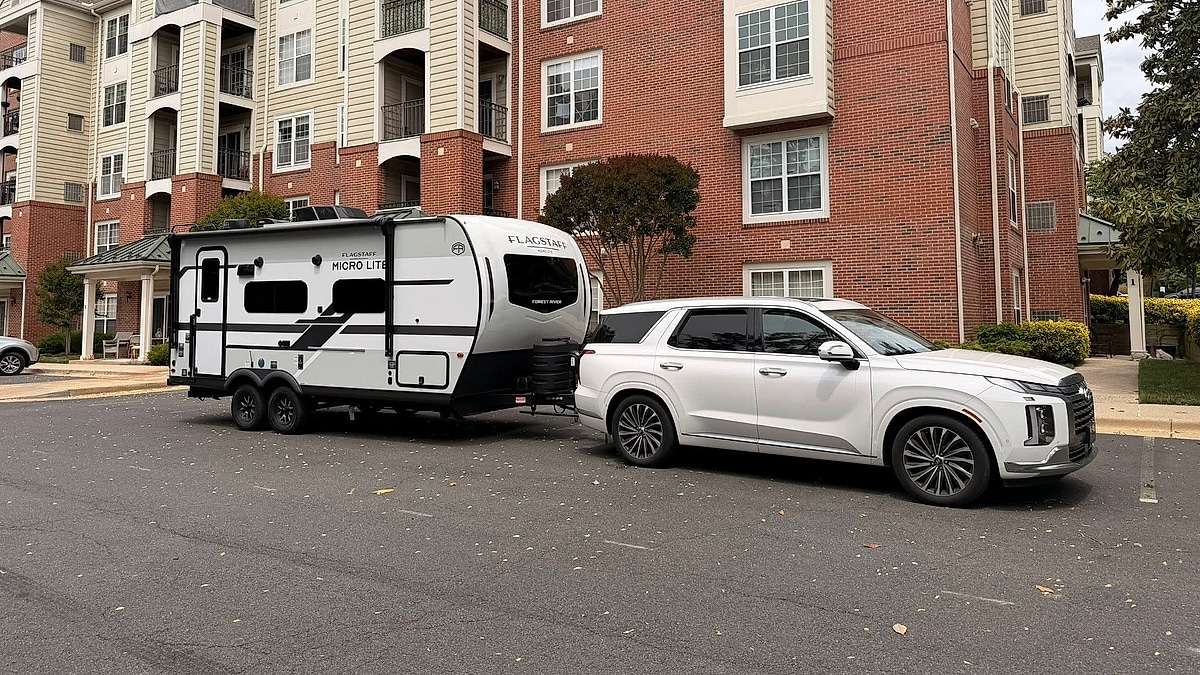

A Hyundai Palisade owner says his SUV handled a 4,430-pound Flagstaff Micro Lite travel trailer across a 600-mile trip, including a return leg with 22-mph crosswinds and gusts near 30 mph. He reported stable handling at 55 mph, used a Curt weight-distribution and sway-control system, added a trailer brake controller, and said the rear self-leveling suspension raised the back of the vehicle after several miles.
That sounds like a clean win for the Palisade. But the comments under the post pointed to the more useful story. One successful trip does not prove every Palisade is ready for the same setup. The better lesson is to look at why this combination worked, then check the details before trying to copy it.

What Torque News Checked
Torque News checked the owner’s towing account, Hyundai’s official 2026 Palisade towing guidance, Hyundai’s owner-manual towing limits, the owner’s use of sway-control and brake equipment, and the questions other owners asked after seeing the post.
Hyundai says the 2026 Palisade can tow up to 5,000 pounds when properly equipped with trailer brakes. Hyundai’s owner guidance also lists 500 pounds as the maximum tongue weight and says tongue weight should be within the allowable 10-15% range. Just as important, Hyundai says the maximum trailer weight includes the trailer, cargo, equipment, and anything attached to the trailer. Any extra weight, cargo, or accessories in the vehicle reduces the available towing margin.
The owner shared the account in a Hyundai Palisade owners group.
That is why the owner's comments were so important
Several people did not challenge whether the Palisade had enough power. They asked better questions: What was the gas mileage? What was the scaled weight? How much gear, food, clothing, and equipment had been added to the camper? What about long-term transmission, engine, and rear shock wear?
Those are the questions that separate a useful towing story from a social media flex.
The owner’s setup included two major pieces that should not be treated as background details: a weight-distribution and sway-control system, plus a trailer brake controller. Those likely mattered more than the simple 4,430-pound number. Crosswinds are where a trailer can start moving the tow vehicle instead of the other way around. Sway control, trailer brakes, speed discipline, and tongue-weight balance are what turn a white-knuckle trip into something manageable.
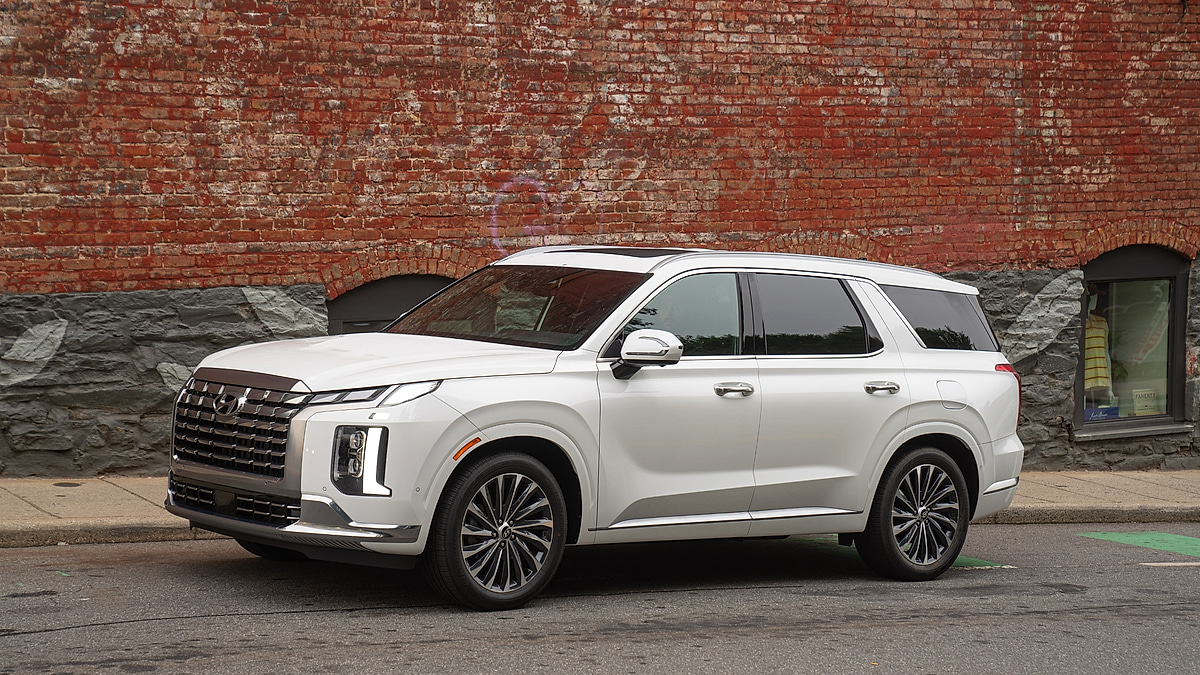
The Palisade’s self-leveling rear suspension also deserves careful treatment. The owner said he measured the rear height at the start of the trip, then again after about 12 miles, and saw the rear rise close to an inch back toward its unloaded position.
That is useful. It suggests the system did what owners want it to do: reduce rear sag while towing.
But leveling is not the same as increasing tow capacity. A vehicle can sit level and still be near its payload, tongue-weight, cooling, braking, or drivetrain limits. That is why one commenter’s advice to load the trailer and visit a truck scale may be the most important practical advice in the entire discussion.
There is also a long-term ownership angle. Hyundai issued a December 2025 technical service bulletin for certain 2020-2022 Palisade vehicles with self-leveling rear shock absorbers, extending warranty coverage to 10 years or 120,000 miles for clunking or thumping noise caused by worn self-leveling rear shocks. That does not mean the 2026 Palisade in this post has that problem. It does mean Palisade owners are right to think beyond the first successful trip and ask how towing affects suspension wear over time.
The owner’s report is still valuable. He did not claim to tow recklessly. He drove 55 mph, slowed to 45 mph across long bridges in heavy crosswinds, used proper towing equipment, and described the ride as stable and comfortable. That is the responsible version of the story.
The mistake would be turning it into “Palisade critics were wrong.”
The smarter takeaway is narrower and more useful: the Palisade can be a comfortable tow vehicle near the upper end of its rating when the trailer is properly controlled, braking is handled correctly, speed is reasonable, and the loaded weight stays inside the real limits.
Before copying this setup, Palisade owners should know five numbers: loaded trailer weight, tongue weight, payload remaining after passengers and cargo, fuel economy while towing, and whether trailer brakes are working properly.
“It pulled great” is a helpful starting point. It is not the whole towing calculation.
Have you towed with a Hyundai Palisade or Kia Telluride? Share your loaded trailer weight, tongue weight if you know it, MPG, brake-controller setup, and whether you used weight distribution or sway control.
Let us know in the comments.
Images by Hyundai USA and Andrew Gumeniuk
About The Author
Noah Washington is an automotive journalist based in Atlanta, Georgia, covering sports cars, luxury vehicles, and performance culture. His reporting focuses on explaining the engineering, design philosophy, and real-world ownership experience behind modern vehicles.
Noah has been immersed in the automotive world since his early teens, attending industry events and following the enthusiast communities that shape how cars are built and driven today. His work blends industry insight with enthusiastic storytelling, helping readers understand not just what a car is, but why it matters.
Noah is also a member of the Southeast Automotive Media Association (SAMA), a professional organization for automotive journalists and industry media in the Southeast.
His coverage regularly explores sports cars, luxury vehicles, and performance-driven segments of the automotive industry, including the evolving culture surrounding Formula Drift and enthusiast builds.
Read more of Noah's work on his author profile page.
You can also follow Noah here:
Set Torque News as Preferred Source on Google
Follow us today...







Comments
I have been towing a 19 foot…
Permalink
I have been towing a 19 foot Airstream Bambi, 4,400 lbs. fully loaded, with my 2024 Hyundai Palisade and with complete satisfaction!
With a tongue weight of approximately 450 lbs and only friction away control (no weight distribution rig).
I typically load the Palisade itself fairly lightly, with just two passengers, a couple of suitcases, a pair of bicycles and a small gas BBQ.
The vehicle is not equipped with self-leveling rear shocks, but I did install adjustable air bags inside the rear coil springs to easily adjust hitch height under load.
I had read that the Palisade's factory equipped stability control may help control sway as well and have had no significant sway issues at all using just the properly adjusted friction sway control.
Overall I am very impressed with my Palisade's towing capabilities, just stick to the weight and speed limits!
That sounds like the right…
Permalink
In reply to I have been towing a 19 foot… by Don Stone (not verified)
That sounds like the right way to do it: stay within the ratings, keep the vehicle lightly loaded, control speed, and pay attention to tongue weight. The air bags help with ride height, but the careful loading is probably doing a lot of the work here.
I own a palisade, I would…
Permalink
I own a palisade, I would never consider towing with it. It all goes through brake pads and rotors every 6k miles, but it's 1st transmission detonated at less than 30k miles and it keeps burning coolant. The dealer replaces parts I get it back and then it burns more. 65k miles now and I can't even sell it.
I know your pain ! Ours blew…
Permalink
In reply to I own a palisade, I would… by Karl Williams (not verified)
I know your pain !
Ours blew the engine .
Do you have any idea what auto wrecking yards want for a used engine ?
And on top of that , you would be spending money on an engine, that has a horribly reputation .
And with the history of bad engines , resale on this car is horrible .
We had an auto salvage company pick it up and said good riddance !
The sad fact of the matter is , we actually liked the car .
Oh how I would love to repay Hyundai, by joining a class action lawsuit .
That is the other side of…
Permalink
In reply to I own a palisade, I would… by Karl Williams (not verified)
That is the other side of the Palisade towing conversation. Some owners have good towing experiences, but transmission, cooling, brakes, and long-term durability are exactly why others are hesitant to tow near the limit.
I hope it doesn't skew the…
Permalink
In reply to I own a palisade, I would… by Karl Williams (not verified)
I hope it doesn't skew the image of the brand for you.
We just bought a 2026…
Permalink
We just bought a 2026 Hyundai Santa Fe XRT with similar tow ratings. Our owner's manual statesa max trailer weight of 4,500 pounds. Hitch weight was recommended to be 10-15 % of the trailer weight. We are looking at new RV campers in the 3,500 to 4,000 pound range. We are planning on adding a weight distribution hitch (WDH) with anti sway. Our XRT does not have auto leveling features however the WDH provides a means of leveling the XRT. Our XRT does have the towing package, anti sway and 5,000 pound rated Class 2 factor hitch.
That sounds like a…
Permalink
In reply to We just bought a 2026… by Robert Morley (not verified)
That sounds like a reasonable plan, especially staying in the 3,500–4,000 lb range instead of maxing it out. The key thing is confirming the manual’s guidance on WDH use, payload, tongue weight, passengers, and cargo together. Tow rating alone is never the full number.