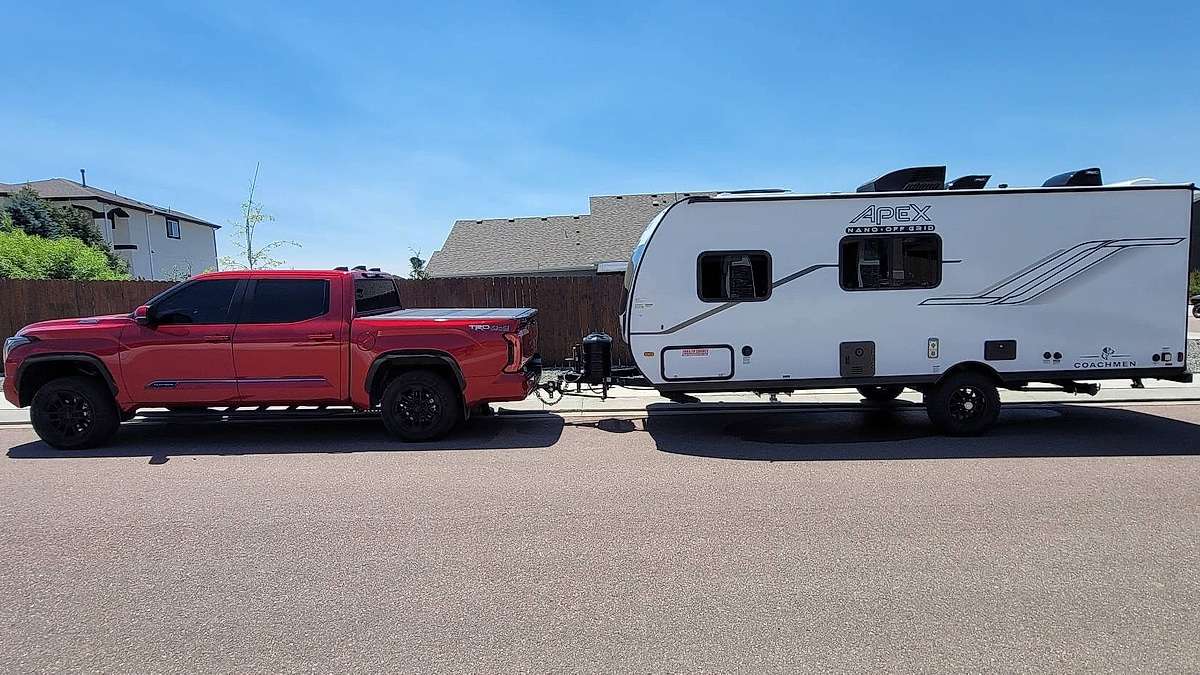

Gerald Perea’s towing post works because the numbers do not ask the truck to work outside the numbers.
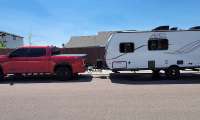
His 2025 Toyota Tundra Platinum TRD Off-Road hybrid has the factory 3-inch lift and i-FORCE MAX powertrain. Behind it sits a 2026 Coachmen Apex Nano 186BH with a 4,700-pound GVWR, no slide, a 22-foot-11 overall length, and a 6,000-pound weight-distribution hitch.
He said it pulled easily, according to his Facebook post.
I believe it.
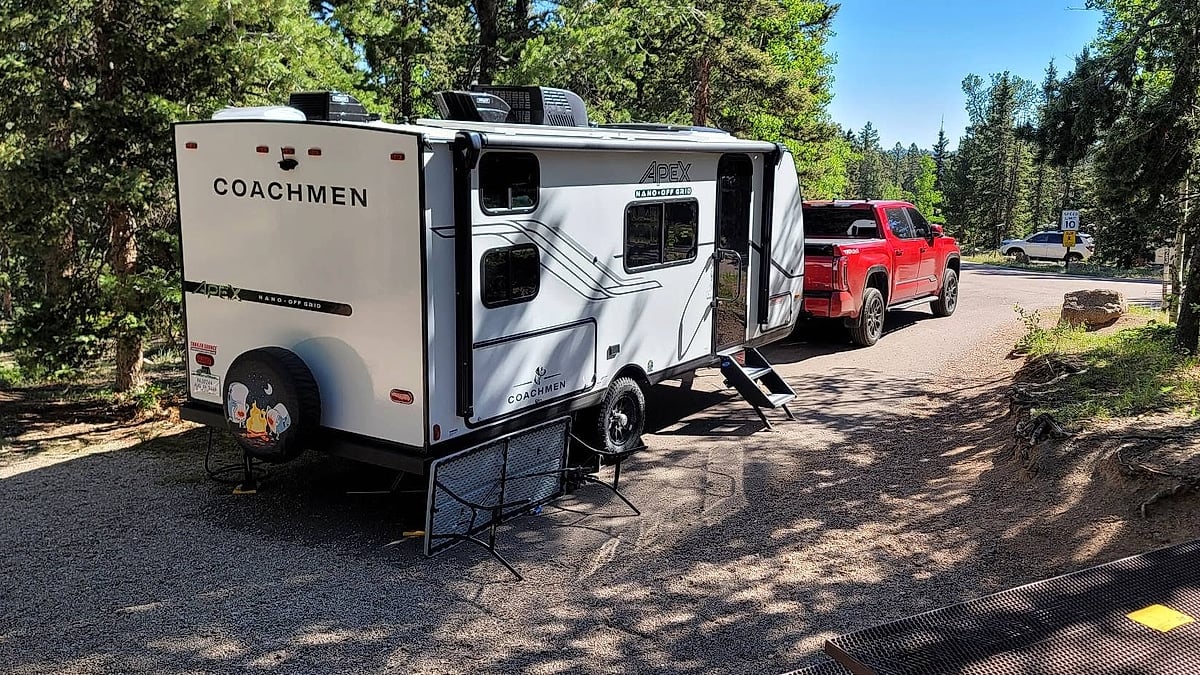
The photograph explains why before the spec sheet arrives. The Apex Nano is narrow, short by travel-trailer standards, and modest in height. The Tundra is a full-size hybrid truck with 437 horsepower and 583 lb-ft of torque. This combination stays away from the trap that ruins so many half-ton towing setups: shopping by max tow rating while ignoring payload, frontal area, tongue weight, and trailer length.
- The real win here is preserving payload margin, which is what keeps the truck stable once passengers, gear, and tongue weight are factored in.
- Trailer length and frontal area matter just as much as weight; a shorter, narrower camper like the Apex Nano reduces sway and wind resistance in ways spec sheets don’t fully capture.
- Matching the weight-distribution hitch to the actual tongue weight range, not the max rating, helps maintain proper axle balance and steering feel, especially on a lifted truck.
Perea did the smarter thing. He picked a camper that gives the truck margin.
The Trailer Stayed In The Tundra’s Wheelhouse
Coachmen lists the Apex Nano 186BH with a 497-pound hitch weight, 3,770-pound unloaded weight, 930 pounds of cargo capacity, and 4,700-pound GVWR. It measures 22 feet 11 inches long, 10 feet 2 inches tall, and 90 inches wide.
That is a friendly travel trailer for a half-ton.
Run the simple tongue-weight math at full GVWR. Ten percent of 4,700 pounds is 470. Twelve percent is 564. Fifteen percent is 705. A properly loaded 186BH should sit in a range the Tundra can handle if the truck’s door sticker, receiver rating, passengers, and bed cargo cooperate.
That last clause carries weight.
A Platinum hybrid with four-wheel drive, luxury equipment, TRD Off-Road hardware, and a lift will not have the same payload as a stripped work-truck Tundra. The door-jamb sticker decides the final payload number. Still, this trailer starts in the right place. It does not demand 900 or 1,100 pounds on the hitch before anyone adds bikes or firewood.
The 6,000-pound weight-distribution hitch also matches the job better than oversized hardware chosen for bragging rights. A WDH should suit the actual tongue range. Too soft creates poor distribution. Too stiff can make the connection harsh and awkward to tune.
A small trailer rewards correct parts.
The Factory Lift Changes The Equation, Then Toyota Brings It Back
A lifted tow vehicle usually makes me cautious.
Raising a truck changes hitch height, center of gravity, suspension geometry, and the way weight transfers under load. A poorly matched lift can make a good trailer feel worse.
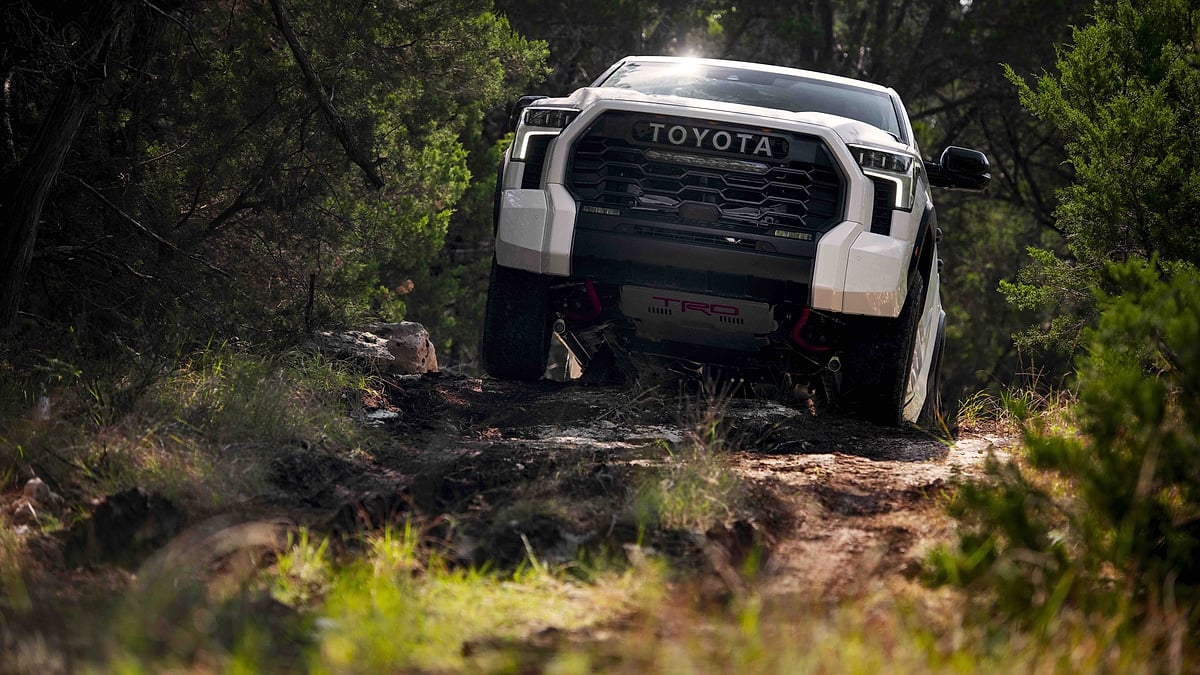
Perea’s truck uses Toyota’s factory 3-inch lift, which is the important part. Toyota’s TRD lift was developed with Bilstein shocks, TRD-tuned springs, forged upper control arms, and calibration work intended to preserve Toyota Safety Sense compatibility. The kit raises the front about 3 inches and the rear about 2.
That does not make the truck immune to a bad setup. It does mean the lift began as an engineered system rather than a box of parts chosen from a forum thread at midnight.
Hitch height still needs careful adjustment. The photo shows a level-looking trailer, which is exactly what I want to see. Nose-high trailers can get nervous. Nose-down trailers can overload the front axle of the trailer and complicate weight distribution. Level, or very slightly nose-down, gives the best starting point.
The Apex Nano’s size gives the lifted Tundra a further advantage. A 29-foot camper behind a lifted half-ton can turn into a wind fight. A 23-foot, 90-inch-wide trailer has less leverage and less side area.
The lift did not have to rescue a marginal trailer.
Power Was The Easy Part
Toyota’s i-FORCE MAX is the wrong thing to worry about here.
The hybrid twin-turbo V6 produces 437 horsepower and 583 lb-ft of torque, with the motor generator mounted between the engine and the 10-speed automatic. The electric assist gives the truck a strong low-speed response and makes it feel relaxed when leaving a stop with a trailer.
A 4,700-pound GVWR camper is well below the Tundra family’s advertised maximum tow ratings. Even allowing for the exact trim and configuration, the powertrain has plenty of reserve.
The harder questions live underneath the excitement:
- How much payload remains after passengers and gear?
- What is the loaded tongue weight with propane, battery, water, food, tools, and camping supplies?
- Are the trailer brakes adjusted?
- Does the hitch restore enough front-axle load without over-tensioning?
- What pressure are the truck and trailer tires running?
Those details decide whether “pulled easy” stays true after a windy interstate run or a mountain descent.
Power makes the first mile feel good.
The setup makes the next 200 miles boring.
No Slide Helped More Than People Think
The owner mentioned that the 186BH has no slide and stays “nice and light.”
That carries practical weight even if nobody wants to talk about floor plans at the campground.
Slides add weight, mechanical complexity, and often shift mass toward one side. They also encourage larger floor plans with more frontal area and more cargo. A no-slide bunkhouse keeps the trailer simple. The Apex Nano 186BH still gives a family bunks, a dinette, a bed, and basic camping utility, but it avoids becoming a rolling apartment.
That restraint fits the Tundra better.
A travel trailer does not need to max out the truck to feel useful. A camper under 23 feet can get into smaller campsites, fuel stops, and tight storage areas. It also asks less from the truck’s wheelbase when crosswinds or passing traffic hit the sidewall.
The underrated luxury here is calm.
A truck that has enough margin feels more expensive than one constantly using all of its rating. Less steering correction. Less brake anxiety. Less mirror-watching. Less arguing over whether to stop and recheck the hitch.
Perea’s setup looks enjoyable because it was not built around a dare.
What I Would Verify Before Calling It Done
I like this pairing, but I would still put it on a CAT Scale.
The cleaning process is simple. Weigh the Tundra loaded for a real trip without the trailer. Then weigh the truck and trailer with the WDH engaged. If possible, do one more pass with the spring bars relaxed.
That gives steer axle, drive axle, trailer axle, combined weight, front-axle restoration, and an actual loaded trailer number. Add a tongue scale at home, and the picture gets even better.
The Apex Nano’s GVWR gives an upper limit, but actual camping weight depends on water, propane, battery, food, bedding, tools, chairs, and dealer-installed options. Coachmen’s published 497-pound hitch figure is a starting point. Real tongue weight after loading can differ.
I would also confirm trailer brake gain before any long downhill run. A light camper can still shove a full-size truck if the trailer brakes do too little work. The controller should let the trailer contribute without jerking or locking.
This is the boring part.
Boring is good.
Why This Setup Works
Perea’s Tundra and Apex Nano combination works because it respects the truck before the trip starts.
The trailer stays short enough to avoid excessive yaw leverage. It stays light enough to protect the payload. It avoids a slide. It uses a weight-distribution hitch sized close to the camper’s actual range. The truck brings a strong hybrid powertrain, modern chassis, factory-engineered lift hardware, and enough size to keep the trailer in line.
That is the kind of half-ton tow setup I like.
No hero numbers. No “it can tow 12,000 pounds” chest-thumping. No massive bunkhouse hanging off a receiver while the owner tries to fix squat with airbags and optimism.
A capable truck. A sensible camper. A hitch is doing its job.
That is how towing becomes uneventful.
And uneventful is exactly what a good tow should be.
Tundra Owners, What Camper Size Feels Right?
If you tow with a third-generation Tundra, share the trim, engine, door-sticker payload, trailer model, loaded weight, tongue weight, WDH model, fuel economy, and the speed at which the setup feels settled.
Comment your thoughts below.
Two images by Gerald Perea
About The Author
Noah Washington is an automotive journalist based in Atlanta, Georgia, covering sports cars, luxury vehicles, and performance culture. His reporting focuses on explaining the engineering, design philosophy, and real-world ownership experience behind modern vehicles.
Noah has been immersed in the automotive world since his early teens, attending industry events and following the enthusiast communities that shape how cars are built and driven today. His work blends industry insight with enthusiastic storytelling, helping readers understand not just what a car is, but why it matters.
Noah is also a member of the Southeast Automotive Media Association (SAMA), a professional organization for automotive journalists and industry media in the Southeast.
His coverage regularly explores sports cars, luxury vehicles, and performance-driven segments of the automotive industry, including the evolving culture surrounding Formula Drift and enthusiast builds.
Read more of Noah's work on his author profile page.
You can also follow Noah here:
Set Torque News as Preferred Source on Google
Follow us today...