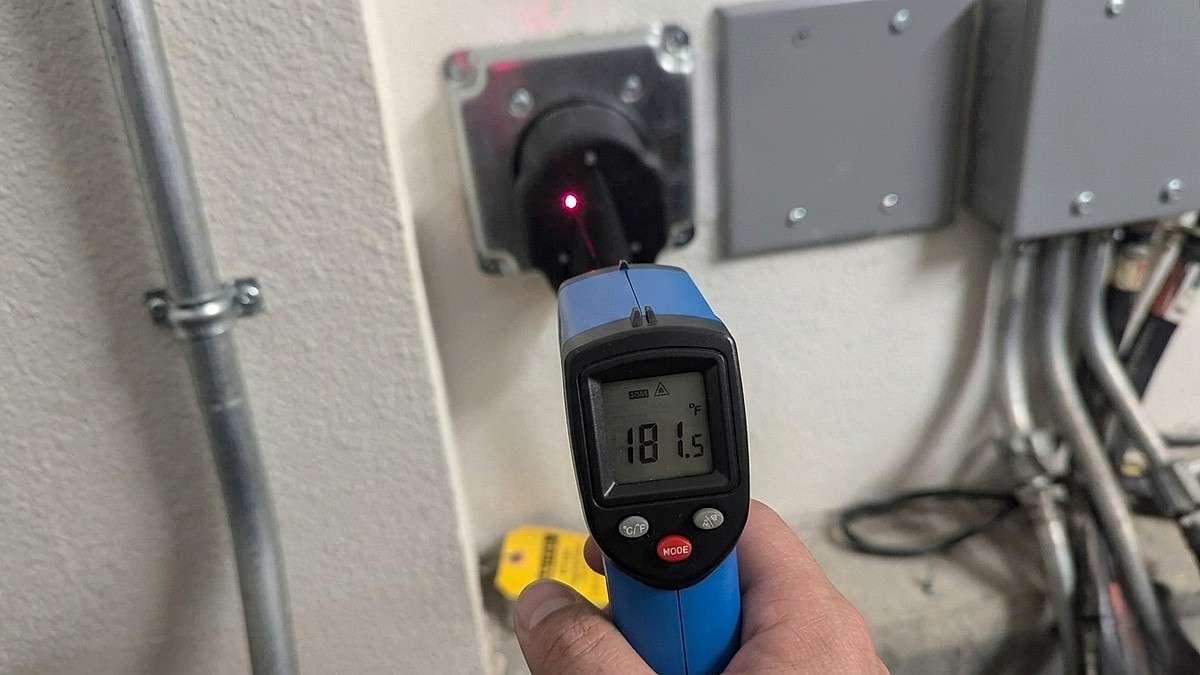

A 2025 Hyundai Ioniq 5 owner in Southern California checked their charger after four hours, and what they found was shocking. One pin had reached 184°F and the other 165°F, raising serious concerns about heat buildup during normal home charging.
This occurred while charging an Ioniq 5 from 30% to 71% in ambient garage temperatures exceeding 100°F. The core problem is clear: EV charging systems, even with "EV-rated" outlets, are generating significant heat under sustained load, potentially beyond safe operating parameters.
EV owners pushing the limits of their home charging setups, particularly in high ambient temperatures, experience similar issues. The thermal management of charging infrastructure, from the vehicle's port to the wall outlet, is a critical, often overlooked, component of daily EV ownership that can lead to premature wear, component failure, or worse. The industry's reliance on owners' understanding of electrical codes for safe operation is a dangerous assumption.
"UPDATE Thanks everyone, learn something new every day.
I finished charging at 80% around 3:30 pm here in SoCal. left pin was 184F, right pin 165F, my garage temp was still hot over 100F.
Here is my non-scientific data:
At night, 9:30 PM, I charged again from 80% to 100%, garage temp was maybe 100F, still hot, outside was nice 70F. I did not take a temperature reading of the plug at this point.
10 PM: LP 150F / RP 140F, the garage was over 100F, and then I opened my garage door to let some cooler air in.
10:15PM: LP dropped to 130F / RP 125F, garage (door open) temp 85F
10:30 PM: LP 122 / RP 118F. And then I closed my garage door.
10:45 PM: LP 124 / RP 122F
Advertising
11:25PM LP 127 / RP 125F, charging complete at 100%.
lesson learn, ambient temp plays a big role in plug temp.
My original post:
This is after over 4 hours of charging from 30 to 71 percent, 1 hour more to go to 80 percent. Maybe because it is 95F outside. I check every time I charge, usually around 170F or below. No issue, all seems normal. I can see why the cheap outlet will melt. Mine is a Leviton EV-rated outlet, with a 50A charger, set at 40A, I'm getting 9.4kWh. 2025 Ioniq 5. Have you ever checked yours?"
The owner, Reddit user u/E1nt3r, initially observed temperatures around 170°F, considering it normal. The jump to 184°F, however, prompted a deeper look, revealing a critical interaction between continuous high-amperage draw and elevated ambient temperatures.
Hyundai Ioniq 5: Home Charging Thermal Management
- The Hyundai Ioniq 5 supports Level 2 AC charging up to 10.9 kW, which typically translates to a maximum draw of 48 amps on a 240V circuit. Owners, however, utilize 40-amp chargers on 50-amp circuits, such as the one described in this incident.
- The National Electrical Code (NEC) mandates that continuous loads, defined as loads operating for three hours or more, should not exceed 80% of the circuit breaker's rating. For a 50-amp circuit, this means a continuous draw should be limited to 40 amps; for a 40-amp circuit, the continuous draw should be 32 amps.
- Plug and outlet temperatures are directly influenced by current draw, connection quality, and ambient temperature, with higher resistance or heat leading to increased thermal stress on components. Temperatures exceeding 170°F (77°C) can accelerate material degradation in plastics and insulation, increasing fire risk.
- Discoloration on electrical prongs or outlets is a clear indicator of excessive heat and potential arcing, signaling a compromised connection that requires immediate inspection and repair by a qualified electrician to prevent further damage or fire.
The "non-scientific data" provided by u/E1nt3r, while anecdotal, clearly illustrates how opening a garage door to drop the ambient temperature from over 100°F to 85°F immediately reduced the plug temperature by 20°F. This direct correlation shows a fundamental flaw in how many EV home charging setups are operated.
The manufacturer provides a charger that can draw 40 amps, and the owner has an "EV-rated" 50-amp outlet for their Ioniq 5. On paper, this seems like a match. But the National Electrical Code (NEC) has a specific, non-negotiable rule for continuous loads: circuits should only be loaded to 80% of their rated capacity. This is a safety standard designed to prevent overheating and potential fires, especially in residential settings.
Reddit user IM_The_Liquor, commenting on the original post, acknowledged the high temperatures but dismissed them as not "alarming" for continuous 40+ amp draws. "This will happen when you pull 40+ amps continuously for a few hours," IM_The_Liquor wrote, adding that a "better than the $1.99 dryer outlet" is necessary. This perspective, while correctly identifying the continuous load as the cause, dangerously normalizes operating equipment at its thermal limits, ignoring the NEC's critical safety buffer.
The problem is the discolored prong u/E1nt3r noted, which indicates localized overheating and material degradation. This is a clear sign of stress and potential failure, not normal operation. The fact that the owner typically leaves the charger plugged in, "like a refrigerator," suggests a misunderstanding of the electrical demands of EV charging versus a typical appliance. Refrigerators cycle; EV chargers, especially when fast charging, do not.
This is where the pattern becomes clear. Reddit user That_____, cutting directly to the chase, stated, "That's a 40A outlet. You should only be running 32A on it. Yes, it will do 40A but only briefly. Per the NEC code, you should only pull 80% of the rating when the load is continuous." This comment directly contradicts the common practice of matching a charger's maximum draw to an outlet's rating, a practice that is widespread and fundamentally unsafe under continuous load conditions.
The manufacturer, in providing a 40-amp charger for the Ioniq 5, and the installer, in wiring a 50-amp circuit, are both operating within their respective technical specifications. However, the disconnect lies in the communication, or lack thereof, to the end-user about the practical application of the NEC's 80% rule for continuous loads. This is a basic safety principle that should be front and center in every EV owner's manual and charger installation guide. The fact that owners are learning this "lesson" through dangerously high plug temperatures instead of clear instructions is a failure of the industry.
The Ioniq 5 owner's experience shows that the responsibility for electrical safety in EV home charging is often unfairly placed on the consumer. Manufacturers must provide clearer, more prominent warnings about continuous load ratings and the NEC's 80% rule, and charging equipment should ideally default to a safe continuous draw or offer explicit user guidance to prevent these dangerous thermal events. The current approach is a recipe for electrical fires.
Image Sources: Hyundai Media Center
About The Author
Noah Washington is an automotive journalist based in Atlanta, Georgia, covering sports cars, luxury vehicles, and performance culture. His reporting focuses on explaining the engineering, design philosophy, and real-world ownership experience behind modern vehicles.
Noah has been immersed in the automotive world since his early teens, attending industry events and following the enthusiast communities that shape how cars are built and driven today. His work blends industry insight with enthusiastic storytelling, helping readers understand not just what a car is, but why it matters.
Noah is also a member of the Southeast Automotive Media Association (SAMA), a professional organization for automotive journalists and industry media in the Southeast.
His coverage regularly explores sports cars, luxury vehicles, and performance-driven segments of the automotive industry, including the evolving culture surrounding Formula Drift and enthusiast builds.
Read more of Noah's work on his author profile page or on his personal website.
You can also follow Noah here:
Set Torque News as Preferred Source on Google
Follow us today...