
For over a decade, the primary hurdle for electric vehicle adoption has been a psychological ghost known universally as "range anxiety." This fear—the pervasive dread that a car will inevitably leave its driver stranded on a desolate stretch of highway devoid of infrastructure—was largely a marketing artifact. It was created by attempting to directly compare the nascent, scattered charging infrastructure of the early 2010s to the century-old, hyper-ubiquitous network of corner gas stations. However, as the electric vehicle market rapidly matures, we are witnessing a fundamental and permanent shift in consumer intelligence and automotive engineering. Buyers are finally realizing that a massive 400-mile or 500-mile range is essentially a costly security blanket they rarely, if ever, utilize to its full capacity, while a slow charging speed is a daily, compounding tax on their most precious resource: their time.
Historically, range anxiety should likely never have been the dominant narrative it became. Decades of transportation statistics consistently demonstrate that the vast majority of electric vehicles currently serve as second cars in multi-vehicle households, primarily deployed for daily commuting, school runs, and short-hop errands. Data from the U.S. Department of Energy confirms that the average American drive is significantly shorter than even the most basic first-generation EV range limits. When the average daily commute hovers just under 40 miles round-trip, a vehicle equipped with a 300-mile range battery is carrying roughly 260 miles of expensive, heavy, and ecologically demanding battery weight that serves absolutely no functional purpose for 95 percent of the car's operational life. We are finally seeing a pivotal market correction where the "10-to-80 percent charge time" is usurping total range as the single most critical metric on any electric vehicle's spec sheet.
Why Charging Speed Is the New Horsepower
The aggressive shift toward prioritizing charging velocity over total battery capacity is the hallmark of a maturing, rational market. If a driver can seamlessly add 200 miles of driving range in the time it takes to walk into a convenience store, grab a cup of coffee, and use the restroom, the total maximum capacity of the battery pack becomes almost entirely irrelevant. This transition perfectly mirrors the technological evolution we witnessed with the modern smartphone; consumers entirely stopped caring how many days their cell phone battery lasted once rapid fast-charging technologies and ubiquitous USB-C ports made "topping off" a frictionless, background activity.
Extensive research into consumer behavior and technological adaptation, such as the comprehensive studies found within TCU’s repository on emerging technology adoption, suggests that as infrastructure density improves, the perceived utility of a vehicle is measured primarily by its seamless integration into the user's daily flow, not by its maximum theoretical limits. High-voltage electrical architectures—specifically the migration from 400V to 800V and even 900V systems—are the foundational enablers of this paradigm shift. These advanced architectures allow vehicles to pull massive amounts of electrical current without succumbing to thermal throttling or melting the charging cables.
Industry analysts and discerning buyers are increasingly tracking the technical specifications of upcoming models precisely on these metrics. Consumers are explicitly weighing the thermal management and peak kilowatt acceptance rates against raw battery size, understanding that the true luxury in electric mobility is waiting less, not carrying more.
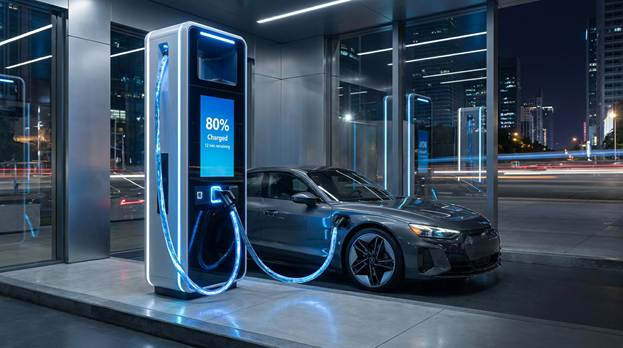
[Image Prompt 1: A photorealistic, high-tech 800V charging station illuminated at night, showing a sleek, dark-grey electric sedan connected to a glowing liquid-cooled charging cable. A crisp digital display on the dispenser reads "80% Charged" with a prominent timer showing exactly 12 minutes.] [Location: Immediately following the "Why Charging Speed Is the New Horsepower" section.]
The Ideal Balance to Convert ICE Loyalists
To truly move the needle and convert dedicated Internal Combustion Engine (ICE) loyalists, the electric vehicle industry needs to consistently hit a specific "Golden Ratio" of performance. Based on the realities of current highway infrastructure and human psychological patience, the ideal battery range is likely situated securely between 250 and 300 miles. This capacity is more than sufficient to absorb a full week of urban commuting or to manage a standard three-hour stint of highway driving on a family road trip without inducing any panic.
However, while the range can be capped at 300 miles, the charging time absolutely must drop into the 10-to-15-minute window for a standard 10-to-80 percent replenishment cycle. When an electric vehicle can reliably match the "restroom, stretch, and snack" break duration of a traditional gas-powered car driver, the very last logical, convenience-based argument for burning fossil fuels evaporates completely. We do not need heavy, resource-intensive 500-mile batteries to save the environment; we need ultra-efficient 15-minute high-capacity chargers to save the driver's schedule.
Ranking the Leaders in Charging Velocity
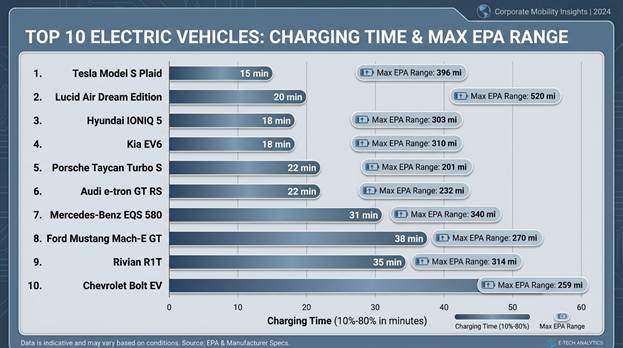
The following vehicles represent the absolute vanguard of this technological shift. They are ranked and evaluated primarily on their peak charging capabilities and real-world efficiency, as these are the exact metrics that define the modern, friction-free user experience.
- Lucid Gravity
- Charging Time: Adds 200 miles in under 11 minutes.
- Estimated Range: Up to 440 miles (projected).
- Pros/Cons: Setting a new absolute benchmark for the industry, the upcoming Lucid Gravity SUV demonstrates what is possible with hyper-optimized electrical architecture. Reaching a staggering 419 kW peak in independent testing by State of Charge, it completely redefines expectations for large family haulers. The primary con is that its premium price point will keep it out of reach for the entry-level buyer.
- Lucid Air Grand Touring
- Charging Time: Adds 200 miles in 12 minutes.
- Estimated Range: EPA-estimated up to 512 miles.
- Pros/Cons: The true gold standard of EV engineering. It officially rates at 300 kW but peaks at 340 kW in third-party testing by Motor Trend. While other vehicles boast high ranges through massive battery packs, the Air achieves its rating through aerodynamic and drivetrain supremacy, establishing unmatched efficiency that surpasses the rest of the market. The infotainment software, while improving, initially lacked the polish of its powertrain.
- Porsche Taycan (2025 Model)
- Charging Time: 18 minutes (10-80%).
- Estimated Range: ~315 miles.
- Pros/Cons: While its 320kW peak is incredibly impressive and a massive leap for German engineering, it places slightly behind the raw throughput capabilities of Lucid. It remains the dominant force in performance driving dynamics and chassis tuning, but the cost of entry is exceptionally steep, and rear passenger space is tight.
- Hyundai Ioniq 6
- Charging Time: 18 minutes (10-80%).
- Estimated Range: Max EPA 361 miles.
- Pros/Cons: Built on a robust 800V architecture, the Ioniq 6 is arguably the best value-per-charging-second in the mainstream market today. While it is incredibly efficient, official EPA data shows it is still surpassed in raw electrical efficiency by the Tesla Model 3 and the Lucid Air. The swooping styling remains highly polarizing, resembling a streamliner from the 1930s.
- Kia EV6
- Charging Time: 18 minutes (10-80%).
- Estimated Range: ~310 miles.
- Pros/Cons: Sharing the heralded E-GMP platform with its corporate sibling, Hyundai, the EV6 offers supercar-level charging speeds inside the footprint of a practical, sharply styled crossover. It strikes a great balance of features and speed, though the aggressive roofline does slightly compromise rear cargo space compared to boxier SUV alternatives.
- Tesla Model 3 (Long Range)
- Charging Time: ~25-30 minutes (10-80%).
- Estimated Range: ~341 miles.
- Pros/Cons: While its older 400V architecture prevents it from matching the sub-20-minute charge times of 800V rivals, the Model 3 remains a masterclass in efficiency. Furthermore, the unparalleled reliability of the Tesla Supercharger network ensures that real-world travel times are often shorter than those of faster-charging competitors who must hunt for functioning third-party stations.
- Genesis GV60
- Charging Time: 18 minutes (10-80%).
- Estimated Range: ~248 miles.
- Pros/Cons: The GV60 successfully marries traditional high-end luxury with cutting-edge 800V speed. It intentionally sacrifices a massive, heavy battery pack in favor of rapid replenishment. This means its total range is lower than many on this list, but its turnaround time at a DC fast charger makes highway travel remarkably easy.
- Audi e-tron GT
- Charging Time: 22.5 minutes (10-80%).
- Estimated Range: ~249 miles.
- Pros/Cons: Sharing DNA with the Taycan, the e-tron GT offers a flatter, more consistent charging curve than many competitors, meaning it sustains high kW input for longer durations. Its range is modest, reinforcing the design philosophy that charging speed supersedes total battery capacity.
- Rivian R1S / R1T (Gen 2)
- Charging Time: ~30-35 minutes (10-80%).
- Estimated Range: ~410 miles (Max Pack).
- Pros/Cons: Rivian’s second-generation architecture introduces vastly improved thermal management. Because the battery packs are inherently massive to support off-road utility and towing, the total time plugged in is longer, but the miles-added-per-minute remains highly competitive for the heavy truck segment.
- Ford F-150 Lightning
- Charging Time: 41 minutes (15-80%).
- Estimated Range: ~320 miles (Extended Range).
- Pros/Cons: The physical utility, payload, and bi-directional charging capabilities of the Lightning are currently unmatched in the traditional truck space. However, constrained by a 400V architecture and the aerodynamic profile of a brick, it represents the "slowest" of the premium tier when it comes to long-distance highway road tripping.
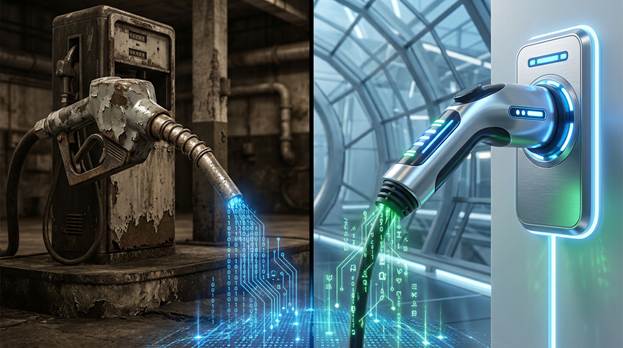
The Infrastructure Reality Check
While the automotive engineering and battery chemistry are clearly ready for this high-speed revolution, the physical public charging infrastructure often lags painfully behind. To achieve the blistering 11-to-18-minute charge times boasted by Lucid, Porsche, and Hyundai, drivers absolutely must have access to fully functioning 350kW DC fast chargers. Currently, third-party networks like Electrify America are in a frantic, capital-intensive race to upgrade their older 150kW stations to meet this new standard.
Simultaneously, the industry is closely monitoring the integration of the NACS (North American Charging Standard) to see if Tesla’s legendary network uptime can be maintained as it opens its high-speed stalls to the broader 800V market. The shift in buyer priority from range to speed will inevitably force utility companies and charging providers to focus entirely on the "quality and sustained wattage of power" rather than merely boasting about the total number of physical plugs installed in a parking lot. A broken or severely throttled 50kW charger is entirely useless to a driver who purchased a vehicle specifically for its 350kW capabilities. We are moving into an era where charger reliability and peak output are the true bottlenecks, not the vehicles themselves.
Wrapping Up
The definitive transition from a market obsessed with total battery range to one ruthlessly focused on charging speed marks the end of the electric vehicle’s technological infancy. We are rapidly moving away from the brute-force era of oversized, excessively heavy, and environmentally expensive batteries designed merely to soothe an irrational psychological fear. Instead, we are entering a sophisticated era of hyper-efficient, high-voltage machines that fundamentally respect the driver’s time. For the average buyer, particularly those utilizing an EV for the vast majority of daily tasks, the "range anxiety" narrative has been thoroughly overhyped and is now effectively obsolete. As ultra-fast charging systems—like the record-breaking architecture pioneered by Lucid—establish the new industry standard, the last remaining logical barrier to entry for internal combustion engine buyers is actively being engineered completely out of existence.
Disclosure: Images rendered by Artlist.io
Rob Enderle is a technology analyst at Torque News who covers automotive technology and battery developments. You can learn more about Rob on Wikipedia and follow his articles on TechNewsWord, TGDaily, and TechSpective.
Set Torque News as Preferred Source on Google
Follow us today...