
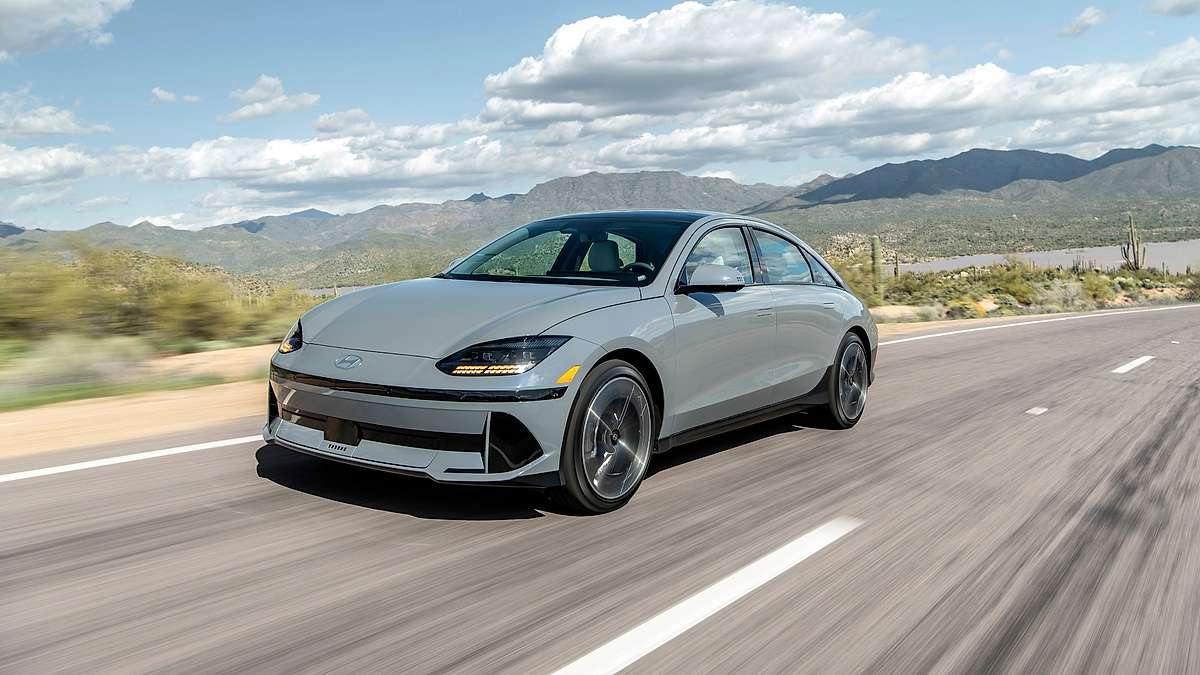

Instead of another EV road-trip story built around charging speeds and range estimates, this one started with something far more revealing: a set of battery diagnostics captured during a brutally hot day in North Carolina. Colin Goodall, an Ioniq Guy Facebook Group contributor, shared six screenshots from his 2024 Hyundai Ioniq 6 Limited RWD Long Range that showed exactly what was happening inside the battery pack before, during, and after fast charging, including module temperatures that briefly climbed as high as 115°F.
That is my kind of data.
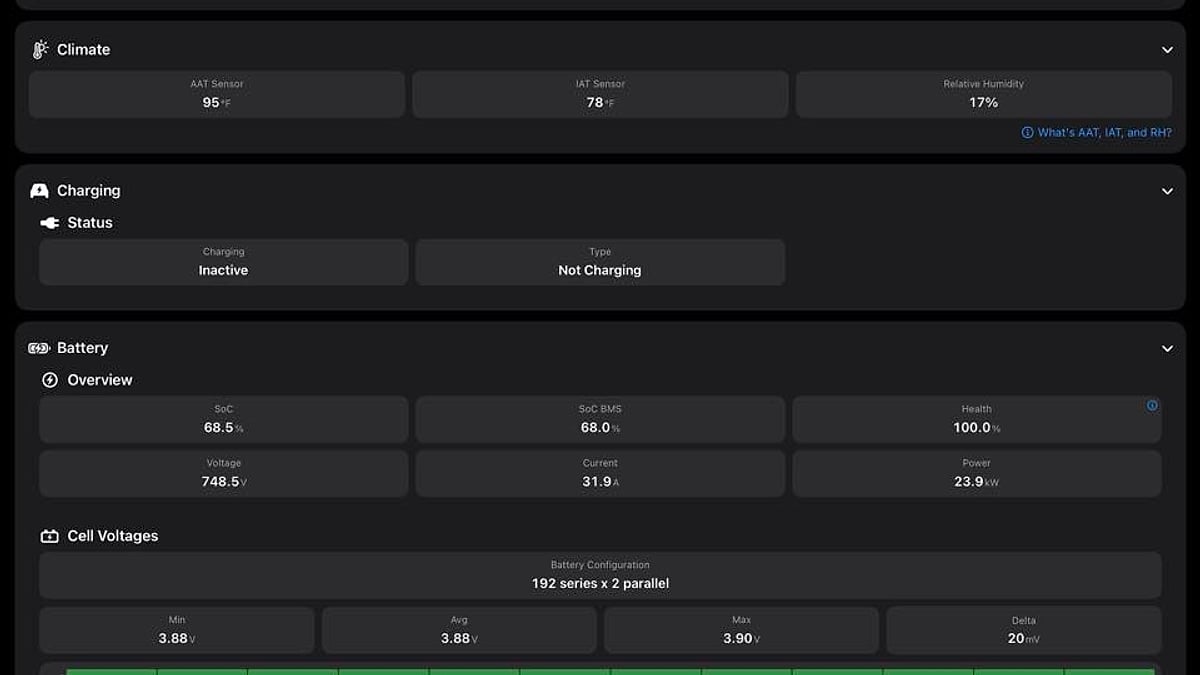
Goodall used Greg Burlingame’s Ioniq 5 Companion app with his Ioniq 6 while his son drove for a couple of hours at about 80 mph on a 90-degree day. The car had about 14,000 miles on it. The app showed a 192-series by 2-parallel battery configuration, 100 percent battery health, and, at one point, a 95°F outside air temperature. Then the battery temperature blocks turned red.
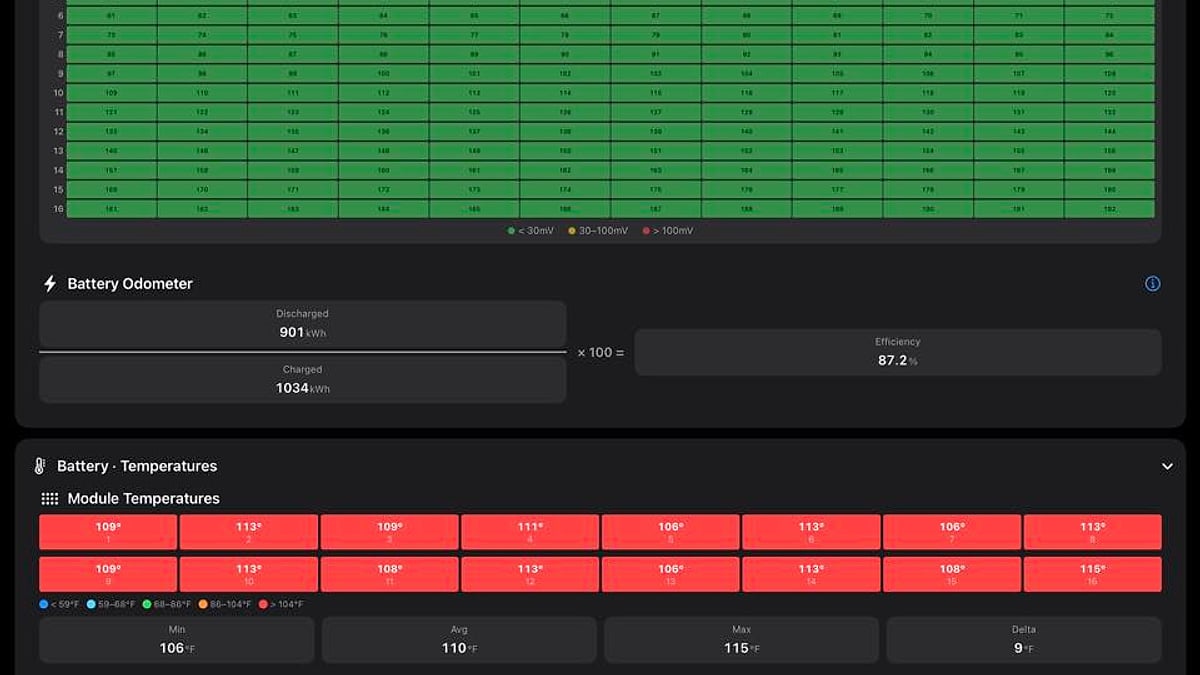
One screenshot shows module temperatures ranging from 106°F to 115°F, with an average of 110°F. Another shows the modules at 99°F to 106°F. Later screenshots show the pack cooling to a far calmer 84°F to 91°F range.
Why 115°F battery temperatures are less alarming than they look
The Ioniq 5 Companion app appears to color module temperatures above 104°F in red. That makes sense as a visual warning, but it can also make a normal fast-charging event look like a mechanical emergency.
Look at the sequence.
At 11:03, the pack is hot: 106°F minimum, 110°F average, 115°F maximum. At 11:13, it has already dropped to a 99°F minimum, 103°F average, and 106°F maximum. By 11:51 and 12:08, the pack is sitting mostly in the mid-to-high 80s, with maximum readings of 90°F. That is the car doing its job.
DC fast charging is a heat event. Highway driving at 80 mph on a 90-degree day is also a heat event. Combine them, and I expect the thermal system to work. What I do not want to see is heat that keeps climbing after the session ends, a stubbornly hot module that refuses to follow the rest of the pack, or a temperature spread that stays wide after the car has had time to stabilize.
Goodall’s screenshots show the opposite. The hot pack cools. The module spread tightens. Nothing in those images screams panic.
Why a 60 mV cell-voltage delta is not automatically a problem
The screenshots also show the cell voltage map moving through several states. One image shows a perfect-looking 0 mV delta at 4.12 volts. Another shows a 20 mV delta. One later image shows a 60 mV delta, with yellow cells appearing in the app’s grid. The legend marks green as less than 30 mV, yellow as 30 to 100 mV, and red as greater than 100 mV.
That 60 mV image will make some owners squint.
I would not lose sleep over it by itself. A voltage delta snapshot depends on state of charge, recent charging, load, temperature, and when the battery management system last had a chance to balance the pack. The more important point is that none of the screenshots show red voltage deviation, and other images show the delta down at 20 mV or even 0 mV. The car also reports 100 percent battery health in the overview screen.
Hyundai Ioniq 6: Charging Data
- The 115°F peak matters less than the recovery curve, because the pack cooled quickly instead of staying heat-soaked.
- Owners should watch for repeated outlier modules, not just one hot screenshot during fast charging.
- The bigger road-trip frustration may be charger layout and compatibility, not the Ioniq 6’s battery temperature behavior.
This is where enthusiast diagnostics can become a full-body scan. You start out wanting useful data. Ten minutes later you’re staring at one yellow rectangle and wondering whether your battery pack has filed for divorce.
I like the app. I like the transparency. But owners need context, or the data becomes noise.
Why Tesla Superchargers can be more frustrating than a hot battery
Goodall’s post starts with several complaints before the battery question, and those complaints deserve attention.
He asks if other Ioniq 6 owners have pulled into a Tesla Supercharger site with open posts, only to find that the open posts are not actually usable. That is the port-location problem. Tesla vehicles put the charge port at the left rear. The Ioniq 6 has its charge port on the passenger-side rear in the U.S. At many V3 Supercharger sites, the cable is too short to reach unless the Hyundai parks awkwardly or blocks the wrong stall.
That is not user error. That is infrastructure designed around Tesla geometry.
Tesla is working its way toward longer-cable V4 hardware, but the older V3 sites still dominate plenty of road trips. John Apel gave the blunt version in the comment thread: V3 dispensers were built for Tesla charge-port placement, and if Ioniq owners use them, they may have to park in the wrong stall. He also warned not to expect every V2 or V3 site to be updated quickly.
He’s right.
Andrew Chiang raised the other half of the issue: why use Tesla Superchargers in an 800V Hyundai when other networks can let the car run closer to its natural charging speed? Hyundai’s E-GMP cars are at their best on high-voltage DC hardware. On an 800V-capable 350-kW unit, the Ioniq 6 can deliver the kind of charging curve that made these cars famous. On many Tesla V3 units, Hyundai says owners should expect roughly 95 to 125 kW.
That is still useful. It is not the Ioniq 6 at full stride.
Why charger compatibility matters more than charging speed
Goodall also points out a more irritating problem: the car navigation may route drivers to a Tesla station that is not open to non-Tesla EVs. The Tesla app may know the site is not available. The car may not.
That is why I would not let the factory route planner be the only authority on a long EV trip.
Use the car’s nav for battery conditioning and broad routing. Then cross-check the stop in the Tesla app or PlugShare before committing. Look for recent check-ins. Look at stall layout. Look at whether the station is open to non-Tesla vehicles. Look at whether the site has V4 posts, Magic Dock hardware, or NACS access that applies to your specific car and adapter setup.
That sounds tedious because it is tedious.
But it beats arriving at an open charger that your car cannot physically reach.
What owners really want from EV diagnostics
Goodall also asks whether the Ioniq 6 can show friction braking versus regenerative braking, and whether it can break out climate-control energy from driving energy. Peter Jensen answered one piece in the thread: the main EV menu includes an energy-use breakdown.
That is helpful, but Hyundai could go further.
EV owners are getting more sophisticated. They do not just want a giant state-of-charge number. They want to know how much energy went to cabin cooling, battery conditioning, drivetrain losses, and accessory use. They want to know when the friction brakes blended in. They want to know why the car chose one charging stop over another.
The Ioniq 6 is efficient enough to invite that curiosity. Hyundai should reward it.
Then there is Goodall’s footrest complaint, which sounds minor until you have driven several hours with your left leg jammed into the wrong angle. He says pushing too hard on the left footrest caused thigh-muscle knots, and his partial fix was to move the seat back and telescope the steering column.
That is old-school road-test gold. Not glamorous. Completely useful.
What this hot-weather charging test really reveals
This owner data should calm some people down and irritate others for the right reasons.
The battery heat screenshots do not make the Ioniq 6 look fragile. They make it look like a modern EV managing heat after fast charging and high-speed hot-weather driving. The real headache is not the pack temperature. It is the road-trip workflow around Tesla sites, older short-cable stalls, 400V-limited charging behavior, and navigation that can still send a Hyundai driver to the wrong place.
That is where Hyundai and Tesla still have work to do.
What these battery screenshots actually tell owners
The biggest lesson from Goodall’s data is that EV owners should learn the difference between a snapshot and a trend.
A single screenshot can make a battery look unhealthy when it is actually behaving exactly as designed. The more useful question is what happens 10, 20, or 30 minutes later. In these images, the battery reaches temperatures as high as 115°F during a demanding combination of fast charging and hot-weather highway driving, then gradually returns to the 80s and low 90s. That cooling behavior is arguably more important than the peak number itself.
I would also pay attention to temperature balance, not just temperature magnitude. A battery pack where every module rises and falls together tells a different story than a pack where one section consistently runs much hotter than the rest. The screenshots supplied here show relatively consistent module behavior, which is generally what owners want to see.
Why trends matter more than peak battery temperatures
The same principle applies to cell-voltage deviation. Many owners obsess over a single voltage-delta reading without considering battery state of charge, recent charging activity, or balancing cycles. A temporary 60 mV spread immediately after charging is a very different situation from a persistent imbalance that remains after multiple charge cycles. Context matters more than the number alone.
There is another overlooked takeaway here. The Ioniq 6's thermal-management system may actually be hiding how much work it is doing. Drivers see a charging session and a battery percentage. They do not see the pumps, valves, coolant loops, and software decisions constantly managing temperature in the background. When owners use diagnostic apps, they finally get a glimpse behind the curtain. Sometimes that transparency is reassuring. Sometimes it creates anxiety because people are seeing normal operating behavior for the first time.
For road trips, I would spend less time chasing the theoretically fastest charger and more time chasing the most reliable charger. EV enthusiasts often focus on peak charging speed, but a charger delivering a consistent session with available stalls can save more time than a theoretically faster station with long waits, broken dispensers, or awkward cable placement. The screenshots and comments in this discussion reinforce that reality.
That is especially true for Hyundai's E-GMP vehicles. On paper, an Ioniq 6 can achieve remarkable charging performance on compatible 800V infrastructure. In practice, charger availability, cable reach, station layout, and software routing often determine the actual travel experience. The charging network is part of the vehicle now. Owners who understand that tend to have fewer unpleasant surprises.
Why understanding the whole charging ecosystem matters more than any single battery reading
I would also recommend building a simple charging log during long trips. Record outside temperature, charger type, starting state of charge, ending state of charge, peak charging power, and any unusual battery-temperature readings. After several trips, patterns emerge. Owners can identify which stations consistently perform well, which locations throttle unexpectedly, and how weather affects charging behavior in their specific vehicle.
Finally, Goodall's footrest observation highlights something many reviewers miss. Long-distance comfort is often determined by small ergonomic details rather than headline specifications. A vehicle can have excellent efficiency, rapid charging, and advanced technology, yet still create fatigue if the seating position does not work for a particular driver. Before spending hours analyzing battery temperatures, owners should make sure their seat position, steering-wheel reach, and leg support are optimized. A poorly adjusted driving position can create more discomfort on a road trip than a charging stop that takes five extra minutes.
The broader lesson from these screenshots is that modern EV ownership increasingly rewards understanding systems rather than isolated numbers. Battery temperature, charging speed, navigation, charger compatibility, and ergonomics all interact. Looking at any one of them in isolation can lead to the wrong conclusion. Looking at all of them together provides a much clearer picture of how the Ioniq 6 actually performs in the real world.
If you own an Ioniq 5, Ioniq 6, EV6, or Genesis GV60 and have charged at Tesla Superchargers, what peak kW did you see, what version site were you using, and did the cable reach without blocking the wrong stall?
Take to the comments below with your thoughts.
About The Author
Noah Washington is an automotive journalist based in Atlanta, Georgia, covering sports cars, luxury vehicles, and performance culture. His reporting focuses on explaining the engineering, design philosophy, and real-world ownership experience behind modern vehicles.
Noah has been immersed in the automotive world since his early teens, attending industry events and following the enthusiast communities that shape how cars are built and driven today. His work blends industry insight with enthusiastic storytelling, helping readers understand not just what a car is, but why it matters.
Noah is also a member of the Southeast Automotive Media Association (SAMA), a professional organization for automotive journalists and industry media in the Southeast.
His coverage regularly explores sports cars, luxury vehicles, and performance-driven segments of the automotive industry, including the evolving culture surrounding Formula Drift and enthusiast builds.
Read more of Noah's work on his author profile page.
You can also follow Noah here:
Set Torque News as Preferred Source on Google
Follow us today...






