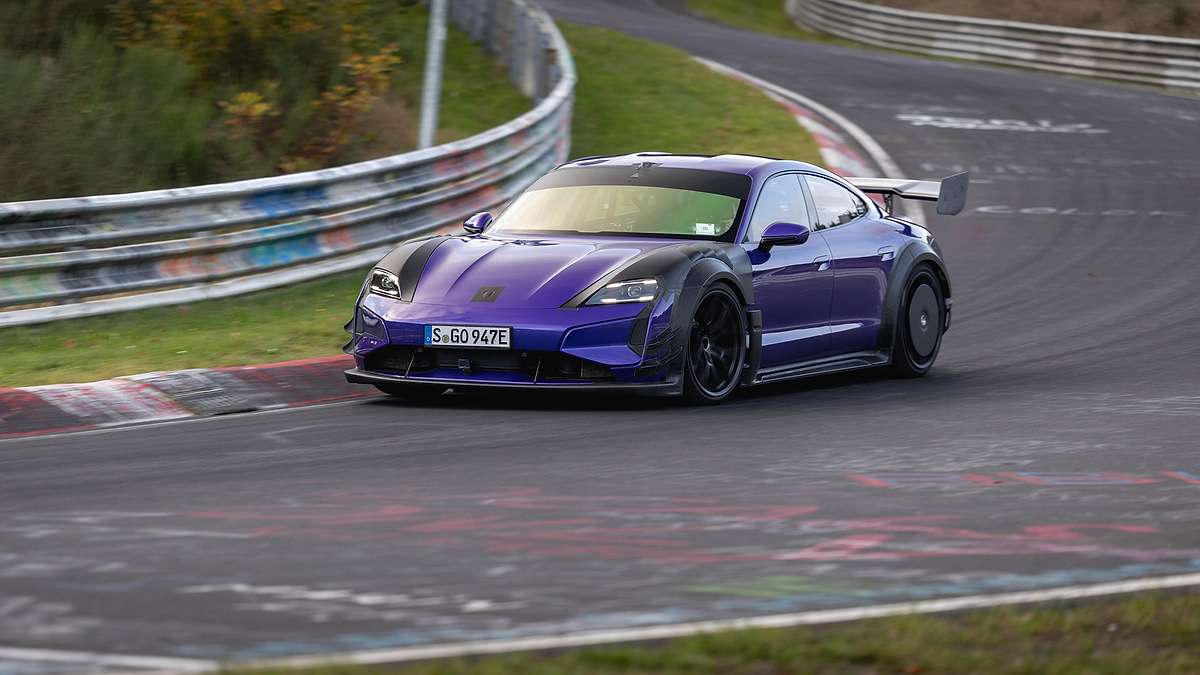

The Porsche Taycan Turbo GT with Manthey Kit did not run a 6:55 Nürburgring lap on an off-the-shelf track tire.
Pirelli’s answer to Torque News makes the tire development sound closer to chassis work than accessory selection. The P Zero Trofeo RS used for the record was enlarged, retuned, and co-developed with the car from the beginning. The standard Taycan Turbo GT fitment uses 265/35ZR21 tires in front and 305/30ZR21 tires in the rear. The Manthey car moves to 305/30ZR21 in front and 325/30ZR21 in the rear, with reduced tread depth.
That front tire jump is the giveaway. Porsche and Manthey were not only chasing rear grip for the Taycan’s torque. They were feeding the front axle more tire, more support, and more consistency, because a heavy, brutally fast EV needs to be trusted before the driver can use the rest of the car.
- The jump to a 305-section front tire increases the contact patch and lateral load capacity, helping the Taycan’s front axle resist understeer and maintain steering precision under heavy braking and turn-in.
- Reduced tread depth lowers tread block movement and heat buildup, improving consistency over a full Nürburgring lap, where sustained high speeds can quickly overwork a conventional semi-slick.
- The wider rear (325-section) works with the EV’s instant torque delivery, spreading load more evenly across the contact patch to improve traction on corner exit and reduce thermal spikes that can degrade grip mid-lap.
Pirelli described the on-track effect in direct language: quicker and stronger corner entry, the ability to get back on the throttle earlier at corner exit, and better consistency across the full Nürburgring lap.
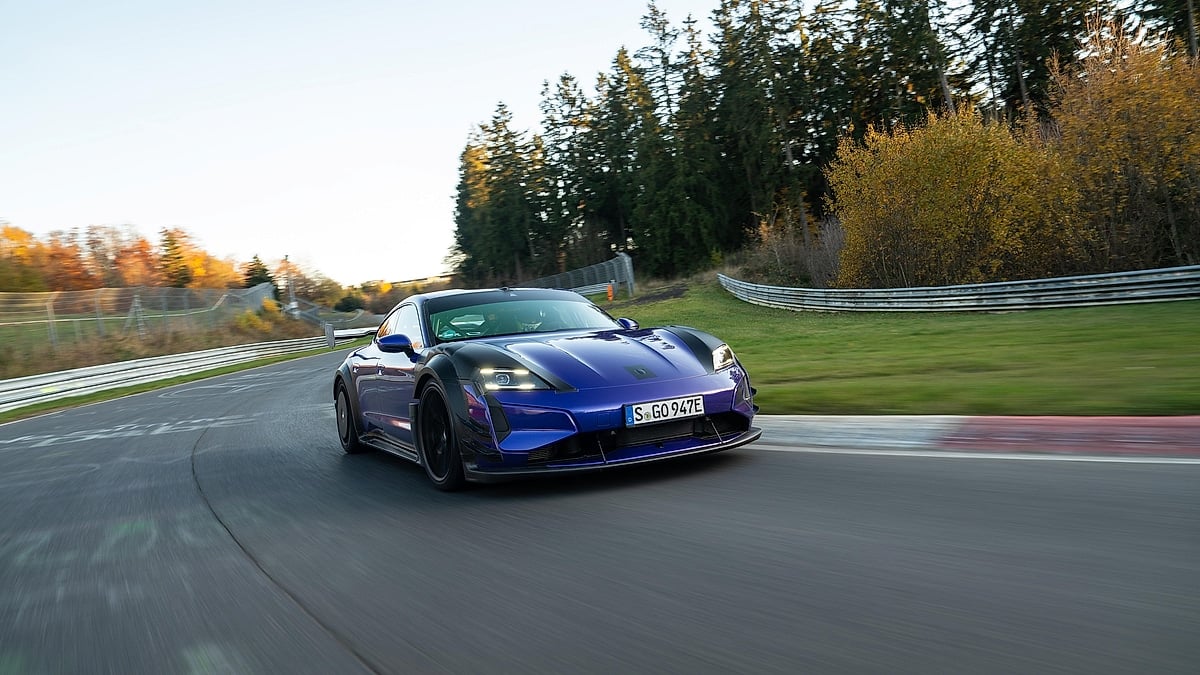
Those are the three things an EV like the Taycan has to earn. It can produce power almost instantly. It can accelerate hard enough to make most gas-powered cars feel old. What it cannot cheat is load. Every hard braking zone, every direction change, every curb strike, every long corner, and every traction event pushes heat and pressure through the tire. A tire that gives up early turns a fast EV into a one-sector car.
Corner Entry Authority, Early Throttle Application, and Lap Consistency
The Trofeo RS had to carry the Taycan’s mass without going vague, absorb its torque without smearing the exit, and keep the contact patch alive long enough for the lap to mean something. Nürburgring records are won with confidence as much as grip. If the front end stops talking, the driver starts waiting. Waiting kills the lap.
Pirelli told Torque News that high-performance EVs place their own demands on the tire.
“Every high-performance vehicle presents its own technical challenges, especially as electrification becomes more prevalent,” Pirelli said.
“Rather than taking a one-size-fits-all approach, Pirelli develops track-focused tires in close partnership with each OEM, ensuring the tire is perfectly matched to the vehicle's characteristics and intended use through our Perfect Fit strategy.”
For the Taycan Turbo GT with Manthey Kit, the pressure points are obvious: mass, torque, temperature, and repeatability. Pirelli said a tire for a high-power, heavy EV must manage higher vehicle mass, instant torque, and the thermal and load demands of electrified performance while still delivering consistent grip, precise handling, and durability during repeated high-performance driving.
That separates the Taycan from a traditional Porsche track car. A 911 GT3 RS tire lives with a different weight profile, a different balance, and a different powertrain. The Taycan asks more from the tire in places where electric performance cars have always been vulnerable: repeated load, repeated heat, and repeated acceleration from low speed, with no soft ramp from an engine.
Pirelli made that comparison itself.
A track tire for a car like the 911 GT3 RS is optimized around lower weight, different weight distribution, and the behavior of an internal-combustion powertrain. The Taycan Turbo GT with Manthey Kit needed a different answer. The tire had to be shaped around the car’s weight, torque delivery, and temperature behavior rather than treated as a generic semi-slick with Porsche markings.
EV Load, Torque Delivery, and Thermal Stress Shape Tire Design
That is where the co-development becomes important. The tire was not a late-stage bolt-on. Pirelli said the compound, construction, tread pattern, and tire architecture were developed with the vehicle from the earliest stages, so the tire matched the character of the car.
Near the end of its answers, Pirelli put the point plainly.
“The key point is that the performance wasn’t just achieved by selecting an existing tire afterward or optimizing the car in isolation,” Pirelli said.
“It came from a co-development process between the vehicle and the tire from the very beginning. That tire was born for that model; it wasn’t chosen afterwards; it was developed together with the car itself.”
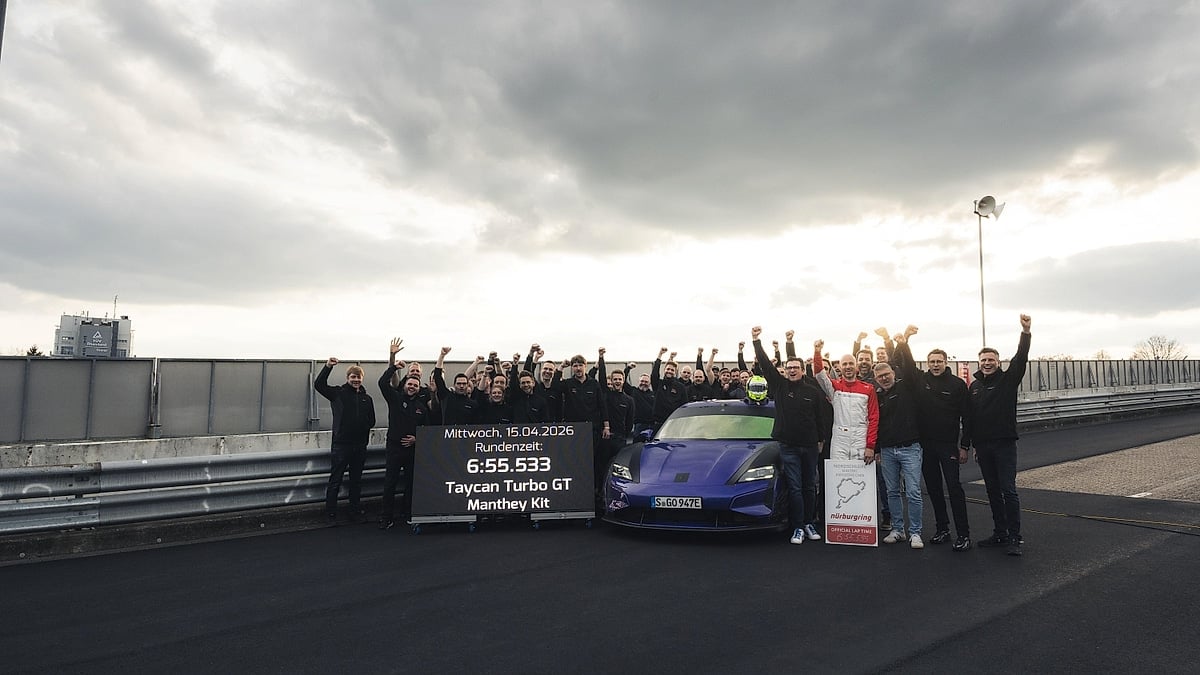
The public record is that the Taycan Turbo GT with Manthey Kit set a new production electric-vehicle Nürburgring record at 6:55, breaking the seven-minute barrier and improving on the 7:07.5 benchmark previously set by the Taycan Turbo GT Weissach. Pirelli’s release says the bespoke Trofeo RS provided additional grip and uses Pirelli Elect technology for electrified vehicles.
The private answer from Pirelli fills in the part that the lap time cannot show. Wider front and rear sizing. Reduced tread depth. EV-specific load work. Heat distribution. Contact pressure. A tire built to let the car attack corner entry harder, settle earlier, and use its torque sooner on exit.
The sustainability claim also deserves more than a side note. Pirelli says this version of the P Zero Trofeo RS is the first production tire made with more than 50 percent certified bio-based and recycled materials to contribute to a Nürburgring record. The tire also uses FSC-certified natural rubber.
That kind of claim usually lives in a separate lane from lap times. At the Nürburgring, it has nowhere to hide. A semi-slick cannot trade away warmup, peak grip, wear behavior, or heat consistency and still help a heavy EV run 6:55.
Pirelli said the material change required careful engineering to avoid compromising dynamic performance. Its Eco-Safety Design approach, the company said, integrates sustainability and performance from the beginning rather than treating them as separate objectives.
Tire Construction, Compound, and Heat Management Under Repeated Load
The technical pieces are familiar to anyone who has spent time around serious tires, but they matter more here because of the car underneath them. Pirelli said the polymer and reinforcing filler mix helps maintain grip and warm-up characteristics. The casing construction and footprint design are tuned to keep contact pressure and heat distribution consistent during repeated high-speed laps. The tread compound has to balance wear resistance with peak grip.
Pirelli’s track-use procedure also shows how narrow the operating window is for a road-legal semi-slick at this level. The company recommends working toward the vehicle manufacturer’s target pressure at operating temperature, using an initial pressure reduction before warmup, driving roughly 25 kilometers to bring the tires into operating condition, correcting pressure if it exceeds the target, and resetting pressure after the track session.
That procedure is how a tire like this stays in the window. A Trofeo RS is road legal, but it is not a commuter tire wearing a costume. Pressure and temperature are part of the product. The tire does its best work when the owner treats it like a piece of track equipment.
The Taycan Turbo GT with Manthey Kit makes the larger point clearly. The next generation of electric performance cars will not be judged by motor output alone. Power is easy to advertise. The harder work sits in the tires, brakes, cooling, software, aero, and calibration that keep the car repeatable.
The Taycan already had the power. Manthey gave it more discipline. Pirelli gave it the tire to make the lap hold together.
A 6:55 lap at the Nürburgring is the visible result. The engineering underneath is more interesting: a tire widened for the car, tuned for the car, built with the car, and forced to prove that more sustainable material content does not have to soften the edge of a record-level EV.
What Do You Think?
Would you trust a tire engineered this tightly with an EV for track use? Drop your thoughts in the comments and share this with someone who follows Nürburgring records.
About The Author
Noah Washington is an automotive journalist based in Atlanta, Georgia, covering sports cars, luxury vehicles, and performance culture. His reporting focuses on explaining the engineering, design philosophy, and real-world ownership experience behind modern vehicles.
Noah has been immersed in the automotive world since his early teens, attending industry events and following the enthusiast communities that shape how cars are built and driven today. His work blends industry insight with enthusiastic storytelling, helping readers understand not just what a car is, but why it matters.
Noah is also a member of the Southeast Automotive Media Association (SAMA), a professional organization for automotive journalists and industry media in the Southeast.
His coverage regularly explores sports cars, luxury vehicles, and performance-driven segments of the automotive industry, including the evolving culture surrounding Formula Drift and enthusiast builds.
Read more of Noah's work on his author profile page.
You can also follow Noah here:
Set Torque News as Preferred Source on Google
Follow us today...