
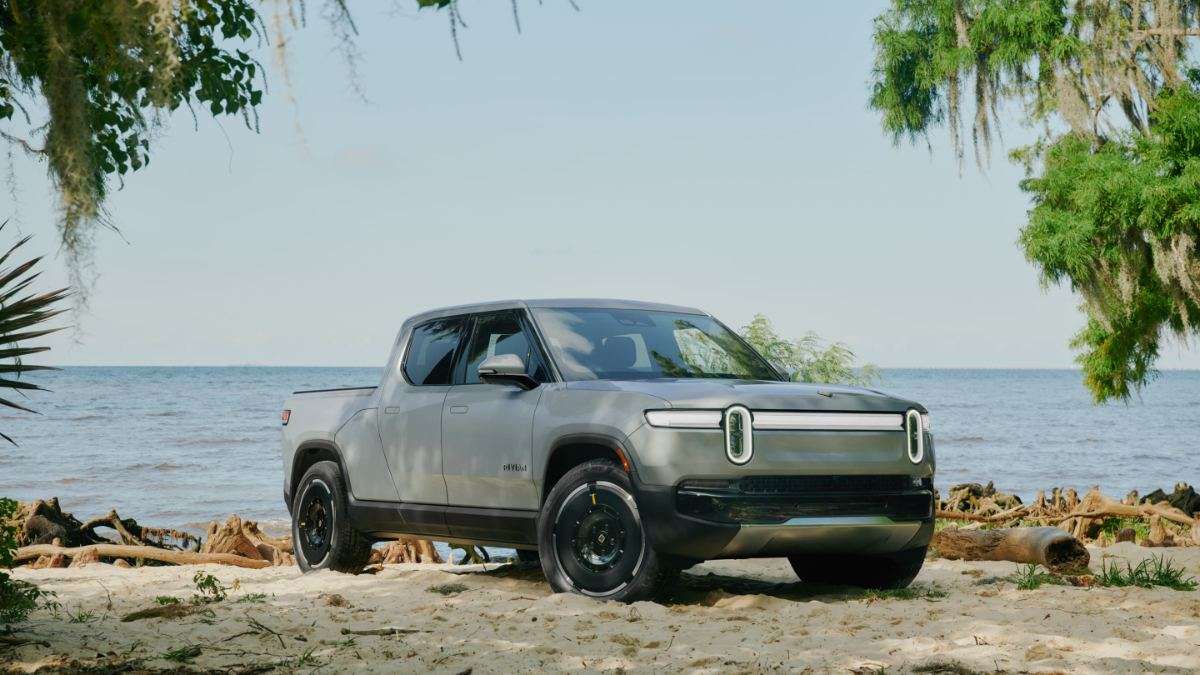

There is a very small window in a carmaker's life when the balance is just right. Big enough to build something ambitious, small enough to still hear every creak, rattle, and complaint from the people writing the checks.
Before the conference rooms fill up and the service experience gets reduced to a script, there is a phase where the company still behaves like a race team. Someone shows up with a problem, and the instinct is to fix it completely, not minimally. Rivian, at least judging by one recent story, looks like it is still living in that rare moment.
The story comes from Cameron Trial, a man whose day job is running two EV repair shops that specialize in Teslas. In other words, this is not someone who gets confused by a warning light. Posting in a Rivian Facebook group, he wrote:
“First Rivian service experience under warranty, and I’m absolutely thrilled with my experience.
I’m intimately familiar with EV service, as I own two EV repair shops that specialize in Teslas. We put out high-quality, with great customer service, so naturally, I expect the same when I’m the customer and not the owner.
Bought her on November 18th, 3 days after scheduling a service appointment, for what I self-diagnosed as failing front half shafts, an HVAC assembly that was leaking water onto the front driver floor, and a door seal that had come loose. For the front half shaft issue, there was a bit of noise coming from the front end when loading and unloading the suspension at low speeds. I perceived it to be more than just half shafts, but I was going to let them do their diagnosis and tell me what they were going to replace. There is a known issue with the front subframe on the Gen 1 Rivians that exhibits popping noises due to the way they were manufactured. The only fix for it is a complete subframe retrofit to the Gen 2 subframe, which requires pretty much every suspension component up front to be replaced.
During the test, the technician said the noise was the front half shafts. I was fine with that. I wasn’t going to press the subframe issue, even though I badly wanted it replaced while still under warranty.
Rivian was unfortunately out of Rivian loaners, but put me in a brand new Mercedes SUV rental, so I couldn’t really complain about that.
Rivian kept me updated every step of the way. Communication was great.
Picked my truck up today, and it turns out they not only replaced the HVAC assembly, front half shafts, door seal, but they also did the entire front subframe retrofit, replacing the subframe, lower control arms, both air struts, jounce lines, and all the other smaller components required for that.
In total, 35 hours worth of labor. All replaced under warranty. Probably about $15-20k worth of parts, if I had to guesstimate, and another $8k in labor if I were to have to pay out of pocket.
Advertising
The process was seamless. Reminded me of Tesla in their early days.
I also have a few aftermarket parts, which I fully expected them to ask me to remove prior to service. But they didn’t, they worked around them and even hooked them back up after repairs were completed, including my rock sliders, and my Comma 3X self-driving system, which they most definitely had to remove when taking the dash out to replace my HVAC assembly.
Just wanted to share my experience, coming from someone who’s intimately involved with the service of EVs.
Truck feels brand new, and I’m thrilled.”
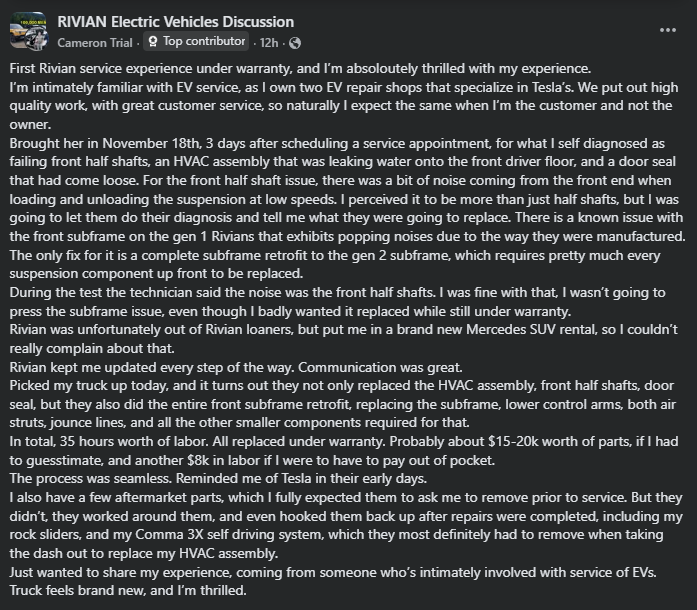
That is a customer walking in with a realistic diagnosis and professional expectations.
Cameron also knew there was a known issue with the front subframe on first-generation Rivians that can cause popping noises due to the way the parts were manufactured, with the only true fix being a full retrofit to the updated front subframe and a long list of suspension components. He suspected his truck might need more than half shafts, but he deliberately held back. Let the service team do their own work, he figured. During the test drive, the technician called them the front half shafts. He accepted that, did not argue, and left the truck in their hands. Rivian was out of its own loaners that day but put him in a new Mercedes SUV rental and then stayed in touch throughout the process. Clear communication, no drama.
Rivian R1T: Unique Features
- The R1T’s quad-motor configuration offers precise control at each wheel, allowing the truck to redistribute power instantly in challenging terrain or during sharp directional changes.
- Its gear tunnel provides enclosed storage in an area typically unused by pickups, adding versatility for camping gear, tools, or travel equipment.
- The truck’s cabin presents a warm, natural design direction, using real wood and soft surfaces to create a relaxed environment that contrasts with its rugged capability.
- The R1T’s acceleration surprises many first-time drivers, as the truck launches forward with the immediacy of a performance EV while maintaining a stable and predictable chassis response.
The surprise came when he picked up the truck. Rivian had not just replaced the HVAC assembly, the front half shafts, and the loose door seal. They had also performed the full front subframe retrofit, swapping in the updated subframe along with lower control arms, both front air struts, jounce lines, and the smaller associated components. In total, he counted about 35 hours of labor and estimated the value at roughly 15,000 to 20,000 dollars in parts and another 8,000 in labor if he had been paying out of pocket, which puts the total repair in the neighborhood of 23,000 to 28,000 dollars.
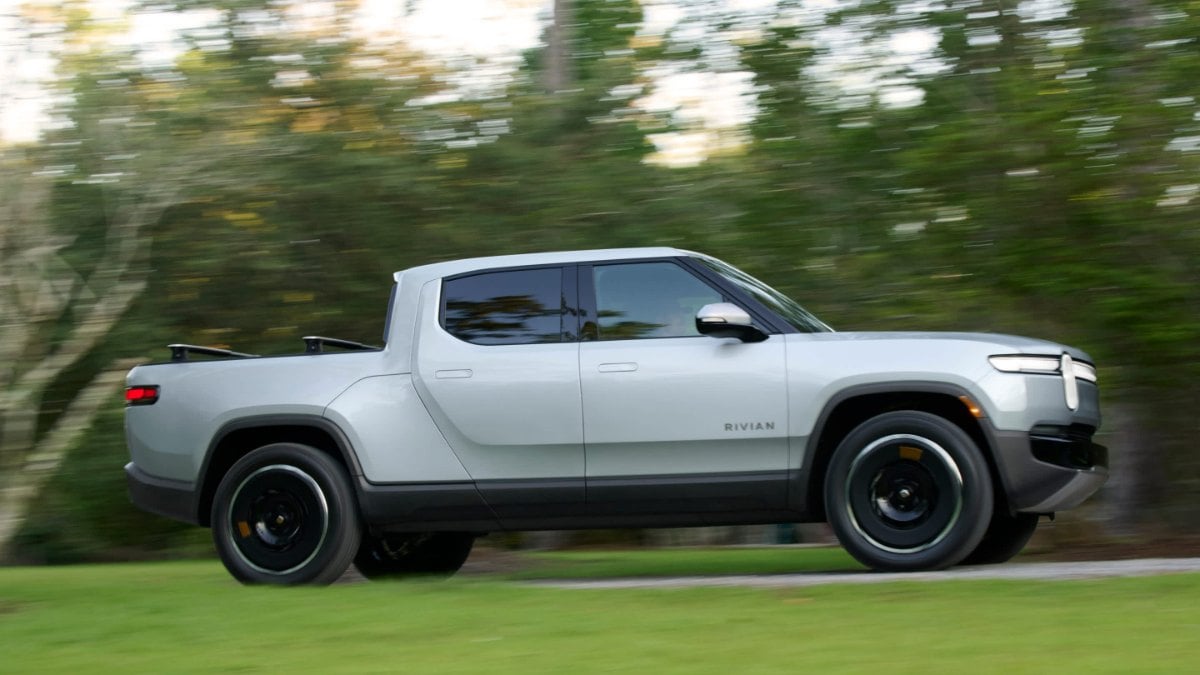
All of it was covered under warranty. On top of that, he had aftermarket rock sliders and a Comma 3X self-driving system on the truck, and he fully expected to be told to strip those off before service. Instead, Rivian worked around the modifications, removed what they needed to remove, and then reinstalled and reconnected everything properly.
Cameron summed it up with a line that should make every executive in the EV world sit up:
“The process was seamless. Reminded me of Tesla in their early days. [...] Truck feels brand new, and I’m thrilled.”
In the EV world, that comparison carries a specific meaning. The early years of Tesla service were famous for a very personal, very hands-on attitude, the kind that made customers feel like partners in an experiment rather than numbers in a queue. To hear someone who repairs Teslas for a living say a different brand now gives him that feeling again is not trivial praise. It suggests a culture inside Rivian service that still leans toward over-fixing rather than doing the minimum to close a ticket.
Look underneath the main post, and you see another important piece of the picture. In the comments, the owners behave like people who trust both the company and each other. Hoby Groves mentions noticing popping sounds at low speeds in his own Gen 1 R1S and asks if he should have the service center look at it while the truck is still under warranty. Another commenter, Kip Garrison, answers with practical clarity: yes, get it checked, because the last thing you want is a 20,000 dollar repair after coverage expires. Ownership of a complex vehicle is always a negotiation between risk and timing, and here you see the community urging each other to be proactive while the manufacturer is still standing behind the product.
Then there is Kassim Osgood, just a week into owning a 2023 R1S and trying to make sense of air suspension behavior. He reports that the suspension goes up and down at stop signs and lights, and that there are popping noises as well. Cameron replies that this is not normal and advises him to have it inspected. Another commenter, Chris DeGrego, suggests it sounds like either a leak or a ride height sensor issue. What could easily devolve into fear or brand bashing instead turns into early-stage, detail-focused troubleshooting among owners who assume the service network will take them seriously.
Not every voice in the thread is fully sold on this new world. Ken Morris steps in to point out that he keeps seeing stories of Rivians in the shop and contrasts that with his own experience in a 2017 F-150 that has so far needed nothing but tires and oil changes. He notes the range and capability of his truck and is clearly proud of it. That perspective matters too. For many drivers, a proven internal combustion pickup is the benchmark of reliability and simplicity. The interesting part is Cameron's reply. He explains that he was one of the first four people in Houston to receive Ford's aluminum body F-150 when it came out in 2017, that he loved that truck, and that he still prefers his Rivian. There will be problems with any first-generation vehicle, he notes, but in his case, those problems were solved under warranty with a luxury loaner provided. From his point of view, that is a fair trade.
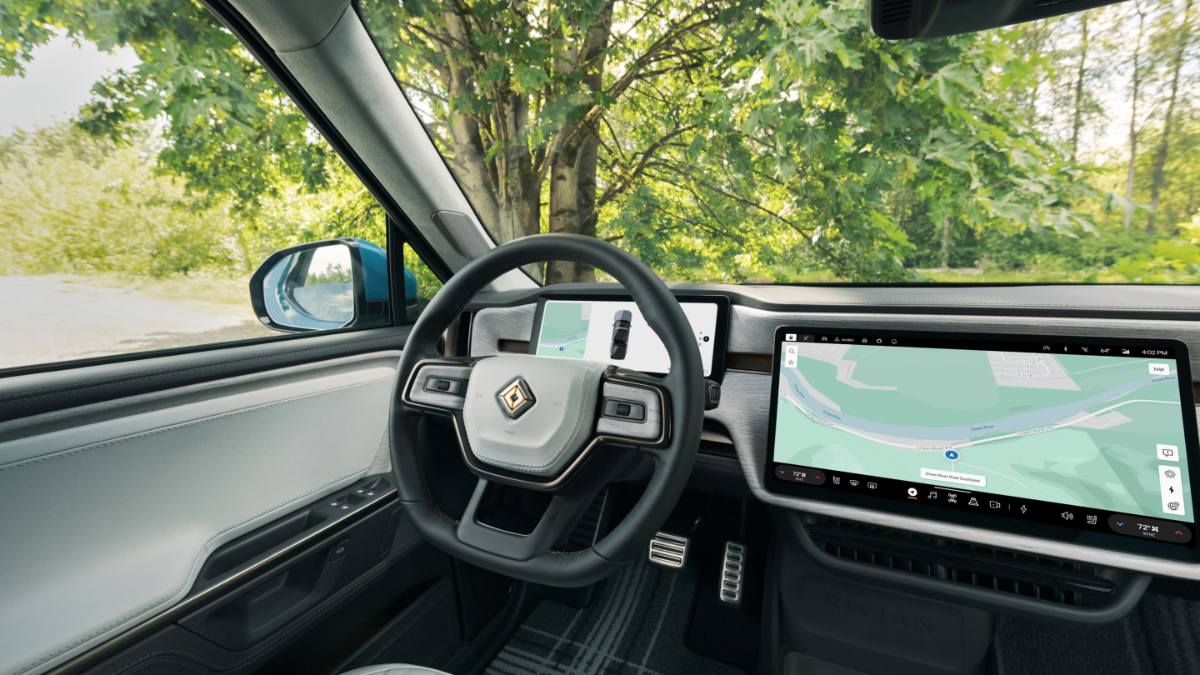
Taken together, the post and the comments read like a snapshot of a young company in the middle of its formative years. The hardware is ambitious and still evolving. Some owners are encountering issues, some are simply learning what normal behavior is for an EV with adaptive suspension and a complex front subframe, and some are comparing it to their long-serving traditional trucks. The common thread is that when a serious problem appeared, Rivian chose to go deep. Comprehensive diagnosis. Extensive parts replacement. Respect for the customer's technical knowledge and his aftermarket modifications. Clear communication and a proper loaner. That is what earns the comparison to the early days of another pioneering EV brand.
The real measure of an automaker is not whether its vehicles ever develop problems. Every machine does. The measure is what happens when those problems surface. In this case, a customer who understands the business better than most walked in with a concern and walked out with a truck that felt brand new, and a sense that the manufacturer was on his side. If Rivian can keep operating that way as volumes increase and pressures mount, it has a chance to grow without losing the responsiveness that made stories like this possible in the first place.
Image Sources: Rivian Media Center
Noah Washington is an automotive journalist based in Atlanta, Georgia. He enjoys covering the latest news in the automotive industry and conducting reviews on the latest cars. He has been in the automotive industry since 15 years old and has been featured in prominent automotive news sites. You can reach him on X and LinkedIn for tips and to follow his automotive coverage.
Set Torque News as Preferred Source on Google
Follow us today...




Comments
Hello. I am an R1T owner and…
Permalink
Hello. I am an R1T owner and I do feel the same issues on my vehicle. Wondering where is your shop and if possible tot take it for inspection?