


The Tesla Cybertruck has already earned a reputation as a tool for people who do not wait for permission to try something new. It is a pickup shaped by the idea that a vehicle can serve as a workshop, an office, a generator, and a traveling base of operations. That versatility encourages its owners to treat it not simply as transportation but as a companion for problem-solving. One recent story from the Cybertruck Owners Only Facebook community captures this spirit clearly and shows how the vehicle’s capability invites a particular brand of thoughtful improvisation.
“Grok got it wrong.
Said I could plug into the USB-C to power the Starlink.
It powers on but can't acquire a signal.
So I had to go back to my car stereo installation days in the '90s and do some splicing and soldering.
Now I have an inside mini Starlink to work remotely and travel.”
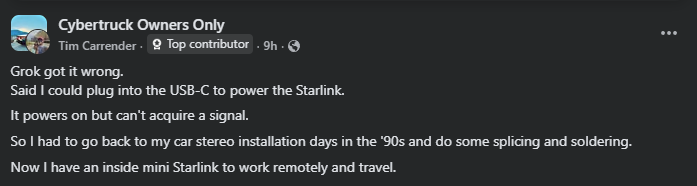
The post came from Tim Carrender, a long-time contributor in that group who approached a modern problem with a craftsman’s sensibility. He wanted to integrate a Starlink Mini inside the cabin of his Cybertruck so he could work anywhere the road allowed. When he asked Grok, the truck’s onboard digital assistant, how to power the dish, he received an answer that seemed practical at first. The USB-C ports can deliver meaningful wattage, which makes the suggestion reasonable. The dish powered on. Yet it could not acquire a satellite signal, a reminder that powering sensitive electronics and powering them with the necessary stability are sometimes two different matters.
Rather than treating the setback as a failure, Tim did what experienced tinkerers do. He returned to skills he learned decades ago during the era of aftermarket stereos and trunk-mounted amplifiers. With a soldering iron, proper wiring, and a methodical approach, he created a more reliable power feed directly from the Cybertruck’s ample electrical system. The vehicle is built around a 48-volt architecture and significant accessory power capability, which gave him the foundation he needed to support something as demanding as satellite communications hardware. Within hours, the cabin became a compact connectivity hub suitable for real remote work.
Tesla Cybertruck: How It Performs
- The Cybertruck’s sharp-edged profile creates a unique aerodynamic footprint, allowing air to channel along its flat surfaces in a way that differs noticeably from rounded pickup designs.
- Its battery placement gives the truck a low center of gravity that steadies the chassis during higher speed travel, offering a planted feel that contrasts with its tall exterior proportions.
- The onboard power outlets turn the truck into a mobile workstation, giving drivers the ability to operate tools and equipment without relying on external generators.
- The cargo bed’s integrated power outlets and durable composite floor offer practical utility for hauling gear, and the covered vault design keeps equipment protected from weather.
Other owners quickly joined the conversation. They offered notes about cable routing, power draw, and mounting options, each message reinforcing a shared understanding that this truck rewards careful hands and thoughtful experimentation. Nobody expressed surprise that the factory assistant’s advice was not fully accurate. Most simply accepted that digital guidance can be imperfect, and that part of the ownership experience involves knowing when to trust your own tools and experience. The thread read like a workshop full of people leaning over diagrams, sharing ideas with a kind of quiet enthusiasm.
The Cybertruck’s interior space, available power, and structural build quality allow owners to attempt projects that would challenge traditional pickups. Outlets in the bed, a large battery reserve, and a power architecture designed for future accessories mean the platform is flexible enough to support serious off-grid tasks. Whether the goal is running tools, setting up a campsite, or connecting to a satellite network from inside the cabin, the truck gives owners a broad path for exploration.
Tim’s experience with Grok illustrates an important truth about modern vehicles. Technology can guide, simplify, and predict, yet it cannot replace craftsmanship. In this case, the assistant provided a starting point rather than a full solution. The owner provided the insight that comes from understanding wiring, load demands, and the feel of a proper solder joint. The combination produced a result that no menu option or automated prompt could have delivered. It transformed a moment of mild inconvenience into a demonstration of capability.
Tim returned to Facebook not to vent, but to share a small triumph. The Cybertruck now houses a fully functional Starlink Mini that allows him to work wherever the sky is clear. The truck supplied the power and the platform. He supplied the problem-solving. It is a partnership that suits the Cybertruck’s character well. The vehicle thrives when its owners ask something unusual of it, and this time the request was answered with a blend of modern engineering and old-fashioned know-how. It is proof that a machine built for many roles can exceed expectations when paired with someone willing to make the most of it.
Image Sources: Tesla Media Center
Noah Washington is an automotive journalist based in Atlanta, Georgia. He enjoys covering the latest news in the automotive industry and conducting reviews on the latest cars. He has been in the automotive industry since 15 years old and has been featured in prominent automotive news sites. You can reach him on X and LinkedIn for tips and to follow his automotive coverage.
Set Torque News as Preferred Source on Google
Follow us today...





Comments
I like how the article doesn…
Permalink
I like how the article doesn't address the fact that this guy most certainly voided his warranty by doing this. it also does not address the fact that USBC power delivery standards are a thing, and that there should be no discernable reason that either the USBC or inverter ports on the cyber truck wouldn't power the starlink mini sufficiently. this was basically just a circle jerk fluff article. but you got your daily in, good job author!
Circle jerk, Fanboi, Rim…
Permalink
In reply to I like how the article doesn… by Phil (not verified)
Circle jerk, Fanboi, Rim Licker, choose from these or any similar descriptors for this article.
The Starlink Mini is very…
Permalink
In reply to I like how the article doesn… by Phil (not verified)
The Starlink Mini is very finicky with USBC, as I don't believe it really has the USB PD firmware. You're connecting a cable with the same DC barrel plug on one end, and USB C on the other end. Even though it's an official Starlink cable, I don't think USBC PD devices can really negotiate the power requirements with the dish, so you also need the official car adapter which outputs exactly what the mini needs, or trial and error with a USB C port that outputs more power without any negotiating. I've found that most of the time, trying to power the mini via USB C just doesn't work for unknown reasons, even if said adapter is rated for appropriate wattages. Little embarrassing that Tesla and SpaceX didn't make them compatible, but I wouldn't have spliced wires or soldered anything in a cybertruck. I do find it kind of funny that this article is treating it like a cool and fun little hack. Also, duh... An "ai" assistant getting something wrong... Who would've thought
They took a shitty truck and…
Permalink
They took a shitty truck and made it marginally better.
Its still a shitty truck.