
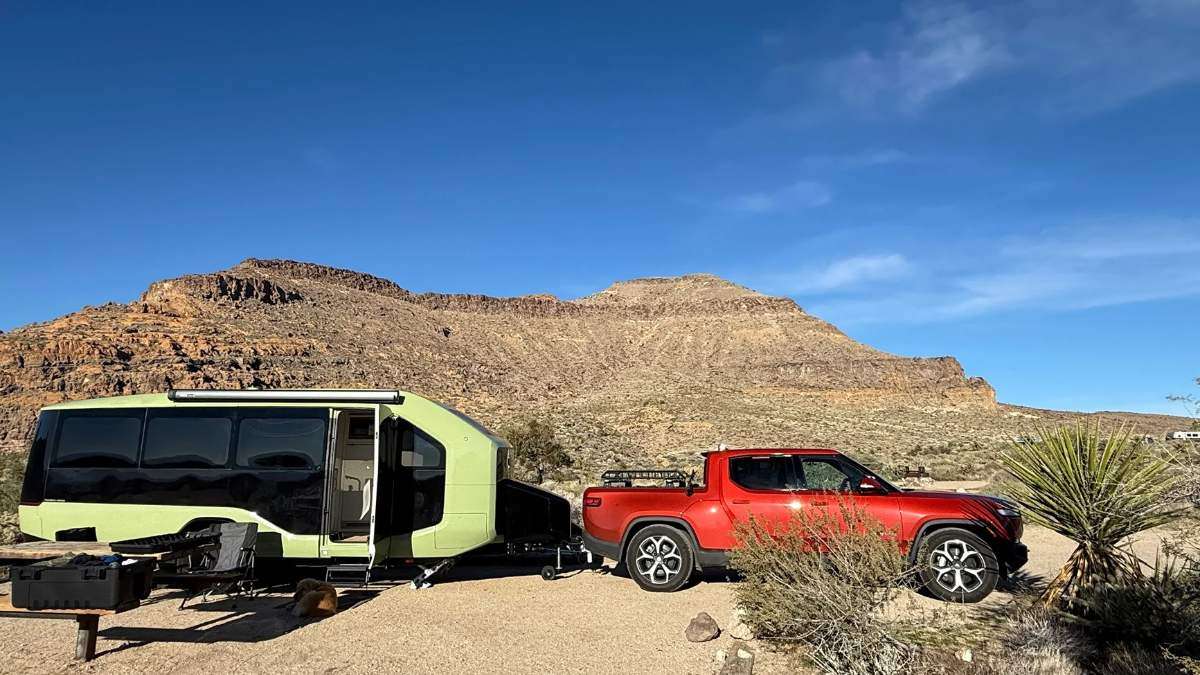

There is a certain American confidence that appears whenever someone hitches something unfamiliar to a pickup and heads for real geography instead of a test loop. In late 2025, that confidence took the form of a Rivian R1T leaving Fremont, California, towing one of the first Pebble Flow electric trailers toward Durango, Colorado. This was not a manufacturer demonstration or a carefully stage-managed event. It was a private owner, a retired petroleum engineer, using public roads, public chargers, and his own judgment to see how far an electric truck and an electric trailer could realistically go together.
The owner, known as JamuJoe on the Rivian Forum, had plenty of towing experience to ground the experiment. His R1T had already hauled a 28-foot Airstream for more than 14,000 miles, delivering a long-term average of about 1.1 miles per kilowatt-hour. That number represents the unvarnished reality of electric towing. The Pebble Flow introduced a new variable. It is a single-axle, nearly 25-foot trailer with its own dual electric motors and a 45 kWh LFP battery, designed not only to power onboard living systems but also to assist the tow vehicle through a system Pebble calls Tow Assist.
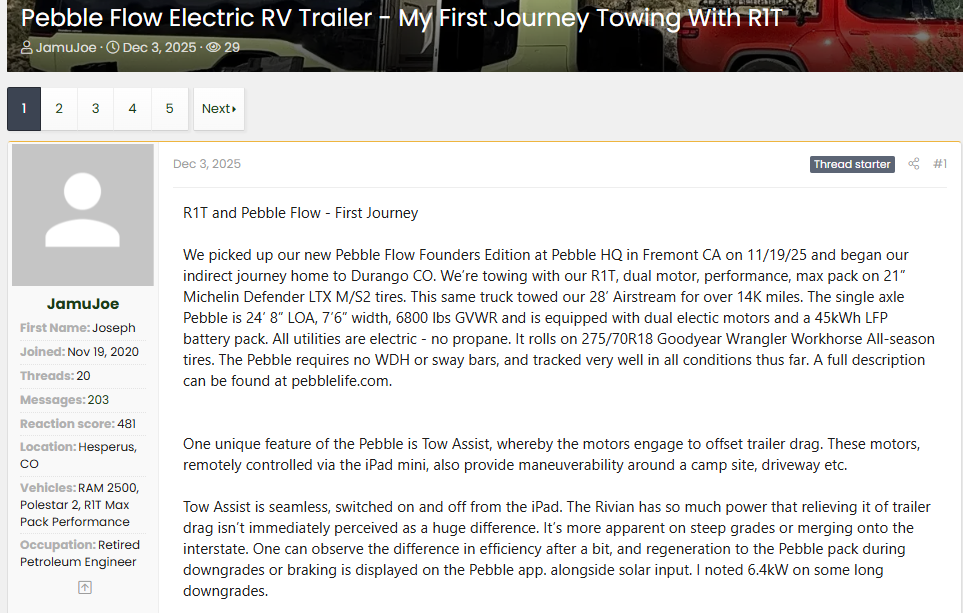
“R1T and Pebble Flow - First Journey
We picked up our new Pebble Flow Founders Edition at Pebble HQ in Fremont, CA, on 11/19/25 and began our indirect journey home to Durango, CO. We’re towing with our R1T, dual motor, performance, max pack on 21” Michelin Defender LTX M/S2 tires. This same truck towed our 28’ Airstream for over 14K miles. The single axle Pebble is 24’ 8” LOA, 7’6” width, 6800 lbs GVWR, and is equipped with dual electric motors and a 45kWh LFP battery pack. All utilities are electric - no propane. It rolls on 275/70R18 Goodyear Wrangler Workhorse All-season tires. The Pebble requires no WDH or sway bars, and tracked very well in all conditions thus far. A full description can be found at pebblelife.com.
One unique feature of the Pebble is Tow Assist, whereby the motors engage to offset trailer drag. These motors, remotely controlled via the iPad mini, also provide maneuverability around a campsite, driveway, etc.
Tow Assist is seamless, switched on and off from the iPad. The Rivian has so much power that relieving it of trailer drag isn’t immediately perceived as a huge difference. It’s more apparent on steep grades or merging onto the interstate. One can observe the difference in efficiency after a bit, and regeneration to the Pebble pack during downgrades or braking is displayed on the Pebble app. alongside solar input. I noted 6.4kW on some long downgrades.
The Pebble has great aerodynamics, with no aircon units on top, minimal vents, and recessed solar panels. The Aero Box on the bow (covering the 15,000 BTU heat pump) raises for towing, presenting a clean entry. The R1T was not as sleek on this trip, with two cargo boxes atop the bed, so some efficiency loss there.
Efficiency varies with a number of factors, short run comparisons are not statistically valid, and I realize that these early results are hardly scientific, but they do offer a glimpse at the benefit of Tow Assist. Interstate driving is generally my worst efficiency. I tow at 65 mph. And am buffeted by the bow waves of passing semis.
Advertising
My ‘baseline’ efficiency for comparison was an average of 1.1 mi/kWh for our 7500 lb Airstream 28, over 14,000 miles.
The Rivian recalculates trailer weight after every hitch-up and a few miles of towing, rounding to the nearest 500 lbs. One can also force a recalculation from the trailer display. Without Tow Assist, Rivian estimated the weight of the trailer at 6500 lbs. With Tow Assist, the Rivian in motion recalculated the weight of the trailer at 5000 lbs.
With Tow assist, a 168-mile run on I40 at 65mph yielded efficiency of 1.76 mi/kWh.
We left Gallup, NM, after charging at the RAN to 94%. Having made the run from Holbrook to Gallup without Tow Assist, the navigation system estimated our home arrival SOC at 4%. A bit risky, as there is but one fast charger en route, and that at a GM dealership in Farmington with uncertain availability. I’ve had to stop there with the Airstream, and it’s awkward. We rolled, and I activated Tow Assist. I towed at 65 mph, but this time on NM 491 with little traffic. The estimated arrival SOC increased to 26%. No charging stop required! We arrived home after 156 miles and 1200 ft of elevation gain with exactly that 26% SOC, in a brisk 30F.
We look forward to many great trips next year, but now it’s snowing and time for covered winter storage.”
In concept, Tow Assist is simple and radical at the same time. Motors in the trailer engage to offset aerodynamic drag and rolling resistance, reducing the load seen by the truck. In practice, the effect was subtle from behind the wheel. The Rivian has ample power, so the immediate sensation was not dramatic.
The data, however, told a different story. On a 168-mile run at 65 mph, the R1T returned 1.76 mi/kWh, a substantial improvement over the owner’s established baseline. Even more telling, Rivian’s own systems recalculated the trailer’s effective weight, dropping it from an estimated 6,500 pounds without Tow Assist to 5,000 pounds with it engaged.
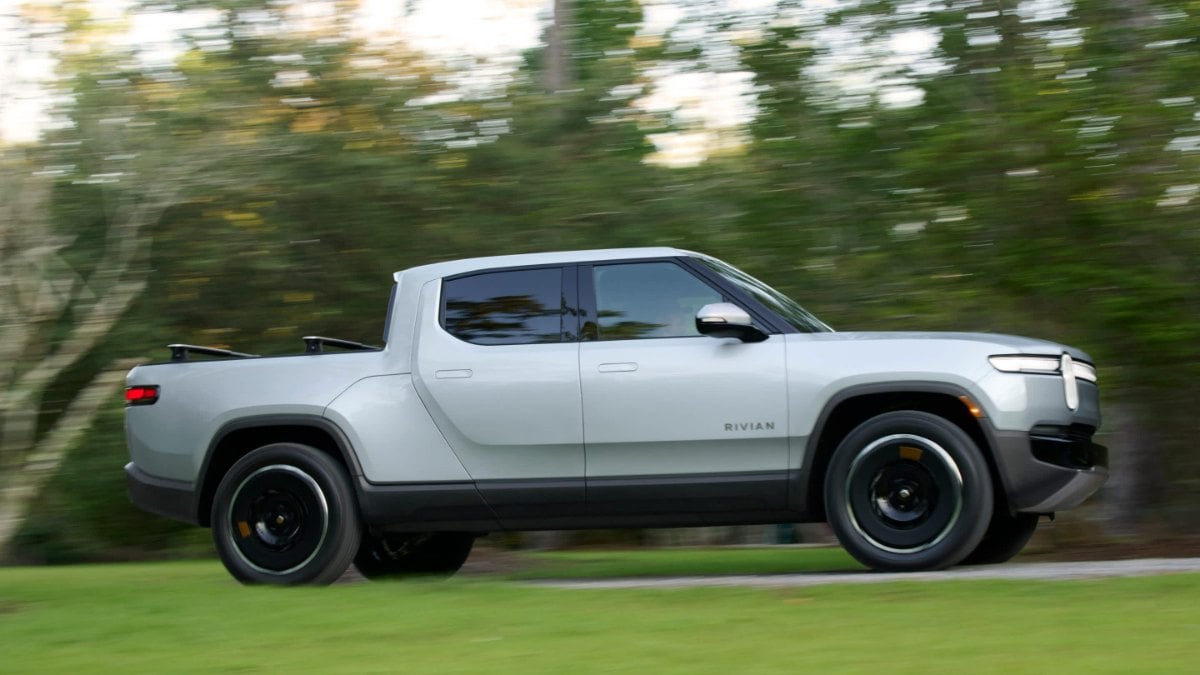
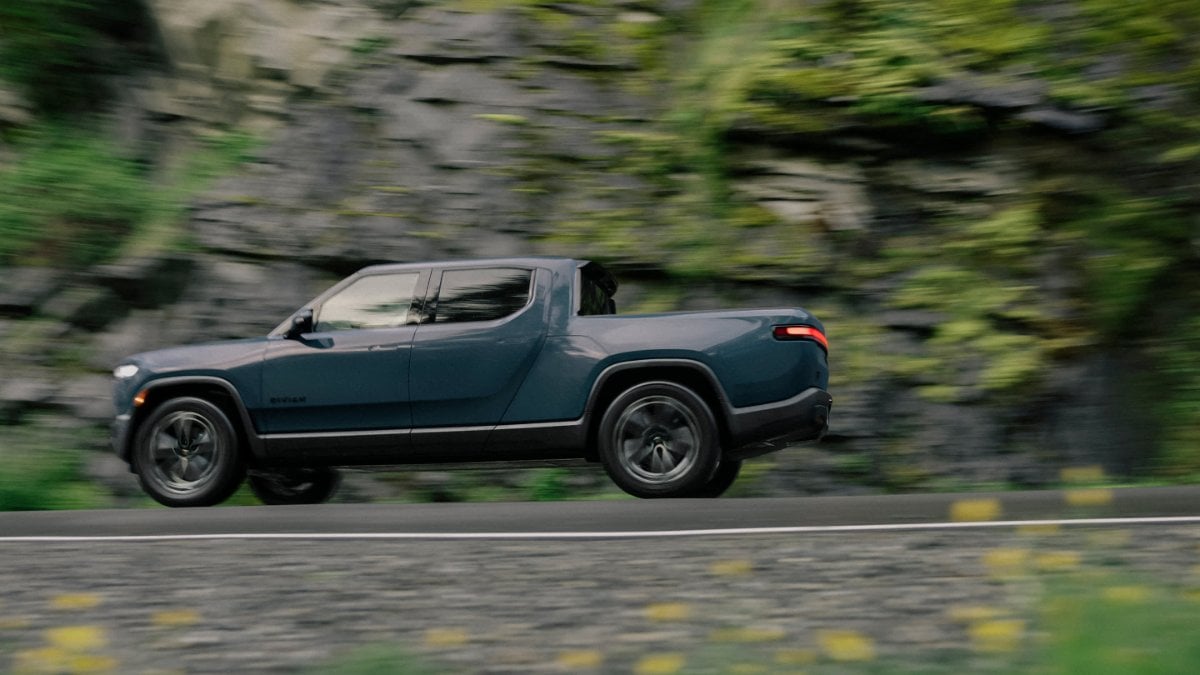
Rivian R1T: A Pickup Reimagined for Electric Use
- The R1T blends pickup utility with electric performance, using its independent motor control to maintain composure while hauling or navigating uneven ground.
- A relatively short overall length improves maneuverability compared to traditional full-size trucks, especially in urban and trail environments.
- The gear tunnel adds enclosed storage without reducing bed space, giving the truck a functional advantage for carrying tools or recreational equipment.
- On-road behavior feels composed and controlled, with a low center of gravity helping to manage body movement despite the truck’s weight.
The most consequential moment came on the final leg home from Gallup, New Mexico. After towing without assistance earlier in the trip, the navigation system predicted an arrival state of charge of just 4 percent, with only one uncertain fast charger along the route. Activating Tow Assist changed the forecast almost immediately. The estimated arrival climbed to 26 percent. After 156 miles, 1,200 feet of elevation gain, and cold winter temperatures, the truck arrived with exactly that margin intact. It was a clear demonstration that this was not merely a laboratory gain but a difference that altered real-world decision-making.
Naturally, the forum discussion moved beyond the headline numbers. Some readers questioned whether the efficiency gain represented a true system improvement or simply shifted energy use to the trailer’s battery. That is a fair technical question. The Pebble does draw from its own reserves to assist propulsion, though it can also regenerate energy on downgrades, with the owner reporting up to 6.4 kW captured during long descents. The important point is not that energy appears from nowhere, but that the combined system manages it more intelligently than a passive trailer ever could.
Others focused on practical ownership concerns. Charging logistics for a truck and trailer combination matter, as does how much energy remains in the trailer once the campsite is reached. The Pebble uses a CCS1 connector, which opens access to most public fast-charging networks, though it does not imply blanket access to Tesla Superchargers outside of the limited Magic Dock locations. These are solvable issues, but they underscore that electric towing is as much about infrastructure clarity as it is about vehicle capability.
From a broader industry perspective, this trip hints at a shift in how towing might evolve. Instead of endlessly increasing battery size in trucks alone, distributing energy storage and propulsion across both truck and trailer changes the equation. It reduces the penalty of towing without demanding extreme solutions. For recreational trailers, and potentially for commercial freight, that idea could reshape design priorities over the next decade.
What makes this story compelling is not that it proves everything is solved, but that it shows meaningful progress under ordinary conditions. An electric truck towing an electric trailer across multiple states, arriving with usable range instead of anxiety, is no longer theoretical. It is happening quietly, owner by owner, mile by mile. That is often how real change begins in the automotive world, not with proclamations, but with someone simply hitching up and driving home.
Image Sources: Rivian Media Center
Noah Washington is an automotive journalist based in Atlanta, Georgia. He enjoys covering the latest news in the automotive industry and conducting reviews on the latest cars. He has been in the automotive industry since 15 years old and has been featured in prominent automotive news sites. You can reach him on X and LinkedIn for tips and to follow his automotive coverage.
Set Torque News as Preferred Source on Google
Follow us today...






Comments
I just wonder if tying the…
Permalink
I just wonder if tying the energy from the batteries to the Rivian through an electrical hookup wouldn't make more sense. No need for motors in the trailer. Just seems more simple, less trouble prone and efficient. But I guess that would need Rivians cooperation so this approach can be done independently.
This is getting out of hand,…
Permalink
This is getting out of hand, what's next? You should not be towing with an electric vehicle, there are things that you just can't do with certain vehicles. Charging trailers? How would that work? Maybe the truck has two ports, one thing pass thru on the rear and another so you only connect one? That would slow the charging to a crawl. What about the price of the trailers of they have a drive system, why not put an ICE assist? It just doesn't make sense unless the trailers have batteries inside to increase range and be compatible with the vehicles towing....
You celebrate a 168 mile…
Permalink
You celebrate a 168 mile round-trip journey as some major accomplishment. It's utterly ridiculous is what it is. And this is exactly why the EV market is collapsing now. The vehicles are horrible, and the infrastructure is even worse. Stick to golf carts for now.
Very interesting to see the…
Permalink
Very interesting to see the newest technology evolving and growing in capabilities. I had a 1972 Hilux with a propane conversion and it had a 150gal nurse tank on a trailer that the previous owner built and used it to transport propane he bought at certain locations that gave him a bulk discount. I always wanted to hook the tank/trailer to the pickup and see just how far I could go. The 30gal tank in the truck kept me going for about 2 weeks. Sure milage was just a simple math equation but now you have another source of power at your geeky little finger tips. Oh Joy. Have fun towing guys and thank you for evolving! Woot