
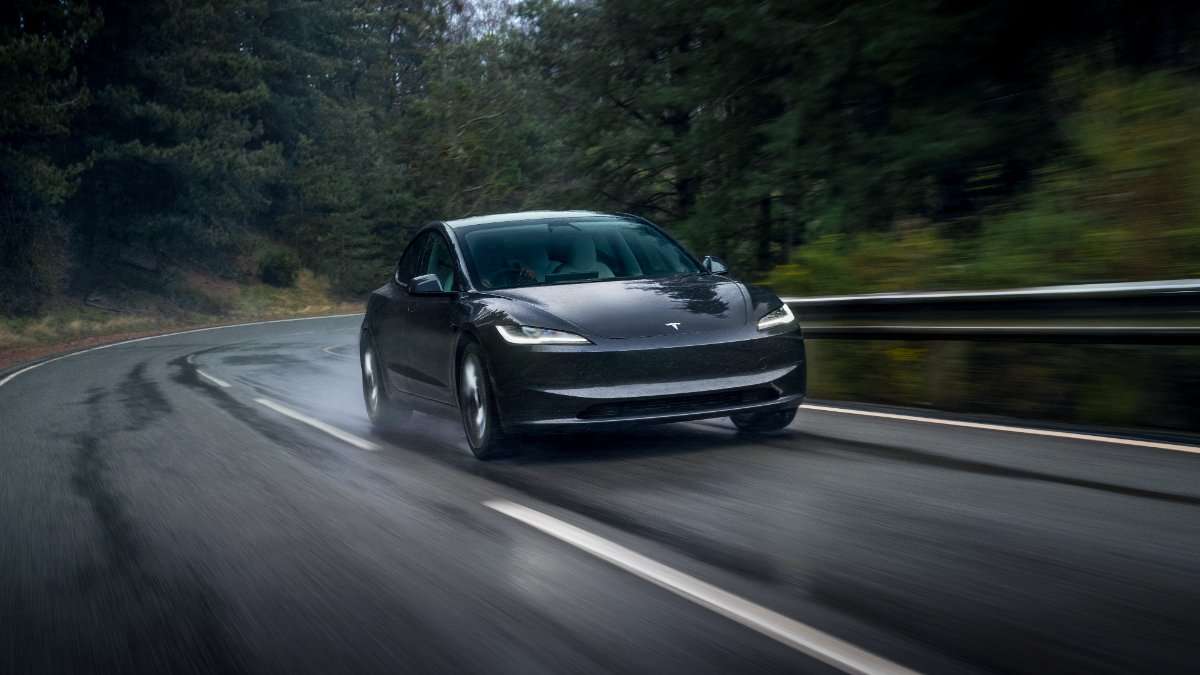

Some of the most telling automotive stories don’t come from press launches or YouTube reviews, they come from the road itself, with nothing more than a trailer, two tired vehicles, and a curious owner asking a simple question: what really works out there? That’s exactly what Reddit user JuniorDirk did when he set out to tow the same 620-pound motorcycle 1,700 miles, twice, first with his seasoned 2018 Tesla Model 3 Long Range, then with a 2005 Toyota Highlander V6. Both had logged over 205,000 miles, and neither was babied.
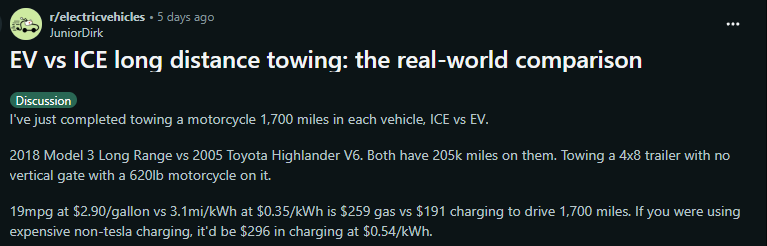
"I've just completed towing a motorcycle 1,700 miles in each vehicle, ICE vs EV.
2018 Model 3 Long Range vs 2005 Toyota Highlander V6. Both have 205k miles on them. Towing a 4x8 trailer with no vertical gate with a 620lb motorcycle on it.
19mpg at $2.90/gallon vs 3.1mi/kWh at $0.35/kWh is $259 gas vs $191 charging to drive 1,700 miles. If you were using expensive non-Tesla charging, it'd be $296 in charging at $0.54/kWh.
3h30min spent on charging/bathroom/food stops(including driving to and from the charger). 17 stops, each of which was can charging stop. My charges were typically 5%-55% to maximize my charge curve. We stopped when the car needed a charge, and peed while we were at it.
1hr50min spent on 8 gas/bathroom/food stops. We stopped when we had to pee, and filled gas while we were at it. The inverse of the EV way of doing things.
Unhooked the trailer at charging stations 6 out of 17 times. Unhooked at gas pumps zero times.
Got soaked at an EV charger twice while plugging in. Got soaked at a gas pump zero times.
Advertising
My experience is that the minimal cost savings are not worth the hassle of long-distance EV towing, even at a decent 3.1mi/kWh efficiency. In a non-Tesla, you'd likely spend more on charging than on gas. Combine that with trailer-unfriendly charge stations, uncovered charge stations, and frequency of stops, and ICE still reigns supreme for towing long distances. Autopilot was very nice, though, and I wouldn't give up EV for ICE for any other use case, including long trips without a trailer."
JuniorDirk isn’t abandoning EVs, nor is he waving a flag for gasoline. He’s just telling the truth. As Reddit commenter sverrebr pointed out, “Cars like the Tesla Model 3 are efficient mostly because they are relatively light and low... Both advantages get negated by towing.” The Model 3, in unladen form, is a marvel of design and efficiency. But once you throw a trailer into the mix, aerodynamics go out the window and physics takes the wheel.
Tesla Model 3 Towing Capacity & Trailer Brake Limitations
- Maximum braked towing capacity (~1,000 kg / 2,200 lb) when equipped with the official Tesla tow package, suitable for light trailers, small boats, or bike racks
- Allowed unbraked trailer weight ~750 kg (1,653 lb) in regions like Europe when using the tow package
- 100 kg (220 lb) on the hitch, ensuring safe and balanced towing
- The Model 3 does not support electric trailer brakes, which restricts its ability to handle heavier trailers that require integrated braking
Let’s not pretend that internal combustion is invincible. It's just that right now, for long-distance towing, it’s still the more practical option. The Highlander, a 20-year-old crossover that wouldn’t make most people's top 10 for towing, still completed the same trip with fewer stops and less hassle. Why? Because gasoline stations are everywhere. You don’t need to calculate state-by-state energy costs or fiddle with charging curves. You pull up, fill up, and go. As moon307 nailed it: “The range and infrastructure are still just frustratingly lacking.” Especially when there’s a trailer attached.
There’s also the question of time. The Tesla required 17 charging stops and 3.5 hours off the road, while the Highlander only needed eight fuel stops, totaling 1 hour and 50 minutes. And during six of those EV stops, JuniorDirk had to unhook the trailer. That means manually detaching a loaded hitch, repositioning the car, charging, and repeating the process in reverse. On a dry day, that’s a chore. In the rain? As the Redditor noted, he got soaked twice at chargers and zero times at gas pumps. Infrastructure matters. Layouts matter. Cover matters.
Tesla Model 3 Towing Costs: Supercharging vs Gasoline Comparison
And yet, the Model 3 still managed to save money, barely. $191 in Supercharging versus $259 in gasoline. But toss in pricier non-Tesla chargers at $0.54/kWh, and the EV cost jumps to $296. Suddenly, those savings vanish. As Vattaa noted, “Based on the many towing tests I have watched… You get roughly half the unladen efficiency when towing.” And that’s across the board, not just with Teslas. But EVs, with their smaller effective range and longer refueling times, suffer more acutely from that 50% drop.
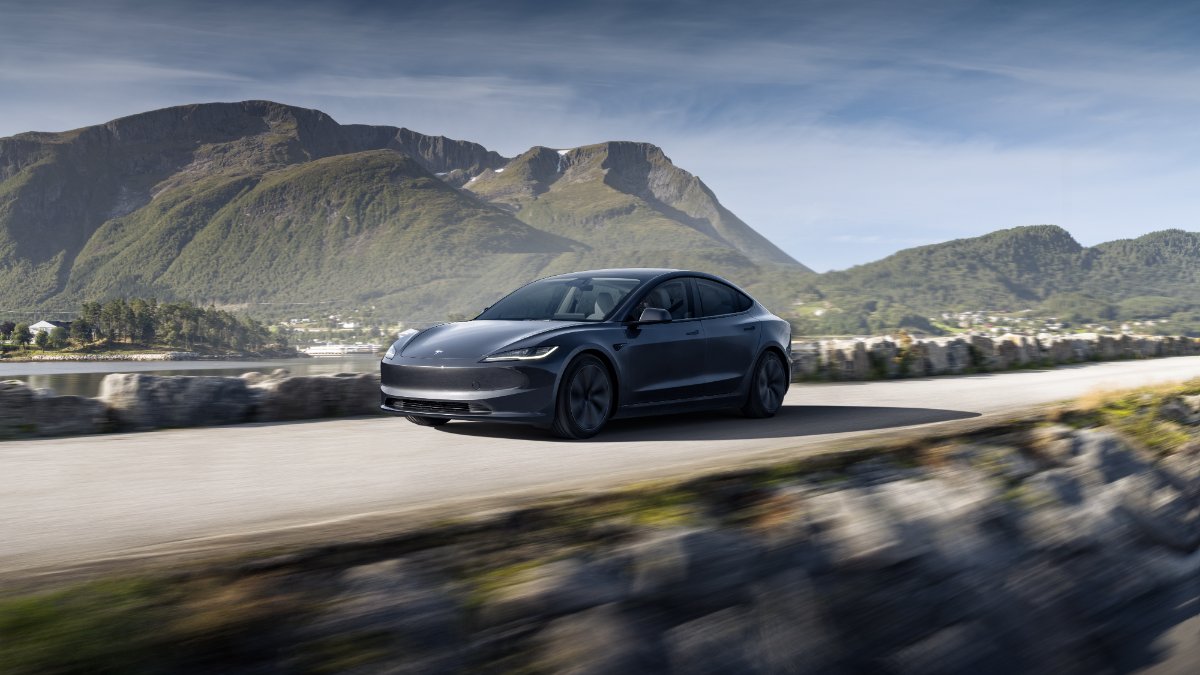
Still, this doesn’t mean EVs can’t tow. It means they tow differently. They require more planning, more patience, and, currently, more compromise. As LastEntertainment684 commented, “EVs are great. In the summer, in an unladen vehicle, it’s now almost on par with ICE.” But throw in winter conditions, a trailer, and limited charge windows (most folks charge to 80% to protect battery longevity), and long-distance towing gets complicated fast. This is less about fault and more about growing pains. The tech works. The world around it just hasn’t caught up yet.
Tesla Model 3 Specs: Dimensions, Performance & Pricing Overview
- Length ≈ 185.8 in (4,720 mm), width w/ mirrors ≈ 82.2 in (2,089 mm), height ≈ 56.7 in (1,431 mm), and a wheelbase of 113.2 in (2,875 mm)
- Around 4,030–4,080 lb, with approximately 21–24 cu ft of combined trunk/frunk cargo volume.
- Rear‑wheel or dual‑motor AWD; 0–60 mph accelerates in 5.8 sec (RWD), 4.2 sec (Long Range AWD), and as quickly as 2.9 sec in the Performance variant
- Starts around US$44,130 for the basic trim, up to ≈ $54,990 – $56,630 for the Performance edition
So, where does that leave us? For now, the smart money is on dual citizenship: EVs for everyday driving and ICE for the big hauls. That’s not a knock on electric propulsion; it’s a reflection of where infrastructure, range, and practicality intersect. As moon307 envisioned, “If there were at least one fast charger at every gas station,” the game would change. And it’s getting there. But until then, even the most committed EV owners might find themselves reaching for the old keys when a trailer is involved.
JuniorDirk’s road trip isn’t a declaration of war between gas and electric, it’s a reminder that despite all our technological advances, the American road still demands a certain kind of readiness. Until chargers are as easy to find and use as gas pumps, and until trailers don’t require reverse gymnastics to plug in, the gasoline engine remains, at least in this use case, the tool better suited for the job. Not because it’s better overall, but because it’s better today.
Image Sources: Tesla Media Center
Noah Washington is an automotive journalist based in Atlanta, Georgia. He enjoys covering the latest news in the automotive industry and conducting reviews on the latest cars. He has been in the automotive industry since 15 years old and has been featured in prominent automotive news sites. You can reach him on X and LinkedIn for tips and to follow his automotive coverage.
Set Torque News as Preferred Source on Google
Follow us today...



Comments
But this is simply part of…
Permalink
But this is simply part of the EV ownership experience. Yes...charging and the ten-mile tailpipe are still very real, very large obstacles to EV going viable.
Eight stops in 1700 miles?…
Permalink
Eight stops in 1700 miles? That's insane. It's kind of amazing that he got to his destination at all. Eight stops???