
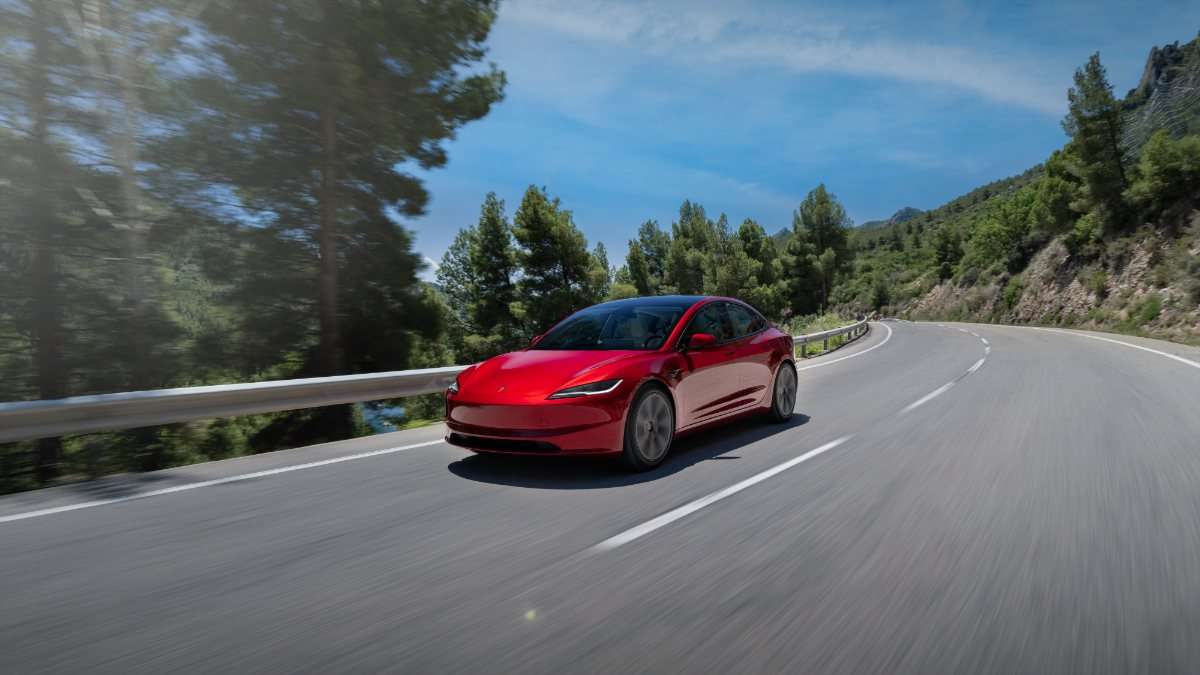

There comes a moment in every car owner’s life, often somewhere between the seventh coffee and the eleventh highway exit, when you stop admiring the machine and start listening to the math. You’ve done the miles. You check the receipt. That’s precisely the quiet reckoning one Tesla Model 3 owner had after a 784-mile road trip, when the real cost of running his EV bumped shoulders with the long shadow of internal combustion. No drama. No tantrum. Just numbers, and the unflinching realization that, in some cases, gas still wins.
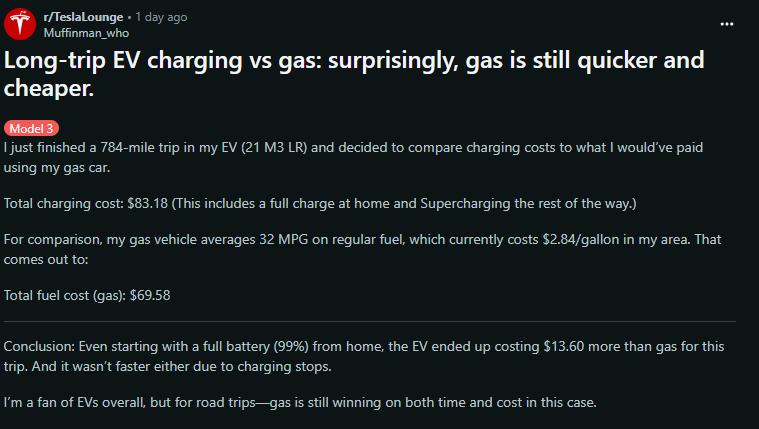
“I just finished a 784-mile trip in my EV (21 M3 LR) and decided to compare charging costs to what I would’ve paid using my gas car.
Total charging cost: $83.18 (This includes a full charge at home and Supercharging the rest of the way.)
For comparison, my gas vehicle averages 32 MPG on regular fuel, which currently costs $2.84/gallon in my area. That comes out to:
Total fuel cost (gas): $69.58
Conclusion: Even starting with a full battery (99%) from home, the EV ended up costing $13.60 more than gas for this trip. And it wasn’t faster either, due to charging stops.
I’m a fan of EVs overall, but for road trips, gas is still winning on both time and cost in this case.”
- Muffinman_who via r/TeslaLounge
It was an honest report from a driver in the trenches, someone who believed in the electric revolution but still had the courage to say, “Hey, this one didn’t pencil out.” And that’s where things got interesting. The thread filled up not with hate, but with perspective. As Grayapesnuts pointed out, “Double that gas price where I live. So glad I have an electric car in California.” Geography, as it turns out, might be the biggest factor in this entire equation.
Tesla Model 3 Long Range AWD: EPA-Rated Range & Driving Dynamics
- EPA-rated up to approximately 358 miles (Long Range AWD), delivering strong real-world range for daily use and road trips.
- Instant torque and one-pedal driving make efficient energy use while enhancing driving enjoyment.
- Range can dynamically improve via over‑the‑air software updates that optimize performance and efficiency
- Driver stories confirm that highways and city driving both benefit from solid range, though charging infrastructure remains critical
In a state like California, where fuel prices dance between $5 and outright extortion, the economics of an EV are practically bulletproof. But this trip happened in a part of the country where gas is $2.84, less than a Venti latte. And suddenly, the numbers shift. Clef75 nailed it:
“Yeah, the super cheap gas is the real cause here. Bump that gas up a dollar or more, and the equation flips quickly.”
That’s not just speculation, it’s a reminder that national averages are meaningless in a game that’s always local.
And then there's the Supercharger pricing, which, as iaflyer explained, has become a growing pain for road-tripping EV owners. “Yes, Supercharging prices have gone up a lot. They are at least double what I pay at home for charging (off peak),” they wrote. Tesla’s home charging is a financial slam dunk, but once you're out on the open road relying on Superchargers, the cost dynamic starts resembling, gasp, a gas station. 4N8NDW added, “They are at least 3–4x what I pay super off peak.” That's a pretty stiff premium just to avoid the gas pump.
Why Tesla Superchargers Are a Supplement, Not Your Primary Fuel
Even then, this isn’t a black mark against EVs; it’s a reminder of their context. Tesla’s Supercharger network was never meant to be your primary fuel source. It’s a supplement. A freedom machine for when you break out of the city and aim for the state line. But when you start using Superchargers like a daily driver uses Shell, the numbers stop making sense. EVs, like internal combustion cars before them, are tools. And some tools work better in certain jobs.
It’s also worth noting that Muffinman_who wasn’t comparing his EV to some 12-MPG bro-dozer. His gas vehicle averages 32 MPG, a perfectly respectable economy figure. If the comparison had been against something thirstier, the EV would’ve come out on top. As Spidermangeo wrote, “I used to pay around $150 a week just to fill up my inefficient gas guzzler… approximately 70ish miles a day. I live in SoCal. So glad I don’t have to worry about that anymore.” That right there is the core of the electric pitch: daily driving. Commutes. Gridlock. Suburbia. That's where EVs shine brightest.
32 MPG Gas Cars: Fuel Efficiency & Refueling Advantages
- 32 MPG delivers a balance between fuel efficiency and performance, ideal for long commutes and road trips.
- Results in lower fuel bills and CO₂ emissions compared to less efficient vehicles.
- Maintains flexibility with widespread fueling options and fast refueling times.
- Often found in compact to midsize sedans with modern engine downsizing or hybrid-assist technologies.
The lesson here isn’t that EVs are a mistake. It’s that blanket truths rarely work in the real world. When the infrastructure is aligned and you're charging at home, EVs are cheaper, cleaner, and quieter. But if your use case revolves around frequent, long-haul trips, and you’re charging at premium rates on the road, the edge blurs. It’s not heresy, it’s just data. And as any seasoned driver will tell you, the car you think you need often isn’t the car you actually need.
Muffinman_who didn’t throw in the towel. He didn’t light his tie on fire. He simply said what we all need to say sometimes:
“I ran the numbers, and this one didn’t add up the way I thought it would.”
Image Sources: Tesla Media Center
Noah Washington is an automotive journalist based in Atlanta, Georgia. He enjoys covering the latest news in the automotive industry and conducting reviews on the latest cars. He has been in the automotive industry since 15 years old and has been featured in prominent automotive news sites. You can reach him on X and LinkedIn for tips and to follow his automotive coverage.
Set Torque News as Preferred Source on Google
Follow us today...







Comments
Here we go again. EVs are…
Permalink
Here we go again. EVs are plenty cute, but that doesn't mean we want one in the garage, of course.
Yeah but excepted if you got…
Permalink
Yeah but excepted if you got a Toyota or a diesel no engine make easily 500 k km with no problem.
Ummm. Please show me the…
Permalink
Ummm. Please show me the actual data.
The advantages of EVs are…
Permalink
The advantages of EVs are worth more than 13$ once a year!
Fast
Handle better
Low maintenance
Nearly silent
Runs on local, cheap energy
No smell
No poisonous emission
Always starts great in extreme cold
Never stolen
Thank you for an excellent…
Permalink
Thank you for an excellent analysis. I believe that electric vehicles are here to stay. And I also believe that if the president rebuilds our electrical grid, things will progress for electrical vehicles and make them easier to deal with. I have an interest in a hybrid, but I haven’t found one that match matches my four-cylinder Mustang turbo. I love the way it rides, and I love the convertible top. The cost of a brand new Mustang, similar to mine is about $60,000. Even though I’m 77 years old, I still enjoy the sporty car ride and I do upgrade certain aspects of it in the aftermarket. So I actually personalized the car and like it that much more. I’m sure someday electric cars will be able to upgrade and will also come in convertible versions that are reasonably priced. Meanwhile, once again, I’d like to thank you for a very straightforward analysis and report on the use of an electric vehicle.
I love my Tesla, but this is…
Permalink
I love my Tesla, but this is so on point! Great cars but taking trips isn't quite there yet.