
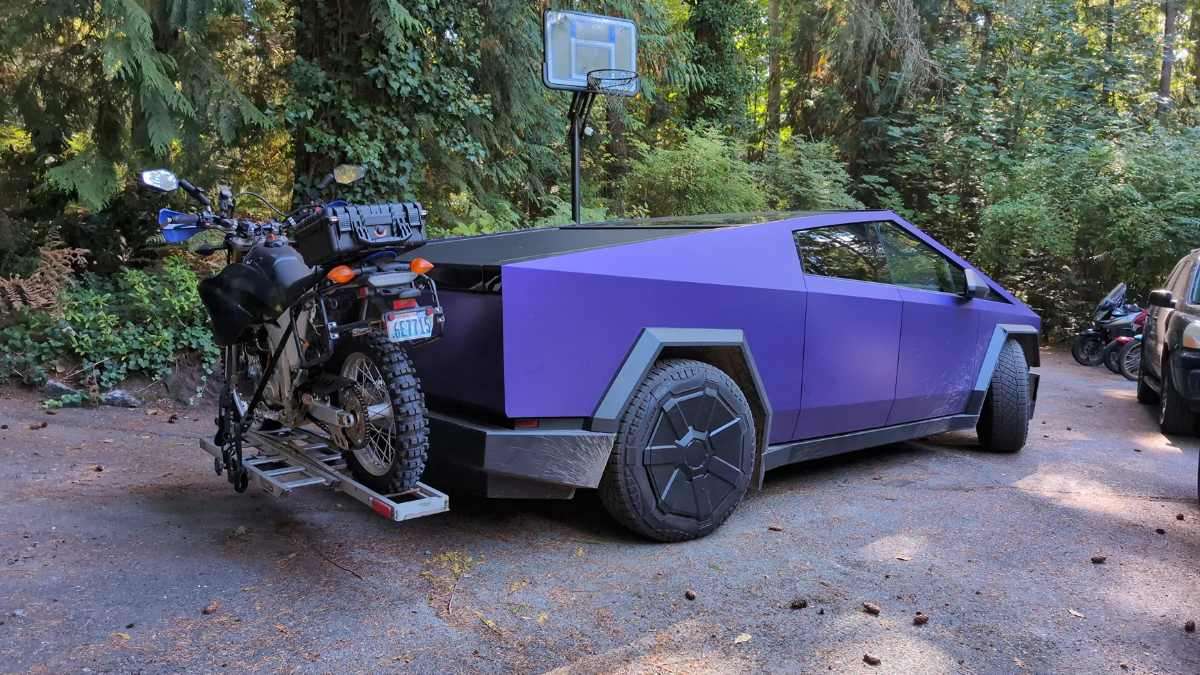

The intersection of electric vehicle technology and serious off-road adventure represents one of the most compelling frontiers in automotive capability, challenging traditional assumptions about electric vehicle limitations while pushing the boundaries of what's possible with battery-powered transportation. An ambitious attempt by thefsm93 to complete the Washington Backcountry Discovery Route in a Tesla Cybertruck represents a significant milestone in electric vehicle adventure capability, potentially establishing new precedents for off-road electric vehicle performance and endurance.
“Hey everyone,
Typing this out from a pretty mediocre two-star motel in Cascade Locks, where I should be sleeping right now. But of course, I can’t, because today kicks off a trip I’ve been planning for the last three months. (Man, having a 3yo really slowed down my planning abilities)
When the Cybertruck was first announced years ago, I told all my friends that if I ever got one, I’d take it through the Washington Backcountry Discovery Route (WA-BDR). For anyone unfamiliar, the BDR is a multi-day off-road route that crosses Washington from Oregon to Canada, mostly via dirt and gravel forest roads, built for adventure bikes and overlanding rigs.
To my surprise, I couldn’t find any record of an EV completing it. The only attempt I found was a Rivian owner who broke down on day one. So… time to change that.
Here’s the plan: I’ve mapped out the full route. There are 6 sections, and I plan to complete a section per day. Sadly, though, we’ll likely need to skip all of section 3 and parts of section 4 due to active wildfires. Still, the goal is to make it as far as possible, fully electric, while avoiding highways.
I’m feeling optimistic; this should be doable. The big question is energy consumption. I’ve planned around 1,000 Wh/mile, but I’m hoping to do better. If it’s worse, well… I might be in trouble. My first leg is 119 miles, and with that estimate, I’d get 123 miles of range, cutting it close. I’m charging to 100% in the morning and crossing my fingers.
This isn’t a solo trip either. My buddy’s riding a Yamaha WR250 and is attempting the BDR for the first time. The Cybertruck is acting as his support vehicle. Another friend is joining in an ICE F-150 XLT — mostly, I think, so he can laugh at me if I run out of juice and he has to tow me to a charger.
The truck’s packed to the brim (the tonneau cover actually drags on a few things in the bed), and I’ve got it as ready as it’ll ever be. We are loaded up with all the gear we could possibly need (camping, tools, spare tire, etc). I have gone an additional step and mounted a Starlink to the roof, two action cameras running, and Tesla fleet telemetry configured to log real-time data.
I’ll be using this thread for daily updates as we make our way north. If the mods are cool with it, I’ll also drop a link to a live stream once we’re rolling, though the feed might get a bit choppy in the forest. This isn’t some big channel or promo thing, just a way for anyone interested to follow along with the adventure. My primary reason for doing the live stream is simply to document for proof that an EV can complete this.
Here’s to making a little Cybertruck history (or at least some good stories).
It's still dark out here, so I can't get any photos of the crew right now, but here is one of Grimus loaded up.”
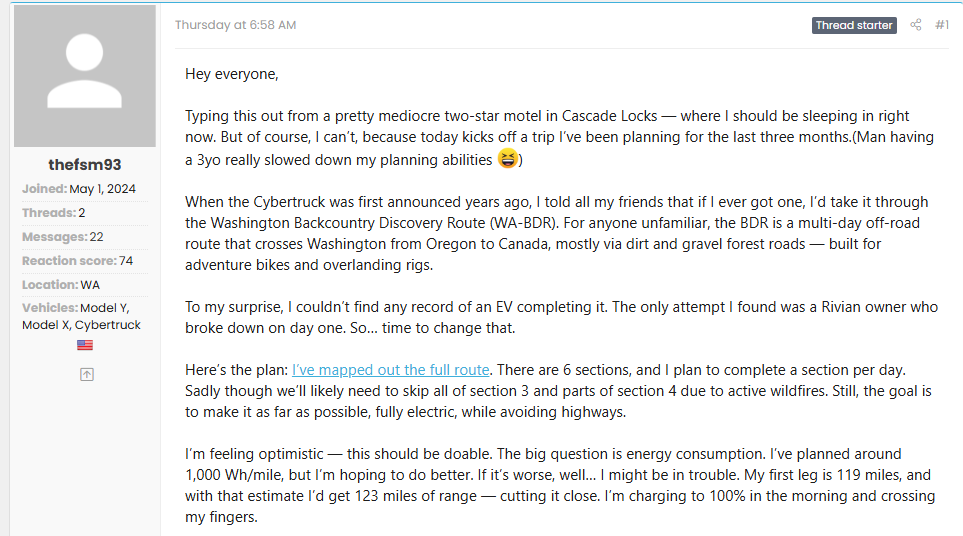
This long-term commitment to testing the Cybertruck's off-road capabilities demonstrates the kind of real-world validation that electric vehicle technology needs to gain credibility among serious outdoor enthusiasts. The owner's dedication to following through on this ambitious plan, despite the inherent risks and uncertainties involved, reflects the pioneering spirit necessary to advance electric vehicle capabilities into new application areas.
Energy Management Becomes Critical Success Factor
The fundamental challenge of completing a multi-day off-road route in an electric vehicle centers on energy management and consumption prediction in conditions that differ dramatically from typical road testing scenarios. The owner's conservative planning approach, estimating 1,000 watt-hours per mile consumption, demonstrates the careful preparation required for electric vehicle adventures in areas without charging infrastructure.
The big question is energy consumption. I've planned around 1,000 Wh/mile, but I'm hoping to do better. If it's worse, well… I might be in trouble. My first leg is 119 miles, and with that estimate, I'd get 123 miles of range — cutting it close. I'm charging to 100% in the morning and crossing my fingers.
This energy consumption estimate reflects the significant impact that off-road driving conditions can have on electric vehicle efficiency compared to highway or city driving scenarios. The combination of variable terrain, reduced speeds, increased rolling resistance from dirt and gravel surfaces, and the additional power requirements of auxiliary equipment creates energy consumption patterns that are difficult to predict accurately without extensive real-world testing.
The narrow margin between the estimated range and planned distance highlights the precision required for successful electric vehicle adventure planning. Unlike traditional vehicles that can carry additional fuel in jerry cans or rely on widely available gas stations, electric vehicles require careful route planning and consumption modeling to ensure the successful completion of remote adventures without access to charging infrastructure.
Chris's supportive response from the Cybertruck community demonstrates the broader interest in validating electric vehicle capabilities for serious outdoor applications. Godspeed! Stay safe. This simple but heartfelt encouragement reflects the recognition that pioneering attempts like this serve the broader electric vehicle community by establishing what's possible and identifying areas where improvements are needed.
Community Support Validates Adventure Documentation Value
The enthusiastic response from the electric vehicle community reveals significant interest in documented proof of electric vehicle capabilities in challenging real-world conditions. Phil's request for live streaming access demonstrates how these pioneering attempts serve educational and inspirational purposes beyond the immediate adventure goals.
Send out the live stream when it's up so we can live your adventure vicariously. This desire to follow along with the adventure reflects the broader community interest in understanding electric vehicle limitations and capabilities through real-world testing rather than theoretical specifications or controlled testing environments.
The owner's commitment to comprehensive documentation through multiple cameras, Starlink connectivity, and Tesla fleet telemetry logging demonstrates an understanding of the broader significance of this attempt. I have gone an additional step and mounted a Starlink to the roof, two action cameras running, and Tesla fleet telemetry configured to log real-time data. This level of documentation preparation suggests recognition that the attempt serves purposes beyond personal adventure, potentially providing valuable data for other electric vehicle owners considering similar adventures.
Brandon's enthusiastic support with the Star Trek reference captures the pioneering spirit of the attempt while acknowledging the broader significance for electric vehicle capability validation. Safe travels @thefsm93 and crew of Grimus! Boldly go where no EV has gone before! This playful but sincere encouragement reflects how the electric vehicle community views attempts like this as important steps in expanding the boundaries of what's possible with battery-powered transportation.
The community response demonstrates how individual pioneering efforts can inspire and educate broader audiences about electric vehicle capabilities. The interest in live streaming and documentation suggests that successful completion of challenging adventures like the WA-BDR could significantly impact perceptions of electric vehicle utility and reliability among outdoor enthusiasts who might otherwise dismiss electric vehicles as unsuitable for serious adventure applications.
Electric Vehicle Adventure Challenges:
- Off-road driving conditions create highly variable energy consumption patterns that are difficult to predict accurately, requiring conservative planning and narrow safety margins for successful completion.
- Remote adventure routes lack charging infrastructure, requiring complete energy self-sufficiency and precise consumption modeling to avoid stranding situations in areas without recovery options.
- Pioneering attempts require comprehensive documentation to provide credible proof of capabilities and valuable data for future electric vehicle adventure planning and development.
- Electric vehicle adventures serve broader community interests by establishing precedents and demonstrating real-world capabilities that influence perceptions and adoption decisions.
Multi-Vehicle Support Strategy Addresses EV Limitations
The expedition's multi-vehicle approach demonstrates practical strategies for mitigating electric vehicle limitations while attempting challenging adventures in remote areas. The combination of electric and traditional vehicles provides backup options and support capabilities that address the unique challenges of electric vehicle adventure travel.
This isn't a solo trip either. My buddy's riding a Yamaha WR250 and is attempting the BDR for the first time. The Cybertruck is acting as his support vehicle. Another friend is joining in an ICE F-150 XLT — mostly, I think, so he can laugh at me if I run out of juice and he has to tow me to a charger.
This support vehicle strategy reflects realistic planning for electric vehicle adventures that acknowledges current limitations while providing practical solutions for potential problems. The inclusion of a traditional pickup truck provides towing capability and serves as a backup option if the electric vehicle encounters insurmountable challenges, demonstrating how mixed-fleet approaches can enable electric vehicle adventures that might otherwise be too risky to attempt.
The humor in acknowledging the potential need for rescue demonstrates the owner's realistic assessment of the risks involved while maintaining optimism about successful completion. This balanced approach between ambition and pragmatism reflects the kind of careful planning necessary for pioneering electric vehicle adventures in challenging environments.
The expedition preparation reveals the additional complexity required for electric vehicle adventures compared to traditional vehicle trips. The truck's packed to the brim (the tonneau cover actually drags on a few things in the bed), and I've got it as ready as it'll ever be. We are loaded up with all the gear we could possibly need (camping, tools, spare tire, etc). The extensive preparation and equipment requirements demonstrate how electric vehicle adventures currently require more planning and backup equipment than traditional vehicle trips.
Wildfire Complications Test Adaptability
The impact of active wildfires on the planned route demonstrates how external factors can significantly complicate electric vehicle adventure planning, requiring flexibility and alternative strategies that may not be necessary for traditional vehicles with greater range and refueling flexibility.
Sadly, though, we'll likely need to skip all of section 3 and parts of section 4 due to active wildfires. Still, the goal is to make it as far as possible, fully electric, while avoiding highways. The need to modify the route due to wildfires highlights how electric vehicle adventures must account for changing conditions that could affect energy consumption, route accessibility, and charging opportunities.
The commitment to avoiding highways while maintaining electric-only operation demonstrates the purity of the attempt and its value for validating off-road electric vehicle capabilities. This constraint adds significant complexity to route planning and energy management while ensuring that the attempt provides meaningful data about electric vehicle performance in the intended application environment.
Advanced Preparation and Technology Integration:
- Multiple camera systems, satellite connectivity, and telemetry logging provide real-time data collection and proof of capabilities for broader community validation and education.
- Combining electric and traditional vehicles provides backup options and support capabilities while enabling ambitious attempts that might otherwise be too risky for solo electric vehicle adventures.
- Wildfire conditions and other external factors require adaptive planning and alternative route options that account for electric vehicle range and charging limitations.
- Extensive preparation with camping gear, tools, spare parts, and emergency equipment addresses the additional complexity of electric vehicle adventures in remote areas without support infrastructure.
The owner's final update confirming the expedition's launch demonstrates the successful execution of the extensive planning and preparation phase. We are live and moving! This simple announcement marks the beginning of what could become a significant milestone in electric vehicle adventure capability validation, potentially inspiring other owners to attempt similar challenges and advancing the understanding of electric vehicle utility in demanding real-world applications.
The Washington Backcountry Discovery Route attempt represents more than just an individual adventure; it serves as a test case for electric vehicle capabilities in challenging environments and a demonstration of what's possible when careful planning meets pioneering spirit. The comprehensive documentation and community interest ensure that the results will provide valuable insights for the broader electric vehicle community, regardless of whether the attempt achieves complete success.
The expedition's approach to combining ambitious goals with realistic planning and backup strategies provides a model for future electric vehicle adventures. The recognition of current limitations combined with determination to push boundaries reflects the kind of balanced approach necessary to advance electric vehicle capabilities while maintaining safety and credibility.
As electric vehicle technology continues to improve and charging infrastructure expands into more remote areas, attempts like the WA-BDR completion will become more feasible and common. However, current pioneering efforts like this one serve crucial roles in establishing what's possible with existing technology and identifying areas where improvements are most needed.
The success or failure of this attempt will provide valuable data for future electric vehicle adventure planning and development priorities. The comprehensive documentation ensures that lessons learned will benefit the broader community of electric vehicle owners interested in expanding their vehicles' utility into new application areas.
The community support and interest in this attempt demonstrate the broader significance of individual pioneering efforts in advancing electric vehicle acceptance and capability validation. The live streaming and documentation approach ensures that the experience will be shared widely, potentially inspiring other owners to attempt similar challenges and contributing to the growing body of knowledge about electric vehicle capabilities in demanding real-world conditions.
The Washington Backcountry Discovery Route attempt represents a significant step forward in electric vehicle adventure capability validation, demonstrating how individual owners can contribute to broader technology advancement through ambitious real-world testing. The careful planning, comprehensive documentation, and community engagement approach provides a model for future pioneering efforts that balance ambition with responsibility while advancing the boundaries of what's possible with electric vehicle technology.
Have you considered taking your electric vehicle on challenging off-road adventures? What factors would be most important in planning an extended EV adventure, and how do you think electric vehicles will change outdoor recreation and overlanding in the coming years? Share your thoughts on electric vehicle adventure capabilities and planning strategies in the comments below.
Image Sources: Tesla Media Center
Noah Washington is an automotive journalist based in Atlanta, Georgia. He enjoys covering the latest news in the automotive industry and conducting reviews on the latest cars. He has been in the automotive industry since 15 years old and has been featured in prominent automotive news sites. You can reach him on X and LinkedIn for tips and to follow his automotive coverage.
Set Torque News as Preferred Source on Google
Follow us today...


Comments
I'd say I hope he's bringing…
Permalink
I'd say I hope he's bringing a survival pack, but the thing'll probably breakdown within walking distance of the road so he probably won't have to worry.
He's not the first person to…
Permalink
In reply to I'd say I hope he's bringing… by Ronald Raegan (not verified)
He's not the first person to do this route with a Cybertruck. .My husband did it with a group of people who all own Cybertrcks right as the fires were starting in WA, nothing exciting except for a flat tire and some gorgeous photos! They camped the entire way. He also goes off roading/camping monthly with groups of Cybertrucks!
I think is funny that there…
Permalink
I think is funny that there’s a gas powered motor cycle strapped to the back just in case.
I've heard exactly 0 people…
Permalink
I've heard exactly 0 people ask about that (or anything close). In fact, it's such a tremendous failure that I've never heard anyone ask anything about it.
The Cybertruck was a giant exercise in trolling the EV market by proving that EV people will support any EV, no matter how ugly, expensive, or impractical it is, and that the hype does not translate to sales.
The Cybertruck proved that the entire EV market is a giant joke.