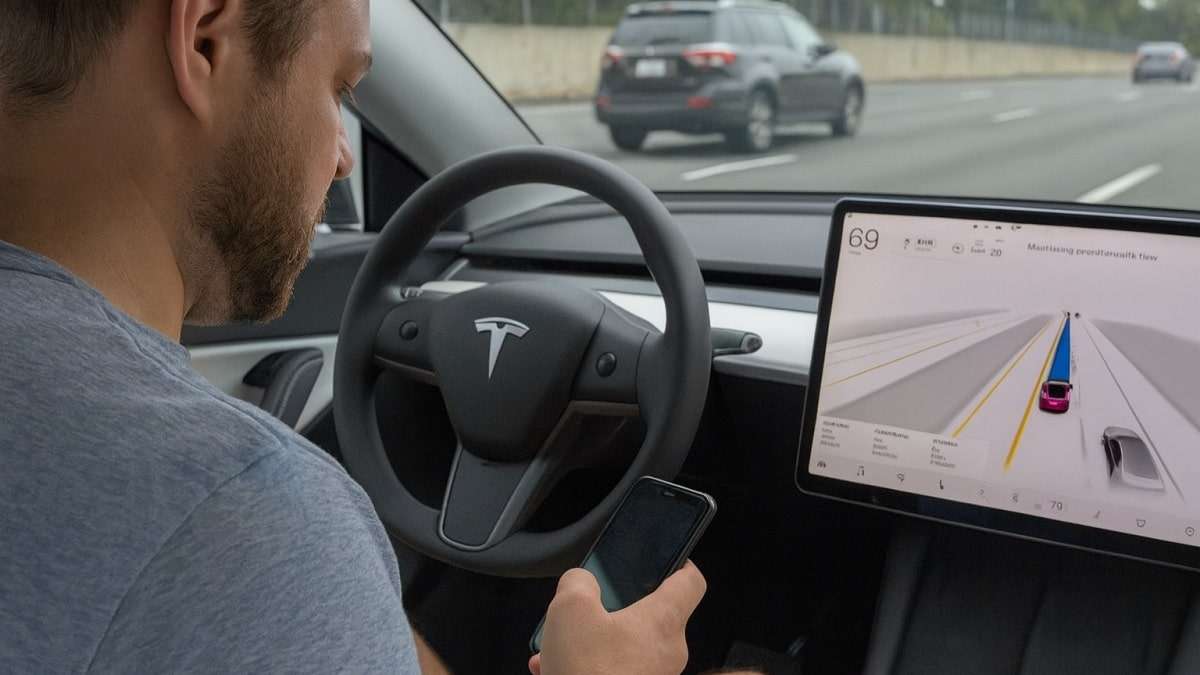

At first glance, it looked like Tesla’s Full Self-Driving (supervised) Advanced Driver-Assistance Systems (ADAS) took a huge leap forward. It all started in last month’s Tesla shareholder meeting where Elon Musk announced that Tesla drivers with the latest version of FSD (supervised) will be able to “text and drive” in a month or so. This led many Tesla owners to think that FSD was about receive a significant upgrade and maybe move from Level 2 (partial automation but with the driver remaining fully attentive and ready to take over at any moment) to Level 3 (conditional driving automation where the car drives itself under specific conditions like highway traffic jams). Earlier this week, Musk clarified on Twitter/X with the following, “depending on [the] context of surrounding traffic.”
Don’t start cheering too soon because the reality is more complicated. First off, according to the U.S. Bureau of Transportation Statistics, almost all 50 states have laws that ban texting while driving. In about half U.S. states the use of any handheld phone while driving is illegal. Where does this leave us? According to social media, it leaves quite a bit of confusion. This subreddit thread with over 200 comments is a good example where KyleFlounder posted:
“Before people jump to attack this decision, they added this functionality because they found people were disabling FSD to text and use their phone. People are going to text and drive anyway. I would rather they do it with FSD enabled. Plenty of level 2 ADAS "allow" it. It's not an infinite amount of time, it's around 30 seconds or so max otherwise you get a strike like usual. Maybe they made it longer for slower traffic. Musk says "It's context aware of the environment / traffic.
That being said, it still doesn't make it legal and people should still get tickets until states start addressing L3 and L4 exceptions.”
Low_Thanks_1540 responded with a sobering news story:
“I believe the guy who just killed a motorcycle rider while texting in his Tesla has been charged with homicide.
https://www.nbcnews.com/news/us-news/tesla-fatal-seattle-area-crash-killed-motorcyclist-was-self-driving-mo-rcna164488”
tech57 added some statistics:
“In USA on average 109 people are going to die every single day because of cars without self-driving.
How many headlines did you read about that today? How many comments in this post are talking about that instead of Tesla and Musk?”
KyleFlounder gave his opinion about relying on human drivers versus FSD:
“There have only been two FSD related deaths vs how many cellphone related deaths? I'll take my chances on FSD being a better driver than someone who's completely distracted, even with it's shortcomings.
Yes, texting and driving is dangerous. That's why this decision was made. It was to save lives, not necessarily enable people or encourage them to do it. Because their disengagement data showed a correlation between people wanting to use their phones vs wanting FSD to drive them.
It's up to our local police to enforce and punish people who are distracted while driving. The car is still going to ding you for it, it's just more lax than previously where it would do it almost instantly.”
Stingray88 seemed to have found the answer in their comment:
“As we suspected at the time, instead of classifying FSD as a level 3 or 4 system, where Tesla takes responsibility for the vehicles under certain conditions and allow the driver not to pay attention, the automaker is instead simply realizing its driver monitoring rules and leaving it to the driver to take on the risk of texting and driving under its level 2 driver assistance system.”
That’s all you need to know to qualify Tesla’s statement as complete and utter BS.
No, you cannot text and drive with Tesla FSD. Not only is it not remotely legal, but it’s also not remotely safe.”
Understanding the Confusion Around Tesla Self-Driving
Many people assume every Tesla can simply drive on its own, although Tesla actually offers several different levels of automated driving. These features range from basic cruise control to advanced supervised self-driving, which makes the terminology confusing. In this article, we’ll try to clear this up by stepping through each level of capability and highlighting why many owners misunderstand what their car can actually do.
How Tesla Uses Cameras Instead of Sensors
Tesla relies almost entirely on small cameras placed around the vehicle to understand its surroundings. These cameras are tiny compared to the much more expensive radar, ultrasonic sensors, or laser systems other brands use. This camera-only strategy is part of what makes Tesla’s approach different and explains both the strengths and limitations of the system.
The Basics of Traffic-Aware Cruise Control
The first level of Tesla automation is simple traffic-aware cruise control (TACC) that adjusts speed based on the car in front of you. It requires the driver to do all the steering and behaves like features found in nearly every modern vehicle. The display shows a blue speed indicator when this mode is active. The system works reliably, although it is not considered smart or advanced.
Autopilot and Automatic Steering
Autopilot is the next level and is included for free in every Tesla. It combines traffic-aware cruise control with automatic steering that keeps the car centered in its lane. The display shows two blue lane lines and a blue steering wheel when engaged. The system performs well in most conditions, much better than similar offerings from Lexus, Cadillac, GMC, Chevy, Kia, Rivian, and Lucid, all of which struggle to maintain lane control consistently.
Navigate on Autopilot and Its Added Capabilities
Navigate on Autopilot mode adds intelligence by suggesting lane changes, passing slower cars, avoiding fast-approaching vehicles, and preparing for freeway exits. It still works only on freeways and hands control back to the driver once the exit is reached. It feels more advanced than basic Autopilot, although it remains far from true self-driving.
Full Self-Driving Supervised and How It Differs
Full Self-Driving Supervised is the major upgrade that currently costs around $8,000. It unlocks software that uses Tesla’s latest onboard computer to handle complex driving tasks. The car can drive on local roads, change lanes, navigate freeway exits, and even decide how to react to obstacles such as a disabled car blocking part of a lane. The system behaves more like a driver with a real brain, although it still relies on cameras and has limitations in fog, heavy rain, or anything that obstructs visibility.
Hardware Generations and Subscription Options
Older Teslas with Hardware 3 (around 2023 and prior) are slower and cannot run newer features that Hardware 4 supports. Elon Musk has said cars with Hardware 3 will eventually be upgraded to Hardware 4 for owners who purchased full self-driving outright. Many drivers may prefer a monthly subscription, since the software is improving quickly and the upfront cost is high for a system that is not yet perfect.
Why Full Self-Driving Is Still Imperfect
Full Self-Driving can make mistakes. It may change lanes unexpectedly, miss exits, handle traffic lights incorrectly, or behave too aggressively in roundabouts. These issues show that the system still requires close supervision. The model excels when compared to competing brands, yet it remains far from being hands-off. Drivers must stay fully alert because the system can disengage without warning, especially in poor visibility.
Comparing FSD With Robo-Taxis and Other Autonomous Systems
Tesla achieves nearly robo-taxi-level capability using only cameras, which is impressive given that systems like Waymo and Zoox depend on expensive mapping and specialized sensors. Tesla’s strength is flexibility, although the driver must stay ready to take control. Other systems only work in specific, pre-mapped areas, while Tesla can operate almost anywhere, provided conditions allow the cameras to see the road.
Smart Summon and Parking Lot Features
Smart Summon is another notable feature of full self-driving. The car can drive itself through a parking lot to pick you up with no one inside. Tests show that it works fairly well, even in busy areas like Costco, although using it still feels unnerving because of how unnatural it is to watch a driverless car navigate pedestrians and obstacles.
Misinterpretation of Autopilot in Popular Videos
A well-known video by Mark Rober tested Tesla’s ability to detect humans in bad weather, although the test used only basic Autopilot. This means the car was not using its full self-driving computer or its most advanced capabilities. If full self-driving had been used, the system likely would have disengaged due to poor visibility rather than behave unpredictably. Tests like these can be fun, although they often misunderstand how the different Tesla modes work.
Bottom Line
Tesla offers several distinct levels of automation, each with unique strengths and limitations. Full Self-Driving Supervised is the only mode that comes close to true autonomy, although it still requires active supervision from the driver. The system continues to evolve rapidly through software updates, which makes subscriptions appealing for many owners. Understanding these differences is key to knowing what your Tesla can actually do and whether upgrading to full self-driving is worth the cost.
The Tesla Model Y
The Tesla Model Y is a popular electric SUV that launched in early 2020 and quickly became one of the best-selling cars in the world. It offers a smooth driving experience, impressive range, and plenty of interior space, which makes it easy to live with every day. The instant acceleration, quiet cabin, and access to the Supercharger network give it an advantage over many competitors. The Model Y stands out because it blends practicality with strong performance, reliable charging access, and constant over the air updates that keep the car feeling fresh long after you bring it home.
What Do You Think?
How do you feel about Tesla Model Y drivers gaining the option to “text and drive” while using FSD, even though the law has not caught up?
What level of responsibility should fall on the driver versus the automaker when using advanced driver assistance features like FSD?
Chris Johnston is the author of SAE’s comprehensive book on electric vehicles, "The Arrival of The Electric Car." His coverage on Torque News focuses on electric vehicles. Chris has decades of product management experience in telematics, mobile computing, and wireless communications. Chris has a B.S. in electrical engineering from Purdue University and an MBA. He lives in Seattle. When not working, Chris enjoys restoring classic wooden boats, open water swimming, cycling and flying (as a private pilot). You can connect with Chris on LinkedIn and follow his work on X at ChrisJohnstonEV.
Photo credit: Provided by author
Set Torque News as Preferred Source on Google
Follow us today...