
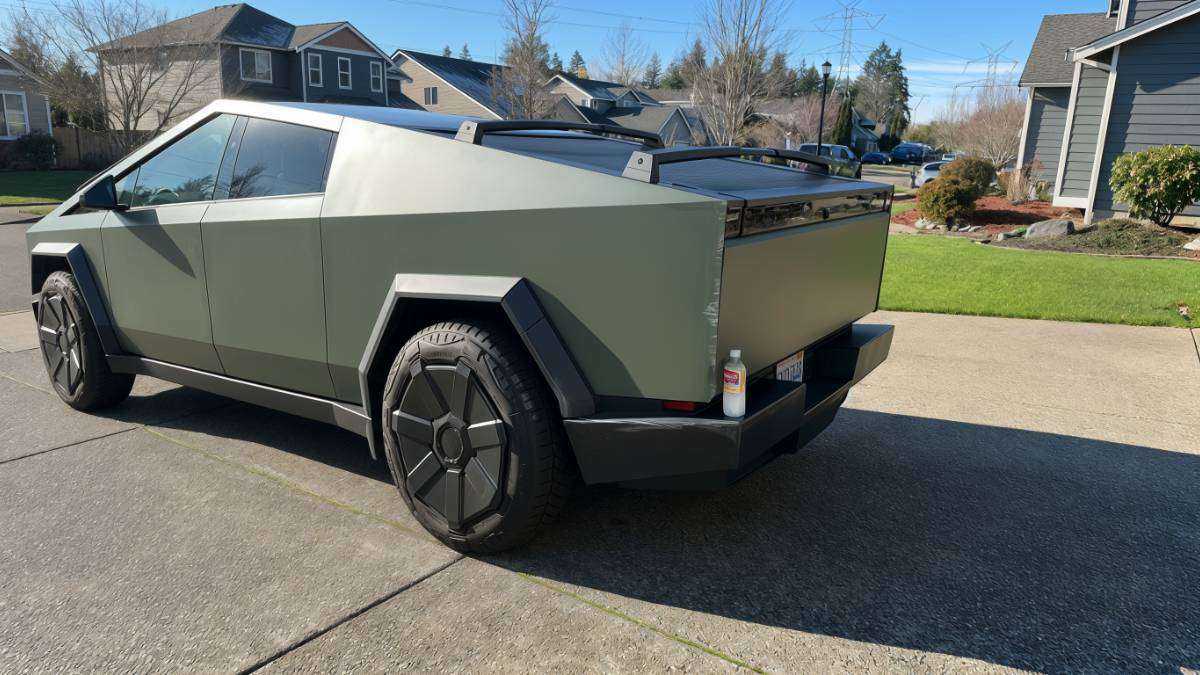

There is a special kind of confidence that comes from watching a complex machine perform its duties with the calm precision of a seasoned chauffeur. The Tesla Cybertruck instills that confidence. It is enormous in every measurable dimension, a stainless steel presence that dwarfs most domestic garages, yet it carries itself with the quiet conviction that software can tame physics. Its size alone makes every parking maneuver a small act of choreography. Even so, automation is still a pupil in a world built for human judgment, and sometimes the lesson arrives with an audible impact.
From the Tesla Cybertruck Forum, owner Mark805 recounted an experience that captured the fragile balance between trust and oversight in automated driving systems:
“Well, I got a little too confident with the whole fsd parking in my garage.Spent the day with my son on errands and watching the truck go and park for us. It took us home, and instead of pulling into the driveway, it turned around to back in… we watched in amazement as it slowly backed up … then boom… contact with my house.
And as it made contact, it maintained backwards pressure as I hit the brake. So I pulled forward, and to my disappointment, the truck made contact rear left corner with the garage pillar and fascia.
So a few notes:
- Yes, I was overconfident in fsd.
- When the truck backed into the garage side mirrors folded back, so I didn’t have the side mirror view, but the pillar cameras were working. (as they do when I park head-in first)
Advertising
- damage to the back quarter panel, wrap, rear bumper, and facia.
I’ll fix the wrap easily, but the bumper looks slightly chewed up.”

The post reads less like a complaint and more like a moment of sober reflection. Mark and his son had spent the day watching Full Self Driving 14.2 perform flawlessly, the truck sliding into spaces with the poise of a highly trained valet. That reliability built a sense of ease that any owner could relate to.

When the truck attempted its final task, backing into the home garage, the maneuver looked routine until the physics changed. The impact startled them, but the real surprise came when the truck continued applying pressure against the wall until he intervened. It was a brief lapse in a system that is generally vigilant, yet a lapse all the same.
Tesla Cybertruck: Early Impressions
- Reviewers note that the Cybertruck’s stainless-steel exoskeleton doesn’t just define its look, it changes the way the truck feels in daily use, giving the doors, panels, and overall structure a firmness uncommon in consumer pickups.
- On the road, its unexpectedly light steering and four-wheel maneuverability have surprised test drivers, who report that the truck navigates parking lots and sharp turns with far more agility than its size suggests.
- The minimalist cabin has been widely described as serene, almost architectural, with its broad dash, expansive windshield, and clutter-free layout creating an atmosphere closer to a modern loft than a traditional truck interior.
- Early impressions highlight the Cybertruck’s instant, undramatic acceleration; journalists consistently remark that it gathers speed so smoothly and quietly that passengers often underestimate how quickly the truck is actually moving.
The thread quickly filled with responses that revealed a community both enthusiastic and measured. Fugue wrote that the incident convinced him to hold off on trying automated garage parking for now, while Sandman1962 shared that parking precision seems to be a weak point for the system in Cybertruck applications. His comment that the truck often ends up slightly crooked resonated with several others. This was not a criticism of the vehicle or its capabilities but an acknowledgment that tight, residential spaces challenge even advanced automation. A Cybertruck is large enough that a misjudged angle has real consequences.
The scale of the vehicle is part of the story. At more than 18 feet long and nearly 7 feet wide without mirrors, the Cybertruck occupies substantial real estate. Maneuvering it into a standard garage requires careful positioning and a kind of spatial awareness that is second nature to a human driver who knows the worn paint on the door frame and the exact spot where the tire must land. A computer functions on data, not intuition, and while Tesla’s camera-based system is impressive, it still contends with the complexity of garages that are rarely square or predictable. Mark noted that the side mirrors folded in automatically, removed one familiar reference point, and left him relying on the vehicle’s digital vision.
Automation in this context is a partnership. The driver supervises while the system executes, and that relationship only works if both sides remain engaged. Forum member ABILISK remarked that autonomy is essentially a 99 percent solution, which underscores the truth that this technology is built around probabilities rather than certainties. When an unexpected variable appears, such as a structural surface that does not register as an obstacle in the same way a vehicle does, the system must choose how to respond. In this case, the response lagged behind reality, and the vehicle continued its planned path until the driver corrected it.

Several participants in the discussion proposed ideas that reflect a natural evolution of the technology. Hello4x suggested allowing owners to train the system for specific garages or parking habits. The concept is simple and sensible. People learn the quirks of a space after repeated exposure, absorbing the angles, the clearances, the small cues that do not appear in any schematic. A system that could integrate owner feedback for these locations might bridge the remaining gap between mathematical precision and lived experience.
The damage to Mark’s truck, while repairable, serves as a reminder that progress often arrives through moments like this. A parking scrape is not a failure of the technology or the owner. It is one more data point in the long process of refining automated driving systems until they match the instincts we built over generations behind the wheel. The fact that Mark returned to the forum to share his story shows a community invested in learning from one another and from the machines that are increasingly part of daily life.
Automation continues to advance at a remarkable speed, and the Cybertruck remains an ambitious product that reflects how far the industry has come. Yet Mark’s experience illustrates that human attention is still an essential ingredient. Parking a vehicle of this size in a tight space has always required care. Whether guided by our hands or silicon logic, the task remains delicate. Until the systems reach a point where every edge case is accounted for, the best course is the oldest one in driving. Stay alert, trust but verify, and keep your foot ready should the unexpected arrive.
Image Sources: Tesla Media Center
Noah Washington is an automotive journalist based in Atlanta, Georgia. He enjoys covering the latest news in the automotive industry and conducting reviews on the latest cars. He has been in the automotive industry since 15 years old and has been featured in prominent automotive news sites. You can reach him on X and LinkedIn for tips and to follow his automotive coverage.
Set Torque News as Preferred Source on Google
Follow us today...


Comments
Still the ugliest looking…
Permalink
Still the ugliest looking thing on the planet...seeing that on a sunny day in a drive way I couldn't imagine the disgust on the other drivers faces as they roll by...just a massive pile of crap...bigger than the one Laura derne has to put her hand in the movie e Jurassic Park
Who wrote this…
Permalink
Who wrote this propagandistic garbage below? Bagdhad Bob?
“There is a special kind of confidence that comes from watching a complex machine perform its duties with the calm precision of a seasoned chauffeur. The Tesla Cybertruck instills that confidence. It is enormous in every measurable dimension, a stainless steel presence that dwarfs most domestic garages, yet it carries itself with the quiet conviction that software can tame physics.”
Sounds like you have to…
Permalink
Sounds like you have to continue to use the most abused supercomputer on the planet - your brain. And, forgo laziness when behind the wheel. Imagine that.
Still just a piece of junk I…
Permalink
Still just a piece of junk I'll never own, no capabilities and plenty of negatives. Thanks but no thanks.