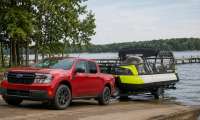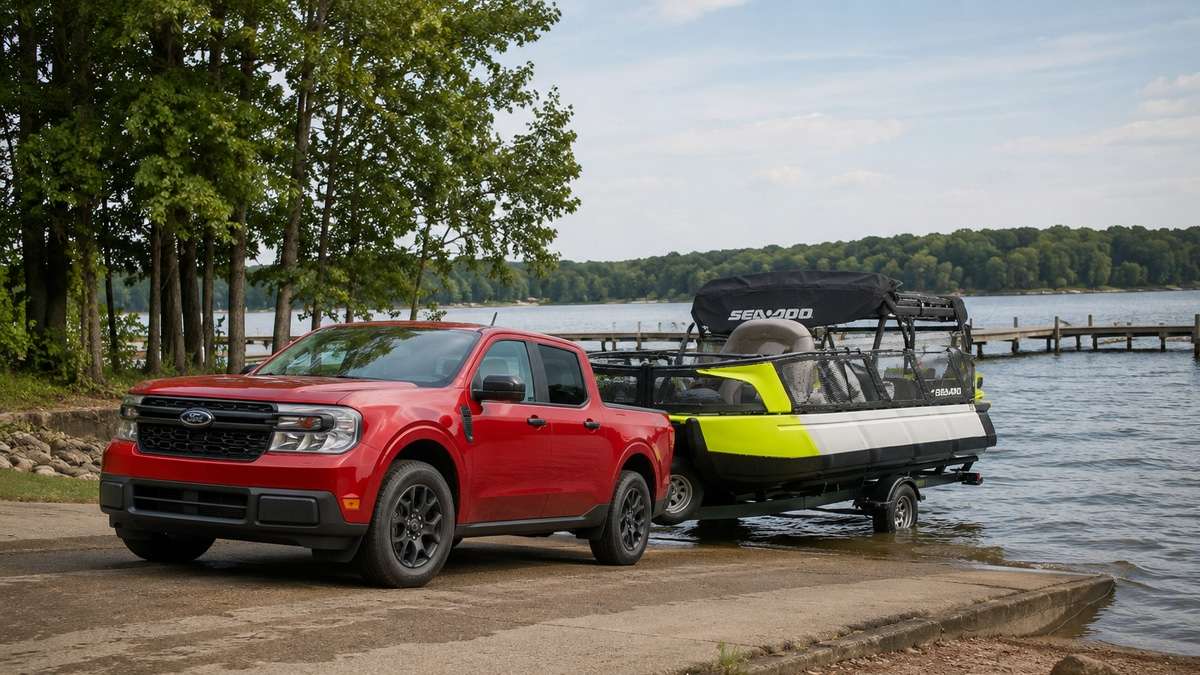

A Ford Maverick spent 1 minute 29 seconds pulling a Sea-Doo Switch and its trailer clear of a wet boat ramp while several adults remained aboard. That was long enough for the compact pickup to become a stand-in for every argument about front-wheel drive, all-wheel drive, towing ratings, and what counts as a “real truck.”
The image contains a problem for the simplest explanation. A factory-style FX4 decal is visible on the Maverick’s bedside. Ford’s current order guide says the FX4 box decal replaces the ordinary AWD badge, and it lists the package with all-terrain tires, off-road equipment, and additional drive modes. Assuming the truck has not been rebadged, the caption blaming the struggle on a lack of AWD is difficult to reconcile with the vehicle shown.
AWD settles one line of the towing ledger. The clip leaves the model year, powertrain, 4K Tow Package, actual boat-and-trailer weight, tongue load, tire pressures, selected drive mode, ramp grade, and surface condition unresolved.
Dean Craig shared the clip in the Ford Maverick Hybrid Only Facebook group with the caption, “In case you don’t have AWD,” followed by “NOT MINE.” The embedded video was credited to The Big Dan Show.
The comments quickly split into familiar camps. Some blamed front-wheel drive. Others pointed to the FX4 decal and said the truck had AWD. Several blamed traction-control settings or the driver. Others focused on the adults still sitting in the boat, the wet sand, a possible lip in the ramp, or a pontoon setup they believed exceeded the Maverick’s limit.
Every one of those theories needs another piece of evidence.
The group supplied no powertrain answer
Sharing the clip in a hybrid-only group does not identify the Maverick in the video. The visible FX4 clue actually points in another direction.
For the 2025 Maverick, Ford restricts the FX4 Off-Road Package to the XLT 302A equipment group. The same order-guide section identifies that configuration as a 2.0-liter EcoBoost with AWD. The clip’s model year remains unverified, and a decal can be added after purchase, so the VIN or original window sticker would settle the question. The group name and repost caption carry no build-sheet value.
This distinction matters because the story was framed as a warning about lacking AWD. The strongest visible evidence suggests the truck already had it.
That still leaves a separate and more important towing question.
FX4 and the 4K Tow Package are different equipment decisions
An FX4 decal does not establish a 4,000-pound tow rating.
Ford lists FX4 and the 4K Tow Package separately. FX4 adds equipment such as all-terrain tires, tow hooks, skid plates, hill-descent control, off-road displays, suspension changes, and extra drive modes. The 4K package adds the trailer brake controller, Class III receiver with four-pin and seven-pin connections, transmission cooling, an upgraded fan, and related cooling hardware.
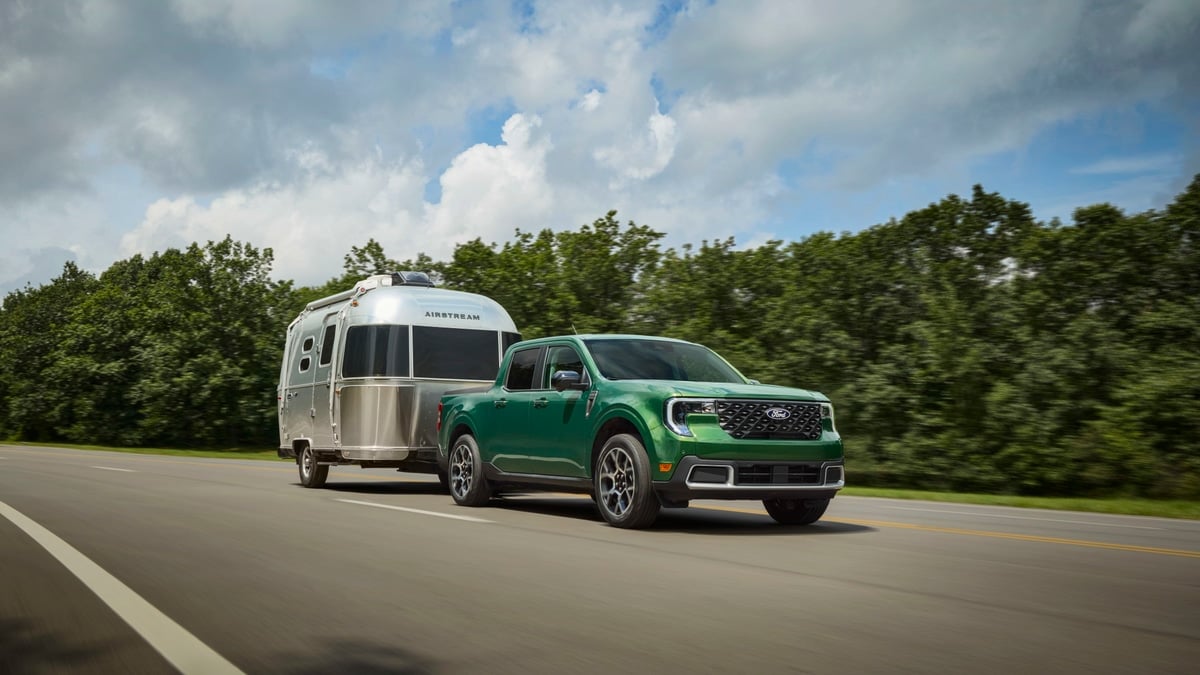
Ford’s 2024 towing guide rates the hybrid Maverick at 2,000 pounds and raises a properly equipped EcoBoost AWD truck to 4,000 pounds with the 4K Tow Package. Ford also caps tongue load at 400 pounds and warns that passengers, cargo, configuration, accessories, and options can reduce available capability.
That means an FX4 truck can have AWD, useful terrain programming, and all-terrain tires while still lacking the equipment Ford requires above 2,000 pounds.
The image does not show a seven-pin connector, factory brake controller, window sticker, or scale ticket. The 4K question remains open.
The Sea-Doo can consume most of the 4,000-pound allowance before people climb aboard
The exact Sea-Doo Switch model, length, year, battery, fuel level, equipment, and trailer are unverified. Current factory figures still show how quickly the margin can disappear.
Sea-Doo’s 2026 Switch Sport specifications list net boat weights from 1,793 to 2,562 pounds and trailer dry weights from 475 to 740 pounds. Adding the published figures produces a boat-and-trailer range of 2,268 to 3,302 pounds before fuel, a battery, safety equipment, coolers, anchors, water, and people. Sea-Doo explicitly describes the boat weights as excluding fuel and battery.
At the upper end of that current range, 3,302 pounds leaves 698 pounds below the Maverick’s 4,000-pound maximum. Several adults aboard could use much of that remaining allowance before fuel and gear are counted.
Those figures are an illustration rather than a weight declaration for the boat in the clip. A shorter Switch could sit comfortably lower. A longer or heavily equipped model could move much closer to the limit. Only the trailer identification plate and a loaded scale ticket can settle it.
The passengers also change the extraction itself. While the hull is floating, the water supports part of the combined load. As the boat rises onto the ramp, buoyancy falls and more weight transfers to the trailer axles and hitch. Tongue force acts behind the Maverick’s rear axle, and the uphill grade can reduce load on the front tires at the same time.
AWD gives the system access to both axles. It cannot manufacture grip where wet concrete, loose sand, algae, tire condition, or excessive wheelspin have taken it away.
Moving the passengers ashore before the pull, where ramp rules and safe conditions allow, would remove a large and unnecessary variable from the test.
“Turn off traction control” is too broad for the evidence
Several commenters prescribed turning traction control off. Others said the truck needed a different drive mode. The clip does not show what the driver selected.
Ford describes Slippery mode as reducing accelerator response, changing shift behavior, and coordinating traction control, stability control, and AWD to reduce wheelspin on slick surfaces. Ford says the mode is intended for firm surfaces covered with snow, ice, or loose and slippery material.
A wet concrete ramp, deep loose sand, algae, and a hard concrete lip present different traction problems. A universal switch-off instruction skips the surface diagnosis and the vehicle’s own programming.
One commenter believed the AWD system barely used the rear tires. Exterior video alone cannot establish commanded torque split, clutch engagement, brake-based traction intervention, or the amount of useful force each tire produced. A clear wheel-level angle, dashboard indications, and ideally vehicle data would be needed before blaming the AWD hardware.
The driver may also have faced a ramp transition. Another commenter observed that the combination appeared to stop at the same point repeatedly. A concrete lip, abrupt grade change, or trailer-axle transition could increase the force required for a few feet. The image provides no measurement of that area, so it remains one competing explanation.
A larger truck would bring more reserve, yet traction still has the final vote
The “get a real truck” comments are easy to dismiss, but there is a fair point inside them.
A full-size or heavy-duty pickup can provide more vehicle mass, wheelbase, engine reserve, axle capacity, hitch capacity, payload, and cooling margin. A Power Stroke Super Duty would also be operating much farther below its maximum trailer rating with this boat.
Its tires still have to turn that reserve into force at the ramp. A heavy truck on the wrong tires can struggle on a slick surface, while a properly configured smaller truck can complete the same pull cleanly. Engine output, ratings, setup, and available traction are separate parts of the result.
The Maverick eventually cleared the ramp. The clip establishes a difficult 89-second extraction. The visible FX4 decal weakens the no-AWD caption. Missing package and weight data keep the loading question open, while the ramp surface, mode, tires, and driver inputs keep the traction diagnosis open.
Have you launched a boat with a Ford Maverick on a wet, sandy, or algae-covered ramp? Tell us your model year, powertrain, 4K Tow Package status, loaded boat-and-trailer weight, and which drive mode worked. I am especially interested in owners who have a scale ticket or video from a similar ramp.
About The Author
Noah Washington is an automotive journalist based in Atlanta, Georgia, covering sports cars, luxury vehicles, and performance culture. His reporting focuses on explaining the engineering, design philosophy, and real-world ownership experience behind modern vehicles.
Noah has been immersed in the automotive world since his early teens, attending industry events and following the enthusiast communities that shape how cars are built and driven today. His work blends industry insight with enthusiastic storytelling, helping readers understand not just what a car is, but why it matters.
Noah is also a member of the Southeast Automotive Media Association (SAMA), a professional organization for automotive journalists and industry media in the Southeast.
His coverage regularly explores sports cars, luxury vehicles, and performance-driven segments of the automotive industry, including the evolving culture surrounding Formula Drift and enthusiast builds.
Read more of Noah's work on his author profile page.
You can also follow Noah here:
Set Torque News as Preferred Source on Google
Follow us today...