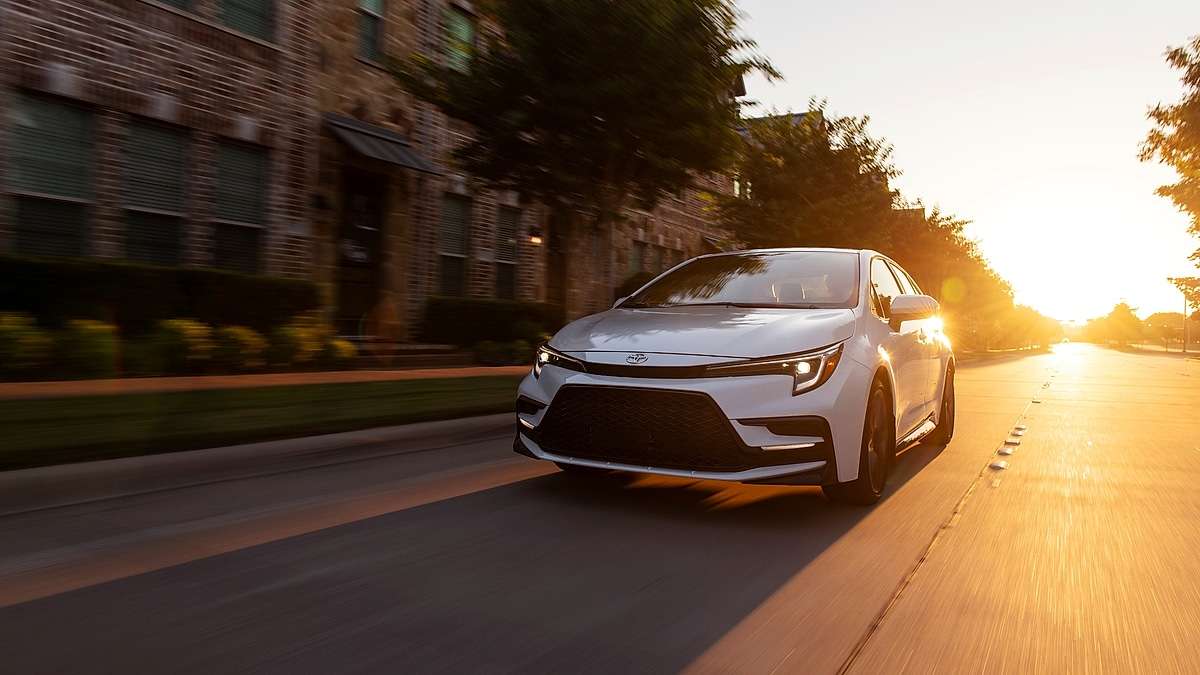

A 2023 Toyota Camry with 40,000 miles just had its second oil change. Ever. Reddit user “SmallYerrow” drove 29,000 miles on one fill of 0W-16, floored it on every on-ramp, lugged it through canyons in 4th gear, then sent a sample to Blackstone Laboratories looking for proof that Toyota’s 10,000-mile interval is a scam.
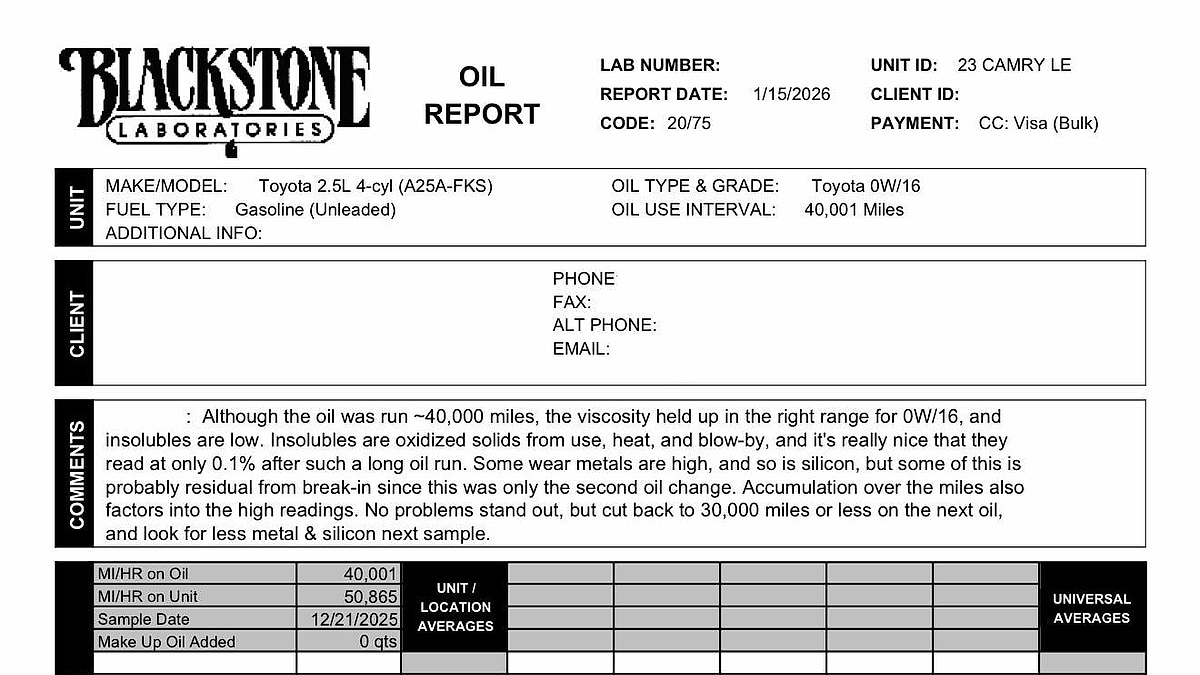
The report came back. The Internet exploded. Nobody noticed the real story.
My first thought: I’ve seen this movie before. I’ve covered the maintenance beat long enough to spot this pattern. Someone reads a Blackstone report with tidy “universal averages,” sees numbers that don’t look catastrophic, and declares victory over the dealership. But Blackstone won’t tell you in bold print what matters most; their report cannot see what’s actually killing your engine.
The Setup
SmallYerrow’s Camry had its first oil change at 10,864 miles at a Toyota dealership, almost certainly filled with 0W-16. That oil came out at roughly 40,000 miles, 29,000 miles on one fill. The owner posted the Blackstone results to r/Toyota as evidence that extended intervals are fine.
The thread turned hostile fast. “So you want to change it only when metal is in the oil?” the top comment read, at 231 upvotes. “Brother, the point is to keep metal and material in the engine and out of the oil.” Another at 151 upvotes: “Idiots like this are the reason I don’t buy used cars anymore.”
The MAINT REQD light triggers every 5,000 miles in that Camry. It illuminated six times during this interval. Six warnings. Six ignored pleas from the dashboard.
Toyota’s official interval is 10,000 miles. This owner went 2.9x past that. Even Toyota, not known for conservative recommendations, would call this engine neglected.
The Numbers Look Deceptively Safe
Blackstone measures wear metals in parts per million. For the A25A-FKS 2.5L four-cylinder, iron at 10K miles runs 15-35 ppm. At 30K on degraded oil, you hit 50-120+ ppm as wear accelerates non-linearly. SmallYerrow’s numbers fell in the middle, not catastrophic. Not immediately.
That’s the trap.
Fresh 0W-16 starts with a TBN (total base number) around 6.0-8.0. At 30,000 miles, you’re at or near zero. The oil can’t neutralize acids anymore. WearCheck research confirms what follows: after the TBN/TAN crossover, “lead levels spike… indicative of corrosive processes beginning to dominate.”
But those borderline wear numbers miss the point. A Reddit mechanic nailed it: “This isn’t showing you all the sludge and varnish that builds up. You need the TBN.” The $35 test tells you what's left in the engine oil. Nothing about what’s stuck inside, on rings, in passages, on bearings.
The 11th Concept: The Blind Spot Nobody Talks About
Every article on this topic hits the same ten points: intervals, Blackstone ppm, Toyota’s 10K rec, 0W-16 vs 0W-20, TBN, sludge, used cars, warranty, expert opinions, and synthetic benefits. Here’s the eleventh, the one making this “experiment” meaningless.
Oil analysis only measures what is suspended in the oil at the moment of sampling. It cannot detect varnish on piston rings. It cannot see sludge narrowing oil passages. It cannot identify ring sticking, cylinder wall deposits, or acid etching of bearing surfaces. A Blackstone report is a blood test claiming to assess your health while completely ignoring plaque in your arteries.
I’ve spoken with techs who’ve torn down engines with “acceptable” Blackstone reports. Oil looked fine on paper. Rings were seized. Passages choked. Deposits no $35 test could catch.
Toyota Master Technician AMD, “The Car Care Nut” on YouTube, documented a 2015 Camry with 180,000 miles on 10K-mile intervals. The owner followed the book. The oil control rings were seized solid. Required an engine block replacement, not an overhaul, a replacement.
And that was on recommended intervals. Not 29,000 miles on one fill.
One Reddit comment cut to the bone: “Blackstone’s wording is always too tactful. Your engine could be blowing up, and they’ll be all nonchalant… By the time their tone changes to sounding slightly concerned, your engine is already toast.”
That’s not a knock on Blackstone. They’re a lab. They report data. Owners use that $35 printout to justify a $30,000 gamble, never realizing the worst damage is invisible, until it isn’t, and you’re shopping for a short block.
Why This Matters Now
The used car market is still inflated, and buyers are desperate. CarFax data shows regular oil change records add roughly $1,320 to resale value, and that’s just what gets reported. One commenter put it perfectly: “Oil changes are relatively cheap. New engines are not.”
Toyota has precedent. The 1997-2002 sludge settlement covered 3.5 million vehicles, and Toyota blamed owners for “poor maintenance.” That case established the framework that dealerships still use to deny warranty claims. A 2023 Camry under powertrain warranty with this service history? Toyota has every right to deny the claim.
What Torque News Checked
- Primary source: Reddit post by “SmallYerrow” in r/Toyota, 2023 Camry ~40,000 miles, second oil change at ~29,000-mile interval.
- Cross-reference: Blackstone Laboratories TBN thresholds (<2.0 = change oil), universal averages methodology, $30-35 per analysis. WearCheck research on TBN/TAN crossover and corrosive wear.
- Expert verification: Toyota Master Technician AMD (“The Car Care Nut”) teardown of 2015 Camry with seized oil control rings at 180K miles on 10K intervals.
- Original checking: 2023 Camry A25A-FKS 2.5L specs, 0W-16 (4.8 quarts), 10K-mile interval, MAINT REQD at 5K triggers, ToyotaCare (2 changes/25K). 1997-2002 sludge settlement records.
Practical Consequences
If you own a Toyota with the A25A-FKS engine, change your oil at 5,000 miles if you drive hard, 7,500 if you’re gentle, and never push past 10,000 regardless of what a Blackstone report says. The $50-80 you spend twice a year is insurance against a $6,000-8,000 engine replacement. The math isn’t close. Shopping used? Ask for service records with dates and mileage, not just “maintenance done.” That clean Blackstone report the previous owner bragged about won’t show up in the CarFax. Or in the engine.
What’s your oil change interval, and has a Blackstone report ever convinced you to push it longer than you otherwise would?
Comment down below with your thoughts.
Used under the relevant US Copyright Law for news-reporting purposes.
About The Author
Noah Washington is an automotive journalist based in Atlanta, Georgia, covering sports cars, luxury vehicles, and performance culture. His reporting focuses on explaining the engineering, design philosophy, and real-world ownership experience behind modern vehicles.
Noah has been immersed in the automotive world since his early teens, attending industry events and following the enthusiast communities that shape how cars are built and driven today. His work blends industry insight with enthusiastic storytelling, helping readers understand not just what a car is, but why it matters.
Noah is also a member of the Southeast Automotive Media Association (SAMA), a professional organization for automotive journalists and industry media in the Southeast.
His coverage regularly explores sports cars, luxury vehicles, and performance-driven segments of the automotive industry, including the evolving culture surrounding Formula Drift and enthusiast builds.
Read more of Noah's work on his author profile page.
You can also follow Noah here:
Set Torque News as Preferred Source on Google
Follow us today...