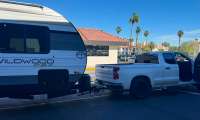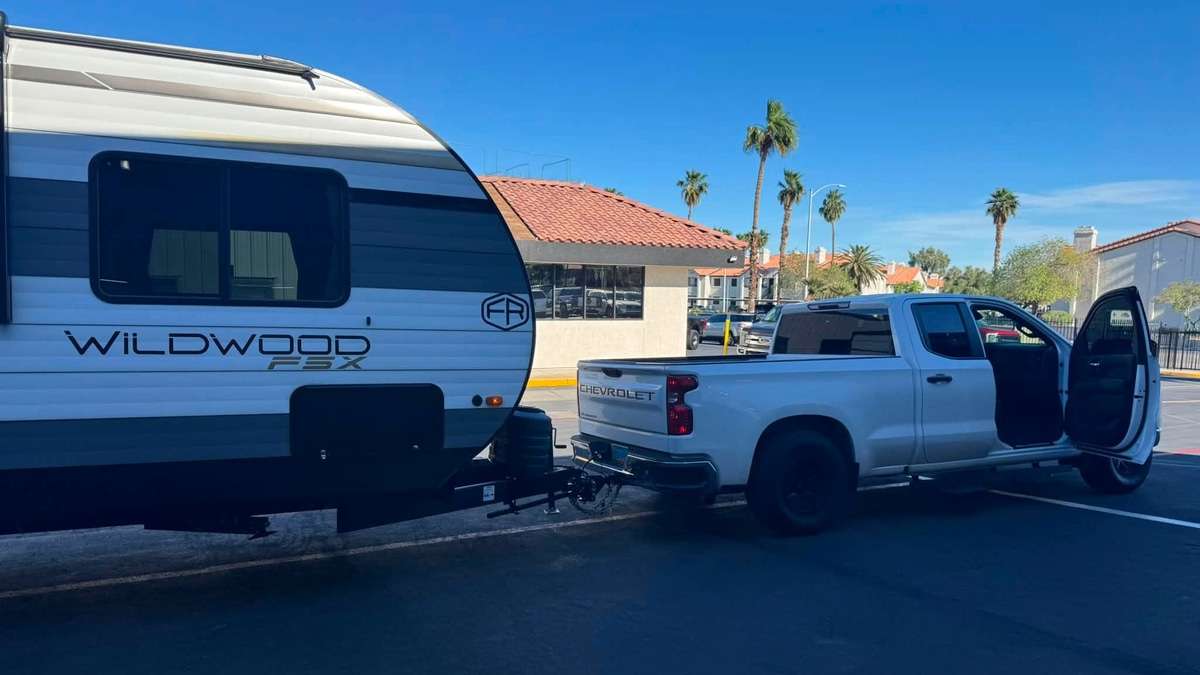

A white 2023 Chevrolet Silverado 1500 Double Cab sits connected to a Forest River Wildwood FSX travel trailer in a Las Vegas parking lot.
The photograph makes the pairing look simple. A four-cylinder truck is hitched to a sizable travel trailer, and the owner wants to know whether the combination works.
Chevrolet rated the 2023 Silverado’s 2.7-liter turbocharged engine for substantial towing. In the Double Cab and standard-bed configuration visible in the photograph, the published maximum is 9,200 pounds with two-wheel drive and 9,000 pounds with four-wheel drive, when properly equipped. Chevrolet also warns that the capacity of a specific truck can vary and that passengers, cargo, options, and accessories reduce what it can tow.
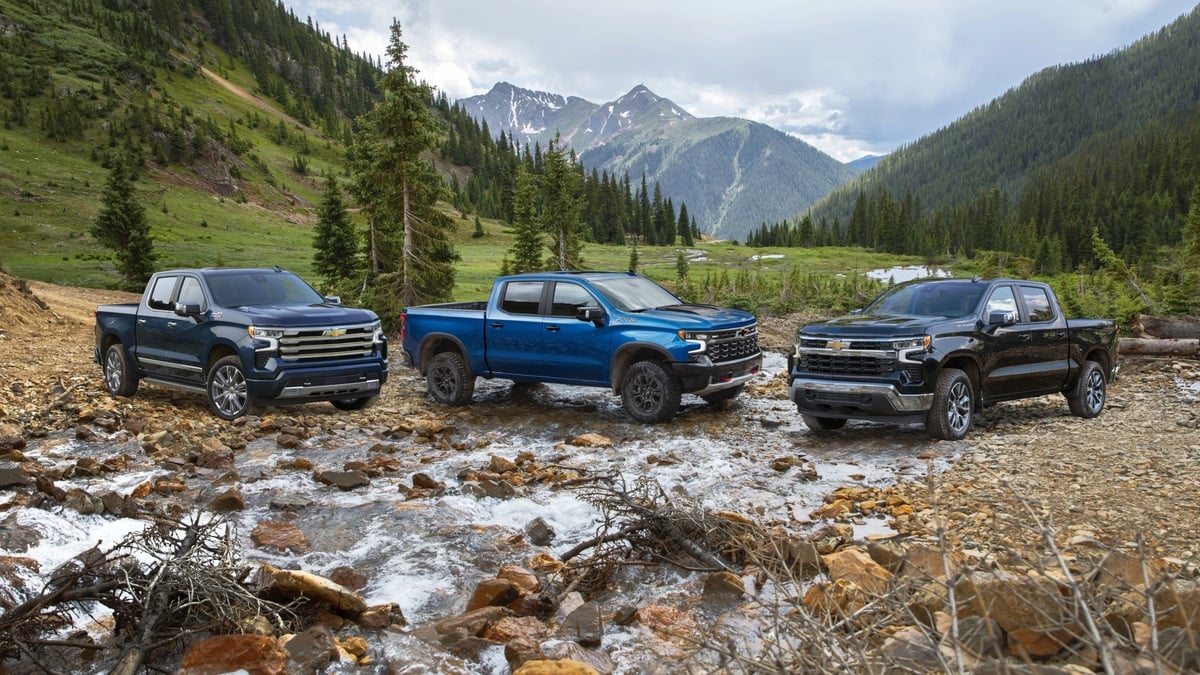
Those ratings establish the upper boundary. The photograph cannot show whether this particular Wildwood FSX fits beneath it.
After picking up the RV, Shawn Mohadjerani asked a Forest River owners group:
“But concerned about my 2023 4 cylinder Silverado 1500. Thoughts?”
The responses quickly divided into camps.
Some readers said the four-cylinder engine would not last. Others quoted a 9,300-pound tow rating. Several recommended a Silverado 2500, with a few insisting that it should have a diesel engine.
The more careful replies asked for the truck’s door labels, the trailer’s exact floorplan and its actual loaded weight.
Those questions move the discussion closer to an answer.
The 2.7-Liter Brings 430 LB-FT to the Argument
For comparison, Chevrolet rated the available 5.3-liter V8 at 355 horsepower and 383 lb-ft of torque. The turbocharged four-cylinder therefore produced 47 lb-ft more peak torque than the naturally aspirated V8, though the V8 used a 10-speed transmission and delivers its power differently.
Cylinder count alone provides little useful towing math.
It does not reveal the truck’s payload, rear axle load, cooling performance under this particular trailer, hitch setup or total combined weight.
Peak torque also tells only part of the ownership story. A large travel trailer presents substantial aerodynamic drag at highway speed. Grade, elevation, temperature, wind direction and cruising speed all affect how hard the engine and transmission must work.
That is where owner experience becomes useful, provided it includes actual details.
A report that the truck “did fine” needs the trailer’s loaded weight, route, speed and fuel economy. A report that the engine “ran out of breath” needs the same context. Neither conclusion transfers automatically to another trailer.
Predictions of early engine or rear differential failure require mileage, operating conditions, maintenance history and failure evidence. None of those details accompanied the original question.
The Pictured Double Cab Has Two Possible Maximum Tow Ratings
The image appears to show a Silverado Double Cab with the standard bed. The drivetrain cannot be confirmed visually.
Chevrolet’s 2023 chart gives the 2.7-liter Double Cab standard-bed truck a 9,200-pound maximum with two-wheel drive and a 9,000-pound maximum with four-wheel drive.
The 9,300-pound figure mentioned in the comments is the maximum for a different four-wheel-drive 2.7-liter configuration elsewhere in the Silverado lineup. Chevrolet listed a 9,500-pound overall maximum for the two-wheel-drive 2.7-liter lineup.
Even the correct column in the chart does not finish the calculation.
Chevrolet describes those maximum ratings as comparison figures. The exact truck’s configuration, installed trailering equipment, passengers, cargo and accessories can reduce the amount available.
The driver-side doorjamb may carry a Trailering Information Label showing vehicle-specific curb weight, GVWR, GCWR, maximum payload, maximum tongue weight and rear GAWR. That label is considerably more useful than a search result quoting the highest number available for the engine.
The 2.7-liter Trailering Package was standard on Custom and higher trims and available on the Work Truck. Chevrolet also offered an integrated trailer brake controller, but availability does not confirm that Shawn’s truck has one.
The option list or a photograph of the controls would settle that question.
Wildwood FSX Is a Product Family, Rather Than One Trailer Weight
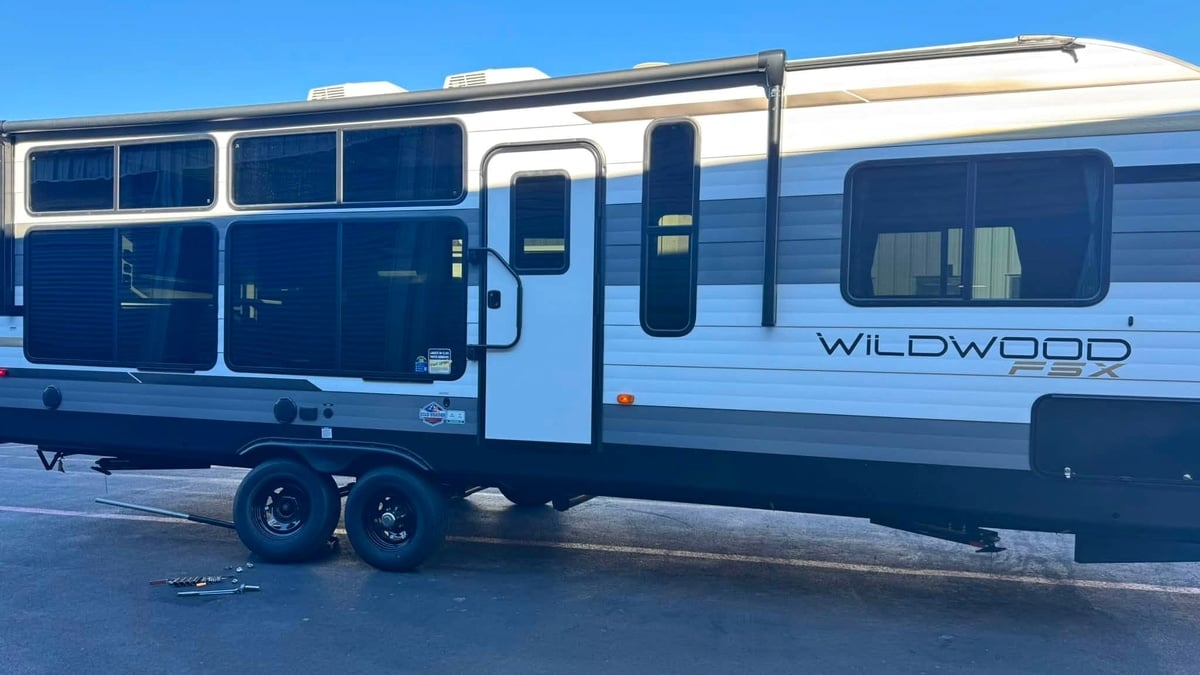
The logo on the trailer identifies it as a Wildwood FSX. It does not reveal the floorplan or loaded weight.
For context, Forest River’s 2023 Wildwood FSX brochure covered couples coaches, bunkhouse trailers, toy haulers and cargo carriers. Listed lengths ran from 21 feet 2 inches to 36 feet 5 inches.
That range is too broad for a useful judgment from the name alone.
A small couples trailer and a 36-foot toy hauler can wear the same FSX branding while placing very different demands on a half-ton truck.
The exact model year is also unknown from the post. The trailer’s floorplan designation and vehicle identification label would narrow the search immediately.
Forest River explains that its published unloaded vehicle weight includes the factory unit, its axle and tongue weight, and LP gas. It excludes cargo, fresh water, additional options and dealer-installed accessories. Forest River says each RV is weighed at the factory and receives a label stating the actual unit’s unloaded weight and cargo-carrying capacity.
That unit-specific label matters more than an average brochure weight.
The owner then needs a loaded scale weight because camping equipment, water, food, clothing and installed accessories can put the trailer hundreds of pounds above its factory-delivered figure.
Payload May Reach Its Limit Before the Tow Rating
A Silverado can remain below a 9,000-pound trailer rating and still exceed its payload, rear axle or receiver limits.
Chevrolet recommends that a conventional trailer’s tongue weight generally equal 10 to 15 percent of its loaded trailer weight. It also states that tongue weight counts toward the truck’s GVWR.
A 5,000-pound loaded trailer could therefore place approximately 500 to 750 pounds on the hitch.
A 6,000-pound trailer could produce roughly 600 to 900 pounds of tongue weight.
That load arrives before adding the driver, passengers, hitch hardware, coolers, generators, firewood, or anything else carried in the truck.
Chevrolet advertised maximum 2.7-liter Silverado payloads of 2,260 pounds with two-wheel drive and 2,140 pounds with four-wheel drive. Those are lineup maximums. Shawn’s individual truck may have substantially less capacity after accounting for cab configuration, trim, options and equipment.
The Tire and Loading Information label supplies the specific occupant-and-cargo number.
One commenter recommended staying below 80 percent of the maximum tow rating. That can serve as a personal comfort margin, especially for drivers who face mountains, wind or long highway days.
It is not an official capacity calculation.
A trailer at 60 percent of the advertised tow rating can still overload a lightly optioned truck’s rear axle or consume all available payload through tongue weight and cargo. A combination above an arbitrary 80-percent line can remain within every published rating.
Payload, axle load, tongue load and total combined weight are the controlling measurements.
The Photograph Leaves the Hitch Setup Unanswered
The image shows a hitch connection and crossed safety chains.
It does not provide enough detail to confirm whether a complete weight-distribution system is installed, whether its spring bars are attached or how the hitch is adjusted.
The truck’s rear stance is also difficult to judge from one photograph. The parking surface, camera position, shadow and trailer angle can make a level combination appear lower or higher at the rear.
A weight-distribution hitch can improve axle-load distribution and steering response when properly specified and adjusted. Its presence does not increase GVWR, GCWR, GAWR or receiver capacity.
The trailer brake system needs verification as well.
Shawn should confirm whether the Silverado has the factory integrated controller or another compatible controller, whether the trailer brakes are operating correctly, and how the gain is set for the loaded trailer.
A four-cylinder Silverado with correct axle loads, functioning trailer brakes and a properly adjusted hitch presents a different case from one carrying excessive tongue weight with an incomplete setup.
The current photograph cannot distinguish between them.
The Door Stickers and Scale Ticket Can Settle the Argument
Before the next highway trip, the truck and trailer should be loaded exactly as they will travel.
That includes the normal passengers, pets, food, fresh water, propane, camping supplies, batteries, tools, bed cargo and hitch equipment.
The truck’s Tire and Loading Information label and Trailering Information Label should be photographed. The trailer’s VIN and weight label should be photographed as well.
Then the complete combination should go across a three-platform scale.
CAT Scale instructs drivers to position the truck’s steer axle on the first platform, the drive axle on the second, and the trailer axles on the third.
The resulting numbers answer several separate questions:
The truck’s two axle readings, added together, show its loaded gross weight. That total must remain within GVWR.
The rear axle reading must remain within rear GAWR and the installed tires’ capacity.
The truck and trailer totals must remain within GCWR.
The trailer’s axle weight, combined with its tongue load, must remain within the trailer’s GVWR.
The tongue weight must remain within the receiver and vehicle-specific maximum while maintaining the trailer manufacturer’s recommended balance.
A separate tongue scale or a carefully conducted series of scale passes can establish the actual hitch load.
Those figures carry more authority than the engine’s cylinder count, the trailer’s exterior appearance or a stranger’s instinct from a Facebook photograph.
The Engine Deserves a Data-Based Judgment
Chevrolet engineered the 2.7-liter Silverado for meaningful towing work. Its 430 lb-ft rating and 9,000- to 9,200-pound Double Cab maximums deserve more consideration than a dismissal based solely on four cylinders.
Those specifications do not certify this particular Silverado and Wildwood pairing.
Some Wildwood FSX floorplans may fit comfortably within the truck’s payload, axle and combined-weight limits. Larger or heavily loaded versions could consume most of the truck’s capacity and produce a tiring highway combination even when the trailer remains below the published tow rating.
A Silverado 2500 would provide more payload and rating reserve. The photograph alone does not establish that an HD truck is required.
Before Shawn trades trucks or heads into the mountains, he needs the exact trailer model, both vehicle labels, actual tongue weight, and a loaded scale ticket.
That evidence will answer the question more reliably than the number of cylinders under the hood.
The four-cylinder badge will dominate the argument, although the loaded combination matters more than the number of cylinders. A scale ticket can show whether this Silverado and Wildwood are comfortably matched or whether the trailer consumes too much of the truck’s payload and rear-axle capacity.
2.7-liter Silverado drivers, what loaded trailer weight has felt comfortable on highway grades and in crosswinds? Tell us in the comments about the trip that proved the truck was well matched, or showed you where its limit was.
Two images by Shawn Mohadjerani
About The Author
Noah Washington is an automotive journalist based in Atlanta, Georgia, covering sports cars, luxury vehicles, and performance culture. His reporting focuses on explaining the engineering, design philosophy, and real-world ownership experience behind modern vehicles.
Noah has been immersed in the automotive world since his early teens, attending industry events and following the enthusiast communities that shape how cars are built and driven today. His work blends industry insight with enthusiastic storytelling, helping readers understand not just what a car is, but why it matters.
Noah is also a member of the Southeast Automotive Media Association (SAMA), a professional organization for automotive journalists and industry media in the Southeast.
His coverage regularly explores sports cars, luxury vehicles, and performance-driven segments of the automotive industry, including the evolving culture surrounding Formula Drift and enthusiast builds.
Read more of Noah's work on his author profile page.
You can also follow Noah here:
Set Torque News as Preferred Source on Google
Follow us today...