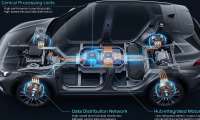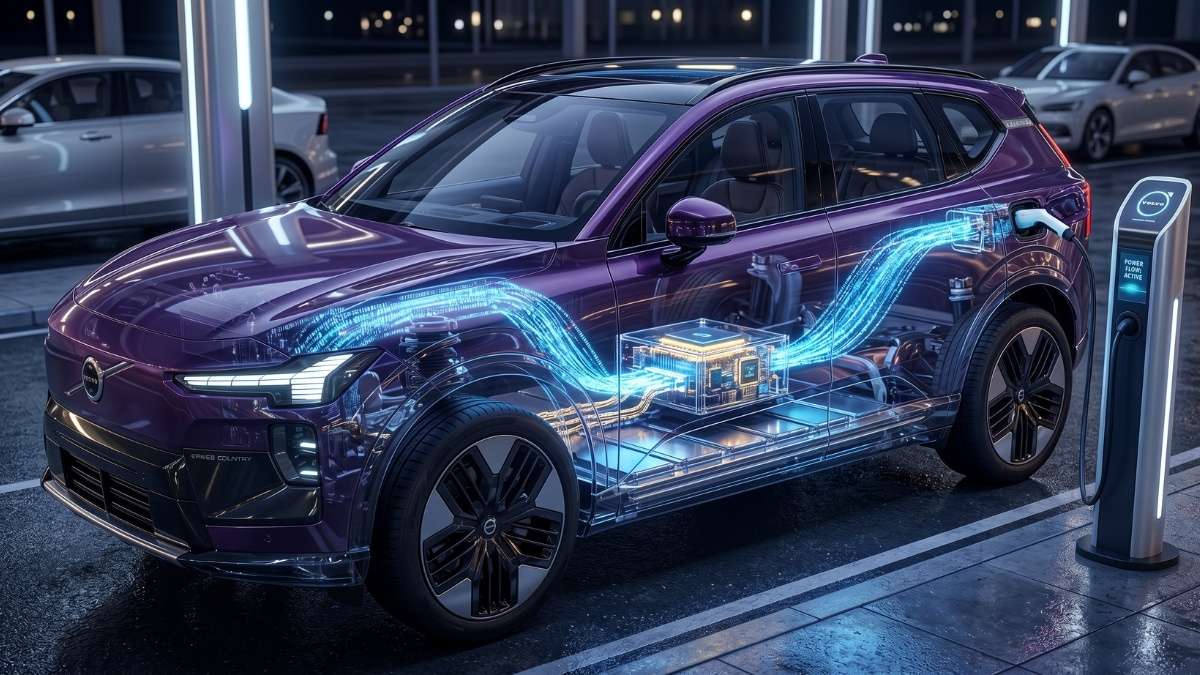

If you look closely at the automotive industry over the past five years, a fascinating and somewhat ruthless reality has emerged. We have stopped evaluating vehicles primarily on their mechanical merits. Horsepower, suspension tuning, and panel gaps still matter, but they are rapidly becoming secondary characteristics. The modern electric vehicle (EV) is, fundamentally, a rolling computer. It is a highly complex edge node functioning within a massive digital network, and the software dictating how that machine operates is now the primary battleground for automotive supremacy.
Nowhere is this shift more evident than in the way automakers handle battery management. Today, almost any manufacturer can purchase exceptional battery cells from a supplier like CATL, which commands nearly 40 percent of the global EV battery market, or LG Chem. Sourcing the hardware is no longer the competitive moat it once was. The true differentiator is how a vehicle's software manages the electrochemical reality of those mass-market cells under real-world stress.
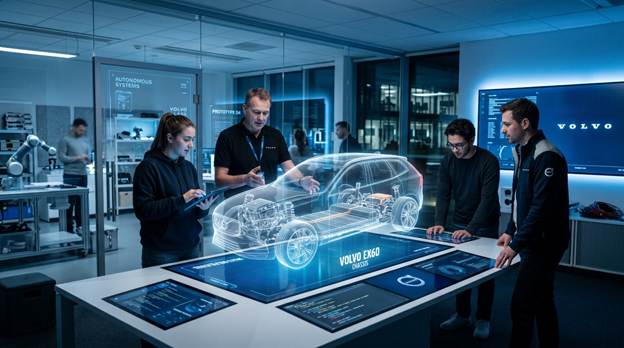
As we look toward the highly anticipated Volvo EX60, a vehicle poised to replace the incredibly successful XC60, it becomes clear that Volvo isn't just building a new electric SUV. They are deploying a highly sophisticated computing platform. The unsung hero of this impending release isn't the exterior design or the sustainable interior materials—it is the revolutionary Breathe Charge software seamlessly integrated into its silicon veins.
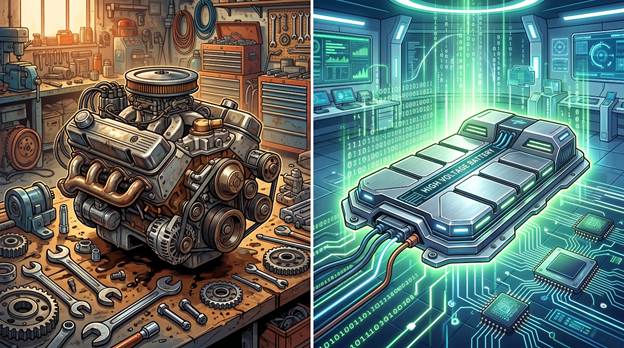 The Automotive Tech Divide
Before we dive into what makes the EX60's battery management so critical, we need to understand the stark software divide in the automotive industry. Not all rolling computers are created equal.
Legacy automakers have historically operated as massive system integrators. They bought an engine control unit from Bosch, an infotainment system from Harman, and brake sensors from Continental, and then stitched them together into a single vehicle. This worked perfectly for mechanical vehicles, but it has proven disastrous for EVs. When you have fifty different computers running proprietary code from fifty different suppliers, pushing a unified Over-the-Air (OTA) update is nearly impossible. This fragmented, decentralized architecture is exactly why giants like Volkswagen have notoriously struggled with their Cariad software division, leading to delayed vehicle launches, software glitches, and frustrated executives.
Conversely, companies born in the tech era started with clean-sheet, centralized compute architectures. Rivian, for example, successfully transitioned its second-generation vehicles to a "zonal architecture," reducing its electronic control units (ECUs) from 17 to just 7. They write their own software, control their own code, and treat the car like a networked appliance on wheels.
Volvo, despite being a legacy automaker with a century of mechanical history, recognized this divide early. Through their strategic investments and a willingness to overhaul their engineering pipelines, Volvo has bridged the gap. They have transitioned to a centralized core computing architecture, allowing them to integrate high-level, third-party software at a fundamental level. This architectural superiority is exactly how they gained their current advantage.
The Magic of Breathe Charge Software
This brings us directly to the EX60 and its most critical technological weapon: Breathe Charge software.
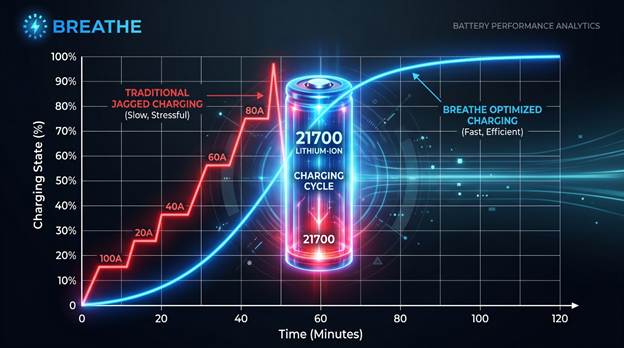
Developed by London-based Breathe Battery Technologies, this software replaces traditional step-charging algorithms with dynamic, physics-based, real-time control. To understand why this matters, you have to understand how EV charging normally works. Traditional battery management systems (BMS) are surprisingly dumb. They use static, pre-programmed look-up tables to guess the state of the battery based on generalized temperature maps.
To prevent damaging the battery or causing lithium plating—a hazardous condition where lithium ions build up as metallic deposits on the anode rather than smoothly entering it, degrading capacity and risking thermal runaway—traditional software errs on the side of extreme caution. It forcefully slows down the charge rate as the battery fills up or if the ambient temperature drops.
The Breathe Charge software integrated into the EX60 operates on an entirely different plane of intelligence. It is a closed-loop system that monitors the battery’s electrochemical state in real-time. By dynamically managing the voltage and current at a micro-level, the software pushes the battery right to its absolute safe physical limits without crossing them.
The real-world results are staggering. This software intelligence allows the EX60 to reduce fast-charging times from 10 to 80 percent by up to 30 percent. More importantly, this isn't just a parlor trick for perfect, 72-degree California days. Because the software actively monitors the battery's internal health rather than relying on external temperature guesses, it can optimize charging speeds even in bitter cold weather—a historical Achilles' heel for electric vehicles. It fundamentally transforms the battery from a passive chemical storage box into an actively managed digital asset.
NACS Integration: The Perfect Symbiosis
Volvo’s software advantage with Breathe Charge perfectly complements the EX60’s hardware advantage: native integration of the North American Charging Standard (NACS).
By fully adopting the standard pioneered by Tesla and codified by the SAE, the EX60 will have seamless, adapter-free access to the vast and highly reliable Supercharger network. But network access is only half the battle; efficiency at the dispenser is the other half. When a driver plugs an EX60 into a high-output NACS charger, they are paying for time as much as they are paying for electricity.
Because the Breathe software can shave up to a third off the overall charging time, the EX60 will spend significantly less time occupying the stall. This creates a vastly superior user experience, reduces charging anxiety on road trips, and maximizes the utility of the NACS infrastructure. The vehicle’s rolling computer is effectively communicating with the charging station’s computer, negotiating the fastest, safest delivery of power mathematically possible. It is a brilliant synergy of software intelligence and hardware standardization.
How Volvo Captured the High Ground
Volvo didn't just stumble into this software advantage; it was the result of a calculated strategic maneuver. Years ago, the company established the Volvo Cars Tech Fund to directly invest in high-potential technology start-ups. They realized that the speed of innovation in Silicon Valley, London, and other European tech hubs vastly outpaced traditional automotive R&D cycles.
By investing directly in Breathe Battery Technologies early on, Volvo gained exclusive integration capabilities that its competitors lacked. Instead of trying to invent a new physics-based charging algorithm from scratch—which could take a legacy automaker a decade of trial and error - Volvo utilized its newly centralized computing architecture to seamlessly inject Breathe’s specialized code directly into the EX60’s nervous system.
This represents a masterclass in modern automotive strategy. Volvo understood that to win in the EV era, you don't need to write every single line of code in-house; you just need a silicon architecture capable of running the best code in the world, and the strategic foresight to partner with the geniuses writing it.
Predicting the Future of EV Software
Looking forward, the concept of the software-defined vehicle (SDV) is only going to accelerate, with market projections showing the automotive software sector quadrupling to a staggering $1.2 trillion by 2035. Over the next five to ten years, EV software will evolve far beyond foundational systems like battery management and infotainment.
We are rapidly heading toward an era of predictive energy routing. In the near future, your vehicle’s AI will read your calendar, check the weather, communicate with the local energy grid, and automatically precondition your battery for an optimal charge exactly when grid rates are at their lowest.
Furthermore, Vehicle-to-Grid (V2G) technology will become standard. This requires immensely complex software to allow the car to intelligently sell power back to the grid during peak hours without degrading the owner's battery lifespan or leaving them stranded the next morning. Eventually, autonomous driving algorithms will begin communicating intimately with the battery management systems. If the car knows it is about to climb a steep mountain pass via topological navigation data, it will actively manage battery thermals minutes before the incline even begins, maximizing power delivery and efficiency.
What Volvo Must Do to Maintain the Lead
Volvo is currently in a highly advantageous position with the EX60 and its Breathe Charge integration, but tech advantages in the modern era are notoriously fleeting. To maintain their lead, Volvo must execute flawlessly on three critical fronts:
- Eradicate Technical Debt: As Volvo continues to add features and integrations via OTA updates, they must ensure their codebase remains clean and efficient. Software bloat can cripple a vehicle's processing power over time, leading to laggy interfaces, increased energy consumption, and compromised driving efficiency.
- Double Down on AI: The Breathe Charge software is brilliant, but it is just the beginning. Volvo must integrate generative AI and advanced machine learning into their core vehicle systems to create cars that actively learn from their owners' driving habits, optimize range dynamically, and diagnose mechanical issues before the driver even notices a problem.
- Protect the Centralized Compute Advantage: Legacy competitors are furiously trying to transition to centralized, zonal architectures to copy the success of Tesla and Rivian. Volvo must keep their hardware powerful enough to handle massive software updates five or even ten years down the road. If the EX60’s internal processors max out their computational headroom in three years, the vehicle becomes functionally obsolete. Future-proofing the silicon is absolutely mandatory.
Wrapping Up
The automotive industry is in the midst of a violent and irreversible transition. Those who still view cars merely as machines of metal, rubber, and glass are destined to fail. The true market leaders understand that the modern vehicle is, above all else, a scalable software platform.
The upcoming Volvo EX60 stands as a primary testament to this new reality. By leveraging the brilliantly engineered Breathe Charge software, Volvo has solved one of the most persistent, frustrating pain points of electric vehicle ownership: extended charging times and cold-weather battery degradation. Through strategic investments, a modernized compute architecture, and seamless integration with the NACS network, Volvo has proven that they possess the intellectual agility to compete with any pure-play tech company in the world.
The EX60 isn’t just a new electric SUV rolling off an assembly line. It is a rolling computer executing its code flawlessly, serving as a decisive warning shot to the rest of the industry that software superiority is no longer optional - it is the only way forward.
Disclosure: Images rendered by Artlist.io
Rob Enderle is a technology analyst at Torque News who covers automotive technology and battery developments. You can learn more about Rob on Wikipedia and follow his articles on TechNewsWord, TGDaily, and TechSpective.
Set Torque News as Preferred Source on Google
Follow us today...