
Living in Bend, Oregon, means accepting that Mother Nature frequently overrules local infrastructure. When winter storms roll over the Cascades, power outages shift from hypothetical inconveniences to immediate operational realities. At my home office, an outage means my custom AMD Threadripper workstation goes dark, my wife Mary’s creative hardware shuts down, our Nest Protect security network loses its primary backbone, and my Yarbo robotic yard equipment halts in its tracks. For decades, the only viable solution for home resilience was a noisy, maintenance-heavy gas generator. But the automotive industry is currently navigating a structural paradigm shift that changes this calculus entirely.
As a technology analyst who spends considerable time tracking Agentic AI orchestration, enterprise security, and the ongoing evolution of 800V versus 400V electric vehicle architectures, I view modern EVs as fundamentally more than just transportation. They are highly mobile, software-defined energy storage systems. Specifically, the imminent arrival of the Volvo EX90 highlights a critical feature that will soon redefine both automotive utility and home resilience: bi-directional charging. While I occasionally dream of integrating a 4,000 HP hub motor conversion into my classic 1970 Jaguar E-Type, the practical reality of daily driving requires modern utility. Let's dig into why the bi-directional capabilities of vehicles like the EX90 represent the most important EV feature of the decade.
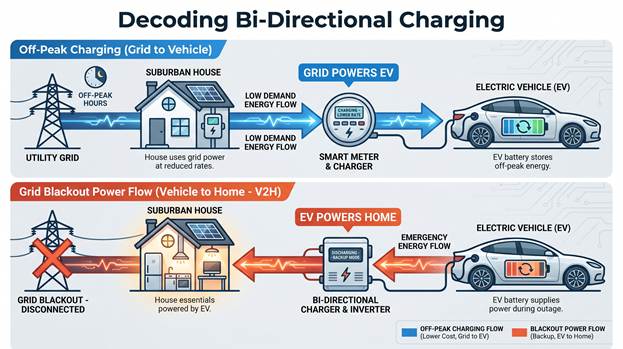
Decoding Bi-Directional Charging
To understand the magnitude of this shift, we must first define what bi-directional charging actually is. Historically, electric vehicles have relied on V1G, or one-way smart charging. You plug the car into the wall, the vehicle’s onboard charger converts the alternating current (AC) from the grid into direct current (DC), and it stores that energy in the battery pack.
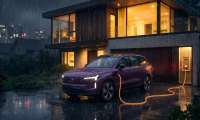
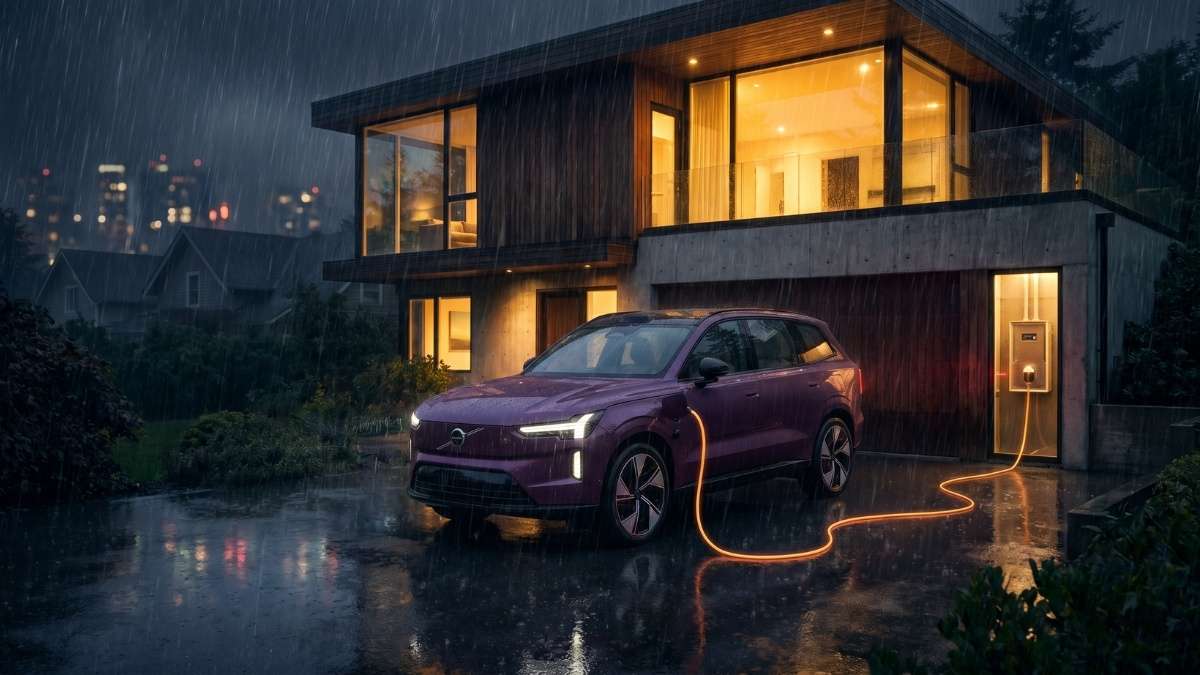
Bi-directional charging, encompassing Vehicle-to-Home (V2H), Vehicle-to-Load (V2L), and Vehicle-to-Grid (V2G), allows that process to run in reverse. The vehicle takes the massive amount of DC energy stored in its floorpan, passes it through an inverter to convert it back into AC power, and pushes it outward. Depending on the architecture, this inverter can be located within the vehicle itself or housed in a specialized smart wallbox mounted in your garage.
Why is this so important? The sheer scale of energy required to stabilize modern life is outpacing traditional utility infrastructure. We are seeing grids pushed to the brink of failure across the country. Distributed energy storage—leveraging millions of parked EVs as localized power reserves—is the most mathematically viable solution to prevent rolling blackouts without spending trillions on new centralized peaker plants. Detailed architectural framework standards like ISO 15118-20 ensure these vehicle-to-grid communications remain standardized and secure across various automotive manufacturers.
The Volvo EX90 Powerhouse
Volvo is engineering its new flagship SUV from the ground up to be a first-class grid citizen. According to testing and specifications published by Car and Driver, the Twin Motor versions of the 2026 Volvo EX90 feature a massive 111-kWh gross (107-kWh usable) liquid-cooled lithium-ion battery pack. More importantly, the EX90’s advanced EV architecture natively supports bi-directional charging, allowing owners to hook the vehicle up to their house to power appliances during an outage.
To put a 107-kWh usable battery into perspective, the average American home consumes roughly 30 kWh of electricity per day. This means a fully charged EX90 could power a typical home under normal load for over three days. If an outage stretches on and you triage your power usage—disabling heavy draw appliances like electric dryers and HVAC systems while keeping only the refrigerator, internet routers, and essential lighting active—that single vehicle could theoretically sustain your household for over a week.
Volvo's approach is deeply integrated, partnering with home energy experts like dcbel to roll out their specialized wallboxes. By routing controls through the EX90's portrait-style 14.5-inch infotainment display and its Google-based interface, the vehicle transforms home power management from a complex electrical engineering task into a simple, user-friendly software toggle, managed directly via the official Volvo Cars App. I am personally watching this technology with intense interest, as I plan to pre-order the upcoming Volvo EX60 P12 once the window opens. I fully expect the mid-size EX60 to inherit this exact electrical DNA, making it a highly compelling option for managing grid instability in the Pacific Northwest.
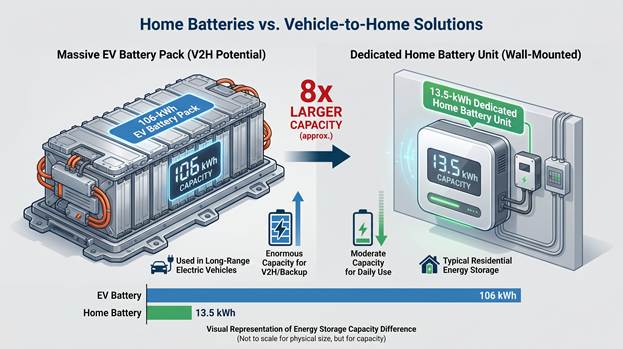
Home Batteries vs. Vehicle-to-Home Solutions
The true value of bi-directional EV charging becomes glaringly obvious when we compare it to dedicated home battery storage. Currently, the industry standard for home backup is the Tesla Powerwall 3. According to updated market reports on EnergySage, it is an excellent piece of hardware, but it stores just 13.5 kWh of energy and costs roughly $13,500 to $16,500 fully installed.
To match the 107-kWh usable capacity of the Volvo EX90, a homeowner would need to purchase and wall-mount nearly eight Tesla Powerwalls. That represents a staggering capital investment of over $100,000 just for static batteries that sit on a wall doing nothing until the grid fails.
An electric vehicle, conversely, is an asset you are already purchasing for transportation. Unlocking its massive, high-density battery pack for home backup is incredibly capital efficient. It essentially subsidizes the cost of the vehicle by eliminating the need for expensive dedicated home storage.
There is, of course, one logistical caveat: if the vehicle isn't parked at home when the power goes out, your house goes dark. Therefore, the optimal future-proof setup is a hybrid one. Installing a single, smaller home battery provides immediate transition power and load-balancing when the grid drops. Then, when the EV returns to the garage, it acts as the heavy-duty generator, backfilling the home battery and keeping the entire property operational for days.
Evaluating the Competition: Who Executes Bi-Directional Best?
Volvo is not operating in a vacuum, and it is crucial to analyze how the broader market is executing bi-directional technology to understand who currently does it best in terms of reliability and ease of use.
Currently, Ford holds the crown for practical, whole-home V2H execution. The F-150 Lightning, utilizing Ford's Home Integration System (developed in partnership with Sunrun), allows the truck's available 131-kWh extended-range battery to automatically power a home the moment an outage occurs, delivering up to 9.6 kW of continuous power. In terms of automated ease of use, Ford is the market leader. However, the installation costs for the proprietary inverter and transfer switch can be exorbitant, sometimes eclipsing $5,000 just for the home hardware alone.
Meanwhile, the Hyundai Motor Group—utilizing the E-GMP platform that underpins the Ioniq 5 and Ioniq 6—excels at Vehicle-to-Load (V2L). As I noted recently when updating range and charging statistics for a column covering the Ioniq 6, these vehicles are incredibly efficient. By plugging a specialized adapter directly into the exterior charge port, users gain access to a standard 120V outlet yielding up to 1.8 kW in the US. It is bulletproof in its reliability and perfect for running a refrigerator or power tools at a campsite, but it lacks the native, automated whole-home integration of Ford’s system.
Legacy players like the Nissan Leaf pioneered this space using the CHAdeMO standard, but with CHAdeMO effectively sunsetting in North America, it is no longer a forward-looking solution.
Ultimately, Ford does whole-home backup best today, while Hyundai leads in portable, localized V2L utility. Volvo’s strategy with the EX90 aims to bridge this gap, offering European-style smart grid integration that promises to be more seamless and software-defined than current domestic offerings.
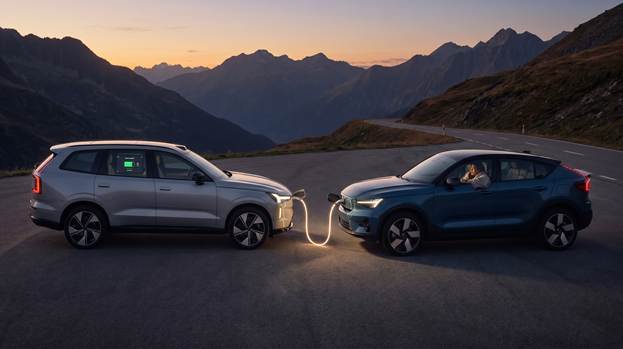
Vehicle-to-Vehicle Utility and Assisting Stranded Drivers
Beyond keeping your home office online, bi-directional charging unlocks profound advantages on the road. Despite rapid infrastructure deployment, range anxiety remains a primary barrier to EV adoption.
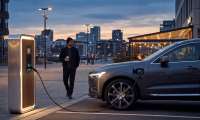
This is where Vehicle-to-Vehicle (V2V) charging becomes revolutionary. Imagine a scenario where a driver miscalculates their range on a remote stretch of highway. Today, resolving that situation requires dispatching a flatbed tow truck. With V2V capabilities natively integrated into vehicles like the EX90, a Good Samaritan can simply pull over, connect a standard charging cable between the two vehicles, and transfer enough energy to get the stranded driver to the nearest fast charger.
Volvo explicitly designed the EX90 to support charging other Volvos. It transforms every bi-directional EV into a mobile energy reserve. Much like how hardware-enforced isolation strategies—such as HP Wolf Security, which I frequently advocate for—create overlapping fields of defense in enterprise IT, widespread V2V charging creates a decentralized, overlapping support network for drivers. It structurally strengthens the entire automotive ecosystem by crowdsourcing roadside assistance.
Forecasting Industry Standards and Mandates
When will bi-directional charging transition from a premium luxury feature to a ubiquitous standard? The timeline is accelerating rapidly, driven largely by the industry's widespread adoption of the North American Charging Standard (NACS). As automakers integrate NACS hardware natively throughout 2025 and 2026, they are simultaneously implementing the underlying software communication protocols that govern bi-directional power flow. I forecast that by 2027, the underlying hardware required for bi-directional capability will be common across all premium EVs, and it will become a ubiquitous standard across all vehicle segments by 2030.
Given the immense public utility of this technology—particularly for grid stabilization and rescuing stranded EVs—will governments eventually mandate it? The answer is almost certainly yes.
California has already attempted to force the issue with Senate Bill 233, which originally aimed to require all new EVs sold in the state to be bi-directional capable by 2030. While that specific legislation was later amended by its author to address other topics, the regulatory writing is clearly on the wall, and advocacy groups like The Climate Center continue to fight for an explicit vehicle-to-grid mandate. Utility commissions and emergency management agencies recognize that millions of rolling batteries represent a massive, untapped public resource. As extreme weather events continue to strain aging infrastructure, I predict we will see hard hardware-readiness mandates in progressive states by 2028, with sweeping federal requirements establishing bi-directional charging as a mandatory safety and infrastructure feature by the early 2030s.
Wrapping Up
The automotive industry is no longer just building cars; it is building mobile nodes for a next-generation energy network. The Volvo EX90 perfectly encapsulates this transition. By outfitting the EX90 with a massive 107-kWh usable battery and native bi-directional hardware, Volvo is effectively providing owners with a robust home backup solution that dwarfs standalone systems like the Tesla Powerwall in sheer capacity.
While companies like Ford currently offer the most robust dedicated whole-home integration, and Hyundai excels in portable V2L simplicity, the incoming wave of software-defined, NACS-equipped vehicles will soon standardize this technology. In a world where the power grid is increasingly unpredictable, the ability to seamlessly pull energy from your driveway to keep your home warm, your office online, or a fellow driver safely on the road is not just a luxury convenience. It is a critical survival tool, and it represents the smartest reason to make your next vehicle an EV.
Disclosure: Images rendered by Artlist.io
Rob Enderle is a technology analyst at Torque News who covers automotive technology and battery developments. You can learn more about Rob on Wikipedia and follow his articles on TechNewsWord, TGDaily, and TechSpective
Set Torque News as Preferred Source on Google
Follow us today...