
In my years conducting competitive analysis for ROLM Systems and IBM, I witnessed firsthand how massive, entrenched corporations can completely miss a paradigm shift because they are financially addicted to their legacy products. The American automotive industry is currently navigating an identical, perilous transition. The shift from internal combustion engines (ICE) to battery electric vehicles (BEVs) is not merely a change in powertrain; it is a fundamental redefinition of the automobile into a rolling, software-defined computing platform.
However, this transition in the United States has hit a massive speedbump. While global markets show resilience—as detailed extensively in recent reports noting how global EV demand rebounded in May 2026 as Europe and emerging markets offset the China and US slowdown—the American domestic market is currently choked by two primary antagonists: punishingly high interest rates and profound political uncertainty. These forces are actively cooling U.S. EV financing, leaving expensive inventory rotting on dealership lots and forcing automotive executives into panicked strategy revisions.
Living in Bend, Oregon, I closely monitor how different vehicles handle the demanding Pacific Northwest environment. The consumer appetite for capable electric platforms remains real. In fact, my own recent decision to pivot a planned vehicle purchase from a 2026 Volvo XC60 plug-in hybrid to the fully electric 2026 Volvo EX60 illustrates a broader consumer reality. Buyers who understand the technology are ready to make the full leap to pure BEVs, provided the product delivers on range, software reliability, and overall value. The problem is that current macroeconomic headwinds make acquiring these vehicles financially unpalatable for the average consumer, and domestic offerings often miss the mark.

The Crushing Weight of High Interest Rates
The American consumer buys monthly payments, not cars. When the Federal Reserve aggressive hiked rates to combat inflation, it fundamentally broke the math of automotive financing. Electric vehicles, which still carry a premium over their ICE counterparts due to battery costs and massive R&D amortization, are disproportionately affected by the cost of capital.
When auto loan rates push past the 7-to-9 percent threshold, a standard $55,000 electric crossover suddenly costs hundreds of dollars more per month than it did three years ago. This effectively locks the middle class out of the EV market. Automakers are responding by heavily subsidizing leases, but subvented leasing strategies bleed corporate profit margins and push the residual value risk directly onto the manufacturer's balance sheet.
So, when will these cooling factors mitigate? The interest rate environment is largely dependent on the Federal Reserve’s inflation targets. We are likely looking at late 2026 or early 2027 before we see the cost of capital return to a level that normalizes retail auto financing. Until then, automakers must endure a brutal margin squeeze to keep metal moving.
Political Uncertainty and the Policy Pendulum
Compounding the financial friction is the chaotic state of American politics. The automotive industry requires a minimum of a five-to-seven-year lead time to design, tool, and produce a new vehicle architecture. They require regulatory certainty to justify billions in capital expenditure. Currently, the U.S. political landscape offers the exact opposite.
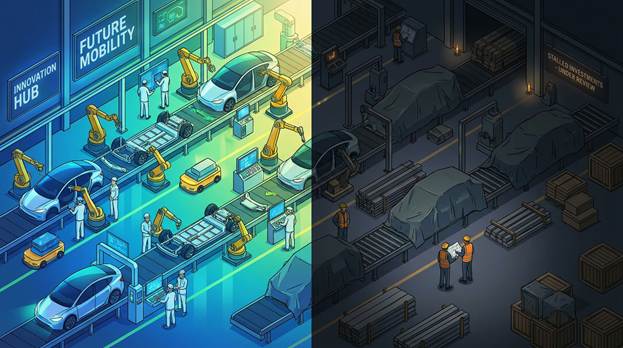
The Inflation Reduction Act (IRA) injected massive subsidies into the EV space, but the shifting political winds threaten to repeal or severely alter these tax credits. Buyers are hesitating, wondering if they should wait for clarity, while automakers are constantly restructuring their supply chains to meet arcane and shifting battery sourcing requirements. When the government effectively weaponizes policy uncertainty, the rational corporate response is to pause investments. We are seeing Ford and General Motors delay battery plant constructions and push back next-generation EV platforms, a reactive strategy that endangers their long-term viability.
Predicting the Failure of U.S. Automotive Companies
Does this current slowdown predict the failure of US automotive companies by 2030? The short answer is yes, for some.
The legacy automakers are currently trapped in the classic "Innovator's Dilemma." They rely heavily on the massive profits generated by their ICE pickup trucks and large SUVs to fund their deeply unprofitable electric vehicle divisions. If the EV transition stalls in the U.S., these companies will naturally retreat to their ICE cash cows. However, the rest of the world—particularly China and Europe—is pushing forward.
If American automakers use this domestic slowdown as an excuse to defund their EV development, they will find themselves completely uncompetitive on a global scale by the end of the decade. Companies like BYD are producing high-quality, software-rich electric vehicles at a price point that legacy American automakers simply cannot match. By 2030, the protective tariffs currently shielding the U.S. market may not be enough to save companies that stopped innovating in 2025.
The 2030 Roster: Which Automakers Will Flourish
By 2030, the companies that will flourish are those that treated software as the core of the vehicle from day one, rather than an afterthought bolted onto an ICE architecture.
Tesla will undoubtedly continue to flourish. Despite the eccentricities of its CEO and occasional missteps in product cadence, Tesla has the manufacturing scale, the charging infrastructure (the Supercharger network is an unparalleled competitive moat), and the software integration to weather the current economic storm. They have already achieved profitability on their EVs and possess the margin buffer to survive high interest rates by lowering prices, a lever legacy auto cannot pull without facing bankruptcy.
Rivian also stands poised to flourish by 2030. They have survived the critical "valley of death" for automotive startups. Their vehicles enjoy massive brand loyalty, and their recent strategic software and electrical architecture partnership with the Volkswagen Group provides them with the capital runway needed to launch their lower-cost R2 and R3 platforms. Rivian understands the lifestyle branding required to sell premium vehicles in the modern era, mirroring the early success dynamics I observed during Apple's rise in the consumer electronics space.
The 2030 Roster: Who Fails On or Before 2030
The companies destined for failure are those unable to bridge the gap between their legacy operations and the electric future.
Stellantis (specifically its American brands like Chrysler and Dodge) is facing an existential crisis that will likely result in a dramatic failure or severe fracturing by 2030. They have been dangerously slow to the EV party in the United States. While they have enjoyed profits from their Jeep and Ram divisions, their software integration is generations behind, and their strategy of relying heavily on plug-in hybrids feels like a stopgap measure rather than a cohesive vision for the future. The sheer weight of maintaining so many disparate, overlapping legacy brands while trying to fund a transition will be their undoing. Expect the Chrysler brand to be effectively dead or sold off before the decade concludes.
Smaller startups that haven't secured massive, legacy-level capital backing will also vanish. We have already seen Fisker collapse, and companies like Lucid, despite having excellent engineering, will likely fail as independent entities unless they are entirely absorbed by their sovereign wealth backers, as they simply lack the scale to compete in a high-interest-rate environment.

The 2030 Roster: Who Remains on Life Support
General Motors will find itself on life support by 2030. GM's strategy with its Ultium platform was theoretically sound—a modular battery architecture that could underpin everything from a Chevrolet Equinox to a GMC Hummer. However, execution is everything. GM has been plagued by severe software glitches, production bottlenecks, and a massive cash burn rate on its electric division.
They are heavily reliant on highly profitable ICE trucks, but as the global market shifts, those profits will begin to dry up. GM will likely survive, but it will be a shadow of its former self, heavily bruised, bleeding market share to software-first competitors, and potentially requiring severe restructuring or government intervention to remain operational as the 2030s begin. They have the engineering talent, but their corporate bureaucracy—reminiscent of the old IBM I used to analyze—is too slow to react to an agile, digitally native market.
Wrapping Up
The transition to electric vehicles is not a linear path; it is a volatile technological revolution currently fighting against severe macroeconomic and political headwinds. High interest rates have temporarily broken the consumer financing model. While this cooling factors may mitigate toward the end of the decade as inflation normalizes and policy solidifies, the damage to legacy automakers is currently compounding.
By 2030, the United States automotive market will be fundamentally fractured. Software-native companies like Tesla and Rivian will flourish, leveraging their agility and unified digital architectures. Conversely, slow-moving giants saddled with legacy ICE debt and inferior software capabilities will face a harsh reckoning. Stellantis's American portfolio risks total failure, while General Motors will likely be fighting for its life on corporate life support. The next four years are the crucible; automakers must innovate through the financial pain today, or they will simply cease to exist tomorrow.
Disclosure: Images rendered by Artlist.io
Rob Enderle is a technology analyst at Torque News who covers automotive technology and battery developments. You can learn more about Rob on Wikipedia and follow his articles on TechNewsWord, TGDaily, and TechSpective.
Set Torque News as Preferred Source on Google
Follow us today...