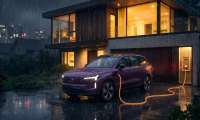

I recently made a significant decision regarding our garage in Bend, Oregon. After initially looking at securing an order for a new Volvo XC60, I completely pivoted my strategy to wait for the upcoming 2026 Volvo EX60 P12. The reasoning goes far beyond simply wanting to jump onto the next new electric vehicle platform. As a technology analyst who spends his days scrutinizing everything from AI orchestration to hardware-enforced security, I look at vehicles as rolling computers. But my wife, Mary, approaches this from a completely different, yet equally rigorous, perspective. As a former Creative Director for Intel, Mary has an exacting lens for design. She evaluates how technology interfaces with the human aesthetic experience, ensuring that a product does not just perform well on a spreadsheet, but feels right in the physical world.
When we sat down to look at the latest specifications and design elements for the 2026 Volvo EX60, it became clear that this midsize EV SUV represents a fascinating convergence of our two worlds. It pairs breathtaking computational power and range with a design language that redefines modern minimalism. We are looking at a machine that delivers a staggering 670 horsepower and 400 miles of range in its P12 AWD trim, while maintaining an aesthetic that is incredibly restrained.
Historical Context And The Evolution Of Volvo Design
To understand why the EX60 looks the way it does, we have to look backward. For decades, Volvo was affectionately known for producing "flying bricks." In the 1980s and early 1990s, vehicles like the 240 and 850 series prioritized ultimate safety and cargo capacity above all else, resulting in a squared-off, utilitarian aesthetic. It was form following the function of surviving a crash and carrying a family.
However, the late 1990s and early 2000s saw a massive shift under designers like Peter Horbury, who introduced the prominent "catwalk" shoulder lines and softer curves seen on the original S80. This evolved further with the introduction of the Scalable Product Architecture (SPA) platform over the last decade, bringing us the "Thor’s Hammer" headlights and a planted, premium stance that finally allowed Volvo to compete on pure styling against the German luxury marques.
The EX60 represents the next massive evolutionary leap. Going forward, Volvo’s design language is entirely dictated by aerodynamic efficiency and electric vehicle packaging. Because the EX60 utilizes advanced cell-to-body technology—where the battery is structurally integrated into the vehicle rather than bolted on—the designers had more freedom to lower the stance and improve the drag coefficient. We are moving away from the era of faux grilles and decorative venting. The future of Volvo design, as previewed by the EX60, is about extreme surface purity. It features an aerodynamic nose, tapered sides, and a sloping roofline that cheats the wind. According to Mary’s creative perspective, this evolution is brilliant because it strips away automotive posturing. The car no longer has to look "aggressive" to convey performance; it looks purposeful, which is a far more sophisticated design statement.
Evaluating The EX60 Minimalist Exterior And Sustainable Interior
Mary and I discuss how difficult true minimalism is to achieve. It is incredibly easy to just leave things out and call it minimalist, but that usually results in a product looking cheap or unfinished. True minimalism requires every remaining element to be perfectly executed.
Looking at the exterior of the EX60, the color palette itself tells a story of restraint. Volvo is offering shades like Forest Lake and Heather Bronze. These are not the screaming neon colors you see on some modern performance cars; they are earthy, confident hues that reflect the natural environment. The tapered sides and flush surfaces reduce turbulence, effectively increasing range while presenting a lithe, futuristic profile.
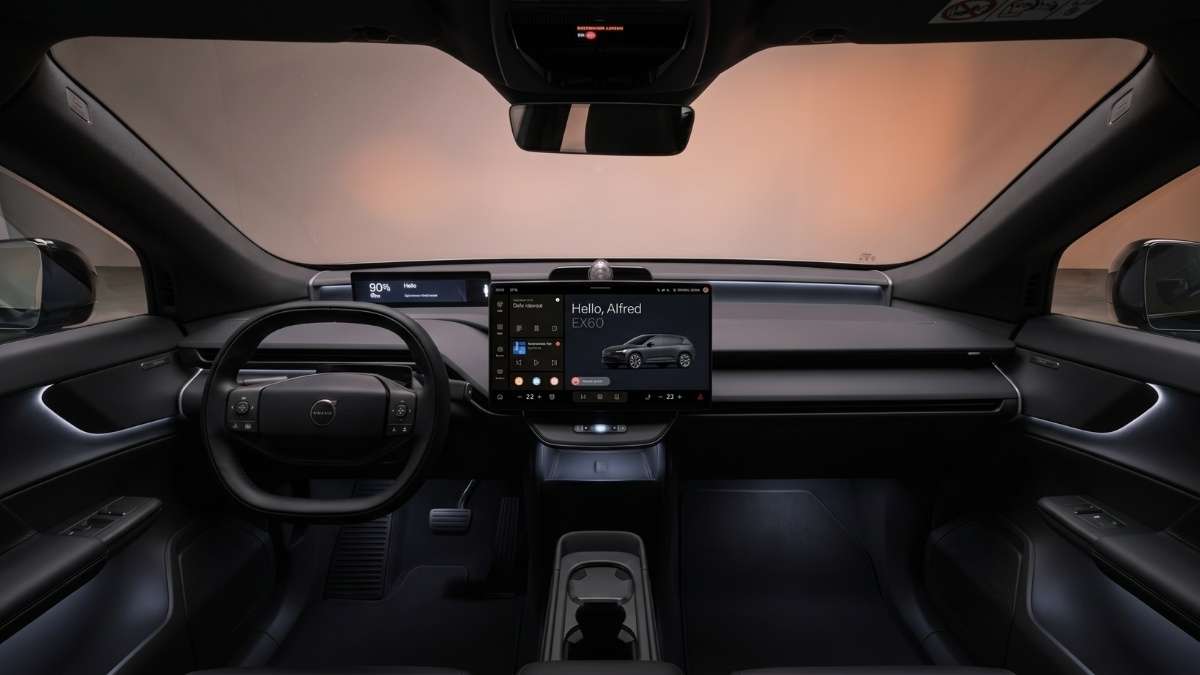
Inside the cabin, the EX60 is a masterclass in Scandinavian design. By utilizing a flat floor architecture—a direct benefit of the dedicated EV platform—Volvo has maximized rear legroom and integrated clever storage throughout both rows. But the real triumph here is the material selection. Instead of relying on vast swaths of cheap piano-black plastic or heavy animal leathers, Volvo leans into sustainable, premium textiles like wool blends. Mary points out that this brings an architectural warmth to the interior, making it feel less like a machine and more like a high-end modern living room.
From a technology standpoint, the interior is dominated by a system powered by the HuginCore processing unit and NVIDIA DRIVE intelligence. This provides a zero-lag infotainment experience. Crucially, the EX60 incorporates Google Gemini as an in-car AI assistant. Unlike some systems that erroneously slap the term "Agentic AI" on basic execution-layer vehicle functions, this is true generative AI designed to understand natural everyday speech for routing, media, and climate controls. Combined with a premium Bowers & Wilkins audio system featuring Dolby Atmos, the interior is an acoustically perfect, sustainably built sanctuary.
Comparing Volvo Minimalist Design Against The Tesla Model Y
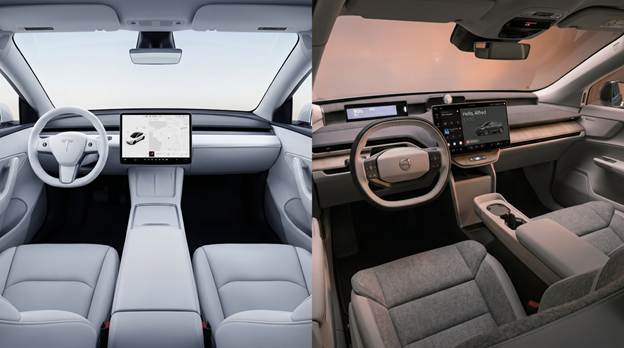
You cannot discuss minimalist EV design without addressing the elephant in the room: Tesla. The Tesla Model Y brought a radical form of minimalism to the mass market. However, Mary describes Tesla’s approach as "clinical minimalism." Stepping into a Model Y feels akin to stepping into a sterilized operating room. You have a stark dashboard, a steering wheel, and a massive central screen that handles absolutely everything. It is a design born from Silicon Valley's obsession with screen-time, often sacrificing tactile usability for visual emptiness.
Volvo’s minimalism in the EX60 is fundamentally different. It is human-centric. While Volvo also utilizes large screens, they do not eliminate physical touchpoints where safety and intuition demand them. The EX60’s interior design is meant to lower your cognitive load and heart rate, not just save money on manufacturing buttons. The integration of sustainable fabrics and thoughtful ambient lighting creates a space that feels curated and warm.
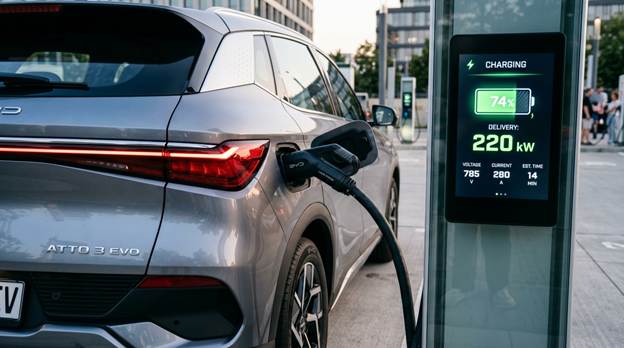
Furthermore, from a functional standpoint, the EX60 completely neutralizes Tesla's biggest historic advantage: the charging network. Because the 2026 EX60 will feature an integrated NACS (North American Charging Standard) port natively, it can utilize the vast Tesla Supercharger network without requiring you to endure the stark, spartan interior of a Model Y. The EX60 even includes Breathe Charge software, which monitors the battery in real-time to enhance fast-charging speeds by up to 30 percent, allowing a 10 to 80 percent charge in just 19 minutes. You get the charging convenience of a Tesla with the luxurious, thoughtful design of a Volvo.

Standing Firm Against The Emerging Chinese EV Wave
The global automotive market is currently undergoing a massive disruption driven by Chinese EV manufacturers like BYD, NIO, and Zeekr. These companies are producing vehicles at an astonishing rate, often throwing massive amounts of technology, screens, and highly aggressive exterior styling at the consumer. If you look at the current crop of Chinese EVs, many feature overwhelming, hyper-styled designs that feel like a chaotic Las Vegas casino on wheels.
Interestingly, Volvo is owned by Geely, a massive Chinese automotive conglomerate. However, Geely has historically allowed Volvo to maintain its distinct Swedish design ethos and engineering independence. How does the EX60 compare to its corporate cousins and competitors from the East? It uses restraint as a weapon.
While Chinese EVs often try to dazzle you with sheer quantity—more screens, more LED light shows, more aggressive angles—the EX60 relies on qualitative design. Mary views this as a vital differentiator for the luxury buyer. When you are overwhelmed by notifications, screens, and digital noise all day at work, the last thing you want is for your vehicle to shout at you. The EX60’s aerodynamic exterior and sustainable, quiet interior stand in stark contrast to the busy designs flooding out of China. It proves that luxury is not about how much you can cram into a car, but about how gracefully you can edit the experience down to its most essential, highest-quality components.
How The EX60 Will Evolve And Differentiate Going Forward
Looking ahead, the EX60 is perfectly positioned to evolve and maintain its competitive edge in a rapidly shifting market. Because it is built on a highly advanced compute architecture featuring HuginCore and NVIDIA DRIVE, the EX60 is a true software-defined vehicle. This means its capabilities will not remain static.
I expect we will see the EX60 evolve primarily through over-the-air updates that continuously refine its AI integration. As generative AI like Google Gemini becomes more capable, the car will transition from a reactive assistant to a proactive partner, anticipating your needs based on the time of day, weather, and your schedule. Furthermore, I anticipate Volvo will continue to lead in safety—a core brand pillar. The EX60 already introduces a world-first multi-adaptive safety belt that provides customized accident protection. Going forward, we will likely see these systems integrate even deeper with the vehicle's sensor suite to preemptively mitigate crash forces before an impact even occurs.
To maintain its differentiation, Volvo must ensure that its software updates remain heavily secured. As I frequently advocate in my security columns, hardware-enforced security is paramount when you are dealing with vehicles capable of 670 horsepower. Ensuring that these systems remain isolated from malicious external actors will be just as important as the sustainable wool on the seats. The EX60 will win by continuing to offer a sanctuary of safety, both physically and digitally.
Wrapping Up
Pivoting my pre-order strategy to the 2026 Volvo EX60 P12 was not a decision made lightly, but analyzing the vehicle through both a technological and a creative lens makes the choice obvious. With its staggering 400-mile EPA-estimated range, 19-minute fast charging capability, and devastatingly powerful AWD powertrain, the EX60 satisfies the uncompromising demands of modern EV performance.
More importantly, it wraps that performance in an aesthetic that is incredibly difficult to execute. By rejecting the clinical starkness of the Tesla Model Y and the chaotic over-styling of emerging Chinese EVs, Volvo has crafted a masterpiece of Scandinavian minimalism. Through the exacting eyes of a former Intel creative director, the EX60 proves that the future of automotive design is not about stripping away humanity in favor of screens, but rather using technology to quietly elevate the human experience. It is a beautiful, aerodynamic sanctuary, and I cannot wait to park one in our Bend driveway.
Disclosure: Images rendered by Artlist.io
Rob Enderle is a technology analyst at Torque News who covers automotive technology and battery developments. You can learn more about Rob on Wikipedia and follow his articles on TechNewsWord, TGDaily, and TechSpective.
Set Torque News as Preferred Source on Google
Follow us today...