
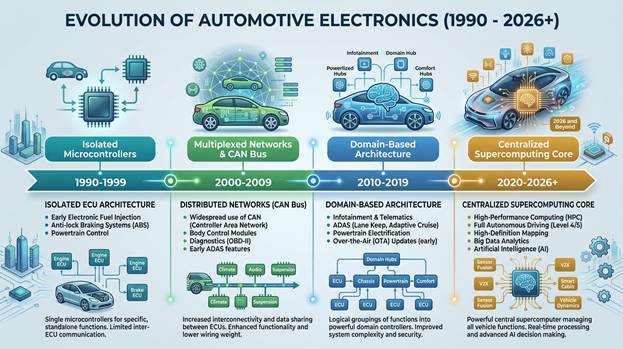
For decades, the automotive industry approached electronics like an afterthought. If a designer wanted to add power windows, they threw in a dedicated electronic control unit (ECU). If they wanted anti-lock brakes, another box went under the hood. By the time the industry transitioned toward electrification, premium vehicles were burdened with over a hundred independent, siloed ECUs, held together by miles of heavy, complex wiring harnesses. This legacy approach is not just inefficient; it is entirely incompatible with the demands of modern electric vehicles (EVs).
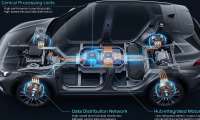
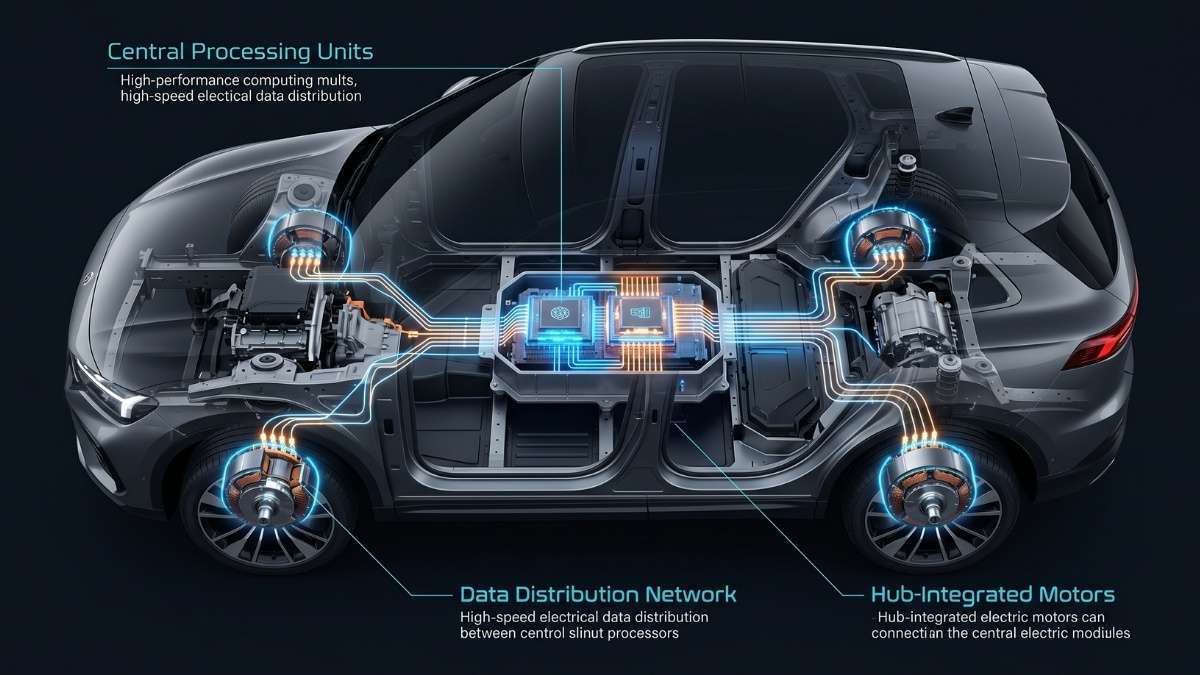
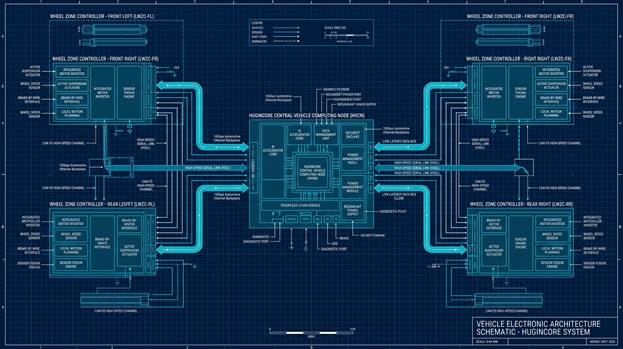
The arrival of the Volvo EX60 signals a structural paradigm shift, proving that the modern premium EV is no longer a mechanical machine with digital features, but a rolling supercomputer built from the silicon up. At the heart of this evolution is what Volvo calls HuginCore - the automaker’s newly christened centralized computing system. Named after one of the omniscient ravens of Norse mythology, HuginCore consolidates the vehicle's electrical architecture, central computer, zone controllers, and proprietary software stack into a single unified foundation.
According to official engineering details published by the manufacturer at Volvo Cars Global News, this architecture represents a pure software-defined vehicle platform capable of executing more than 250 trillion operations per second (TOPS). This astronomical level of computing power is achieved through close silicon-level integration with the world's leading chipmakers.
Instead of relying on a patchwork of low-power microcontrollers, the platform runs on the safety-certified DriveOS operating system, powered by the NVIDIA DRIVE AGX Orin system-on-a-chip (SoC). Simultaneously, the user experience and continuous connectivity are managed by the next-generation Snapdragon Cockpit and Auto Connectivity Platforms developed by Qualcomm Technologies. This level of deep technological collaboration yields an infrastructure where raw computational power directly translates into vehicle dynamics, completely rewriting the rules of how cars behave on asphalt. To understand how these changes are being adopted industry-wide, the Automotive Edge Computing Consortium (AECC) provides extensive studies on how car-to-cloud data pathways are altering global highway infrastructure.
Execution-Layer Automation Versus the Myth of Agentic AI
As automotive marketing departments scramble to capitalize on the public fascination with artificial intelligence, a dangerous trend of linguistic inflation has emerged. Industry executives routinely throw around buzzwords like "agentic AI" or "autonomous agents" when describing everything from smart cruise control to advanced chassis management. This is a severe mischaracterization that confuses the probabilistic nature of high-level generative assistants with the deterministic imperatives of execution-layer automation.
The EX60 beautifully illustrates this distinction by utilizing both systems in their proper, separated domains. Inside the cabin, the vehicle deploys Google's Gemini AI assistant to handle natural, multi-turn human language conversations, allowing the driver to ask complex questions or look up emails hands-free. This is an appropriate use of generative, probabilistic AI, where a minor error or a slight delay in response is harmless.
However, when you dive below the infotainment system into the execution layer—the silicon responsible for advanced torque vectoring, dynamic traction control, and active stability management - probabilistic behavior is completely unacceptable. If a car hits a patch of black ice at seventy miles per hour, the system cannot "hallucinate" or take a few seconds to brainstorm the best course of action. It demands absolute determinism.
Execution-layer automation in a software-defined chassis relies on hardcoded mathematical algorithms operating on dedicated silicon. When the sensors on the EX60 read a loss of traction, the NVIDIA DRIVE platform processes the data and modulates torque to individual wheels in fractions of a millisecond. This isn't an "agent" deciding what to do based on an LLM-style training set; it is a highly advanced, ultra-high-speed feedback loop running deterministic calculations.
The SAE International standards for automotive engineering emphasize that safety-critical systems must possess predictable, repeatable latency and execution paths. This engineering principle is deeply explored in documentation by the Institute of Electrical and Electronics Engineers (IEEE), which outlines why deterministic computing frameworks are non-negotiable for autonomous operations. Mislabeling these critical systems as "agentic AI" undermines public trust and obfuscates the brilliant engineering required to achieve hardware-level smarts. The silicon inside the EX60 does not think like a human; it executes mathematical models of physics with a speed and precision that no human or generative model could ever replicate.
The Evolution and Future Trajectory of Automotive Silicon
To appreciate what Volvo has accomplished with its Superset tech stack, one must look at the historical trajectory of semiconductor technology in transportation. Historically, automotive silicon was defined by its longevity and environmental resilience rather than its raw speed. Carmakers used primitive, mature silicon nodes (often 90-nanometer or larger) because they could withstand extreme temperature swings and vibration, and were guaranteed to remain in production for over a decade.
The explosion of consumer smartphones changed everything. Consumers began demanding that their vehicles match the fluidity, responsiveness, and update frequency of their mobile devices. This forced the automotive supply chain to pivot toward advanced sub-7-nanometer lithography nodes, bringing high-performance computing (HPC) into the mobile space.
The evolution moved from isolated ECUs to domain-centralized architectures, and finally to the zone-centralized architecture seen in the EX60. In this modern setup, localized zone controllers act as data hubs, gathering high-bandwidth sensor inputs from cameras, radars, and lidars, and feeding them back to a central supercomputing node.
Looking toward the future, this silicon trajectory will only accelerate. The next logical leap involves the integration of neuromorphic computing and specialized application-specific integrated circuits (ASICs) designed explicitly for real-time sensor fusion. For a broader look at how semiconductor miniaturization impacts heavy machinery, the Semiconductor Industry Association (SIA) publishes regular roadmaps tracker trends in advanced node scaling. Future platforms will likely transcend the 250 TOPS barrier of the Orin platform, moving into the petaFLOPS range as vehicles transition toward deeper environmental awareness. This computing power will enable predictive chassis adjustments, where the vehicle's silicon scans the road surface meters ahead via lidar and preemptively adjusts the suspension and torque vectoring before the tires even touch the upcoming pothole or slick surface.
The Physical Reality: Power, Heat, and Supply Chains
While the promise of a rolling supercomputer is enticing, it introduces intense physical and thermodynamic engineering challenges that traditional internal combustion vehicles never had to face. The most pressing of these is power management. High-performance silicon chips like the NVIDIA AGX Orin draw significant amounts of electrical energy. In an electric vehicle, every watt consumed by the compute platform is a watt that cannot be used to turn the wheels, directly impacting total driving range.
Worse yet, high computational loads generate massive amounts of excess heat. Consumer laptops use noisy fans to stay cool, but an automotive supercomputer must operate silently and flawlessly for fifteen years in environments ranging from sub-zero arctic winters to blistering desert summers. To combat this, modern EVs must integrate their computing hardware into the vehicle’s primary thermal management loop. This requires complex liquid-cooling plates draped over the silicon processors, rejecting heat into the same thermal system that regulates the battery pack and electric motors. Deep dives into these liquid-cooling dynamics can be found in technical briefs by the Society of Automotive Engineers of Japan (JSAE), who study thermal stresses in dense electric drivetrains.
Beyond the physics of power and heat lies the fragile reality of the global semiconductor supply chain. The automotive chip shortage of the early 2020s proved that the entire global transportation infrastructure is highly vulnerable to foundry disruptions. Because advanced automotive silicon relies on a highly concentrated network of advanced fabrication plants - primarily located in Taiwan and South Korea—any disruption can halt vehicle production worldwide. The European Chips Act framework highlights regional legislative efforts to re-shore this exact type of safety-critical manufacturing. As carmakers pack more advanced processing power into mid-size SUVs like the EX60, their dependency on these specialized semiconductor foundries grows exponentially, turning silicon sourcing into a critical national security and corporate risk management issue.
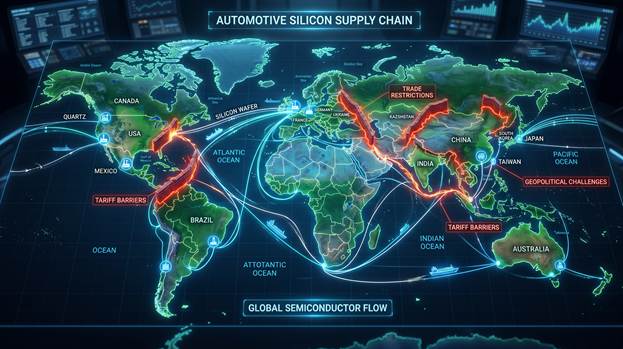
Geopolitical Headwinds: How Tariffs Harm EV Innovation
The greatest threat to the widespread adoption of these advanced, silicon-driven safety technologies isn't engineering limitations - it is geopolitics. The global automotive market is currently fracturing under the weight of aggressive international trade barriers and escalating tariffs. Policymakers in Western economies have increasingly turned to protective tariffs to shield domestic industries from foreign competition, particularly regarding battery manufacturing and electric vehicle assemblies.
However, these blunt economic instruments often trigger severe unintended consequences for technological innovation. Advanced silicon components, sensor suites, and high-performance computing platforms rely on a deeply interwoven international supply chain. A single autonomous sensor platform may feature silicon designed in Silicon Valley, fabricated in Taiwan, packaged in Malaysia, and integrated into a chassis module in Europe or Asia.
When tariffs are slapped on vehicles or components based on their country of origin, it disrupts this delicate ecosystem. Tariffs inflate the baseline cost of importing advanced electronic sub-assemblies, forcing automakers to either strip high-end safety and automation silicon out of entry-level models or pass thousands of dollars in added costs onto the consumer. Research by the Center for Strategic and International Studies (CSIS) emphasizes how supply chain friction directly slows down the deployment of clean energy technologies worldwide.
Consequently, instead of fostering domestic innovation, protective trade barriers risk delaying the rollout of next-generation safety platforms. If an automaker cannot economically deploy a 250 TOPS centralized computing core globally due to tariff-induced margin compression, the democratization of execution-layer safety features stalls. Consumers are left driving less efficient, less intelligent, and ultimately less safe vehicles simply because geopolitical posturing has choked the free flow of advanced automotive silicon.
Wrapping Up
The Volvo EX60 represents a watershed moment in the transition toward true software-defined transportation. By consolidating its operational architecture into the HuginCore system, Volvo has successfully demonstrated how high-performance silicon from NVIDIA and Qualcomm can elevate vehicle dynamics, safety, and responsiveness to unprecedented levels.
Crucially, this engineering achievement reminds us to look past the superficial marketing buzzwords of the day. The core safety mechanisms of the vehicle - such as torque vectoring and traction control—are built on the back of deterministic execution-layer automation, a domain where predictable math must always triumph over the fluid probabilities of generative AI.
As the industry pushes forward, automakers will continue to wrestle with the physical realities of thermal management, power optimization, and an incredibly volatile geopolitical climate plagued by restrictive tariffs. Yet, the blueprint laid out by this rolling supercomputer makes one thing undeniably clear: the future of automotive competitive advantage is no longer forged in the foundry of the ironworker, but engineered in the cleanrooms of the silicon architect.
Disclosure: Images rendered by Artlist.io
Rob Enderle is a technology analyst at Torque News who covers automotive technology and battery developments. You can learn more about Rob on Wikipedia and follow his articles on TechNewsWord, TGDaily, and TechSpective.
Set Torque News as Preferred Source on Google
Follow us today...