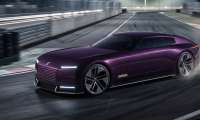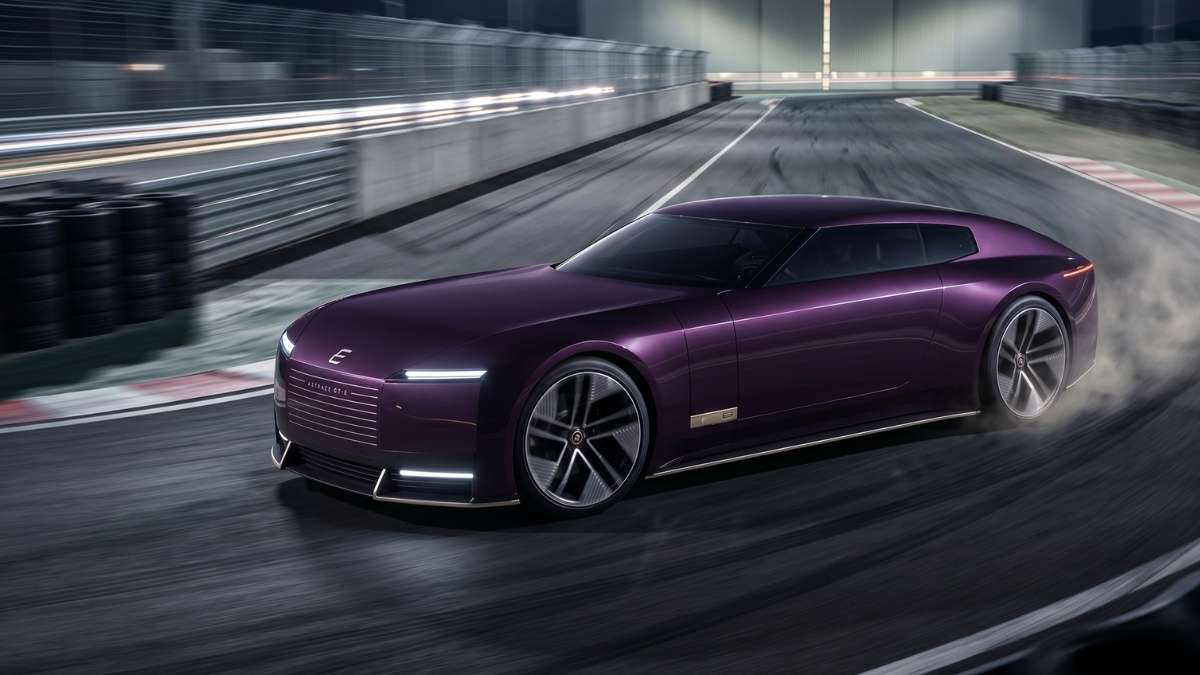

I have spent decades analyzing technology platforms—whether we are discussing the leap from legacy x86 architectures to modern AI-driven silicon like NVIDIA's Blackwell, or the automotive transition from internal combustion engines (ICE) to advanced electric vehicle platforms. Time and time again, the technology industry proves that if the foundational architecture is compromised, the end product will inevitably suffer.
Recently, Jaguar has been in the headlines for all the wrong reasons. A disastrous marketing campaign devoid of vehicles, a polarizing rebrand, and a confusing visual identity alienated their core enthusiast base. It was a textbook example of how not to manage a legacy luxury brand.
However, if you look past the PR nightmare and the controversial new branding, something remarkable is happening beneath the sheet metal. Jaguar took an agonizing multi-year production hiatus, literally stopping their assembly lines, to build an entirely new technological foundation from scratch. As detailed in a recent deep dive into the 2026 Jaguar model lineup, the upcoming Type 01 grand tourer relies on the bespoke Jaguar Electric Architecture (JEA). This platform completely abandons Jaguar's supercharged V8 past to embrace a tri-motor, 800-volt future.
As someone who pushes modern electric vehicles to their limits—often running diagnostics on my own Audi E-Tron GT to monitor how the software interacts with the hardware—I find the JEA platform fascinating. Let's unpack why this dedicated architecture is an engineering marvel and whether it has the sheer processing and mechanical power to pull Jaguar out of the hole they have dug for themselves.
The Clean-Sheet Advantage
When the automotive industry first pivoted toward electrification, most manufacturers took the path of least resistance. They modified existing ICE platforms to accommodate heavy batteries and electric motors. I liken this to trying to cram a massive, modern cooling block and top-tier AMD processor into an outdated PC case; you are forced to make too many compromises on airflow, space, and efficiency.
In a shared vehicle platform, battery placement constantly fights with structural elements originally designed for exhaust routing, transmission tunnels, and engine mounts. The result is typically a vehicle with compromised electric range, awkward weight distribution, and subpar handling dynamics.
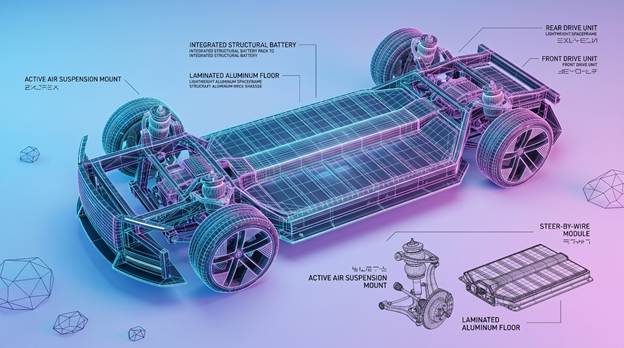
By contrast, a ground-up EV architecture like JEA treats the battery and the electric motors as the fundamental building blocks of the vehicle. Designing a platform exclusively for electric propulsion allows engineers to achieve perfect 50:50 weight distribution and optimize the chassis for the immense, instantaneous torque that EVs generate. In the Type 01, the battery pack isn't just a heavy box bolted to the bottom of the car; it acts as a stressed structural member of the aluminum chassis.
This deep integration results in a staggering torsional rigidity of 50 kilonewtons. A highly rigid chassis is the holy grail for suspension tuning, allowing engineers to dictate exactly how the car behaves in a corner without the structural flex that plagues lesser vehicles. For a driving enthusiast, a clean-sheet design isn't just about efficiency; it is the absolute prerequisite for authentic high performance.
Inside the Jaguar Electric Architecture
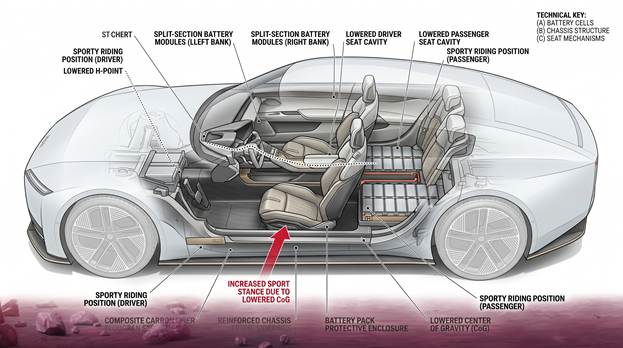
The defining characteristic of the JEA platform is how it manages energy packaging to preserve the low-slung aesthetics of a traditional grand tourer. Most modern electric vehicles utilize a basic "skateboard" platform, where a thick, flat slab of batteries spans the entire floor. While this lowers the center of gravity, it fundamentally raises the floor height of the cabin. To compensate and maintain interior headroom, designers are forced to build taller, bulkier vehicles—which is why the automotive market is currently saturated with electric crossovers rather than sleek, aerodynamic sedans.
Jaguar's engineering team took a different, far more complex route for the Type 01. According to technical specifications released by Jaguar, Jaguar opted to split the massive 120 kWh NMC (Nickel Manganese Cobalt) battery pack into distinct sections rather than employing a uniform flat floor. This ingenious layout allows the passenger footwells to sit lower to the tarmac. It preserves the classic, laid-back driving position of a proper grand tourer and keeps the car’s roofline aggressively low without sacrificing passenger comfort.
Backing up this unique battery configuration is an advanced 800-volt electrical architecture. In the technology sector, bandwidth and throughput are everything. An 800V system allows for dramatically thinner wiring harnesses—reducing overall vehicle weight—while enabling ultra-fast 350 kW DC charging speeds. This capability means the Type 01 can theoretically add 200 miles of its estimated 400-plus mile range in roughly 15 minutes. When you consider that charging anxiety remains a massive hurdle for luxury buyers who expect seamless long-distance travel, integrating an 800V backbone is entirely non-negotiable for a modern flagship.
Comparing JEA to Volvo’s SPA3 Platform
To truly understand where Jaguar is positioning the JEA, we need to compare it to another cutting-edge architecture entering the market: Volvo's SPA3 (Scalable Product Architecture 3), which underpins the highly anticipated 2027 EX60.
Volvo's approach with SPA3 is a masterclass in modern manufacturing scalability. As detailed in Volvo's technical breakdown of the architecture, SPA3 utilizes "cell-to-body" technology, where individual battery cells are bonded directly into the floor structure, entirely eliminating separate battery enclosures. Volvo’s primary goal with SPA3 is manufacturing flexibility - the ability to stretch or shrink the wheelbase and swap battery chemistries on the fly without halting their assembly lines. It is a brilliant strategy for mass-market profitability and consistent software integration via their centralized core computing systems.
However, Jaguar's JEA serves a vastly different master. Where Volvo's SPA3 is optimized for volume and modularity, Jaguar’s JEA is heavily biased toward extreme, uncompromising performance and bespoke luxury. Volvo wants to build everything from compact crossovers to large SUVs on one efficient line. Jaguar, conversely, is intentionally moving upmarket into ultra-luxury territory, targeting Bentley and Porsche buyers.
The JEA's bespoke, split-battery layout is less efficient from a pure mass-manufacturing standpoint than Volvo's uniform cell-to-body skateboard, but it pays massive dividends in driving dynamics, aesthetics, and seating posture. Both are state-of-the-art clean-sheet EV platforms, but they reflect divergent corporate philosophies: Volvo’s utilitarian scalability versus Jaguar’s emotional, performance-driven exclusivity.
Performance That Defies the Packaging
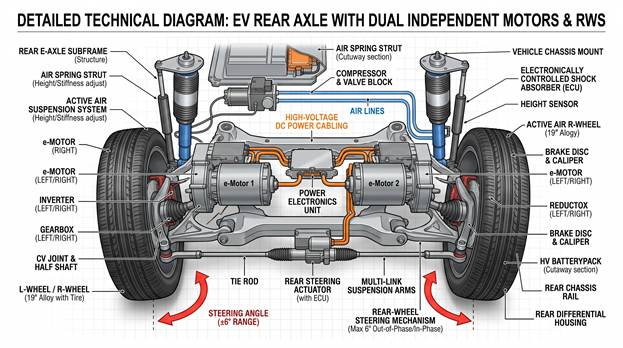
The raw specifications enabled by the JEA platform are nothing short of breathtaking. The Type 01 features a sophisticated tri-motor configuration—one motor dedicated to the front axle and two independent motors managing the rear. This setup generates over 1,000 horsepower and an earth-shattering 959 pound-feet of instantaneous torque.
Straight-line speed is the easiest metric to achieve in an electric vehicle. Making a 5.2-meter-long, 2.7-ton grand tourer dance through a canyon road is an entirely different engineering challenge. This is where the Silicon Foundation truly shines. The JEA utilizes a centralized compute module that governs a highly advanced torque vectoring system. This system monitors wheel slip 1,000 times per second, dynamically distributing power across the rear axle to push the car aggressively through corners.
It is crucial to understand that this level of real-time execution-layer automation—like active torque vectoring and traction control—relies on deterministic algorithmic processing. It is a conceptual mismatch for the kind of generative AI that dominates today’s headlines, but it is absolutely essential for keeping a heavy, 1,000-horsepower vehicle safely on the road.
Jaguar went to great lengths in testing to ensure the Type 01 retains a distinctly rear-wheel-drive soul, allowing the system to shift up to 87 percent of its power bias to the rear wheels. To further mask its substantial wheelbase, the architecture incorporates standard four-corner air suspension, active twin-valve dampers, and a rear-wheel steering system capable of pivoting the back tires up to six degrees. Having tested vehicles with similar rear-steer technologies, I can attest that it virtually shrinks the wheelbase at low speeds while providing bullet-train stability during highway lane changes.
Can Engineering Save a Controversial Design?
For all its mechanical brilliance, we must address the reality of the market. The rollout of the Jaguar rebrand and the debut of the Type 00 concept have been widely regarded as a massive misstep. The decision to abandon decades of beloved heritage, eliminate the leaping cat from primary branding, and launch an abstract ad campaign without showing a single vehicle profoundly alienated their most loyal customers.
Furthermore, the design of the Type 01 - featuring a monolithic silhouette and the complete elimination of a traditional rear window in favor of a digital camera feed—has proven deeply polarizing. The core question is whether transcendent hardware can overcome unpopular styling and disastrous public relations.
In the technology world, we have seen brilliant hardware fail due to poor marketing, but we have also seen undeniable performance metrics force critics to change their tune. If the Type 01 drives with the precision that the JEA platform promises—if it genuinely delivers 1,000 horsepower, seamless 350 kW charging, and the handling of a car half its size—it will command respect from the automotive press and affluent enthusiasts. The high-end EV buyer is often driven by exclusivity and measurable superiority, and the technology embedded in the Jaguar Electric Architecture is undeniably world-class.
Wrapping Up
Jaguar’s transition to an electric-only future has been undeniably turbulent, marred by confusing marketing and a design language that has yet to win over the masses. Yet, beneath the controversial exterior of the upcoming Type 01 lies the Jaguar Electric Architecture - a platform that represents a monumental achievement in automotive engineering. By committing to a clean-sheet, 800-volt design featuring a bespoke split-battery layout, tri-motor torque vectoring, and immense structural rigidity, Jaguar has created a silicon and aluminum foundation capable of challenging the absolute best in the ultra-luxury EV market. While it lacks the manufacturing scalability of platforms like Volvo's SPA3, it compensates with uncompromising, purebred performance. If anything can pull Jaguar out of the reputational hole they are currently occupying, it will not be an abstract ad campaign; it will be the sheer, undeniable excellence of the hardware hidden underneath.
Disclosure: Images rendered by Artlist.io
Rob Enderle is a technology analyst at Torque News who covers automotive technology and battery developments. You can learn more about Rob on Wikipedia and follow his articles on TechNewsWord, TGDaily, and TechSpective.
Set Torque News as Preferred Source on Google
Follow us today...