
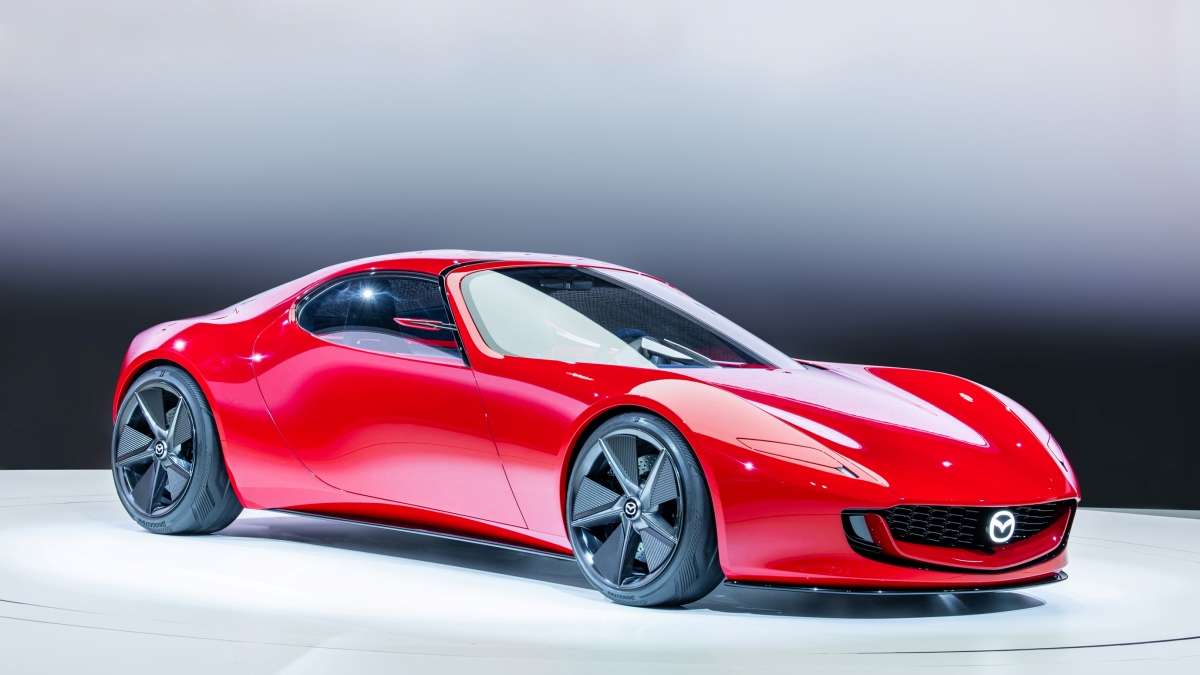

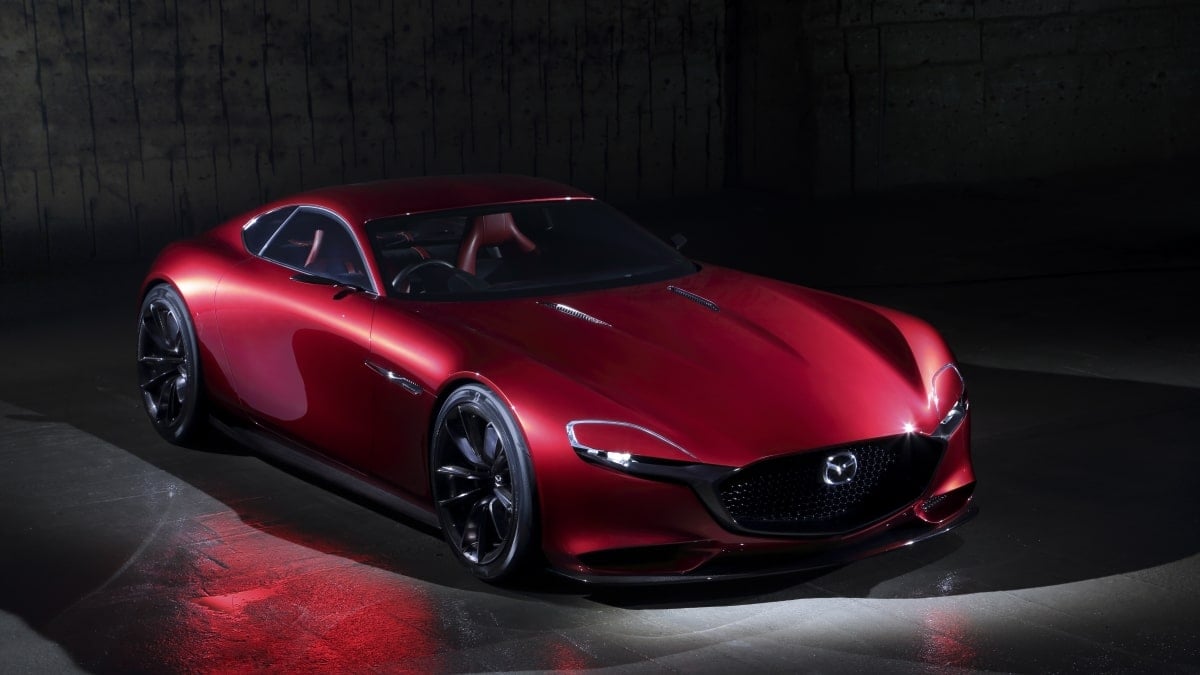
Mazda has always done things differently, and there is no better example of that than the rotary sports cars the company used to make. While most other Japanese carmakers were focusing on high-tech, cars like the RX-7 focused on a small, but power-dense Wankel engine fitted in a balanced lightweight package. Back in 2015, Mazda unveiled the RX Vision Concept - a stunning recreation of what a modern-day RX-7 FD would look like.
I really wanted Mazda to make that, and patents suggest the company was working on a hybrid rotary powertrain with all-wheel-drive capability. Since then, many conflicting reports have surfaced, and the patents Mazda filed were proof that the company is hard at work making the new rotary sports car feasible. Unfortunately, the latest reports indicate that the revival of the rotary sports car will be put on hold indefinitely, and there is a good reason for that.
Related story: Mazda RX-Vision Coupe May Have Remained A Concept, But Someone Else Made A Road-Legal Variant
Sales decrease
The grim reality of the automotive industry is that, like all other businesses, it is always a question of finances. Questions like “how much will it cost” and “how much can be saved” are evermore prevalent in the industry for obvious reasons. Even though Mazda currently makes some of the most interesting vehicles, the company isn’t doing too well in North America. The Japanese company’s North American division saw a 14.4-percent decrease in sales for the first quarter of 2026. In March alone, Mazda sales dropped by a whopping 25.7 percent compared to March 2025.
Mazda said its performance models hinged on the success of its SUV models
Promises of a rear-wheel-drive Mazda 6 were not made, but in an interview with Car and Driver, Mazda’s CEO mentioned that the development of more performance-oriented models hinges on the success of their new SUV lineup, including models like the CX-70 and the full-size CX-90, to name a few.
"We've got a really beautiful concept. We already have this idea. We are able to install a six-cylinder, but marketability remains a concern,” Masahiro Moro said.
Mazda sales in North America have dropped due to strategic production cuts in response to tariffs on vehicles built in Mexico. Mazda2, Mazda3, and Mazda CX-30 are built in the company’s plant in Salamanca, Guanajuato. Two of these (the 3 and CX-30) are among the top-selling models in North America, and they are being taxed at a 25-percent tariff. Interestingly enough, the most popular Mazda model - the CX-5 - is produced primarily in Japan. US import tariffs on cars produced in the land of the rising sun are 15 percent.
Related story: 5 Clever Features That Make The Mazda 3 More Premium Than You Think
Mazda is forced to increasingly depend on its US-based production facility in Huntsville, Alabama, which is a joint manufacturing plant with Toyota, in order to bypass US import tariffs. Currently, the plant focuses on producing the Mazda CX-50 and Toyota Corolla Cross.
Even the Mazda MX-5 won’t stay the same, but this could be for the better
The Mazda MX-5 Miata continues to be the company’s flagship performance model. The ND generation came out for the 2016 model year, which officially makes it a decade old at the time of writing this article. But even the Miata won’t stay the same, as the next generation brings a few important changes, including a new engine.
Why are these changes still necessary
The Trump administration may have neutered CAFE regulations, but many of Mazda’s models, including the Miata, are global. This means they still need to cover emissions requirements in Europe and other regions of the world.
Rotary engines are notoriously difficult to make compliant with the ever-stringent emissions requirements. This was, reportedly, the main reason Mazda delayed the RX-7 successor for so long, and probably why we may never get it, at least not with a rotary. Many Mazda employees are pushing for a new flagship sports car. There is light at the end of the tunnel. Toyota has reportedly shown interest in Mazda’s inline-six engine for a future sports car, which could be the Supra, and the two companies work closely on multiple levels, an inline-six-powered Mazda flagship sports car is not out of the question.
While much of that last part is speculation, such a strategic move is not beyond the realm of possibility. Toyota has experience with high-performance inline-six engines, and Mazda may have produced the perfect foundation for one. But let me know what you think. Would you buy a Mazda sports car, powered by an inline-six? Let me know in the comments below.
Related stories:
Mazda Never Made A New Speed3, But Here's How Little It Takes For The Current Model To Become One
Image source: Mazda RX-Vision, Mazda Iconic SP
About the author
Dimitar Angelov has been an automotive journalist since 2014. His passion for cars and motorcycles led him to take up classic car restoration at the Classic Car Museum in Malta. While living there, he also graduated with a Master's in Media and Communications. Aside from Torquenews, his work can also be seen on Topspeed.com, HotCars.com, Motorheads.com, Jalopnik.com, and his own website, Ridereverie.com, where he also includes motorcycle content.
Other relevant experiences in the automotive scene include working at a Toyota dealership, professional driving, and automotive insurance. Dim is happy to get behind the wheel of any car and share his impressions. You can follow Dimitar on X, LinkedIn, Instagram, and Facebook.
Experience
- 2012-2017 and 2025-Present: Insurance Advisor - ANG Univers and Generali Insurance Group
- 2016-2016: Car salesman at Toyota dealership
- 2014-Present: Automotive journalist, blogger, vlogger, test driver
Education
- Bachelor's degree in International Economic Relations
- Master's degree in Marketing
- Master's degree in Media and Communications
Dimitar Angelov has been quoted in the following publications:
Set Torque News as Preferred Source on Google
Follow us today...







Comments
While the CX-50 is doing…
Permalink
While the CX-50 is doing well, I wouldn't place a bet on the 2026 CX-5 helping fix things for Mazda.
I know it is -supposedly- doing well in Japan, according to what Mazda says. If truly so, that will help. But in the US, the car is wildly disliked. Including by me. Longer, wider, heavier, less net horsepower, cheaper materials and construction, dis-contented vs prior generation, ugly nose, wrecked-looking rear, etc. Even the wheels are ugly.
I had thought about replacing my 2020 Signature with a new 2026, but there is nothing about the new version I like. Literally not a thing. It is a CX-5 in name only. It has none of the sport or energy of the first two generations.
RIP CX-5