
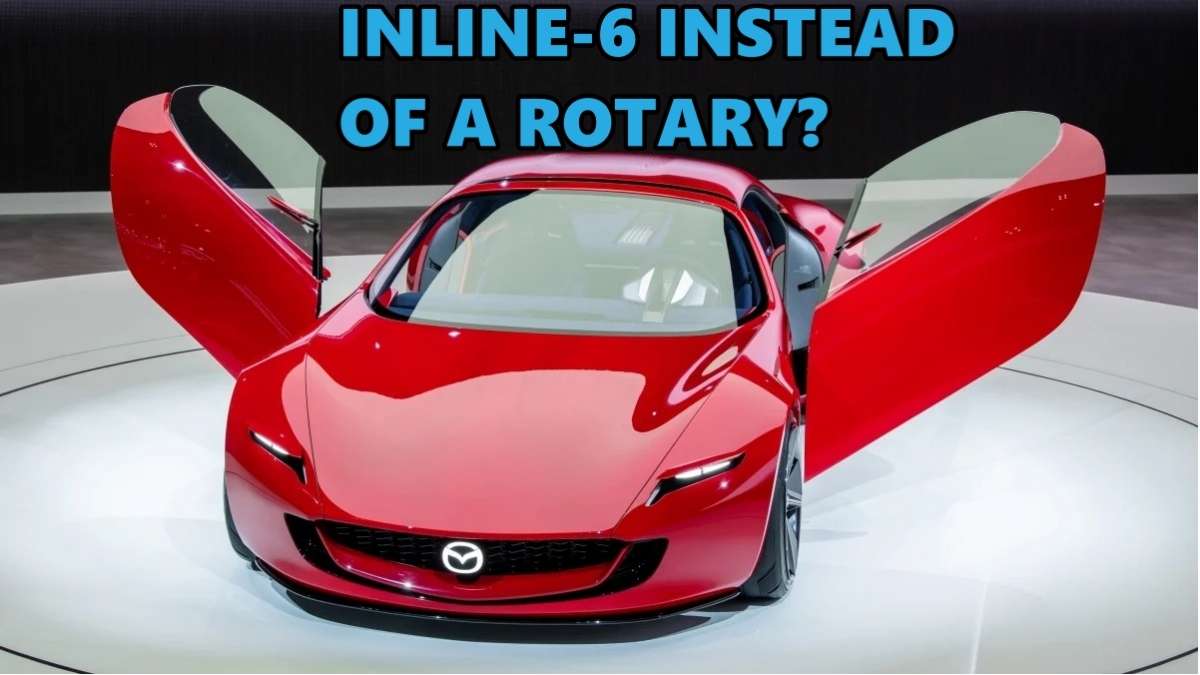

The return of Mazda’s rotary sports car is something I have been discussing for years. Since 2015, every once in a while, we have been hearing reports that a new flagship sports car is either in the works or being shelved. From the patents Mazda filed last year to the internal pressure the company is facing from Mazda enthusiast employees, things have been rocky for the rotary engine’s rebirth since the beginning.
The latest reports, however, paint a different picture…again! I recently reported on a scoop from the Japanese publication, BestCarWeb, according to which Mazda has already developed a twin-rotary engine for use in an RX-7 successor. This new report puts the car in a completely different performance segment than what we were initially led to believe, and this will no doubt come with a price tag worthy of a flagship sports car… which will likely spell bad news for most enthusiasts.
Related story: Mazda RX-Vision Coupe May Have Remained A Concept, But Someone Else Made A Road-Legal Variant
The rotary engine dilemma and the alternative that might be better.
A few things we have always known about rotary engines is that they are more maintenance-intensive than conventional reciprocating engines, they burn oil by design, and that covering strict emissions regulations is more of a challenge. They also have a reputation for a much shorter lifespan, compared to piston engines, although there are ways to make your Mazda rotary engine last 150,000 miles or more.
Mazda has already developed a twin-rotary engine with a total displacement of 1,660 cc (2x830cc). Unlike previous reports, the latest scoop doesn’t mention three electric motors and all-wheel drive. Instead, it only mentions one electric motor and the ability to drive on electricity only for a certain amount of distance.
But Mazda has another engine that is arguably better-suited for a high-performance sports car. So good, in fact, that Toyota has shown interest in the Mazda engine. The 3.3-liter Skyactiv-G engine is Mazda’s biggest engine, completely developed in-house. Yes, there was the 3.7-liter V-6 from older models, but that mill was from the Ford Cyclone engine family.

The 3.3-liter inline-six makes 340 horsepower and 369 pound-feet in its most powerful iteration. It also works as part of a mild-hybrid setup where a small electric motor with 17 horsepower and 112 pound-feet is located in the transmission housing. This is already a good baseline for a performance car. A larger motor and some engine tweaks could easily result in a total output of 500 horsepower.
Mazda’s overall carbon footprint is competitive when compared to other manufacturers, despite the company falling behind on the electrification front. The company’s Skyactiv engines are some of the most efficient on the market, thanks to advanced engineering such as Spark controlled compression ignition (SPCCI), which combines elements from diesel and gasoline cycles.
A Wankel engine has a higher carbon footprint than a reciprocating engine due to a considerably higher oil consumption, lower fuel efficiency, and higher emissions. The logical thing to do is to use the inline-six engine, which already covers the strict Euro 7 emissions regulations, which are some of the most stringent in the world. There are inherent advantages to the inline-six configuration such as smooth operation and ease of maintenance.
Moreover, Toyota has great experience with the inline-six layout, and since it is partnering with Mazda, it is practically an invitation to make a new 2JZ, based on the Skyactiv architecture. Do you think a flagship Mazda sports car should remain rotary-powered or should it get an inline-six? Lately, we are seeing how manufacturers are listening to enthusiasts, so let me know what you think in the comments below.
Related stories:
5 Clever Features That Make The Mazda 3 More Premium Than You Think
Should Mazda Make A Larger, More Powerful Miata?
About the author
Dimitar Angelov has been an automotive journalist since 2014. His passion for cars and motorcycles led him to take up classic car restoration at the Classic Car Museum in Malta. While living there, he also graduated with a Master's in Media and Communications. Aside from Torquenews, his work can also be seen on Topspeed.com, HotCars.com, Motorheads.com, Jalopnik.com, and his own website, Ridereverie.com, where he also includes motorcycle content.
Image source: Mazda press
Set Torque News as Preferred Source on Google
Follow us today...






Comments
So true! Or just use the 2…
Permalink
So true! Or just use the 2.5L with 320 lb-ft of torque. It's already here, and it's a great engine.
An inline engine is long,…
Permalink
In reply to So true! Or just use the 2… by John Goreham
An inline engine is long, and shifts the weight balance forward, a mistake for front-engine sporty. Wankels are never worth living with. Always, V-configuration motors are the best choice.
Toyota pulled it off with…
Permalink
In reply to An inline engine is long,… by anonymous (not verified)
Toyota pulled it off with the GR Supra. Granted, the Mazda will likely be smaller.
It's an option. It will be…
Permalink
In reply to So true! Or just use the 2… by John Goreham
It's an option. It will be more compact too. But to get to the aforementioned 500 horsepower, they'll need to use a very powerful electric motor that provides half the power.