
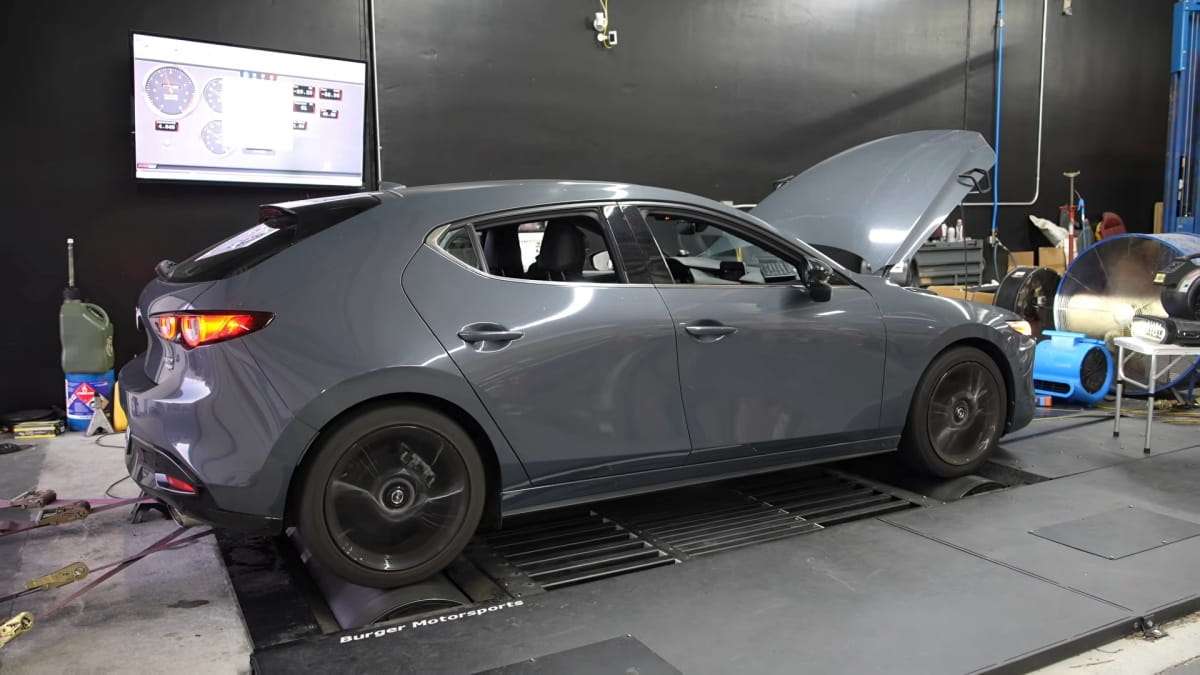

In the automotive world, there are certain cars that are the go-to platforms for those looking to gain performance with little effort. Nowadays, there are plenty of models that offer a turbocharged engine and a playful chassis, especially in the compact sedan and hot hatchback segment. While the Honda Civic Type-R, Hyundai Elantra N, and VW GTI (and its Jetta GLI sedan counterpart) might be the first to come to mind, Mazda has a dirty secret.
We know that in the past, there was the Mazda Speed3, which was the company’s hot hatchback offering. In fact, there were two generations of it, the first one being made from 2007 to 2009, and the second, from 2010 to 2013.
The current generation is a bit of an underrated platform when it comes to making more power. Mazda never advertised the new 3 (which has been around since 2021) as a performance model, but many publications (us included) have compared it to popular performance models from the segment, and for a good reason.
Burger Performance is one of the companies that specialize on the Skyactiv-G platform, and there are plug-and-play solutions, specifically for the 2.5-liter turbo engine. I took a look at how easy it is to gain more power, and while at it, found reasons why people don’t modify this particular platform often.
The baseline is what you would expect, but the torquey nature of the engine is apparent even in stock form.
The Mazda 3’s 2.5-liter turbo-four engine packs 250 horsepower and 310 pound-feet from the factory. Three things stood out to me when I tested this powertrain in a Mazda 6 Turbo, a few years back - the engine isn’t particularly rev-happy, there is a wide torque-band, which starts from around 2,000 RPM, and the six-speed automatic (sadly, there is no manual, but at least it’s not a CVT) isn’t particularly sporty. Still, this isn’t an all-out performance model.
The baseline dyno run revealed 203 horsepower and almost 275 pound-feet, which, given an estimated drivetrain loss of around 20 percent (due to the all-wheel drive), seems to confirm the factory-claimed figures.
The Mazda 3 hatchback seen in the video was used for developmental purposes. After installing the JB4 unit and exchanging the very restrictive intake, the dyno run showed 254 horsepower and 356 pound-feet at the wheels. That’s roughly 300 horsepower and 400 pound-feet at the crankshaft. That’s before adding methanol injection, which results in even more gains. Throughout the dyno runs, the engine retains its torquey and low-revving characteristics. In the third run, peak power is at 4,260 RPM and peak torque is at 2,390 RPM.
Why the Mazda 3 2.5 Turbo is not a popular platform
Mazda likes to do things differently, and the Skyactiv-G engine features some unconventional engineering. While the turbo variant doesn’t have cylinder deactivation, it still has some unconventional engineering. For starters, it features a relatively high compression ratio of 10.5:1, and turning up the boost significantly may result in damage to the pistons. The dome-shaped pistons feature a cavity and are meant to withstand high compression, but due to tight tolerances, the engine is very sensitive to oil quality and timely maintenance.
On the plus side, the 2.5 turbo does not feature Mazda’s Spark Controlled Compression Ignition (SPCCI), which relies on both spark plugs and compression to ignite the fuel mixture. This technology is reserved for the brand’s more economy-focused engines.
Another reason the compact Mazda is underrated is that there are better platforms to build upon. The Mazda 3 Turbo AWD is more of a “gentleman’s hot hatchback”. It appeals more to people who want more refinement while still packing power. The smooth, automatic, and torquey engine are a testimony to that. For this reason, the standard 250 horsepower is enough for most buyers.
I think Mazda’s compact turbocharged hatchback/sedan could become popular in the future, which means you will be able to pick one up for not a lot of money. I can definitely see potential manual swaps, too, since the stick is only available on some of the normally aspirated models. Would you buy the Mazda 3 2.5 Turbo AWD or would you go for one of the more performance-oriented competitors? Let me know in the comments below.
Dimitar Angelov's automotive interests made him an expert in a wide variety of vehicles. Japanese brands like Toyota and Nissan are closest to his heart, although performance cars in general are his favorite segment, which is why he is constantly on the lookout for the best deals on the market. Dimitar Angelov's car passion and knack for the written word led him to complete a Master of Arts in Media and Communications, and classic car restoration. Dim is happy to get behind the wheel of any car and share his impressions. You can follow Dimitar on X, Linked-in, Instagram, and Facebook.
Set Torque News as Preferred Source on Google
Follow us today...







Comments
I've always liked Mazda 3s…
Permalink
I've always liked Mazda 3s. In fact, I owned a non-turbo version, a 2.5L S GT for 9 years. That was a 2014, and sometime around 2018 or so, Mazda added more sound insulation and softened up the ride. Before that car, I had a 1989 MX6 GT Turbo. Many owners, including myself swapped out its "brain box" before increasing boost pressure. That was a great car as well.
I've always loved Mazdas,…
Permalink
In reply to I've always liked Mazda 3s… by David Sulli (not verified)
I've always loved Mazdas, especially the 3 and 6 (and RX-7, of course). Almost ended up buying one a couple of times, but never actually went through with it.
Swapping out the "brain box" as you say, is definitely a good thing to do if you are chasing more power. I wish they did a proper Speed3 variant of the new 3.
I'm in the market to…
Permalink
I'm in the market to purchase a new vehicle. I was wondering about the reliability of this Mazda in question? I like the idea of an all wheel system accompanied by a turbo equiped motor...can anyone out there provide an insight to my query? Thanks in advance.
TED
So far, they seem to be…
Permalink
In reply to I'm in the market to… by Ted Hernandez (not verified)
So far, they seem to be reliable platforms. I don't hear many complaints from owners. I was looking to buy a Mazda 6 or Mazda 3 Turbo for some time, but ultimately went with a different car. They even tried selling me a normally aspirated version of the Mazda 6 that was advertised as a 2.5 Turbo lol
I would add that the 2.5…
Permalink
In reply to I'm in the market to… by Ted Hernandez (not verified)
I would add that the 2.5 Turbo version doesn't have the cylinder deactivation. Mazda isn't known for having issues with those, but still, it is an additional failure point that the Turbo model doesn't have. Of course, the Turbo is also a potential failure point, but at this point, very few normally-aspirated engines are left.
That said, modern engines have much tighter tolerances, and with complex systems like VVT and so on, staying on top of maintenance is what ultimately determines how pain-free your ownership experience is. The 6-speed auto is not the quickest, but it's smooth and reliable. Overall, I'd consider the Mazda 3 if you are in the market for a car in this segment. They also look the part in my opinion.
Mazda retailers offered 0W20…
Permalink
Mazda retailers offered 0W20 F/S Moly until it was
discontinued by Japan in the USA. Now offered for
all Mazda vehicles requiring 0W20 F/S is the ECO 7
product that replaces the original product. It’s only
made in Japan, shipped to the US, and bottled for
sale only at participating retailers. This product was
originally released for the CX-90 models. Idemitsu Lubricants will only offer the best products through the Genuine Mazda Premium Oil Program. Contact
your local retailers. Idemitsu products are the best.