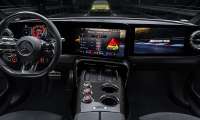

Every once in a while, the modern automobile reminds us that, beneath its calm interfaces and carefully curated design language, it is still a rolling network of computers that occasionally wake up confused. A recent post in the r/MazdaCX30 community captured that reality perfectly, when an owner in Alaska replaced the battery in a 2023 CX-30 Turbo and was greeted not by warning lights or fault codes, but by a speedometer that had decided the world looked better upside down.
The setup is almost too ordinary. Cold climate, factory battery that could not cope, sensible decision to install a new one. This is the kind of maintenance scenario that has played out millions of times without incident. And yet, when the electronics powered back up, the center display in the instrument cluster appeared flipped vertically, as if the car had briefly forgotten which way was up. Ignition cycles changed nothing. Pulling the cluster fuse did nothing. Letting the car sit did nothing. The car drove, but visually, it had entered an alternate reality.
“Any ideas how to reset this? OEM battery can't hold up to the cold here in Alaska, so I swapped a new one, and now it looks like this. Tried letting it sit for a while and also pulling the instrument cluster fuse to see if it would reset, but no dice. (All the lights are on because the ignition is not on, just the electronics. Turning on the ignition does not change it.
Update:
Tried all kinds of tricks to reset the dash or factory reset. Different discharges, talked to Mazda corporate, talked to the dealership. Thanks to those of y'all that offered helpful suggestions, and glad lots of folks got a good laugh. It fixed itself once I drove a couple of miles down the road on the way to the dealer. Poof, and it was right side up. Such a strange mirror flip saga, no one at Mazda had heard of anything like that happening.”
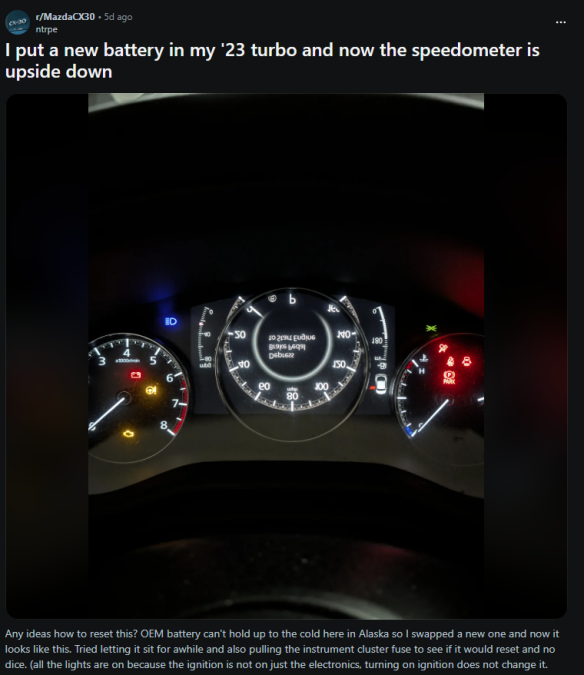
The lights on the CX-30 dashboard were on only because the ignition was not fully engaged, and even with the engine running, the display remained inverted. The head-up display, if equipped, was unaffected. This was not a system-wide failure, just one screen behaving like it had woken up on the wrong side of the codebase.
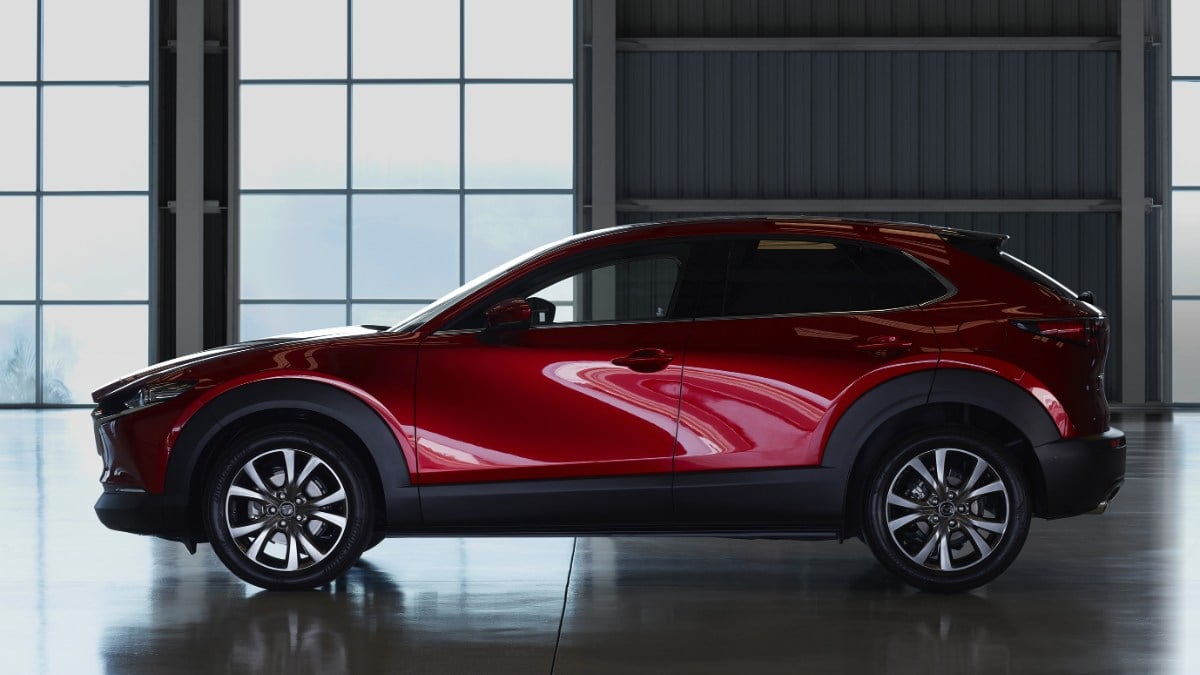
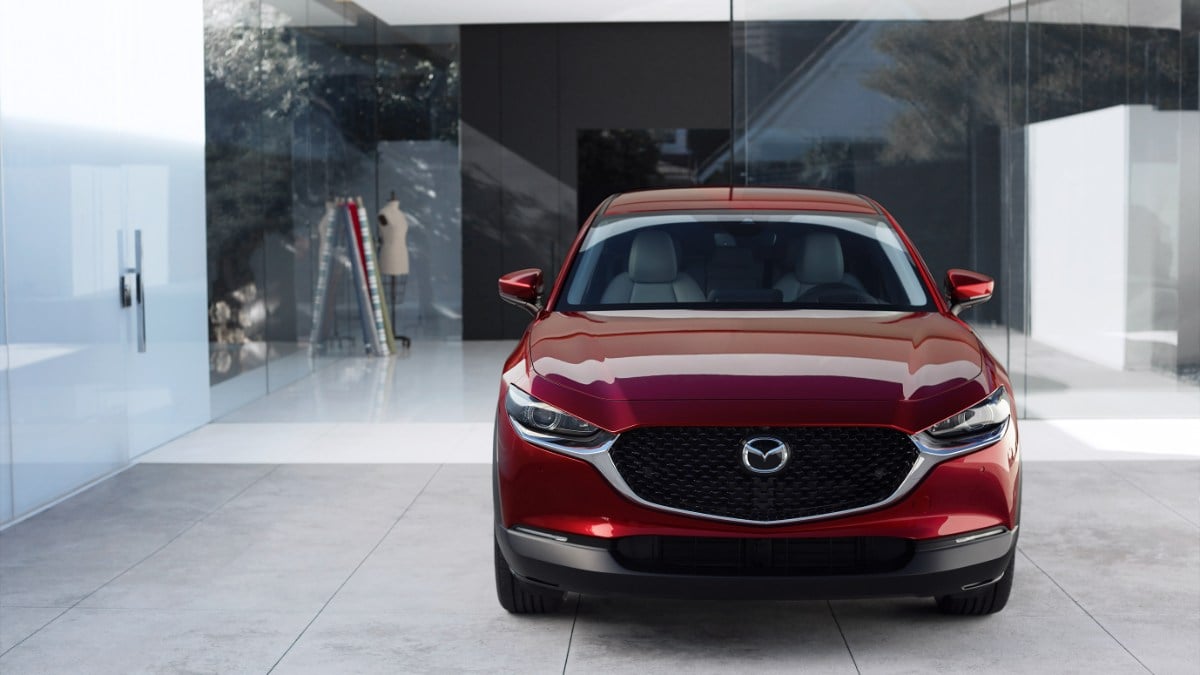
Mazda CX-30: Who It's Made For
- The Mazda CX-30 is a subcompact crossover that fits between the Mazda3 and the larger CX-5 in Mazda’s lineup.
- It is known for a more upscale interior feel compared with many vehicles in the same size and price range.
- The CX-30 comes standard with all-wheel drive in many markets, which is uncommon for small crossovers.
- Its smaller size makes it easier to park and maneuver, especially in urban environments.
Naturally, the comments leaned into humor. People laughed, openly and kindly. Someone suggested turning the battery upside down. Others joked about Mazda engineers hiding Easter eggs or internal pranks. The original poster played along, promising to try reinstalling the old battery, which only added to the charm. In an era when online car discussions often spiral into doom and outrage, this one stayed light, communal, and refreshingly human.
Underneath the jokes, though, there was a real technical curiosity. Instrument clusters are not dumb gauges anymore. They are displays driven by software states, initialization sequences, and sensor inputs. A sudden voltage change to the CX-30, particularly in extreme cold, can leave a control module in a strange limbo where orientation data or screen mapping fails to initialize correctly. It is rare, but not impossible, especially when batteries are swapped without a full system reset.
The owner did the right things. They tried resets. They contacted Mazda corporate. They spoke with the dealership. No one had heard of this specific issue before, which is often the case with edge-condition software behavior. When systems are designed to be robust, the rare failures tend to be bizarre rather than catastrophic. This was not a breakdown. It was a hiccup.
Then came the anticlimax that makes the story perfect. On the drive to the dealer, after a couple of miles on the road, the display simply corrected itself. No warning chime. No dramatic reboot. One moment it was upside down, the next it was normal. Poof. As if the car needed motion, sensor input, or a completed drive cycle to finish orienting itself properly.
That resolution tells you a lot about modern vehicles. Many systems do not fully recalibrate until they see wheel speed, steering angle, and other dynamic inputs. Sitting still in a driveway, even with the engine running, is not always enough. Once the car experienced real-world data, the software snapped back into alignment.
Nothing was broken. No parts were replaced. No software was reflashed. The car simply remembered who it was once it got moving. The episode became a brief but memorable footnote in ownership, the kind of story you tell not because it was frustrating, but because it was strange and oddly endearing.
It is easy to see this as a joke, and it is genuinely funny. But it is also a quiet reminder of how cars work now. They are not just mechanical objects but digital ones, capable of small, surreal lapses that resolve themselves without explanation. Sometimes the fix is not a wrench or a scan tool. Sometimes it is just a short drive down the road, letting the machine wake up fully and realize which way is up.
Image Sources: Mazda Media Center
Noah Washington is an automotive journalist based in Atlanta, Georgia. He enjoys covering the latest news in the automotive industry and conducting reviews on the latest cars. He has been in the automotive industry since 15 years old and has been featured in prominent automotive news sites. You can reach him on X and LinkedIn for tips and to follow his automotive coverage.
Set Torque News as Preferred Source on Google
Follow us today...