
There are repetitive patterns in the automotive industry. For a while now, Hyundai has been doing what Toyota did a few decades ago. The Korean brand is very good at providing more affordable alternatives to long-established brands like Toyota. Similarly, it took a while for Hyundai to shed the image of a company that makes cheap vehicles, and while many still flock to Toyota for the reliability and value retention, the Korean brand is one of the most popular alternatives.
In 2020, the RAV4 overtook the Corolla as the most popular Toyota model in the US. Similarly, the Hyundai Tucson is the companý’s bestseller, and with 234,230 units sold in 2025, the third-bestselling compact SUV in the US, behind RAV4 (479,288 units) and Honda CR-V (403,768 units).
Related story: Toyota RAV4 Remained The Brand's Bestseller For 2025, But The Runner-ups May Surprise You
The Korean SUV consistently ranks near the top, and recently Cars US News awarded the Tucson the Best Hybrid SUV. That said, while other brands (Toyota included) have turned their compact SUV offering into hybrid-only propositions, Hyundai will still sell you a non-hybrid variant.
The 2.5-liter normally-aspirated inline-four engine produces 187 horsepower and 178 pound-feet, and is mated to an eight-speed automatic with a torque converter. Base models are front-wheel-drive-only, but Hyundai’s HTRAC AWD is optional.
The 2.5-liter engine is a big upgrade over the problematic 2.4-liter Theta unit. It also features both GDI and MPI (direct and port) fuel injection, which gives the best of both worlds and negates carbon buildup. Fuel economy is decent, but not spectacular at 28 MPG combined (25 city / 33 highway) for the FWD model and 26 MPG combined (24 city / 30 highway) for the AWD model. The Tucson Hybrid gets up to 38 MPG combined (EPA), which is better, but still worse than the RAV4 hybrid, up to 48 MPG combined.
In case you wonder about the reliability of the Hyundai 2.5-liter engine, there is a popular Reddit thread dedicated to it.
There are a few aspects where the Hyundai Tucson excels compared to the competition.

Aside from still giving you the choice of a non-hybrid model, the Korean compact SUV has other tricks up its sleeve.
-
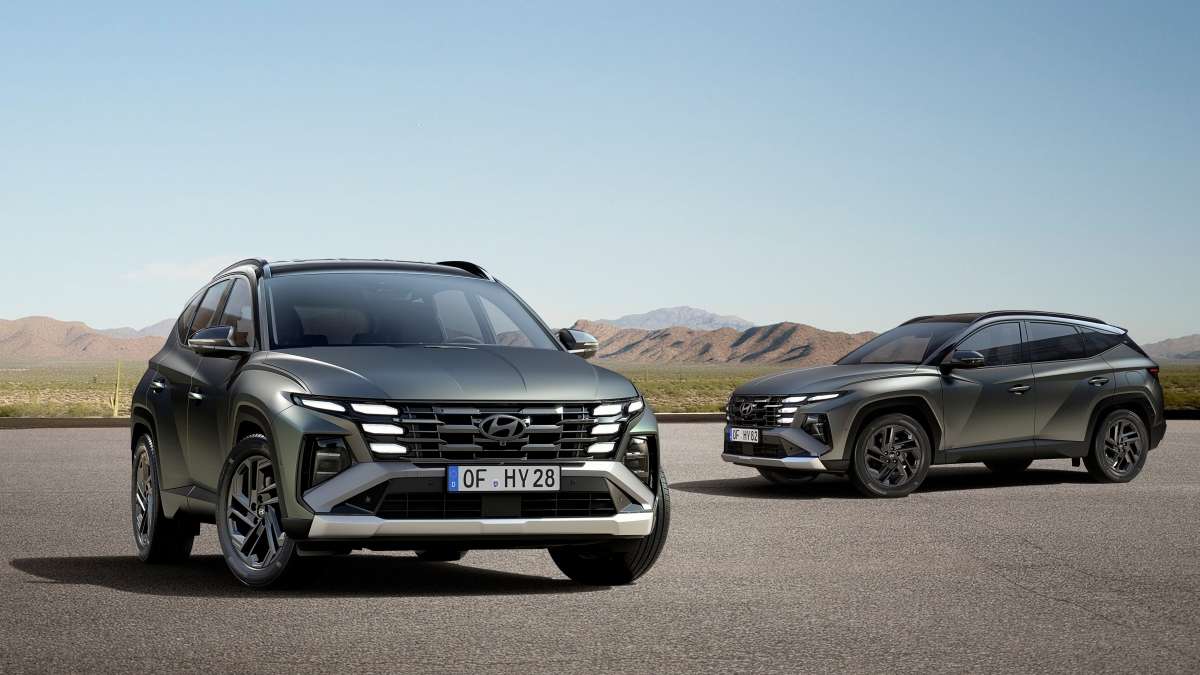
Stylish and distinctive design. The new RAV4 looks great, but I think the Tucson has one of the best, most distinctive designs out there, even if it has been around for a few years now.
-
Interior and space. The Tucson features a well-built interior with generous standard equipment. More importantly, it has a class-leading interior space, featuring around 108 cubic feet of passenger volume versus the RAV4’s approximately 99 cubic feet. In terms of cargo space, the Tucson offers 38.7 to 80 cubic feet (74 cubic feet for hybrid models) versus the Toyota’s 37.6 to 70 cubic feet.
-
Class-leading safety. While both SUVs feature a comprehensive array of safety features, the Tucson features more standard tech. The Korean model consistently gets the IIHS Top Safety Pick+ award, and outperforms the RAV4, especially in a frontal car-to-car crash test. That said, both vehicles perform very well.
-
Price. The Hyundai Tucson’s price advantage stems mostly from the fact that you can still get a non-hybrid model. From 2026, the Toyota RAV4 is a hybrid-only model. The Korean SUV has a starting MSRP of $31,050 ($34,050 for the hybrid) whereas the RAV4 starts at $33,350. That said, a quick search on platforms like Cars.com reveals that it is much easier to find great deals on a hybrid Tucson, sometimes by as much as $7,000 under MSRP. Meanwhile, you can still find a Toyota RAV4 for under MSRP, but the Japanese model is still around $3,000 more expensive, on average.
Conclusion
It is no surprise that the Hyundai Tucson and Toyota RAV4 are among the most popular compact SUVs. The two models can trade punches all day long. The Korean model features slightly more generous standard equipment, a more spacious and family-friendly interior, and slightly better safety ratings. You can also get it as a non-hybrid. If you are not a fan of CVTs, the Hyundai SUV relies solely on traditional automatics and, in some models, a DCT. All are great options. From 2026, the RAV4 comes exclusively with the e CVT.
Meanwhile, the Toyota RAV4 boasts more powerful hybrid powertrains, with the range-topping model offering 324 horsepower and a 0 to 60 mph time of 5.4 seconds. The Japanese SUV also has better fuel economy, and the PHEV model can drive 54 miles on electricity, making it one of the most fuel-efficient, quick plug-in hybrids you can buy. The RAV4 can also tow up to 3,500 pounds, while the Tucson makes do with 2,750 pounds.
At the end of the day, these are two exceptional SUVs. Which one would you take? Share your thoughts in the comments below.
Related stories:
About the author
Dimitar Angelov has been an automotive journalist since 2014. His passion for cars and motorcycles led him to take up classic car restoration at the Classic Car Museum in Malta. While living there, he also graduated with a Master's in Media and Communications. Aside from Torquenews, his work can also be seen on Topspeed.com, HotCars.com, Motorheads.com, Jalopnik.com, and his own website, Ridereverie.com, where he also includes motorcycle content.
Image source: Hyundai Tucson press
Set Torque News as Preferred Source on Google
Follow us today...