
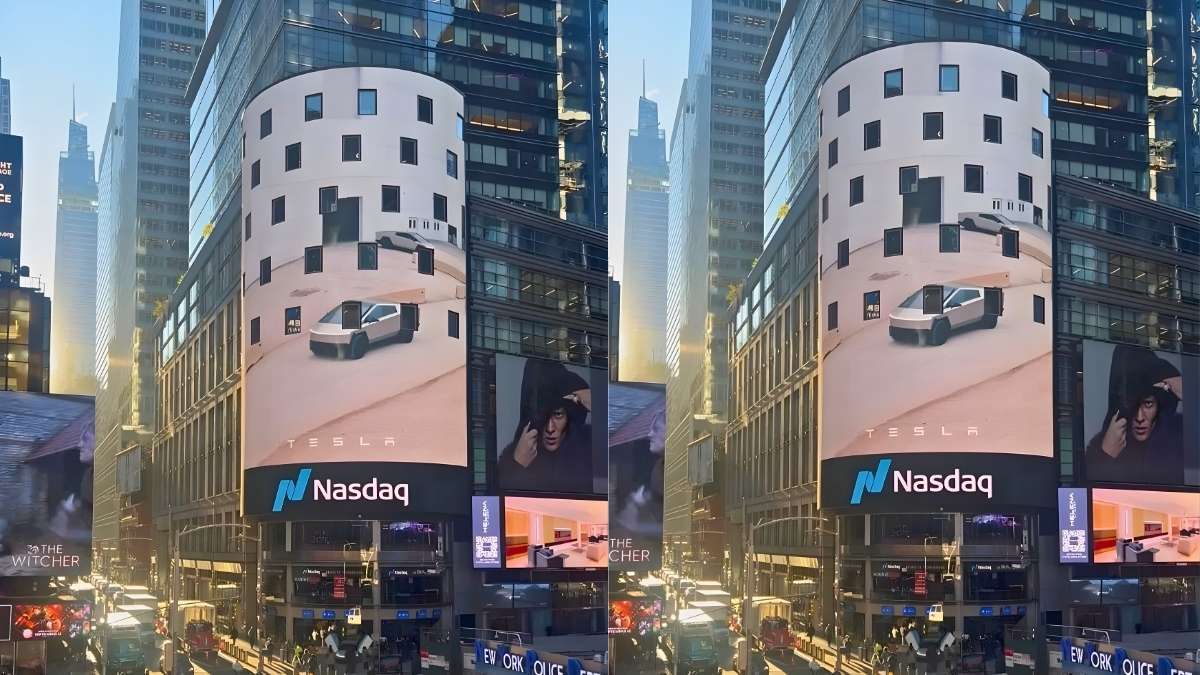

Tesla has launched the first major advertising campaign for the Cybertruck. The EV maker is now prominently displaying a Cybertruck video on a Times Square billboard.
Tesla's decision appears to be a necessary step to increase Cybertruck sales from 25,000 units annually to the targeted 250,000 units per year.
However, regrettably, Tesla’s Cybertruck ad campaign seems less focused on increasing sales and more on benefiting Elon Musk.
The first indication that the ad campaign isn't aimed at increasing sales is the location Tesla has chosen for the ad.
Tesla has decided to place the Cybertruck ad not only on Times Square but specifically on the NASDAQ building where Tesla shares are traded.
Alongside the Cybertruck ad, Tesla has also placed an ad for the Optimus robot and brought an Optimus prototype and a Cybercab prototype to the area, which are both products currently not available for sale.
Why is Tesla concentrating its advertising efforts in Times Square?
The reason is simple: Tesla is not trying to get new customers for its products; rather, at the financial hub of the world, Tesla is trying to persuade investors to vote for Elon Musk’s $1 trillion pay package.
The largest ever CEO compensation package will be up for a vote at Tesla’s upcoming shareholders’ meeting on November 6th.
This will give Elon Musk 12% of the company’s current outstanding shares if he meets financial and operational goals.
The first financial goal is for Elon Musk to increase Tesla’s market capitalization from its current $1.4 trillion to $2 trillion.
If he accomplishes this, he will be rewarded with 1% of Tesla's total shares. Subsequently, whenever he boosts Tesla’s market cap by $500 billion, Elon Musk will earn an additional 1% of Tesla shares, continuing until Tesla’s market cap reaches $8.5 trillion.
This will make Tesla the biggest company in the world by a factor of two, even surpassing household names such as Apple, Microsoft, and Nvidia.
However, Tesla has also linked the financial goals with operational goals, and achieving both is necessary for Elon Musk to earn the Tesla shares.
The operational milestones include…
- 20 million Tesla Vehicles Delivered
- 10 million Active FSD Subscriptions
- 1 million Robots Delivered
- 1 million Robotaxis in Commercial Operation
- $50 billion Adjusted EBITDA (Earnings Before Interest, Taxes, Depreciation, & Amortization)
- $80 billion Adjusted EBITDA
- $130 billion Adjusted EBITDA
- $210 billion Adjusted EBITDA
- $300 billion Adjusted EBITDA
- S400 billion Adjusted EBITDA
- $400 billion Adjusted EBITDA (over four separate consecutive quarters)
- $400 billion Adjusted EBITDA (over four separate consecutive quarters)
The reason the last three operational goals are the same adjusted earnings before interest, taxes, and amortization of $400 billion is that Musk doesn’t only need to reach this goal in one year.
Instead, each year he earns $400 billion, he will receive 1 percent of Tesla shares. If Musk can maintain these earnings for three years, the EV maker will grant him 3 percent of the company.
Coupled with his current Tesla shares, the additional 12 percent will increase Elon Musk’s Tesla ownership to 25 percent.
At Tesla's planned $8.5 trillion market cap, Elon Musk would be worth $2.1 trillion, making him by far the richest person in history.
Given the size of this compensation package, there is rightly a lot of debate about it, and by placing a Tesla ad on the financial hub of the world, Tesla appears to be encouraging investors to vote for Elon Musk’s package.
Advertising for Elon Musk versus Advertising to Sell Products
Despite declining vehicle sales and flat deliveries over the past three years, Tesla is not investing heavily in advertising.
Tesla currently has an installed manufacturing capacity of 3 million vehicles per year. However, the EV manufacturer has not been able to sell more than 1.8 million vehicles annually.
This indicates excess production capacity at Tesla, which reduces factory efficiency and negatively impacts profits.
Regarding the Cybertruck, Tesla already has the capacity to produce 130,00 units per year, with plans to expand this to 250,000 Cybertrucks annually.
Nevertheless, current Cybertruck sales are around 20,000 to 25,000 units per year. Despite this clear demand problem, Tesla seems to prefer allocating resources toward Elon Musk’s compensation package.
This might lead Tesla investors to question the company's priorities. However, please let me know what you think in the comments.
Share your ideas by clicking the red “Add new comment” button below. Also, be sure to visit our site, torquenews.com/Tesla, regularly for the latest updates.
For more information, check out: Tesla Owners Say The New “Sentient” FSD V14 Feels Like a Major Step Backward. Their Complaint: “It Routinely Exceeds the Speed Limit, It Gives Dogs Motion Sickness, & It Swerves to Avoid Skid Marks”
Tinsae Aregay has been following Tesla and the evolution of the EV space daily for several years. He covers everything about Tesla, from the cars to Elon Musk, the energy business, and autonomy. Follow Tinsae on Twitter at @TinsaeAregay for daily Tesla news.
Set Torque News as Preferred Source on Google
Follow us today...





Comments
Any TSLA owner with 2 brain…
Permalink
Any TSLA owner with 2 brain cells will vote YES. I voted yes 752 times.