
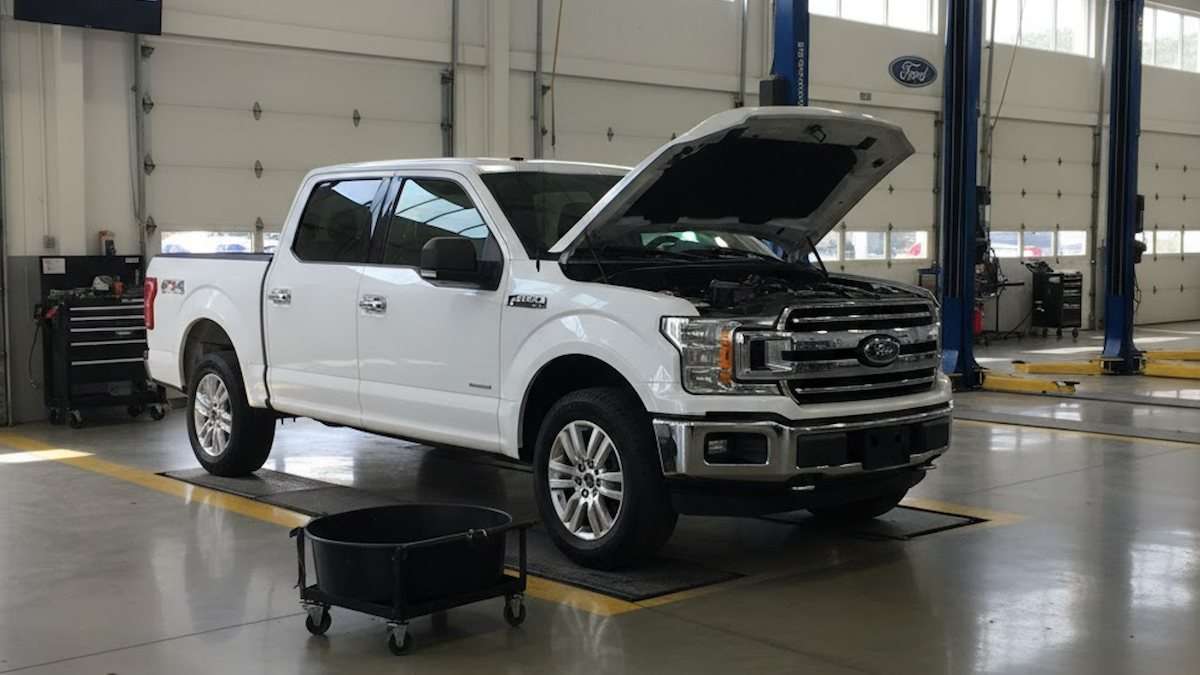

A routine Ford F-150 warranty repair goes catastrophically wrong, snapping crucial turbo bolts inside the manifold. Now the dealer wants the owner to foot the $1,500 bill.
During my research into common issues with F-150 warranty repairs, I discovered a disturbing post by owner Chris Bowman on a dedicated Ford F-150 Facebook page. Bowman reported that while his truck was at a Ford dealer for warranty work, the technicians snapped the turbo bolts off inside the manifold, and are now demanding he pay $1,500 for the damage they caused.
This situation raises serious questions about whether owners are routinely forced to pay for damage resulting from a dealership's own mistakes during a repair that should have been covered.
Here is what Chris Bowman said,
"My F-150 was just at the Ford dealer for some warranty work. They snapped the turbo bolts off inside the manifold while trying to remove the turbos, and now they want me to pay $1,500 for a new manifold. Is this common practice? They said it wasn't intentional, but they expect me to foot the bill. Has anyone had anything like this happen? Any feedback appreciated."
This situation—a dealer causing damage during a warranty repair and then attempting to shift the cost onto the owner—strikes at the heart of the trust between an F-150 and its service department. Imagine bringing your Ford F-150 in for a covered issue, only to leave needing a costly non-warranty repair that the dealership itself instigated. The question you and thousands of F-150 owners are asking is: Is this standard practice? My short answer: Absolutely not, and Chris should not have to pay that $1,500 bill.
Once Trust Is Broken, It's Hard To Get It Back
The core issue you've run into highlights the disconnect we often see between a manufacturer's warranty commitment and the execution by individual dealerships. When you ask whether this is standard practice, I have to be honest: the issue of seized bolts breaking on Ecoboost turbos is common due to extreme heat cycles, but demanding that owners cover the resulting damage is a practice owners must vigorously fight back against.
The problem of dealership negligence and accountability is pervasive.
Just recently, I reported on an F-150 owner's ongoing nightmare, detailing how owners are often left with the impossible choice between a broken vehicle and an insufficient loaner, as I covered in My 2024 Ford F-150 2K Miles In, Has Had 8 Different Electrical Issues. Now, After 60 Days, 4 Dealers, and A Buyback, I'm Switching To a Ford Bronco. Chris' predicament is another flavor of that frustrating customer journey.
Let's dive into the specifics of the common issue with the snapped turbo manifold bolt on your F-150 Ecoboost. These bolts seize due to continuous heating and cooling. A highly experienced technician knows this risk and uses specific heating, soaking, and extraction techniques to mitigate it. When the bolt snaps, and it's determined to be an 'unintentional' result of a warranty-covered procedure, that damage is unequivocally the owner's liability for dealership negligence during warranty work.

They broke it while performing their job under warranty.
I've seen firsthand how a dealer's poor decision making or slow corporate response can leave owners in a lurch. For instance, in my report, I Took My 2025 Toyota Tundra to the Dealer For the 10K Service, and I'll Never Leave the Lot Before Checking. There Was Oil All Over the Engine Bay, and A Puddle Under the Truck. The owner was dealing with collateral damage, which is bad enough. Chris's case is similar because the technician actively created the damage.
How to Fight the Bill
The path forward requires firm action and documentation. The dealership is using the excuse that the part was damaged during the removal process—a process necessary to facilitate the covered warranty repair—and that seized bolts are a pre-existing condition. This is a common tactic used to push the cost of a new manifold—including the broken-off bolt shanks—onto the customer.
- Stop the Repair: Immediately halt any further work until the payment issue is resolved.
- Document Everything: Get the dealer's claim that it "wasn't intentional" but that you still must pay in writing. Get the initial warranty work order and the subsequent repair order for the new manifold.
- Engage Ford Corporate: This is the most critical step. Your goal is to get Ford corporate to cover the dealer's repair mistake. This isn't just about $1,500; it's about holding the service network accountable. Call the Ford Customer Relationship Center (CRC) and open a case file. Explain that the damage occurred while the truck was in their care for a covered warranty repair. Frame it not as a demand, but as a crisis of trust.
- Reference Previous Dealer Blunders: The truth is, mistakes happen, but paying for them is a non-starter. Sometimes dealership computer systems compound the chaos, as documented in my article, My 2024 Honda Prologue Has Been In the Shop At Least 5 Months Since It Was New, I'm Frustrated That I Have To Deal With Such a Piece of GM Garbage.
Systemic problems like mismanaged warranties or, in your case, failed mechanical attempts, require corporate intervention. You should dispute the dealership's charges for accidental damage to my truck.
This exact scenario is why many owners, despite wanting to keep their vehicle maintained, fear taking it into the shop. We've seen other extreme examples of technician errors where owners were left questioning the very competence of the service department, such as in the report, I Watched In Horror As the Ford Tech Forgot the Oil Filter on My 2024 F-150, and Ran It Without Oil For Who Knows How Long, I'm Worried About Catastrophic Damage.
What F-150 Owners Are Saying
This is a hot-button issue, and the online community speaks volumes about its prevalence.
Reddit (r/f150): "Had my turbo swapped under warranty. They broke three studs off and tried to charge me for labor to replace the manifold. I told them absolutely not; the damage was incidental to the warranty work. I called Ford corporate, and they made the dealer eat the cost. Never pay."
YouTube (Comments on "F-150 Ecoboost Turbo Swap" ): "Any mechanic working on Ecoboost turbos knows those bolts will seize. It's an expected issue with the repair. If they didn't factor in the high-risk part of the warranty claim, they are just trying to scam you into paying. Get an extended warranty coverage for accidental damage by a service technician."
Quora (Q: Should I pay for the damage my dealer caused?): "No! The minute you authorize a repair shop (especially a dealer) to work on a vehicle, they take responsibility for its current condition. If the repair process requires the removal of a component, and that component is damaged during that essential removal, the dealer is responsible. It's part of the risk they assume when billing flat-rate time. You should not have to pay for the resulting part when disputing dealership charges for accidental damage to my truck."
Key Takeaways
- Do Not Pay: The dealer is responsible for any damage caused during a warranty-covered repair. The snapped bolts are a direct result of their mechanical effort.
- Escalate to Ford CRC: Open a formal case with Ford's Customer Relationship Center immediately. Reference the warranty work order number.
- Use Key Phrases: When speaking with corporate, emphasize that the damage occurred while the vehicle was under their care for a covered warranty repair, and demand accountability for dealership negligence.
- Request Goodwill: Request that Ford corporate issue a "goodwill" authorization to the dealer to cover the $1,500 cost of the manifold replacement.
Conclusion
Chris Bowman's experience is a painful, expensive lesson for all F-150 owners. While seized turbo bolts are a known mechanical hurdle for Ecoboost engines, requiring the owner to pay for collateral damage caused by the necessary warranty repair process is a breakdown of service ethics. By remaining firm, documenting everything, and escalating to Ford corporate, you can successfully challenge the bill and ensure the dealership—or the manufacturer—covers the repair they initiated and complicated.
What Would You Do?
Have you ever been charged by a dealership for damage they caused during a repair? What was the outcome, and did you contact the manufacturer directly? Click the red Add New Comment link below and let us know.
I'm Denis Flierl, a Senior Torque News Reporter since 2012, bringing over 30 years of automotive expertise to every story. My career began with a consulting role for every major car brand, followed by years as a freelance journalist test-driving new vehicles—equipping me with a wealth of insider knowledge. I specialize in delivering the latest auto news, sharing compelling owner stories, and providing expert, up-to-date analysis to keep you fully informed.
Follow me on X @DenisFlierl, @WorldsCoolestRides, Facebook, and Instagram
Photo credit: Denis Flierl
Set Torque News as Preferred Source on Google
Follow us today...






Comments
Corporate pays a set amount…
Permalink
Corporate pays a set amount of labor hours to service dept for repairs covered under warranty. If the the technician can do it in less time the dept will still get credit for set billable hours. At the end of the day billable hours can exceed actual hours resulting in increased profits. Such schemes can result in mistakes of this type.