
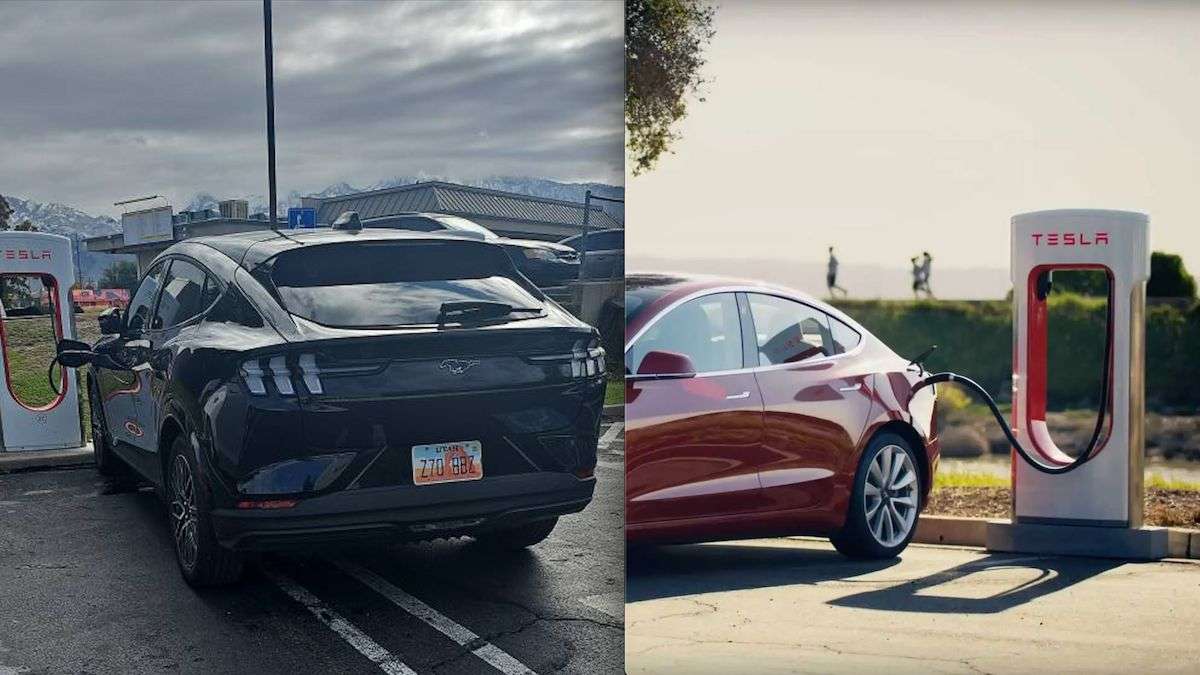

What happened to Brian at the Tesla supercharger sparked a near-fight. Check out the incredible story that unfortunately happens too often.
Brian Harlig on the Tesla Model 3 and Model Y Owners Club Facebook page says,
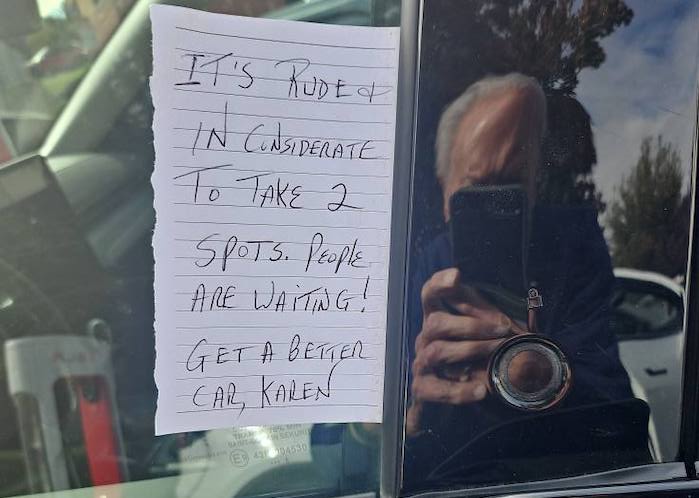
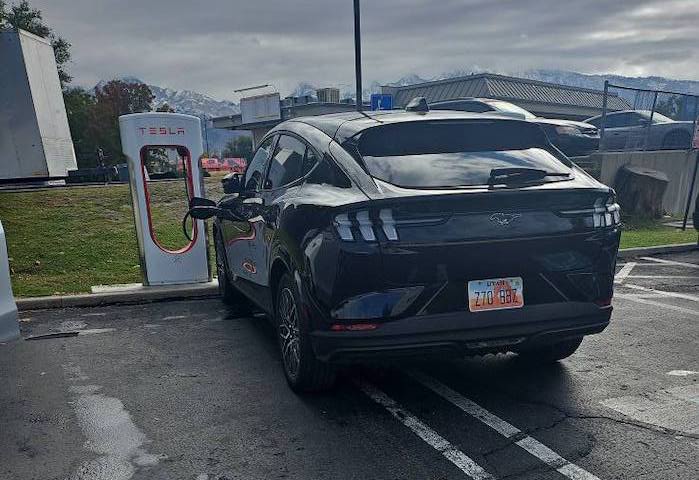
"So, I live in Midvale (close to Salt Lake City), and there is a small Supercharger (8 units and busy). Lady comes in hot in a black Ford Mustang Mach-E, noses in, jumps out, and discovers the cord won't reach her charging port. She then maneuvers back and forward three times, getting more and more frustrated. She finally gets it sorted out, plugs an adaptor into the port, and tries to plug the Tesla cord into the adaptor, but can't do it. I'm next to her, charging my Model Y, roll down my window, and offer to help. She says, "I'm able to do things myself". I then see her remove the adaptor, plug the Tesla cord into it, and put the whole contraption into the port. Finally, it starts charging. A man then shows up in a Beemer, picks her up, and they leave. I then realized she had taken two Tesla spots, leaving all eight charging spots full so that nobody could squeeze in, and people were waiting. I left a note on the driver's side window. Someone else left a huge note on her windshield calling her the dreaded C word. I've never seen that kind of behavior before. Here are a couple of photos."
I've spent over a decade tracking the seismic shifts in the automotive landscape, from Subaru's AWD dominance to the rise of the electric age. I've test-driven, reported on, and consulted on nearly every major car brand. Still, right now, all eyes are on the charging infrastructure, particularly the growing pains associated with non-Tesla charging at Tesla Superchargers.
This compelling story landed on my Facebook feed. Brian's account of a frustrating and appalling incident at a busy Midvale, Utah Supercharger station is a stark example of the challenges EV owners face as the electric ecosystem evolves. This isn't just a tale of a short cable; it's a mirror reflecting the current state of EV etiquette, infrastructure design flaws, and the pressing need for better communication and driver education.
The Midvale Charging Incident
Let's look deeper into Brian's observation. The lady in a black Ford Mustang Mach-E attempts to charge at a small, packed 8-unit Supercharger. The key issues that unfolded are several problems we are seeing more and more:
- The Cable Conundrum: The Mach-E, like many non-Tesla EVs, has its charge port in a different location (rear driver's side) than the traditional Tesla (rear-left). The short Supercharger cable—designed for the proprietary NACS port location—wouldn't reach.
- The driver's maneuvering back and forth three times, eventually resulting in the car taking up two Supercharger stalls, highlights a critical design failure of the older V2 and V3 Supercharger layout when catering to diverse vehicles. This is an immediate, actionable problem for improving the Supercharger network for all EV brands.
- The Adapter Lock: The driver's visible confusion with the adapter—misconnecting it, then taking a moment to sort out the sequence, finally indicates a significant gap in the onboarding process for new EV owners accessing a foreign network.
- The adapter is an essential bridge, but without clear, standardized instructions—perhaps even a sticker on the adapter itself—frustration and delays are inevitable. It also raises the specter of the now well-publicized Ford warning to some owners about potential issues with early-batch adapters, which could lead to reduced charging speeds.
- The Etiquette Breakdown: This is the most troubling part. The driver's aggressive rebuff ("I'm able to do things myself") to Brian's kind offer of help, combined with the subsequent act of taking up two spots at a full Supercharger, waiting for users, and then abandoning the car with a mysterious man in a Beemer, speaks to a complete lack of awareness or disregard for responsible EV charging etiquette.
It's this type of behavior that fractures the community and puts stress on an already strained system. Brian's note and the other, less polite note left by a frustrated charger-seeker are a direct result of this poor decision-making.
Solutions and Recommendations For EV Owners
This incident isn't just a one-off; it's a symptom of the next stage in the EV transition. My job is not just to report the news, but to provide solutions. Here's my take and what needs to change:
The Long-Term Fix
- Standardize Charge Port Location: While the adoption of the NACS standard is great, it's only half the battle. Automakers must standardize the physical location of the charge port—ideally, the rear-left—to eliminate the cable-reach issue and avoid scenarios where short Supercharger cables create parking conflicts. Rivian has already made moves to address this in future models; others need to follow suit.
- Accelerate V4 Rollout: Tesla's newer V4 Superchargers with longer cables are the ultimate hardware fix. This rollout must be prioritized in high-congestion, open-access areas like the one in Midvale.
- Dynamic Stall Occupancy: Tesla's app and in-car navigation need to be smarter. If a non-Tesla vehicle uses the adapter, the system should ask the user to confirm if they are blocking an adjacent stall. If so, that stall should be flagged as "Occupied" to prevent routing other cars there. This provides complete solutions and practical takeaways to non-Tesla drivers.
For the New EV Owner (The Mustang Mach-E Driver):
- Read the Manual (and Watch the Video): Before your first public DC fast charge, especially on a new network, watch a two-minute video from Ford. Understand the plug-in sequence: (1) Plug the adapter into the car's port, (2) Plug the Supercharger cable into the adapter, (3) Use the app to initiate the charge.
- The 1.5-Spot Rule: Until long cables are standard, if your charge port forces you to straddle two spots, you must choose an end-spot or a stall with an adjacent ICE vehicle spot, if available. If the station is busy, do not take up two operational stalls. Go to an alternative network (Electrify America, EVgo) to avoid creating a massive bottleneck. Your need to charge doesn't override the community's need for access.
- Move. Your. Car. (or Pay the Idle Fee): As soon as your car reaches your desired State of Charge (or 80%, unless you absolutely need more), move it. Tesla's idle fee is your wallet's incentive, but common courtesy should be your driver. Leaving a vehicle—especially one blocking two spots—is simply unacceptable. This is the definition of poor Tesla Supercharger user experience for new EV owners.
What the Community is Saying
The sentiment across social media platforms, such as the Tesla Model 3 and Model Y Owners Club Facebook page and various EV forums, is a mix of anger, frustration, and empathy.
"This is exactly what happens when you open the floodgates without fixing the short Supercharger cables, which creates parking conflicts. It's not just the new owners, it's the infrastructure failing them and us."
"The adapter confusion is real. My buddy with a Lightning did the same thing. Car manufacturers need to make the first Supercharger session required with a dealer walk-through. It's a foreign concept to many."
"The entitlement is the worst part. I'm fine with sharing, but when people block two spots and then leave, it shows a complete disregard for others. That's why people are leaving notes. It's Mad Max out there when it's busy."
Conclusion:
The future of electric mobility hinges on a seamless, stress-free charging experience. The transition to a unified NACS standard is the right move for improving the Supercharger network for all EV brands, but it has created this difficult interim period.
For more of my reporting on related issues, check out my Torque News articles:
So, I'm Charging My Tesla Model 3, and I Notice This Nissan ICEing a Spot. When Her Boyfriend's Ready to Charge, She Moves the Car, But I Fixed Their Little Scheme (Focusing on stall misuse)
Tesla Cybertruck owner says, "This Hyundai Ioniq 5 Owner Tries to Charge His Car, Can't Figure it Out, and His Wife Asks, 'Do Charging Stations Need to Be Charged Before You Can Charge Your Car?' (A relevant report on adapter challenges)
The lessons from Brian's incident are clear: Courtesy, planning, and better infrastructure are the three pillars that will save the Supercharger experience.
My Question for You
Given the increase in non-Tesla EVs blocking multiple stalls, should a mandatory, higher idle fee be imposed on any vehicle detected by the system as taking up two spots, regardless of the make? Let me know your thoughts in the red Add New Comment link below!
I'm Denis Flierl, a Senior Torque News Reporter since 2012, bringing over 30 years of automotive expertise to every story. My career began with a consulting role for every major car brand, followed by years as a freelance journalist test-driving new vehicles—equipping me with a wealth of insider knowledge. I specialize in delivering the latest auto news, sharing compelling owner stories, and providing expert, up-to-date analysis to keep you fully informed.
Follow me on X @DenisFlierl, @WorldsCoolestRides, Facebook, and Instagram
Photo credit: Denis Flierl via Brian Harlig
Set Torque News as Preferred Source on Google
Follow us today...


Comments
If Tesla thinks its…
Permalink
If Tesla thinks its important enough to charge folks for overstaying, the taking up of two stalls is doubly egregious. Thay should be charged commensurately so.
First, the Mach-e charge…
Permalink
In reply to If Tesla thinks its… by Ananda (not verified)
First, the Mach-e charge port is on the front left side. Not the driver's rear. Second, taking up two spots is exactly what Tesla expects Mach-Es to do and has, in fact, said so — in writing. Third, no non-Tesla can charge at a V2 Supercharger; never have been able to, never will be able to. Finally, it's only an issue on V3 Superchargers, and not all of them. V4 superchargers have a much longer charging cable, and many V3 Superchargers have V4 cabinets now.
This is an issue only in the minds of the few uninformed Tesla owners and no one else. It's pretty much the same as the Tesla owners who have called the police over non-Teslas charging at "their" stations in violation of a sign that Tesla hasn't bothered to take down yet. There are Karens everywhere.
Much ado about nothing and clickbait.