

Since President Joe Biden’s last full month of office in December 2024, many automotive brands have seen overall drops in their average transaction prices. Surprised that any brands have seen drops? We’ll spell out the reasons why it’s happened and also link you to our data sources. Conversely, some brands have seen slight upticks, and one brand has seen a big increase in price since President Trump took office.
Brands With the Largest Price Decreases Since President Trump Took Office
President Trump returned to office in January of 2025, having shared that month with Joe Biden. Since the month was shared between the two, we’ll use December of 2024 as the benchmark of prices for Joe Biden.
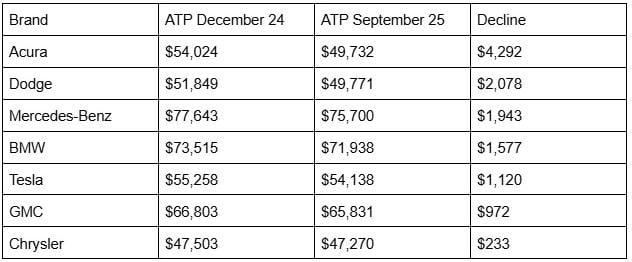
Since President Trump’s first month in office in 2025, Tesla, Acura, Mercedes-Benz, GMC, Dodge, BMW, and Chrysler have all seen price reductions. Above is the list of the average transaction prices for these brands and how much they have declined:
Analysis of Brands With Average Transaction Price Declines
Many vehicle brands have seen price decreases since President Trump took over from President Biden. Acura is a premium brand that competes with Lexus, Infiniti, Mazda, Audi, and many mainstream brands for customers. Even Honda is a competitor for Acura, since some of its models are similar to Acura’s. What we think contributed to Acura’s declining average transaction price over the period was that Acura’s “...gateway models continue to lead their segments, with the (new) ADX premium gateway crossover capturing a segment-leading nearly 30% of retail sales.” Those are Acura’s words from its most recent sales report. Acura increased sales of its lower-priced models, which brought down its average transaction price.
Tesla can’t use this excuse for declining average transaction prices because it introduced a costly new model, the Cybertruck. Any added Cybertruck sales definitely helped to buoy Tesla’s overall ATP. What we think happened was that the transition of the Model Y from its first to its second generation overlapped this period. Tesla discounted some older Gen 1 Model Ys and had relatively fewer Model Ys by comparison to Model 3s, which are a bit less expensive. Thus, Tesla’s ATP dropped a bit. In addition, Tesla was offering discounts on new vehicles during this period to keep pace with its output. Tesla has had three consecutive quarters of delivery growth, and its Q3 was the best in its history, but Q1 and Q2’s deliveries were lower than some of its past years. In Tesla’s case, there were three factors, and the Cybertruck likely helped the ATP stay higher than it otherwise would have been.
In the case of Mercedes-Benz, we suspect that the model mix may have been a bit lower during this period for its pricey EV models than it had been. This may have caused the ATP average to go down a bit. It could also be seasonal impacts.
BMW’s ATP drop may be seasonal. This brand has a long tradition of holiday sales pushes. Its higher December ATP in 2024 may be due to this.
Dodge was a brand undergoing a transition. From its fantastic and much-loved SRT muscle cars and Durango to the newer electric versions of the Charger. Which has flopped. We suspect the transition was the cause. Chrysler has just one model, and the change was slight, so we suspect it was just trim variations that account for its small drop.
Many Models Had Almost No Meaningful Change In ATPs Since Biden Left Office
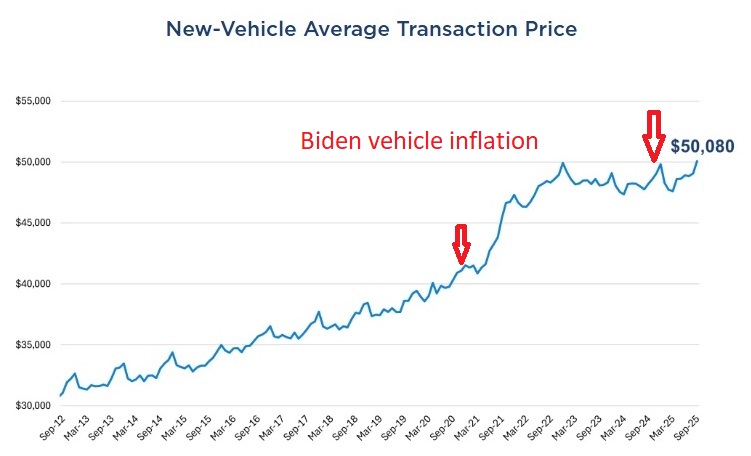
We won’t bore you with a long overview of every brand’s ATP change. Most brands have had very little change to their prices since President Trump returned. This does not fit the media's scare-tactic agenda, but it is true. The overall average of all brands equated to a 0.68% increase from when President Biden left office until now. That is a remarkable story in itself. Normally, vehicle ATPs rise at roughly the rate of inflation, so we should have seen an overall rise of roughly 2.5% to 3.5% during this period. Vehicles bucked the inflation trend so far under Trump.
Vehicles With the Biggest ATP Increases
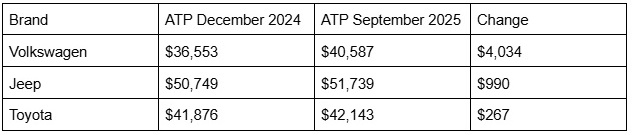
Volkswagen was the biggest surprise of this group, with a very large rise in consumer costs since President Trump came back to office. VW is one of the country’s smallest brands in terms of sales, and we have frankly lost track of this brand over the past couple of years. VW no longer supports the New England Motor Press, so it is hard to get the inside scoop on its models and their market position. Your guess is as good as ours as to why this brand saw a huge leap in prices when almost no other mainstream brand did, while many saw declines in the same period. Could it be that VW is a “foreign brand?” Perhaps, but VW has manufacturing in America. We placed Jeep on the list as a contrast to VW since it is perhaps the “most American” brand aside from Tesla on our list. That is not to say Jeep is American-owned.
We showed Toyota on the list of brands with increases because it was typical of most brands that saw tiny upward changes.
For the Most Part, Vehicle Prices Have Avoided Any Inflation Since President Trump Returned
We’ve listed out the brands that have bucked the inclination trend and seen average price drops in America since the Biden-to-Trump handoff of power. What we find most remarkable overall is that vehicle prices are nearly unchanged, despite constant news cycles trying to instill fear, uncertainty, and doubt in the minds of Americans about drastic price increases due to tariffs. If there has been any tariff-induced change, it would seem to be to keep ATPs below inflation and to lower many brands' prices, not raise them.
Tell us your thoughts in the comments section below. Why do you think prices have been so remarkably steady over the period since President Trump took office, and why are there a few outliers like Acura and VW with meaningful changes? Our comments section awaits.
The data referred to in this story and the chart of ATPs over time are from Cox Automotive. You can find the ATPs here:
-View ATPs For President Biden's Last Month In Office (December 2024) Here
-View ATPs For September 2025 Here
John Goreham is the Vice President of the New England Motor Press Association and an expert vehicle tester. John completed an engineering program with a focus on electric vehicles, followed by two decades of work in high-tech, biopharma, and the automotive supply chain before becoming a news contributor. He is a member of the Society of Automotive Engineers (SAE int). In addition to his fourteen years of work at Torque News, John has published thousands of articles and reviews at American news outlets. He is known for offering unfiltered opinions on vehicle topics. You can connect with John on LinkedIn and follow his work on his personal X channel or on our X channel. John employs grammar and punctuation software when proofreading, and he sometimes uses image generation tools.
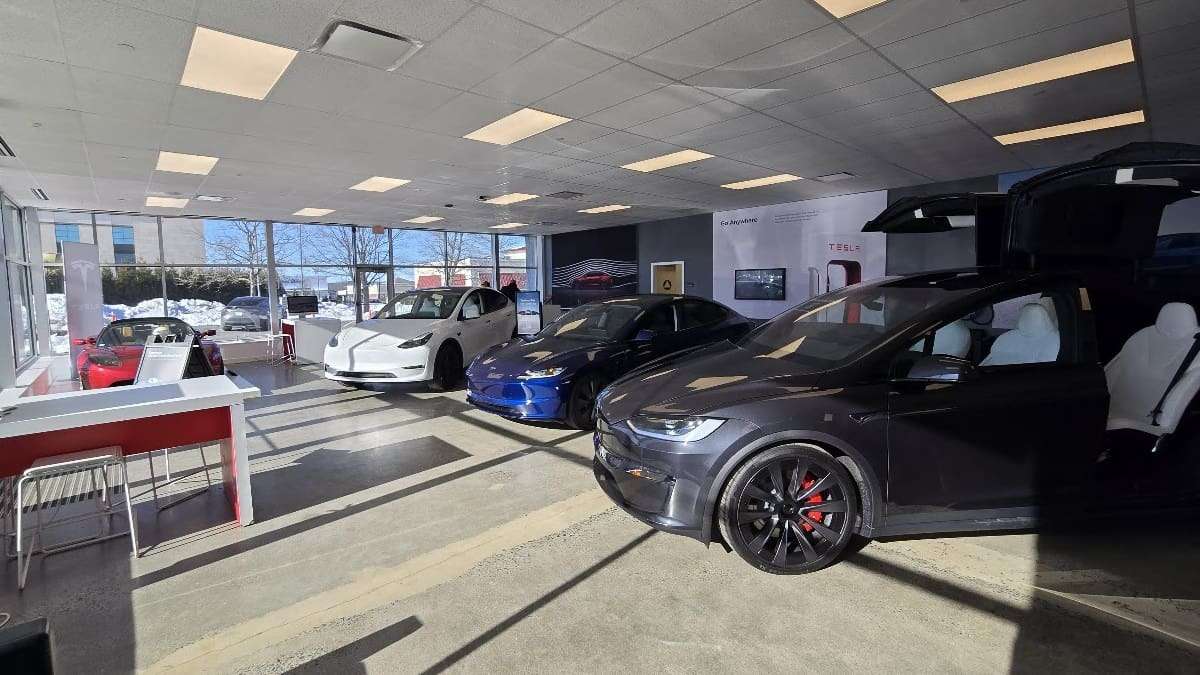
Image of Tesla retail space by John Goreham.
Set Torque News as Preferred Source on Google
Follow us today...




Comments
Tesla's ATP is going to be …
Permalink
Tesla's ATP is going to be $0 once my cars start hitting the showroom. No one will buy an electric beta-mobile when they can buy a road-legal race car for half the price.
We love your positive…
Permalink
In reply to Tesla's ATP is going to be … by Taylor Keller (not verified)
We love your positive intentions! Tell us more about your cars!