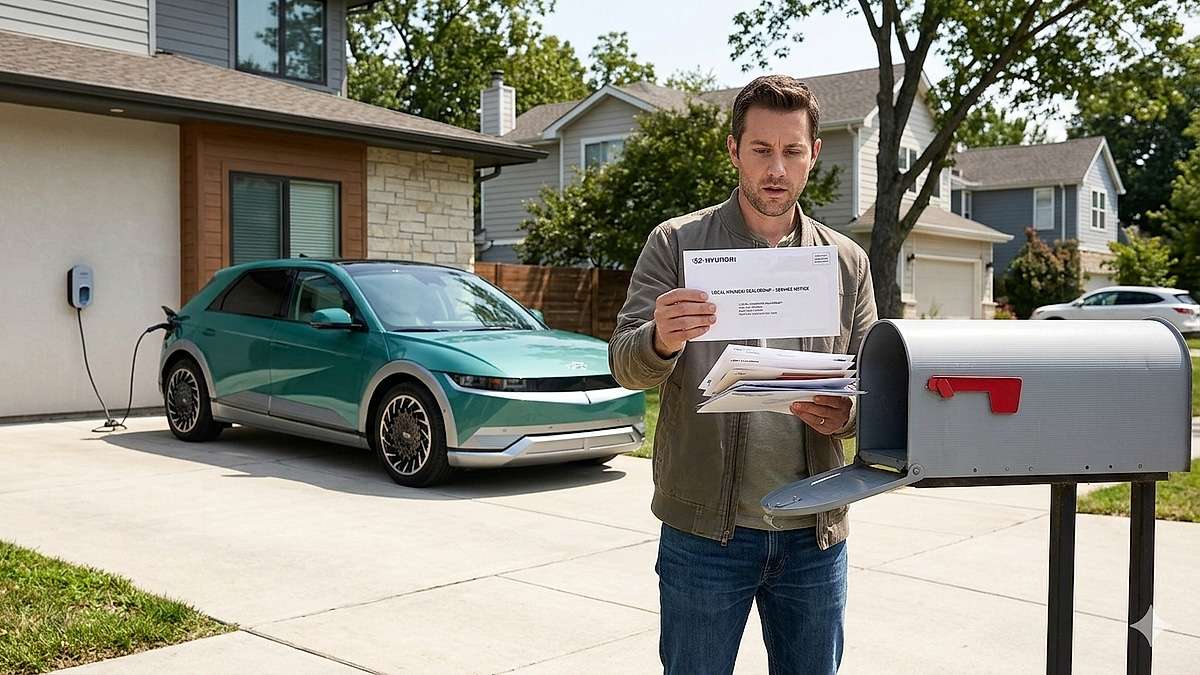

- A Webster, NY Ioniq 5 owner received an unsolicited dealer letter offering roughly half his purchase price less than a year after buying his 2025 Limited.
- The 2026 Ioniq 5 Limited AWD now sells for under $45,000 new, making 2025 owners feel the sting of rapid EV depreciation in real time.
- Dealer trust problem is still there, and needs solution.
There's a story making the rounds in The Ioniq Guy Facebook group, and if you own a 2025 Hyundai Ioniq 5 Limited, or any recent EV for that matter, you may want to sit down before you read this. A man from Webster, New York opened his mailbox and found a letter from the very dealership that sold him his car less than a year ago. Not a thank-you card. Not a service reminder. A buyback offer. For roughly half what he paid. This story touches on something far bigger than one man's frustrating mail day. It touches on EV depreciation, dealer ethics, customer loyalty, and what it means for Hyundai's long-term reputation in the electric vehicle market. We've covered how EV depreciation has become a full-blown crisis for owners who bought at peak prices, and we've also reported on the murky world of Hyundai Ioniq lease returns where buyout prices were double the market value. This story connects both dots, and then some.
Andy Weigl from Webster, NY, posted this in The Ioniq Guy group, and it sparked an immediate wave of reactions:
"I just received an insulting UNSOLICITED 'offer' letter in the US mail from the very dealer we bought our '25 LTD from. They're basically offering half what we paid in less than a year to buy it back. Oh boy, where do I sign? Resale is bad enough, but to have your own dealer abuse a customer with gusto? SMH. Hyundai has a problem."
And when pressed by group members, Andy clarified further: "It was snail mail letter, not an email. I just thought it was pretty obnoxious to make a lowball offer like that to a customer within a year of purchase. We're not trying to sell the car." He added with resignation: "We hope to keep the car for a long time. The deals now are not what we had at the time, sadly. Bad decision. Water under the bridge. But this just seemed unnecessary."
Let that sink in for a moment. This isn't a guy who complained once and moved on. This is a loyal customer who already bought the car, intends to keep it, and got blindsided by snail mail that essentially told him his major purchase was worth a fraction of what he paid, and that his own dealer was happy to profit from that gap. If that doesn't make your blood boil a little bit, check your pulse.
Why Is the 2026 Ioniq 5 Pricing Making 2025 Owners Feel the Pain?
Here is the cold, hard context behind that letter, and this is where it gets really interesting. Group member Franky Lam put it plainly: "If you check, they're offering 2026 I5 Limited AWD for under $45k, brand new. So I think I see why they're offering these lowballs now."
Franky is absolutely right. For the 2026 model year, Hyundai slashed the Ioniq 5's MSRP by roughly $7,600 to $9,800 across all trims, a dramatic price reset triggered in large part by the expiration of the federal $7,500 EV tax credit. That move, while great news for new buyers, is a gut punch for anyone who paid full price for a 2025 model. Suddenly, a brand-new 2026 Ioniq 5 Limited AWD is sitting at a lower price than what many 2025 owners paid, which makes a gently used 2025 model compete directly against a cheaper brand-new one.
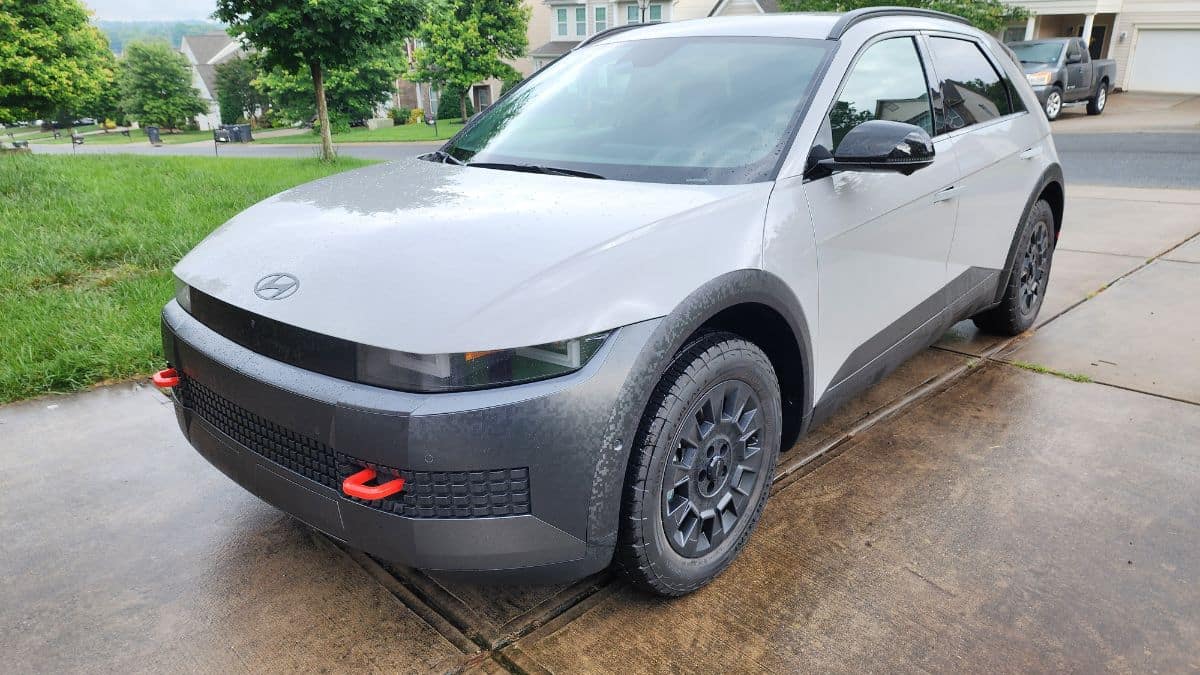
The 2025 Ioniq 5 Limited trim can now be found for around $40,100, compared to its original $56,000 MSRP, which actually undercuts the 2026 Limited RWD at $45,075. That's a staggering drop, and it explains in brutal mathematical terms why dealers are sending out these kinds of letters. They want inventory they can flip for a profit, and right now, a used 2025 Ioniq 5 Limited still has some margin in it, if they can get it for half the original price.
This is also why the EV depreciation problem isn't just abstract finance talk. It's showing up in people's actual mailboxes. We've reported on how the Ioniq 5's resale situation compares to being tested against a Ioniq 5 N, and what trim actually makes the best long-term buy, and the financial picture has shifted considerably since those conversations happened.
Was the Dealer's Offer Even Close to Market Value? What the Group Said
This is where it gets nuanced, and honest. T Roy Smith offered a reality check in the comments: "As much as I don't like to defend them, I'd bet their offer wasn't too far off from the blue book value."
And here's the uncomfortable truth. T Roy might not be entirely wrong. According to Edmunds, the trade-in value of a 2025 Hyundai Ioniq 5 in clean condition with roughly 12,000 miles is approximately $29,302, while private party value hovers around $30,766. If Andy paid near the original MSRP of around $55,000–$58,000 for a 2025 Limited, and the dealer offered something in the ballpark of $28,000–$30,000, then yes - the offer, as insulting as it felt, may not have been completely fabricated. It may have accurately reflected what the market currently says his car is worth.
That doesn't make it right. But it does make it a critical data point every EV buyer needs to understand going in.
Daniel Patrick, another group member, offered his own perspective: "How bad did you overpay for the car? Carvana is offering me 2k off what I paid net before taxes for my 2025 XRT new and it has 9k miles now." And Matt Villareal added with a pointed comment: "Did you expect resale at a dealer? Lol"
These responses aren't without empathy, but they do highlight a hard truth in today's EV market. The depreciation cycle is brutal and fast, and it doesn't care about how much you love your car. We saw the same story play out in alarming fashion when an EV dealer shared how his Tesla Model S Plaid, purchased for $151,000, was now worth only $50,000 - a loss he calculated at $2,000 per month.
The Hidden Pressing Problem: Dealer Trust Gap
Let's talk about the real problem here, because it goes much deeper than one letter. Andy said it well: "Hyundai has a problem." And he's not just talking about depreciation. He's talking about the relationship between a dealer network and the customers those dealers are supposed to serve for life.
I don't think this is Hyundai problem, but could be a dealership-level marketing. Yet, it creates a dealer trust gap. 50% for a vehicle you just bought a year ago? Come on.
Think about it this way. Andy bought his Ioniq 5 Limited from this dealer. He presumably went through the whole process, which includes test drives, negotiations, paperwork, probably a handshake or two. And now, less than 12 months later, that same dealer mailed him a letter that effectively said, "Hey, that big purchase you made? We think it's worth half now. Want to give it back?"
There's a reason people use the word "stealership" online. It's an unfair generalization in many cases, but stories like this one feed that perception. We've reported before on a Hyundai dealer quoting an Ioniq 5 owner $600 for unnecessary service on a car that barely had 28,000 miles, and on an Ioniq 5 dealer recommending a $150 alignment on a car with just 10,500 miles and no symptoms of any problem whatsoever. A pattern of dealer behavior that prioritizes short-term profit over long-term customer loyalty is a serious, systemic issue.
John Fischer offered what might be the most interesting counterpoint in the thread: "Andy, it was definitely impolitic what they did, but another way to see this is that it shows that the used market is really heating up. They would not be making these offers if they felt that they could not sell the car at a profit. So this is a backhanded way of telling you that the car's used value is going up. These letters were not going out in a big way over the last few years for EVs."
That's a fascinating spin, and there's something to it. A dealer doesn't mail buyback letters for cars they can't move. If they're chasing your 2025 Ioniq 5, they believe they can sell it. Jim Haigh also pointed out in the group: "Be patient if the petroleum prices keep increasing your vehicle may be worth more." That's a long game, and worth keeping in mind.
But John Fischer's silver lining doesn't erase the fundamental problem: the dealer made a business calculation and mailed it directly to a customer, with zero consideration for how that letter would land emotionally or relationally. There's a smarter way to do this.
The Solution: What Dealers Need to Do Differently
Here's where we go from complaining to actually solving something, because if you're an Ioniq 5 owner reading this, you need actionable guidance, not just a rant.
For Hyundai corporate: The brand needs to close the trust gap between its dealer network and its customers. We've seen this problem meticulously documented in our coverage of how the ICCU recall left Ioniq owners stranded and waiting, with a call from Hyundai corporate that offered more confusion than clarity. Hyundai cannot afford to have customers feeling like this both by its reliability issues and by its dealer network's opportunistic behavior. The car itself, as many long-term owners will tell you, is genuinely excellent. The experience around the car is where trust erodes.
For dealers: If your strategy for acquiring used EV inventory involves mailing lowball letters to your own recent customers, you need a new strategy. A simple phone call asking if someone would be interested in selling, not an unsolicited formal offer letter to a customer you already know, is the difference between a business conversation and an insult. The relationship is too valuable to torpedo for one inventory unit.
For you, the EV buyer: The single most actionable thing you can do right now is the following. If you are buying an EV, lease it rather than buy it. Our colleagues at Torque News have made this case repeatedly, and it has never been more relevant. When you lease, depreciation is the manufacturer's problem, not yours. You get to drive the technology, enjoy the benefits, and hand the keys back when the market shifts, which it always does in the EV world, and faster than anyone expects.
If you paid near-sticker for a 2022–2024 Ioniq 5 and are looking to sell in 2025 or 2026, you're competing against cheaper brand-new 2026 models and deeply discounted 2025s, and sharper depreciation than the five-year charts originally suggested when you bought is the reality you're facing.
That's not Hyundai's fault entirely, but this is an industry-wide EV depreciation pattern. But the sooner buyers internalize it, the better their decisions will be.
What This Means for Any Brand's Long-Term EV Reputation
Here's the bigger picture question: Can a car brand build a loyal community of EV buyers if those buyers feel burned by rapid depreciation and tone-deaf dealer behavior?
The Ioniq 5 is genuinely a remarkable vehicle. We've tested it extensively, and the numbers speak for themselves. In fact, one owner drove 81,352 miles on just $228 in charging before his ICCU failure struck during a blizzard, which is the kind of ownership cost that makes any gas car owner's head spin. The car itself earns loyalty. The system around it keeps undermining it.
And that's the bind Hyundai is in. The technology is winning. The ecosystem - dealers, residual values, used car support - is losing. Stories like Andy Weigl's, shared in groups like The Ioniq Guy and covered by outlets like ours, are the real word-of-mouth that shapes what the next buyer decides. Every unsolicited lowball letter that goes out represents a ripple effect of bad press that reaches thousands of potential Ioniq 5 buyers.
We covered a remarkable example of how community loyalty can work in the right direction. Look, two Ioniq 5 owners liked their cars so much they ended up buying a second one within days of each other while shopping for something completely different. That's the brand loyalty any car brand, or Hyundai in this case, wants. That's the community it has actually built, against real odds. Tone-deaf dealer letters are the fastest way to unravel it.
The Moral of This Story, And It's a Good One
Here's the thing about Andy's situation that keeps nagging at me, and I think it's worth saying plainly. He handled it with real grace. He didn't blast the dealer publicly by name. He didn't file a complaint or threaten a review. He vented in a community of people who would understand, reflected honestly on his own decision-making ("bad decision, water under the bridge"), and moved on. That's admirable.
There's a lesson there for all of us, buyer and dealer alike. When we feel wronged - by a car purchase that depreciated faster than expected, by a letter that felt like a slap, by a market that shifted under our feet - we have a choice in how we respond. Wisdom says: own your part of it, learn from it, and don't make the same mistake twice. The dealer's choice to send that letter was a reflection of their character. Andy's choice in how he responded was a reflection of his.
For the rest of us, the practical wisdom is this: know what you're buying, know the market you're buying into, and don't expect loyalty from a business relationship unless that loyalty is earned on both sides. If your dealer sends you a letter like that, you don't owe them a sale - ever. And you're allowed to find a dealer who actually values your long-term business.
Two Questions for You
This story raises some important real-world questions that we'd love to hear your thoughts on in the comments below.
Have you ever received an unsolicited offer from a dealer for a car you weren't trying to sell, and how did it make you feel about that dealership and about your purchase?
And for current Ioniq 5 or Ioniq 6 owners: knowing what the market looks like today, would you buy your EV again at the price you paid, or would you have chosen to lease instead, and why?
Tell us your personal experience in the comments section below. Your story might just help the next buyer make a smarter decision.
Images: AI-Generated with Torque News.
About The Author
Armen Hareyan is the founder and Editor-in-Chief of Torque News and an automotive journalist with over 15 years of experience writing car reviews and industry news. Now based in the Charlotte region (Indian Land, SC, he founded Torque News in 2010, which since then has been publishing expert news and analysis about the automotive industry. He can be reached at Torque News on X, Linkedin, Facebook, and Youtube. Armen holds three Masters Degrees, including an MBA, and has become one of the known voices in the industry, specializing in the landscape of electric vehicles and real-world stories of actual car owners. Armen focuses on providing readers with transparent, data-backed analysis bridging the gap of complex engineering and car buyer practicality. Armen frequently participates in automotive events throughout the United States, national and local car reveals and personally test-drives new vehicles every week. Armen has also been published as an automotive expert in publications like the Transit Tomorrow, discussing how will autonomous vehicles reshape the supply chain, and emerging technologies in vehicle maintenance.
Set Torque News as Preferred Source on Google
Follow us today...