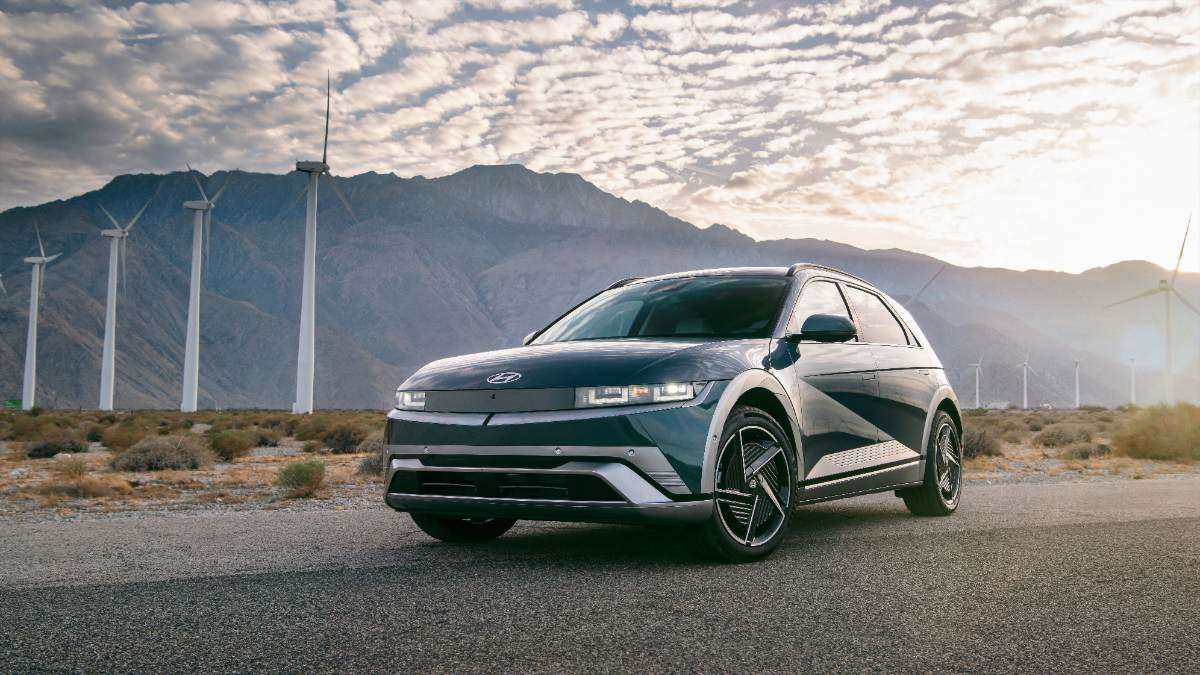

Electric cars are not the future. They’re the now. And for William Jones, an Ioniq 5 owner from Virginia, they were his reliable, economical, and surprisingly thrilling now for over 81,000 miles.
But then, during a brutal winter storm, the future stopped charging. Literally. An ICCU failure brought his chariot to a silent halt, 40 miles from home and 25 miles from the nearest dealership.
“Earlier this month, I said goodbye to my 2022 IONIQ 5 SE AWD with 81,352 miles (~24,833 kW charged) in about 37 months. With the 2-year free Electrify America plan AND free L2 charging provided by my employer, I spent only $228.17 on electricity - I was spending $100/week on gasoline for my 2003 Chevy Trailblazer when I replaced it as my commuter vehicle.
The Good:
Fun to Drive
Awesome Acceleration
Very Solid / Quiet - No Rattles even from the Liftgate
Still had the Original 12V battery - never a problem
Tire life - 66,920 miles on the original set
I never noticed degradation of the battery - the last time I charged to 100%, the GOM was 255 miles, which was fairly accurate for the summer and the same as I would see in 2022 when new.
My local Hyundai Dealership (Wright Way Hyundai) in Waynesboro, VA, that serviced my car, once they became IONIQ Certified in 2023
Lifetime efficiency of 3.28 miles / kW or 254 miles when fully consuming the 77.6 kW battery. That was the EPA rating, as I recall.
The Not So Good:
Advertising
ICCU Failure at 76,606 miles during the worst snow of the winter, 40 miles from home and 25 miles from the nearest dealership. Six Weeks to Replace (but going back to the good Wright Way, Hyundai provided a loaner throughout, including an IONIQ 6 when it became available and kept me informed through the process.) This was the ONLY mechanical issue that I had with the car.
Over the Air Updates - Essentially losing ECO mode for several months due to extremely poor acceleration in that setting - just drove in Normal and all was fine, until I updated the software at the dealer when it became available.
And another OTA update that wiped all personal settings in the infotainment system - summer of 2023
My Final Goodbye to this Group
The 03 Trailblazer finally "died," and I need a vehicle that I can properly tow with on occasion. So made the transition to a 2025 Silverado EV LT. I am sold on electric vehicles - for MY situation - they do not make sense for everyone - but for me, absolutely.
The IONIQ 5 is a Great Car, no regrets
Hyundai / Kia really needs to solve their ICCU problem
Thanks, Corbin, for all your Videos over the past three years - they have been educational and informative
And who knows - I could be back if the wife goes electric to replace her Palisade.”
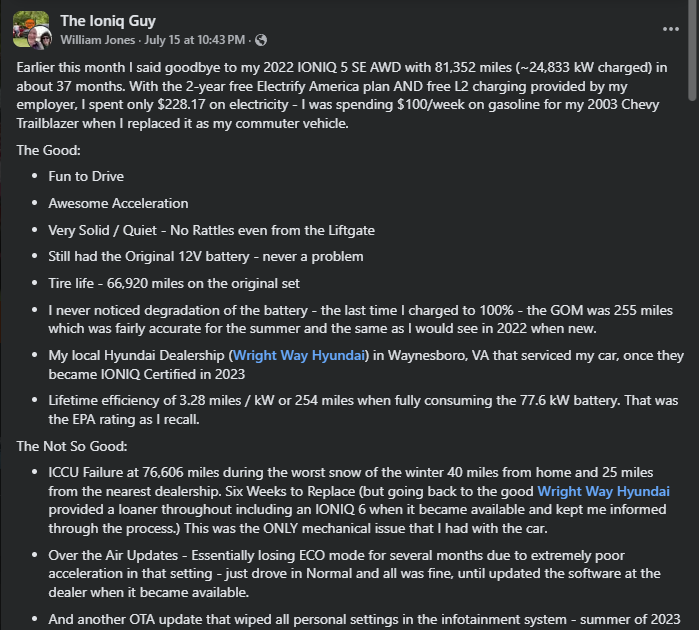
$228.17. That’s less than most of us spend on coffee in three months, and it powered an AWD crossover for more than 81,000 miles. Lifetime efficiency? A rock-solid 3.28 miles per kilowatt-hour. No degradation in battery range. Tire life that reached nearly 67,000 miles, “That tire life is IMPRESSIVE,” noted fellow Ioniq owner T Roy Smith. And remarkably, the original 12V battery never faltered. For three years, the Ioniq 5 was not just efficient, but consistently excellent. Quiet, fast, and well-built. Not a single rattle from the liftgate, even as the odometer spun north.
The ICCU Issue With Hyundai
- The ICCU (Integrated Charge Control Unit) can malfunction and fail to charge the 12 V auxiliary battery, causing it to repeatedly drain until the car becomes unresponsive to boosts
- Owners report that even new 12V batteries can be ruined by a faulty ICCU if not addressed quickly
- Hyundai issued a recall for affected Ioniq 5 vehicles, and many recall repairs include ICCU replacement and often 12V battery replacement if damaged
- Users strongly recommend scheduling recall repairs promptly, checking that the 12 V battery is healthy, and keeping a portable jump starter handy as a backup
So what happened? The ICCU, Integrated Charging Control Unit, failed at 76,606 miles. For context, that’s the part responsible for converting and directing electricity within the car. It’s not a part you ever think about until it fails. And when it does, your Ioniq 5 becomes an immobile sculpture, which is precisely what happened to Jones in the middle of a snowstorm. It took six weeks to source the part and complete the repair. But the experience was salvaged thanks to his local dealer, Wright Way Hyundai, who supplied a loaner, including an Ioniq 6 when one became available, and provided steady updates throughout the ordeal.
This is where the rubber meets the icy road of modern EV ownership. The Ioniq 5 is, by all accounts, a well-designed, reliable vehicle. But the ICCU problem isn’t isolated; it's echoed across Facebook groups and owner forums.
Do Others Have Similar Issues?
A user on IoniqForum.com reported a similar issue, saying, “I think what is happening is that the ICCU overheats, the car stops charging… I get a notification… and continues on charging.” It’s a known issue, and Hyundai seems aware, but whether a long-term fix is coming remains the question. As commenter Heath Duncan pointed out,
“Sorry you went through the ICCU deal, but it sounds like your dealer stepped up to the plate… As they should.”
Yet, even with this issue, Jones’s post paints a picture of a car that largely did everything right. OTA software updates brought some frustrations, Eco mode was unusable for a stretch, and another update wiped out all his infotainment settings, but these are problems of a new automotive era. We’re no longer just owners; we’re beta testers. And that means accepting that sometimes, software and systems need fine-tuning. Still, when your vehicle consistently meets or exceeds its EPA range rating after 81,000 miles, it’s hard to argue that Hyundai didn’t get the fundamentals right.
The data reflects the story: consistent efficiency, generally high monthly mileage, and virtually no mechanical issues beyond the ICCU. For Jones, the cost savings were immediate and obvious, $100 a week on gas in his old Trailblazer versus almost nothing in the Ioniq 5. His story isn’t one of regret, but of realism. When it came time to tow again, he made the jump to a 2025 Silverado EV LT. “I am sold on electric vehicles,” he wrote. “They do not make sense for everyone, but for me, absolutely.” Fellow group member Norman Klemens chimed in from the other side of that transition:
“I have the Max range, and having 492 miles per charge is incredible.”
Hyundai Ioniq 5: Specifications & Dimensions
- The top-tier AWD model (72.6 kWh battery) delivers around 300 hp and 445 lb-ft torque, achieving a 0–60 mph time of about 5.2 seconds
- The smaller 58 kWh battery RWD variant is slightly slower, with a 0–60 mph acceleration in about 6.1 seconds
- AWD configurations offer increased EPA-rated range, with 2023 models reaching up to ~266 miles, and towing capacity improved to 2,300 lb
- The Ioniq 5's electric drivetrain provides instant torque, allowing brisk acceleration despite what some may perceive as modest 0–60 times for a performance EV
There’s a quiet confidence in Jones’s post. A sense that despite the failure, despite the wait, despite the hiccups in OTA software, the Ioniq 5 delivered exactly what it promised, and maybe even a bit more.
If there’s a lesson in this story, it’s that Hyundai’s Ioniq 5 deserves its accolades, but also deserves better internal reliability from components like the ICCU. As the brand continues refining the platform (the 2025 update increases battery size and range), we’re likely to see fewer of these issues down the road. Until then, stories like Jones’s offer a roadmap for prospective buyers: the Ioniq 5 is an affordable, durable, and fun-to-drive EV, just make sure your dealer is ICCU-certified.
Image Sources: Hyundai Media Center
Noah Washington is an automotive journalist based in Atlanta, Georgia. He enjoys covering the latest news in the automotive industry and conducting reviews on the latest cars. He has been in the automotive industry since 15 years old and has been featured in prominent automotive news sites. You can reach him on X and LinkedIn for tips and to follow his automotive coverage.
Set Torque News as Preferred Source on Google
Follow us today...