

Every few years, we see a breakthrough that reshapes how people think about driving. Each generation of innovation shifts what drivers expect from their cars, and now, it's Tesla’s Full Self-Driving that continues to polarize opinions even as the numbers behind it grow more compelling by the day. What’s fascinating is that for every critic raising concerns about its limitations, there are thousands of owners putting millions of miles on the system, and the data suggests it’s getting safer faster than most people realize.
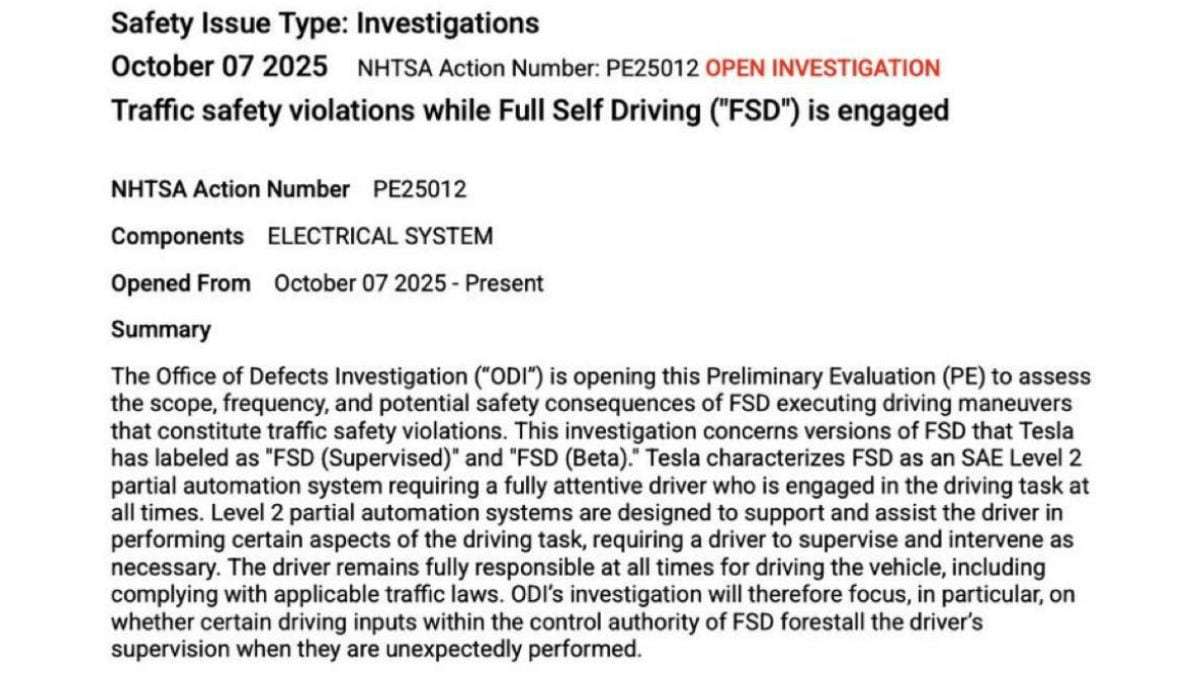
I came across a post by Jianchun Xu on Facebook this evening that shared an eye-opening breakdown of Tesla’s Full Self-Driving progress, revealing that FSD has now logged over 5.3 billion miles with only 55 recorded traffic violations. That's roughly 97 million miles per incident. They compared that figure to the U.S. average of less than 500,000 miles per crash, arguing that Tesla’s supervised FSD is more than 200 times safer than the average human driver.
Here’s how they put it: “This is why Tesla is down today. Tesla FSD has logged 5.3 billion miles with 55 traffic violations (some crashes). This is about 97 million miles per violation. US average miles per crash is less than 500K miles. Tesla supervised FSD is much more than 200 times safer than average drivers. By the way, for those who understand numbers, the U.S. average miles driven per death is 7.9 million miles. Tesla FSD has saved so many lives but it’s hated anyway. For Tesla FSD owners, be responsible while using the supervised FSD. It’s super awesome but not perfect. You still need to supervise your car to make sure it’s absolutely safe while driving.”
Jianchun’s post reflects what a growing number of Tesla owners have been observing firsthand. While FSD isn’t flawless, its real-world performance is improving at a rate few anticipated. It’s not just an engineering milestone but a sign that the concept of autonomy is moving from experiment to everyday experience. What stands out is that even as these statistics show dramatic progress, the NHTSA recently opened a new safety investigation into Tesla’s Full Self-Driving system. It highlights a fascinating contradiction, as the system may be statistically safer than human drivers, yet regulators remain cautious about trusting it completely.
A New Investigation and What It Means
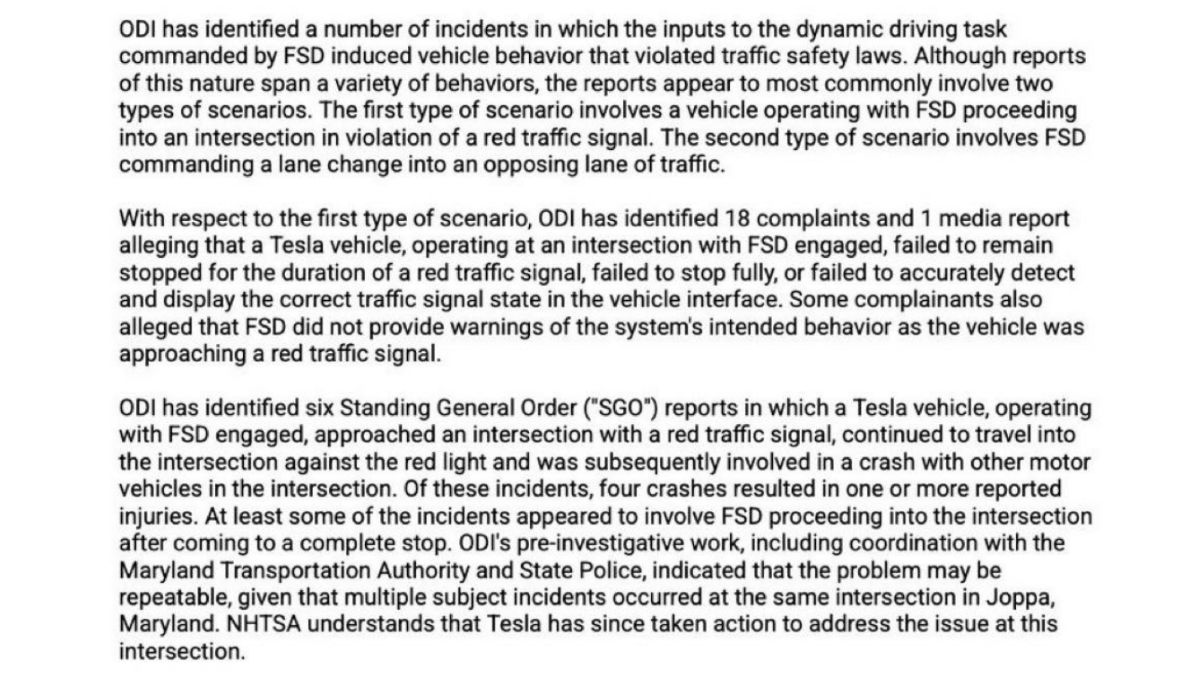
According to the agency, this new probe focuses on reported traffic safety violations involving FSD, including incidents where the system allegedly ran red lights or made improper lane changes. While the numbers in context are small — 18 complaints, 6 safety government reports, and 4 minor crashes — they serve as reminders that Tesla’s FSD, no matter how advanced, is still a supervised system. The fact that such an investigation coincides with Tesla’s 5.3-billion-mile achievement tells us something important: we are witnessing a technology that’s evolving faster than the regulations built to oversee it.
Many Tesla owners have celebrated how capable the system already feels in everyday use. Just last month, one owner reported that their Tesla Model Y’s FSD drove them across three states with zero interventions even through heavy rain. That kind of consistency, especially over long distances, is what fuels confidence among early adopters. Yet for every story like that, there are also reports of unusual edge cases. It's those moments that remind drivers why supervision remains critical. One owner of a Model Y reported that their FSD system crossed several lanes and hit divider posts at 65 mph. Those incidents are rare, but they emphasize that even with billions of miles of data, machine learning systems still face challenges replicating human judgment in unpredictable real-world environments.
Community Reactions and Real Experiences
Under Jianchun’s post, reactions ranged from optimism to skepticism and everything in between.
Theresa Shen commented, “I bought more,” referring to Tesla stock, showing how confidence in the company’s data-driven results continues to influence investor sentiment.
Then there’s Meiji Villahermosa Redoña, who said, “Absolutely! I love my FSD and it must be supervised. It works perfectly in peak traffic! I am tired after work and I’d rather have FSD do the thinking.”
Her statement reflects a common theme among owners who see FSD less as a replacement for driving and more as a partner that reduces fatigue during stressful commutes. That kind of appreciation echoes through many owners’ experiences, including those who say that Tesla has been the most enjoyable vehicle they’ve owned because of it. For them, FSD isn’t just convenience but a glimpse at the next era of driving.
But not all comments were celebratory. Scott DeWitt asked a fair question: “Please provide specific lives (IE names) saved due to FSD.”
It’s a common challenge that is raised whenever people see big safety claims without context. In response, Zachary Michael shared a personal story that put the data into perspective:
“FSD avoided my wife and I colliding with a moose last winter in Alaska. If I was in my truck, I would have smoked that moose. FSD saw it before we did and avoided it. Not sure if you are aware of how big Alaskan moose are, but they are known to seriously injure or kill drivers up here all the time.”
His experience mirrors a story I covered recently when a Tesla owner credited FSD with stopping just in time to avoid a crash, reminding us that real-world interventions can be life-saving.
Another owner, Brian Caperton, offered a more technical reflection: “I use FSD 95% of the time I am in my Model S. I find it exceptional. It has problems occasionally when making a right turn onto a busy road when visibility is partially blocked but so do I! No doubt in my mind that we are close technically to fully autonomous, but I fear a long time to navigate the approval process. I love my Tesla!”
His words strike at the core of the debate. Tesla’s FSD may be technologically ready for more autonomy, but society, law, and regulation are not quite there yet—and perhaps that’s for the best. We shouldn’t rush progress at the expense of safety or put people at unnecessary risk.
Is FSD Ready for Full Autonomy?
As impressive as Tesla’s safety data appears, the real question isn’t whether FSD can drive, but whether the world is ready to let it. Even with 5.3 billion supervised miles, Tesla’s system remains at Level 2 autonomy, meaning drivers must maintain attention and take control at any moment. The technology can execute complex maneuvers, but it still lacks the legal and ethical framework for true self-driving freedom.
In other words, technical readiness doesn’t equal societal readiness. Every time a human driver intervenes, or a regulator launches a new investigation, it reminds us that automation exists inside a system built for humans. FSD might statistically outperform human drivers, but its perfection is measured against an unpredictable world. Until vehicles can account for every unseen hazard and until policies catch up with capability, supervision will remain essential.
That's why I think Tesla’s supervised FSD shows the clearest proof that autonomy can coexist with human oversight. It’s not about replacing drivers; it’s about redefining their role. The way I see it, we’re entering an era where being a good driver might also mean being a good supervisor of technology. I find that balance fascinating, and it’s what makes Tesla’s progress so worth paying attention to. FSD’s 5.3-billion-mile record isn’t just a statistic; it’s a marker of how quickly our expectations are shifting about what a car should do for us.
Key Takeaways
- Tesla’s FSD has logged over 5.3 billion miles, recording just 55 traffic violations, technically making it over 200 times safer than the U.S. average per crash.
- NHTSA’s new investigation highlights how progress in autonomy outpaces current regulations.
- Real-world owner stories continue to show FSD’s potential to prevent serious accidents.
- Full autonomy isn’t just about technology — it’s about trust, accountability, and readiness at every level.
Do You Trust FSD?
Do you think Tesla’s FSD data proves we’re ready to let cars drive themselves without supervision?
Or do you believe that human input will always be necessary no matter how advanced these systems become?
I'd love to hear your thoughts in our comments below.
Aram Krajekian is a young automotive journalist bringing a fresh perspective to his coverage of the evolving automotive landscape. Follow Aram on X and LinkedIn for daily news coverage about cars.
Image Sources: Jianchun Xu’s public Facebook post.
Set Torque News as Preferred Source on Google
Follow us today...


Comments
Only old people are…
Permalink
Only old people are interested in self driving cars. Anyone under 40 would rather drive a Ferrari, only people over 50 would rather sit in the back of a Toyota Prius.