

Sometimes the smallest features generate the loudest debates, especially when they sit at the intersection of comfort, expectation, and design intent.
That was the case in a recent discussion among 2023–2026 Toyota Tundra owners, where a simple question about the heated steering wheel turned into a revealing look at how modern trucks balance ergonomics, engineering, and owner assumptions.
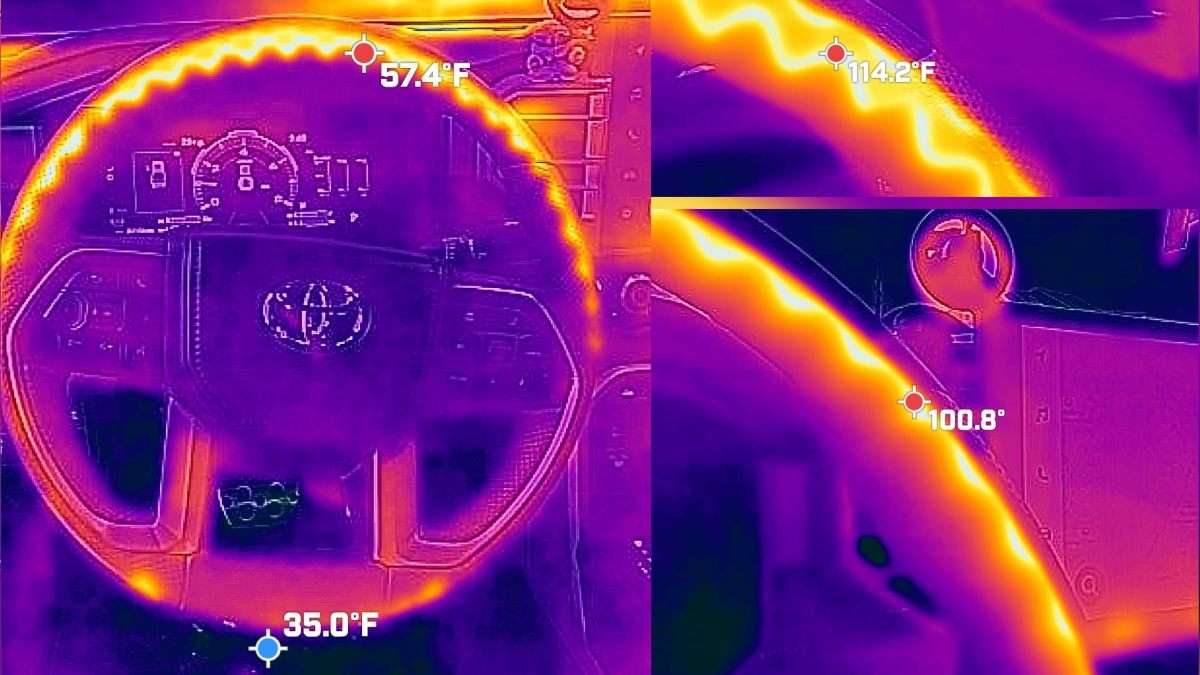
The original question was straightforward and refreshingly non-confrontational. An owner noticed that while the heated steering wheel did warm parts of the rim effectively, the inner underside, particularly around the lower portion of the wheel, remained cold. Fingertips froze while palms stayed warm. The concern was not framed as a complaint, but as a practical warranty question. Was something broken that should have been addressed before coverage expired, or was this simply how Toyota designed it?
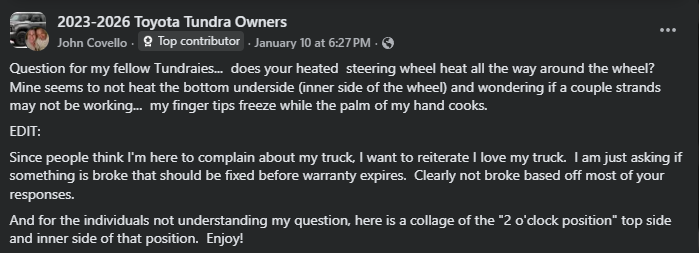
“Question for my fellow Tundraies... does your heated steering wheel heat all the way around the wheel? Mine does not heat the bottom underside (inner side of the wheel), and I'm wondering if a couple of strands may not be working... my finger tips freeze while the palm of my hand cooks. EDIT: Since people think I'm here to complain about my truck, I want to reiterate that I love my truck. I am just asking if something is broken that should be fixed before the warranty expires. Clearly not broke based on most of your responses. And for the individuals not understanding my question, here is a collage of the "2 o'clock position" top side and inner side of that position. Enjoy! Thanks for the responses and the laughs. I won't waste time with a warranty claim then because it's obviously a design flaw. And just an observation, it's amazing to me how many people don't read posts in their entirety or lack critical thinking…”
As responses rolled in, a pattern quickly emerged. Many owners confirmed the same behavior. Heat was concentrated primarily on the outer rim in the upper quadrants of the wheel, while the lower inner section remained largely unheated. For those expecting uniform warmth around the entire circumference, the answer was disappointing but clear. This was not a defect. It was deliberate.
Is this uneven heating pattern unique to the Tundra, or does Toyota do the same thing in other models like the Tacoma, RAV4, and Highlander? See it from this video by Torque News Chief Editor Armen Hareyan from our Torque News Youtube Channel.
Toyota Tundra: Turbocharged Full-size Pickup Truck
- The Toyota Tundra is a full-size pickup truck designed for towing, hauling, and long-term durability rather than maximum fuel efficiency.
- Newer generations of the Tundra use turbocharged engines instead of traditional V8-only options, including an available hybrid powertrain.
- The Tundra is built in the United States and is known for strong resale value compared with many competing full-size trucks.
- It is larger than midsize trucks like the Toyota Tacoma, which affects parking ease, fuel consumption, and overall driving feel.
Several commenters pointed out that the heating elements are focused on where drivers are “supposed” to place their hands. Depending on which school of driver education you subscribe to, that means either the traditional 10-and-2 or the now more widely recommended 9-and-3 positions. Either way, Toyota appears to have engineered the system to prioritize those zones rather than blanket the entire wheel. From an efficiency and cost standpoint, that makes sense. From a cold-weather comfort standpoint, it feels like a compromise.
Not everyone was sympathetic to the design choice. Some owners described the heating as uneven, cycling between warm and cool rather than maintaining a consistent temperature. Others used the opportunity to air broader frustrations, dragging in unrelated gripes about remote start procedures and subscription services. In online owner groups, these conversations rarely stay neatly contained, and this one was no exception.
To the original poster’s credit, they returned to clarify their intent. This was not a rant. They loved the Tundra. They simply wanted to know whether the behavior was normal. Once it became clear that most owners experienced the same thing, the conclusion was pragmatic. No warranty claim was necessary. If anything, this was a design limitation rather than a failure.
What makes the discussion interesting is how it highlights the gap between expectation and reality in modern vehicles such as the Toyota Tundra. Heated steering wheels have existed long enough that many drivers assume full coverage is standard. In practice, manufacturers often make targeted choices about where heat is applied, balancing power draw, cost, and perceived benefit. The result can feel inconsistent if you grip the wheel differently than the design assumes.
There is also a subtle lesson here about how vehicles are actually used versus how engineers imagine them being used. Drivers shift hand positions constantly. Long highway stretches, tight turns, cold mornings, and casual cruising all change how you interact with the wheel. When heating only covers certain zones, those gaps become noticeable very quickly, especially in winter.
The thread settled into something close to consensus. Nothing is broken. The Tundra is fine. The heated steering wheel works as designed, even if that design leaves some fingers colder than others. It is a small issue in the grand scheme of ownership, but one that underscores a larger truth. Modern trucks are packed with features, yet even the simplest comforts are shaped by assumptions that may not match every driver. Sometimes the answer is not a repair, but an understanding of where intention ends and expectation begins.
Image Sources: Toyota Media Center
Noah Washington is an automotive journalist based in Atlanta, Georgia. He enjoys covering the latest news in the automotive industry and conducting reviews on the latest cars. He has been in the automotive industry since 15 years old and has been featured in prominent automotive news sites. You can reach him on X and LinkedIn for tips and to follow his automotive coverage.
Set Torque News as Preferred Source on Google
Follow us today...




Comments
We are truly a society of…
Permalink
We are truly a society of pansies now.
Is it just me, or does it…
Permalink
Is it just me, or does it look like he's measuring a spot in the floorboard?
Yes, it does look that way…
Permalink
In reply to Is it just me, or does it… by Jeff Lentz (not verified)
Yes, it does look that way outright. It likely is. Also the image appears to be using a thermal image overlaid a real image. Although standard feature now with thermal cameras it's likely not perfect. Most thermal cameras that people buy are never properly calibrated anyways. Because they're not professionally obligated to as would a professional thermographer.
Many automakers mess up…
Permalink
Many automakers mess up heated steering wheels. Ford has a thermostatic control on theirs which is dumb. This story doesn’t mention that automakers’ gimmick heated steering wheel design is a market research failure. One of the biggest user groups of heated steering wheels is senior citizens as they help mitigate hand discomfort from holding the wheel for a period of time. Senior drivers use heated steering wheels year round, not just during cold weather. Hyundai does a better job with their heated wheels and has more refined features in general.
The 35 reading was off the…
Permalink
The 35 reading was off the wheel, probably on the floor. At the same time the wheel was at 54.
Other shots show 100 degree readings which should be comfortable.
Beats sitting on one hand, driving with the other.
The steering wheel on my…
Permalink
The steering wheel on my tractor matches outside temperature. Hence why I wear gloves in the winter.
First world city boy problem here....
If I pay for it I damn well…
Permalink
In reply to The steering wheel on my… by Erik (not verified)
If I pay for it I damn well want it to work. I expect the whole wheel to be warm since I use all of it to get out of my parking spot 1st thing in the morning.
Who cares? Get a life and…
Permalink
Who cares? Get a life and more importantly a hobby other than making sissy girl posts about your POS Toyota. Have a nice day 😘
My Ram is similar. I just…
Permalink
My Ram is similar. I just simply move my hands to the warm spots. The great thing about a wheel is there are many points in which to grab
Yeah, the heated steering…
Permalink
Yeah, the heated steering wheel is not engineered well.
The palm area is hot (quickly) (nice) and the finger area is still freezing (not nice).
The solution at this point is to adjust the heater blower vents to blow in the direction of the wheel...lol
Obviously, Toyota has many engineering/manufacturing problems associated with idiots doing the work.
Was this written by AI? The…
Permalink
Was this written by AI? The 35° reading isn't even on the steering wheel.
I guess they didn't realize…
Permalink
I guess they didn't realize that occasionally people needed to make turns and therefore utilized more of the wheel
This is news? Subaru does…
Permalink
This is news? Subaru does the same thing.. hot spots where your hands should be, cools spots where they arent supposed to be
My Ford Edge Titanium does…
Permalink
My Ford Edge Titanium does the same thing. Has some hot areas and cold areas. Cheap design.
Back in the good old days,…
Permalink
Back in the good old days, we would just wear a pair of driving gloves! Problem solved, and probably 1 thousand dollars cheaper!?
That 35 degree point he's…
Permalink
That 35 degree point he's measuring is on the floor of the truck, not the rim of the wheel.
Headline: Man finds out his…
Permalink
Headline: Man finds out his Toyota didn't come with a dress.
Skill issue, the hands…
Permalink
Skill issue, the hands should be on the wheel in proper placement. The heating elements heat those areas perfectly fine.
1st world problems.
Permalink
1st world problems.
It's funny the last 30 years…
Permalink
It's funny the last 30 years of upgrades surmount into a non-plastic and fake leather on roads spilled with oil, potholes from rock-trucks, and less skill to electrify correctly the ideas that are basic enough for Switch-Original Americans.
Have a feature? There's a Switch.
It used to be Automatic, that it wasn't Automatic. Autocratic. Autonomous l. Eye of the Beholder.
Vehicles are now glamor-gashes. Reputable only to themselves, or their V(e)(a)in Creators UVote4.
Relevancy be damned at the nearest dug-out some of our great-great grandparents died making to be filled by sewage and leaking oil as a driveway your neighbor uses to endanger his kids with.. no standings, kids play without teachings with no hot wheels tracks under a lifted truck-- parents can't even make the hot wheels track work as they work on the roads. Better buy them all a boat!
Laughing Matters.
If only someone had taught it well enough... ...
Everyone is missing the…
Permalink
Everyone is missing the obvious. The steering wheel is NOT heated at the bottom because Toyota does not want to get sued by lard butts whose stomachs are so large they press into the bottom of the steering wheel. By new standards 70% of US adults are obese.
Non-story. Total click bait…
Permalink
If you drive with your hands at 10 & 2 you have a heated steering wheel by design. Driving with your hands at 6 o'clock does not allow for proper control of a vehicle in accident avoidance measures.