A 2024 Toyota Tundra catastrophic engine failure at 27,800 miles, and what every 2022+ Toyota Tundra owner must know.
The recent post from Ernie Lee Mozingo in the 2023-2026 Toyota Tundra Owners Facebook page is the kind of news that stops every owner cold. At just 27,800 miles, Ernie's 2024 Tundra Limited suffered a catastrophic engine failure requiring a complete powertrain overhaul and, controversially, the removal of the truck's cab.
Ernie's quote is brutally clear: "My 2024 Toyota Tundra Limited, turns out the front bearing was digging through the front cover. 27,800 miles and it's getting a short block and new turbos. What was strange was that they removed the cab to do it."
In this report, I'll unpack the mechanical severity of this failure, explain the necessary "cab-off" repair, review the issue in the V35A-FTS engine's history, and provide steps for owners to protect their investment.
The Technical Breakdown:
Ernie's description of the "front bearing digging through the front cover" points to a profound mechanical failure in the lower half of the engine. This bearing—likely a crankshaft main bearing or a critical timing component—suffered catastrophic degradation due to a lack of precise oiling or severe misalignment.
The fact that metal-on-metal contact breached the front timing cover means two things:
- Massive Contamination: The engine's internal oil cavity is now saturated with metallic debris, acting as abrasive shrapnel.
- Systemic Damage: The oil system is compromised, which is why the twin turbochargers must also be replaced. Turbos rely on engine oil for cooling and lubrication; even microscopic metal flakes can instantly destroy their delicate bearings.
The resulting fix is a short block replacement, meaning the primary engine structure (block, pistons, and crankshaft assembly) is non-repairable and must be swapped out entirely. This failure confirms that underlying defects—often manifesting as debris-related wear—are causing total engine destruction, even on the supposedly improved 2024 model-year builds.
Why Cab Removal is Necessary
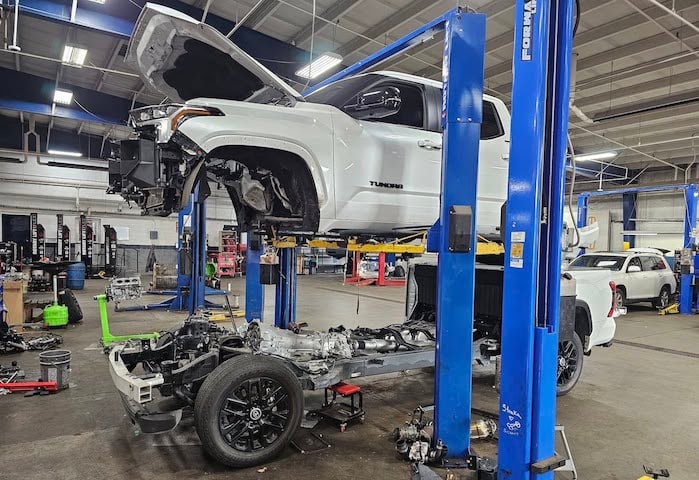
The most startling detail for owners is the requirement to remove the cab: "What was strange was they removed the cab to do it."
This procedure, while shocking, is a critical insight into the Tundra's design. The 3.4L twin-turbo V6 (V35A-FTS) is a compact engine heavily integrated into the Tundra's frame, laden with complex equipment and high-mounted turbos. Unlike previous generations, removing the engine core through the tight hood space is exceptionally difficult.
More On the Cab-Off Approach
- Access: Lifting the cab provides 360-degree access to the entire engine and transmission mating point. This dramatically simplifies the technician's task of safely unbolting accessories, separating the transmission, and dropping the short block out from underneath.
- Precision: For a complex, massive warranty repair, the cab-off method drastically reduces the risk of errors, pinched wiring harnesses, or damage to components like the cylinder heads (which are typically reused in a short-block swap).
- Efficiency: Counterintuitively, a trained dealer technician can often lift the cab and perform the short block swap faster and more accurately than trying to maneuver the engine out through the congested front opening.
The cab removal is thus a necessary step to facilitate a precise, warrantied, and invasive repair on this modern platform.
Takeaways for Owners
The failure of a 2024 model confirms that the underlying manufacturing defects that prompted the massive 2023 recall persist beyond the initially affected production windows. Owners of 2022-2026 Tundras (i-FORCE or i-FORCE MAX) must be hyper-vigilant.
What Should Tundra Owners Do?
- Oil Analysis (UOA): Implement regular used oil analysis through a reputable lab (like Blackstone Labs). UOA detects high levels of internal metals (especially lead and copper, indicating bearing wear) long before the engine throws a code or starts knocking, giving you crucial early warning.
- Document Everything: As Ernie did, document all details: mileage, symptoms, and the dealership's proposed fix (e.g., "cab removed for short block replacement"). This documentation is vital for warranty claims and future vehicle valuation discussions.
- Negotiate Loaner Vehicles: A cab-off short block replacement and turbo job can take weeks or even months, depending on parts availability. If your truck is essential for work, advocate strongly for an equivalent vehicle as a loaner.
What the Community is Saying
The experience of Ernie Lee Mozingo resonates deeply within the Tundra owner community, fueling ongoing long-term reliability concerns about the Toyota Tundra i-FORCE Max engine.
- Resale Value Fear: The most common fear among owners is, as one social media user noted, "Any vehicle that has had its engine rebuilt is going to be worth much less." Owners feel a massive hit to their resale value when a vehicle requires such extensive, early-life work.
- Trust in the Repair: There is anxiety about the quality of the short-block swap. "Fingers crossed the dealerships that did our repairs took their time and got the build right," one user wrote, reflecting the concern that a rebuilt engine, even with new major components, relies heavily on technician skill to reassemble correctly.
If you own a 2022-2026 Tundra, especially those with the i-FORCE or i-FORCE MAX engine, you must be hyper-vigilant.
I've previously reported extensively on this, and you can see my complete report on owners finding themselves in a grey area here: My 2023 Toyota Tundra's Engine Started Knocking at 30K Miles, and I'm 2 Months Outside the Recall, Now the Dealer Says I Can't Get a New Engine
Conclusion:
The fact that 2024 models are showing this failure suggests that Toyota's fix for the original debris problem may not have been a complete systemic change. These frustrated owners paid a premium for the newest model, hoping to avoid early-build issues.
This story confirms that the need for a short block replacement persists. While the factory warranty covers the immediate fix, the lingering question of depreciation and long-term durability keeps owners worried.
Owners must press Toyota for complete transparency and long-term assurance. Until we see evidence that the engine's internal reliability issues have truly been mitigated in the 2024 and beyond models, proactive vigilance—starting with regular oil analysis—is mandatory.
For all 2022+ Tundra owners out there, I want to hear from you:
Given these persistent, high-mileage failures, what specific assurance or proactive measure (beyond the standard warranty) would give you confidence in your Tundra's long-term investment? Click the red Add New Comment link below and let us know.
I'm Denis Flierl, a Senior Torque News Reporter since 2012, bringing over 30 years of automotive expertise to every story. My career began with a consulting role for every major car brand, followed by years as a freelance journalist test-driving new vehicles—equipping me with a wealth of insider knowledge. I specialize in delivering the latest auto news, sharing compelling owner stories, and providing expert, up-to-date analysis to keep you fully informed.
Follow me on X @DenisFlierl, @WorldsCoolestRides, Facebook, and Instagram
Photo credit: Denis Flierl via Ernie Lee Mozingo
Set Torque News as Preferred Source on Google
Follow us today...