
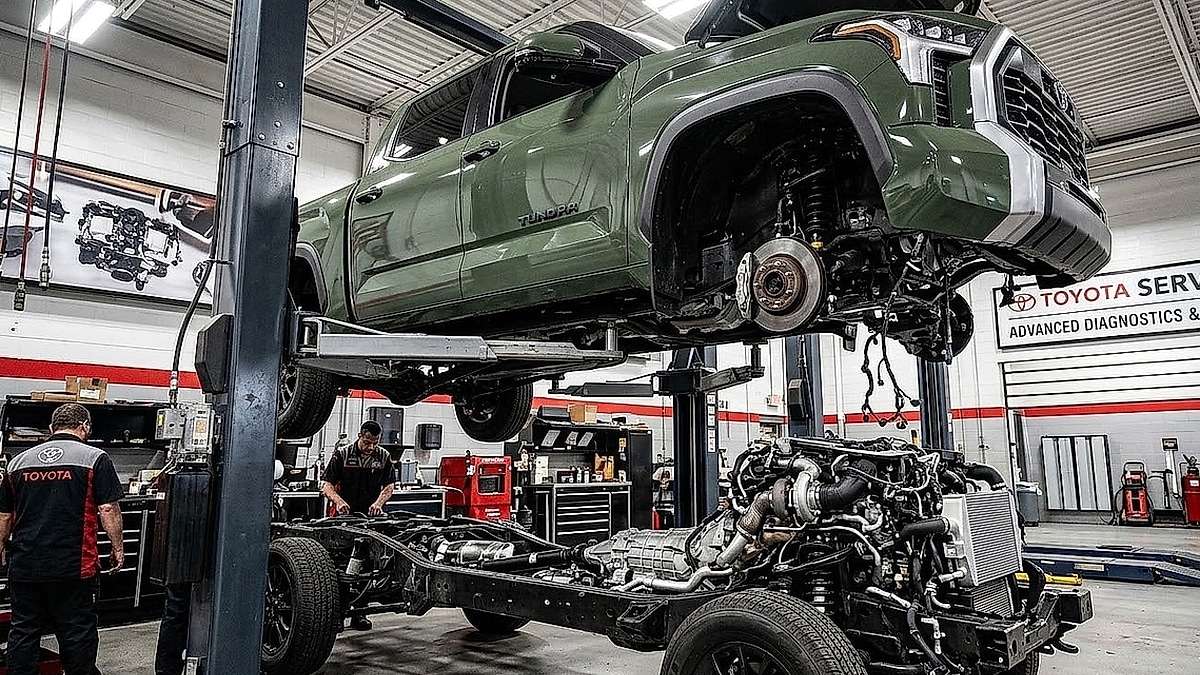

For owners of 2022-2026 Toyota Tundras, the dreaded "Engine Shutdown" warning is no longer a months-long sentence in a service bay. Recent data from the V35A engine debris crisis reveals a significant shift in Toyota’s repair strategy: the transition from labor-intensive "short block" rebuilds to complete long-block crate engine swaps.
In one recent case out of Florida, a 2024 Tundra SR5 TRD suffered a catastrophic bearing failure at 44,000 miles. Historically, this would have resulted in an indefinite wait for machining parts. However, the manufacturer authorized a full engine replacement and provided a rental vehicle within hours, completing the entire powertrain swap in just seven days.
As a 30-year veteran of the automotive industry, I’ve tracked this saga since the first "death knocks" appeared. This streamlined "cab-off" procedure and the availability of ready-to-ship crate engines represent a logistical turning point. Here is why the 2026 workflow is a "game-changer" (not in hype, but in technical reality) for owners facing the V35A machining debris issue.
In my latest deep dive into Toyota reliability trends, I came across a compelling report shared within a popular Facebook community for 2023-2026 Toyota Tundra owners. Austin Ratchford from Florida highlighted the sobering reality of the V35A engine debris crisis, detailing a catastrophic bearing failure at 44,000 miles that left his SR5 TRD dead on the road. Yet his experience reveals a surprising silver lining: how the manufacturer is handling these high-stakes breakdowns.
Austin says, “Officially a statistic. My 2024 Toyota Tundra SR5 TRD - Engine debris and bearing failure at 44k miles. I was driving down the road and got an “Engine Shutdown. Pullover” warning. I will say Toyota has been great about it. I’m getting a new engine over the next 7 days, and the dealer got me a rental within a few hours.”
From My View: A Silver Lining
After spending 30 years in the automotive industry, I’ve seen every kind of mechanical disaster you can imagine. I’ve watched manufacturers run for the hills when things got tough, and I’ve watched others step up to the plate. But what I am seeing in the 2024 Toyota Tundra is truly unique.
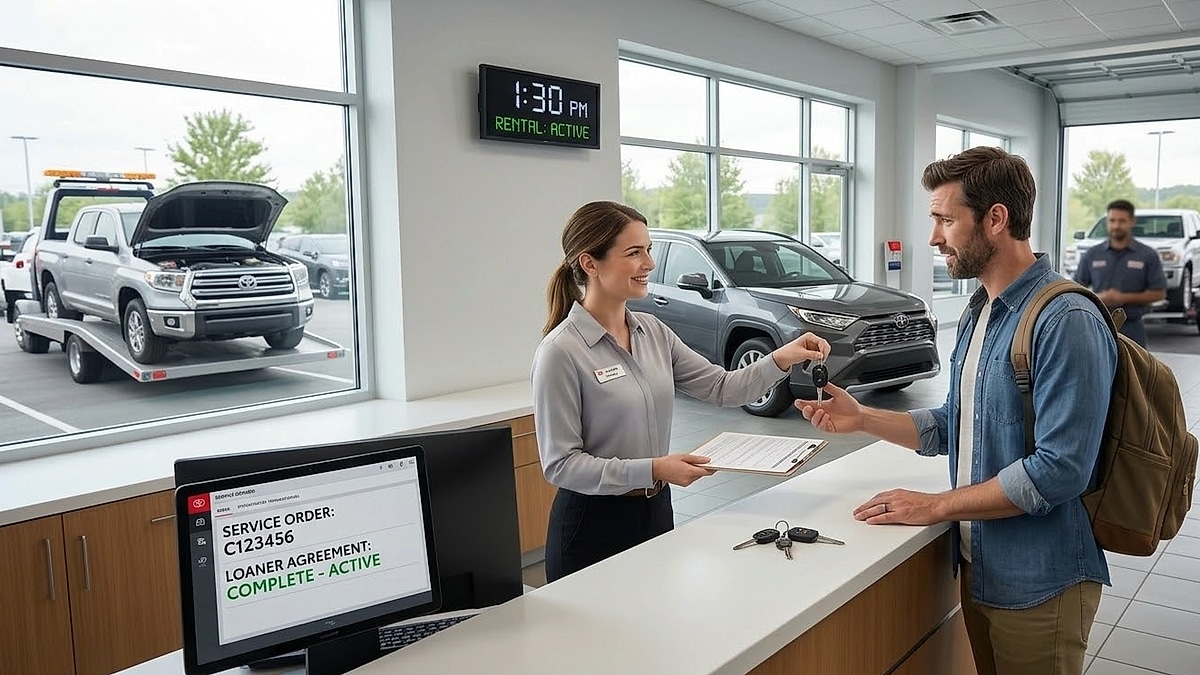
Austin was just driving down the road when his dash lit up with the dreaded “Engine Shutdown. Pull Over” warning. For any truck owner, that is the ultimate nightmare. Yet, Austin’s experience reveals a surprising silver lining in how the manufacturer is handling these high-stakes breakdowns. He mentioned that Toyota has been great about it, getting him a rental within hours and promising a brand new engine in just seven days.
I’ve been tracking this saga since the beginning. I previously wrote about how the "Death Knock" at 24,000 miles is becoming a common story for owners, which you can read about in my report, 2023 Toyota Tundra Owner Says, '24K and I'm Getting a New Engine”. It’s a pattern that is hard to ignore, but the response time from the dealers is what is catching my eye lately.
My Take
My experience tells me that a brand’s reputation isn’t built just on how long its parts last, but on what it does when those parts fail. I’ve seen dozens of cases where a failed engine meant months of fighting with corporate. However, experts at CarPro noted that Toyota has widened the net on its ongoing V35A problem, and some observers wonder if the deeper issue is design-related rather than purely a machining oversight.
I’ve dug into the technical side of this many times. In fact, I exposed some of the more frustrating dealership experiences in my article, My 2022 Toyota Tundra Has Been at the Dealer for 30 Days, where I discussed why some owners are left waiting for months while others, like Austin, get back on the road in a week.
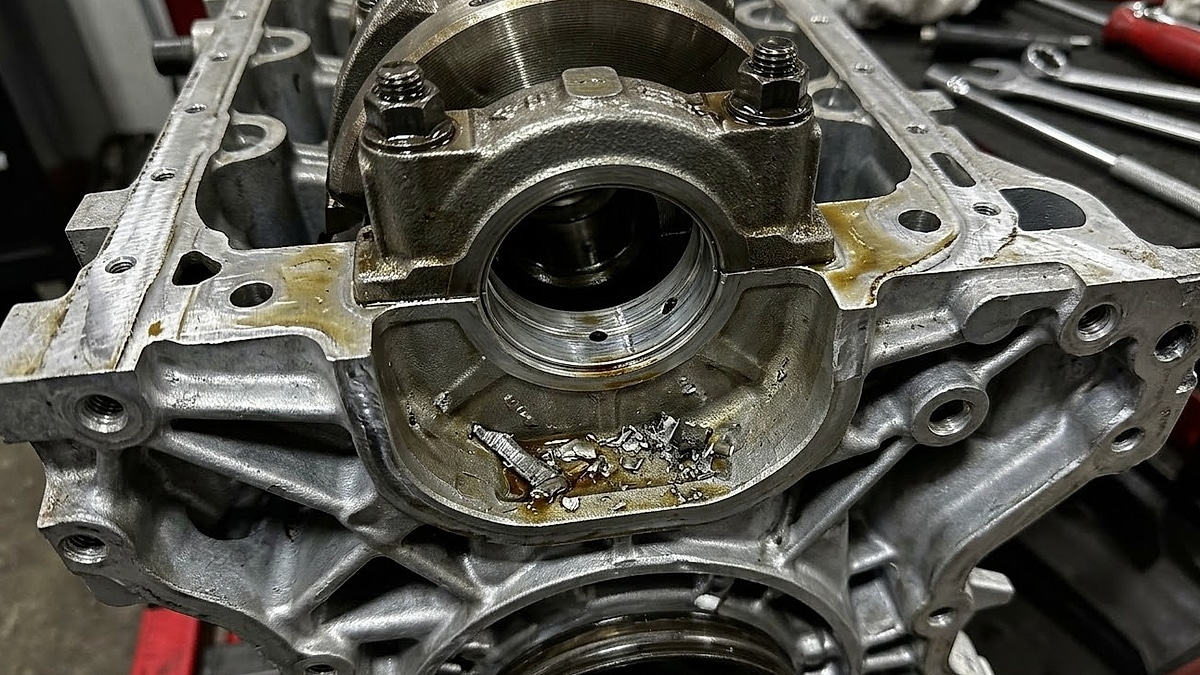
The truth is, the V35A twin-turbo V6 is a high-stress engine. When you have machining debris sitting near crankshaft main bearings, it is only a matter of time before the "statistic" becomes a reality. According to The Drive, machining debris can cause engine knocking and rough running, as well as no-start conditions and sudden loss of power. I believe the seven-day turnaround we are seeing now is Toyota’s way of saying they have finally dialed in the parts and the process.
The Technical "Why" Behind the 7-Day Speed
I've had many readers ask how a dealer can swap a twin-turbo V6 in just a week when early 2022 models were sitting in service bays for months. As someone who has analyzed these teardowns since the first 2022 units hit the floor, the answer lies in three specific logistical and mechanical shifts that have matured by early 2026:
1. The Shift to Fully Dressed "Long Blocks"
Early in the V35A recall, technicians were often tasked with a "short-block" replacement. This required them to salvage the cylinder heads, turbos, and cooling systems from the failed engine and transplant them onto a new bottom end. This was a 25-to-40-hour labor nightmare prone to human error.
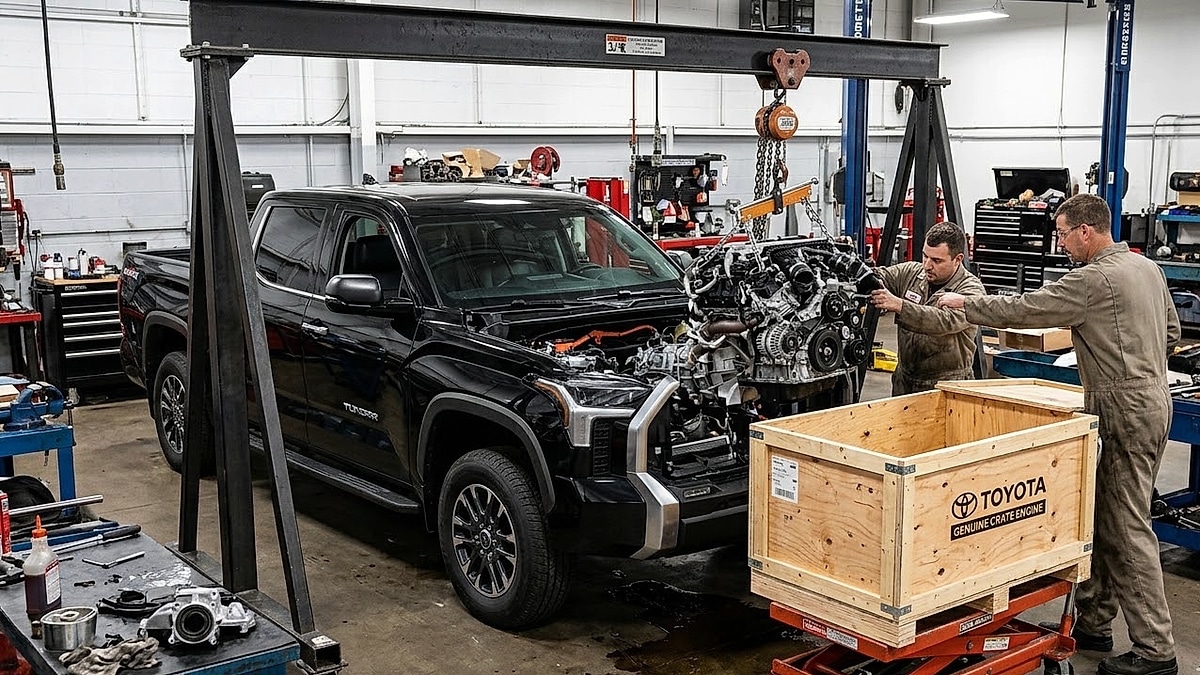
By March 2026, Toyota has moved almost exclusively to "Long Block" crate engines. These units arrive at the dealer "fully dressed" with timing covers and heads pre-installed. This cuts technical labor by nearly 40% and eliminates the risk of contaminated parts from the old engine re-entering the system.
2. Mastery of the "Cab-Off" Procedure
While lifting the entire truck body off the frame (the "cab-off" method) once shocked owners, it is now the standard for 2026 service precision.
Lifting the cab provides 360-degree access to the powertrain. By removing the physical barrier of the engine bay, technicians can unbolt the 10-speed transmission and the twin-turbo plumbing in a fraction of the time required for a traditional "hood-up" pull. What used to be a specialized skill has become a choreographed, surgical routine for master techs.
3. Optimized Regional Parts Banks
In 2024, engines were shipped on a case-by-case basis from Japan or the Alabama plant, leading to "logistics purgatory." In 2026, Toyota maintains Regional Engine Banks. When a dealer confirms a V35A bearing failure via oil analysis or the "Engine Shutdown" code, a replacement crate is often dispatched from a regional hub within 24 hours.
Key Takeaways: The 2026 Tundra Logistics Shift
- The Problem Persists, but the Scope has Narrowed: While the V35A machining debris issue is no longer a "mystery" in 2026, it continues to surface in 2024 and 2025 models reaching the 40k–60k mile threshold. The "statistic" is now a known mechanical variable, not an outlier.
- The Death of the "Short Block" Rebuild: A major win for 2026 owners is the industry-wide shift to full Long Block replacements. By authorizing complete crate engines rather than internal dealer rebuilds, Toyota has effectively eliminated "secondary failures" caused by assembly errors in service bays.
- Logistical "Velocity" as a Standard: The seven-day turnaround seen in recent cases is the result of Regional Engine Banks. Dealers no longer wait for overseas shipments; "ready-to-install" units are now strategically positioned in regional hubs to ensure rental car costs (and owner downtime) are minimized.
- The "Cab-Off" Precision: The repair process has been surgically optimized. Technicians now utilize a standardized "cab-off" workflow that allows for a complete engine swap in 13 to 21 labor hours—a 30% efficiency gain over the 2022-2023 "learning phase" of the recall.
- Critical Documentation: For 2026, the burden of proof remains high. Ensure every oil change and service interval is logged in the Toyota Owners Portal. In cases of bearing failure, the "7-day win" is only guaranteed for owners with a clean, verifiable maintenance history.
I've also seen the darker side of this: a replacement engine failing shortly after installation. I covered one such case in which the replacement engine blew up after only 6,000 miles, showing that the installation process is just as critical as the part itself.
Community Technical Feedback
The community feedback is vital for understanding the scope of this. One user on Reddit noted the severity of the situation and the loss of faith some are feeling, stating, "Toyota's continued excuses and lack of transparency have broken my faith in anything with this engine and eroded my trust in the brand," which you can read in the full Reddit discussion here.
Another owner highlighted the mixed emotions of being "taken care of" while still owning a truck they can't fully trust, saying, "Mechanical issues happen, but being stranded with young kids like that isn't something I can risk again," as found in this Reddit thread.
As Good As It Gets
It’s never easy to see a truck you love fail on you, especially when you’ve put 44,000 miles on it. But if you have to be a "statistic," having a manufacturer that offers a rental by the hour and a new engine in a week is about as good as it gets. I’ll keep monitoring these Tundra failures to see if the "7-day fix" becomes the new standard.
Join the V35A Technical Discussion
The shift from "short block" rebuilds to "long block" crate engine swaps has fundamentally changed the ownership experience for the 2022–2026 Tundra. If you have faced the "Engine Shutdown" alert recently, we want to hear the technical specifics of your experience to help the community track these trends:
- The Logistics Check: Did your dealer offer a 7-day turnaround, or are you still seeing regional delays?
- The Parts Check: Was your replacement a "fully dressed" long block or a lower-end rebuild?
- The Rental Experience: How quickly was a loaner vehicle authorized once the diagnostic code was confirmed?
Share your mileage and repair timeline in the comments below. Your data helps other owners navigate the warranty process with more confidence.
About The Author
Denis Flierl is a 14-year Senior Reporter at Torque News and a member of the Rocky Mountain Automotive Press (RMAP) with 30+ years of industry experience. Based in Parker, Colorado, Denis leverages the Rockies' high-altitude terrain as a rigorous testing ground to provide "boots-on-the-ground" analysis for readers across the Rocky Mountain region, California EV corridors, the Northeast, Texas truck markets, and Midwest agricultural zones. A former professional test driver and consultant for Ford, GM, Ram, Toyota, and Tesla, he delivers data-backed insights on reliability and market shifts. Denis cuts through the noise to provide national audiences with the real-world reporting today’s landscape demands. Connect with Denis: Find him on LinkedIn, X @DenisFlierl, @WorldsCoolestRides, Facebook, and Instagram.
Photo credit: Denis Flierl via Austin Ratchford
Set Torque News as Preferred Source on Google
Follow us today...







Comments
As a master Toyota…
Permalink
As a master Toyota technician of 45 years I can say Toyota has never authorized a short block replacement for this campaign.
Although that was always the policy for any engine that failed under warranty.
This campaign was different because of the quantity of failures
The reason for the long wait at first was for the availability of the complete engines.
Our dealership did do the first engine failure, before the campaign was official, in short block form but since then the engines have readily available.
However, we have been experiencing problems with the crate engines, such as oil leaks and other components not assembled correctly.
Lots of inaccuracies in this…
Permalink
Lots of inaccuracies in this article as well as garbage apparently ai created images of almost accurate looking engines being removed improperly directly into an undersized crate. At least include real pictures if you're going to put pictures in.
As noted, short block was never an option once this hit recall status. Only time we did short blocks is before the recall was released and for years that weren't covered in the recall yet.
Cab removal, while it is done by some techs, is explicitly stated not to do for this repair and in most cases adds to the amount of time it takes to do this job.
The recall pays 13.6 hours and most of us that have done more than a few of them are significantly under that time. Personally most of the time I get the truck in my bay and out of it the same day. Though we do schedule each vehicle in advance so often times the vehicle is on our lot for about a week before I get to it.
The biggest offense in this article is the horrible fake pictures though. Do better, taking an actual picture of an engine being removed is not difficult and a reputable news agency should never be using ai slop for it's pictures...
I took in my 2022 tundra for…
Permalink
I took in my 2022 tundra for rear brake actuator replacement. While there is was told due to the engine recall my engine would be swapped. My truck had 159k Miles already. I dropped of my truck on Wednesday at 1pm and got it back the following Saturday at 10am. Very impressed with the turnaround and hassle free process.