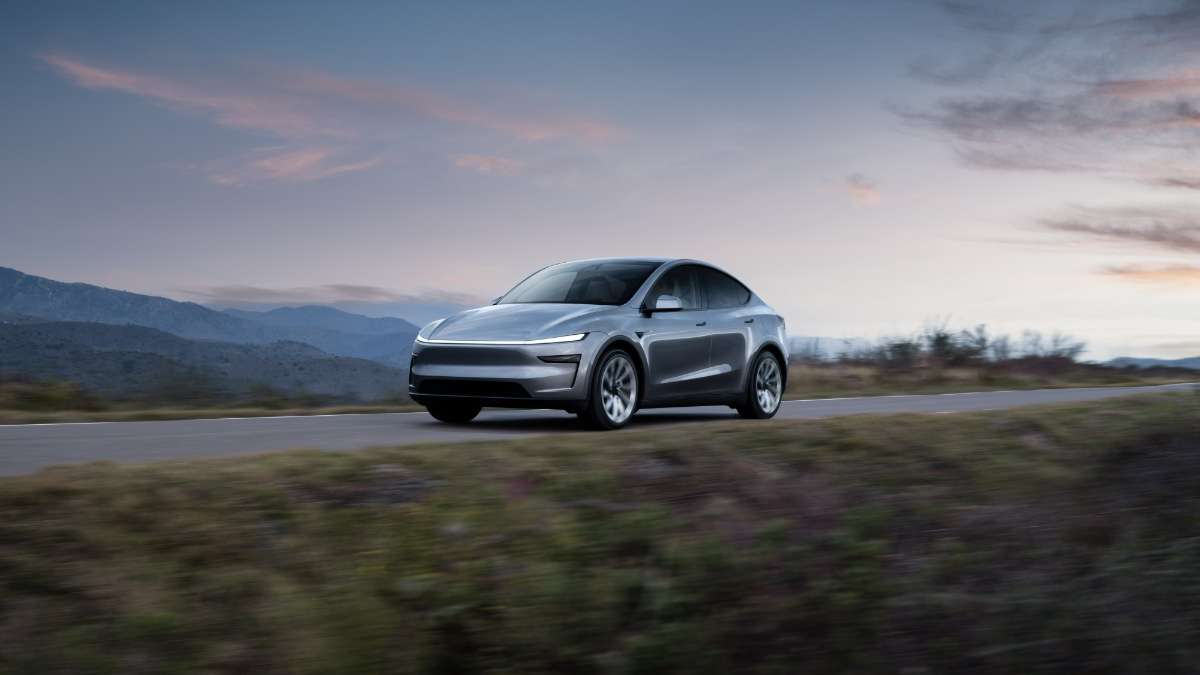

There is a certain kind of brain that gravitates toward a Tesla, and it is not the carefree, impulse-buy variety. It belongs to the methodical thinker who treats a car like a long-term project. Range graphs get studied, charging curves get compared, and road trips are planned with the precision of a flight plan. That is exactly the mindset behind a Model Y owner who has logged 26,000 miles in eight months, leaned hard on Full Self-Driving for cross-country runs, and now finds himself reconsidering the whole arrangement. The car has performed, the Supercharger network has delivered, yet the social weather around the Tesla badge has turned ugly enough that he feels compelled to look at Rivian instead.
So, like many modern owners faced with a big decision, he walks into the digital garage known as r/Rivian to ask the people who actually live with these trucks what life is like on the other side.
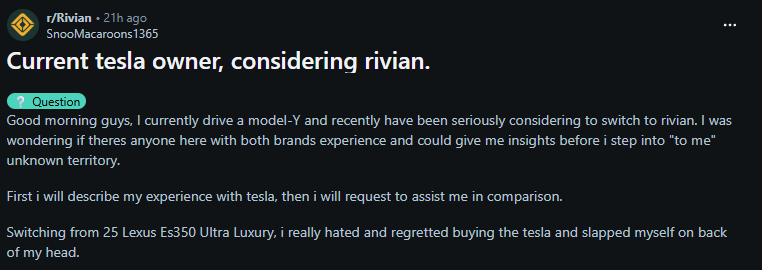
Here is his post on r/Rivian:
“Good morning, guys. I currently drive a Model Y and have recently been seriously considering switching to Rivian. I was wondering if there's anyone here with both brands' experience and could give me insights before I step into "to me" unknown territory.
First, I will describe my experience with Tesla, then I will request assistance in comparison.
Switching from a 25 Lexus ES350 Ultra Luxury, I really hated and regretted buying the Tesla and slapped myself on the back of my head.
I got it at 0% interest and 7500 EV credit, and trading ES350, came about as a straight swap, only with a lower monthly payment.
My experience currently with 25 MY, after having it for 8 months and 26K miles, it's a good car, I've driven it to Texas from GA and back, driving fsd continuously for 30 hrs, then drove it to KY and back, again driving 16hrs fsd.
Superchargers and very very frequently located among all major highways and a lot of county locations.
Have an 11kV home charger and it charges from 10-80% in abt 4 hrs (48A), so it's a good convenience.
Advertising
Have had only 1 rattlesnake issue, and SC took care of itIt'sts fast, I really don't care about all them challengers and chargers trying to rev me at the red stops.
Seats are rather comfortable, but suspension is stiff, and braking is just alright (compared to my previous Camry XSE).
It's a 7-seater and 3rd is probably just for babies of max 66- 8 years. This useless 3rd row also causes less cargo space in the trunk. Even the 2nd row doesn't have much leg room, and the seats feel like a park bench, no lean ability comfort-wise.
Recently, Elon has messed it up for all of us Tesla owners, and I assume a lot have switched. I sometimes get honked at, and sometimes it was a middle finger lol
So I guess it's time to say ttyl to Elon and his reputation, which has a deep impact on his products in general.
I just don't want to buy Riviann and think that I may regret it, or may not. Idk.. I just need a clear comparison that Google searches cannot do because of extreme bias and sponsored content.
So I present my case to u, Rivian owners in light of my experience with Tesla.”
He knows exactly what he has. A 0 percent loan, federal credit, straight swap out of a Lexus ES350 Ultra Luxury with a lower monthly payment. He has measured the car over serious mileage, from Georgia to Texas and back, then up to Kentucky, with FSD shouldering hours of highway duty. He praises the Supercharger network for its density on major routes, notes the practicality of an 11 kW home charger that fills the battery from 10 to 80 percent in roughly four hours, and reports a single rattle fixed promptly by a service center. At the same time, he calls the ride stiff, the braking merely adequate compared to his Camry XSE, and the seven-seat layout compromised for real-world cargo and comfort. Most telling is the social note at the end. Despite the car functioning as advertised, he is tired of being a rolling proxy in a cultural argument that has nothing to do with his daily commute.
Tesla’s Engineering With The Model Y
- Uses a highly integrated software-defined architecture, enabling over-the-air updates that can modify drivetrain behavior, thermal management, and driver-assistance features without hardware changes.
- Built on Tesla’s shared platform with the Model 3, featuring a structural battery pack in newer variants, which increases rigidity and reduces overall vehicle mass.
- Employs a permanent-magnet rear motor paired with an induction or PM front motor (depending on trim) for optimized efficiency under varying load conditions.
- The heat pump–based thermal system (Octovalve) consolidates multiple cooling and heating functions, significantly improving cold-weather range and energy efficiency.
The responses from Rivian owners are not a dogpile or a pep rally. They read more like a service manual written by people with dirt under their nails. User SDNewcomer1234 cuts directly to the tradeoff that matters most to this particular driver.
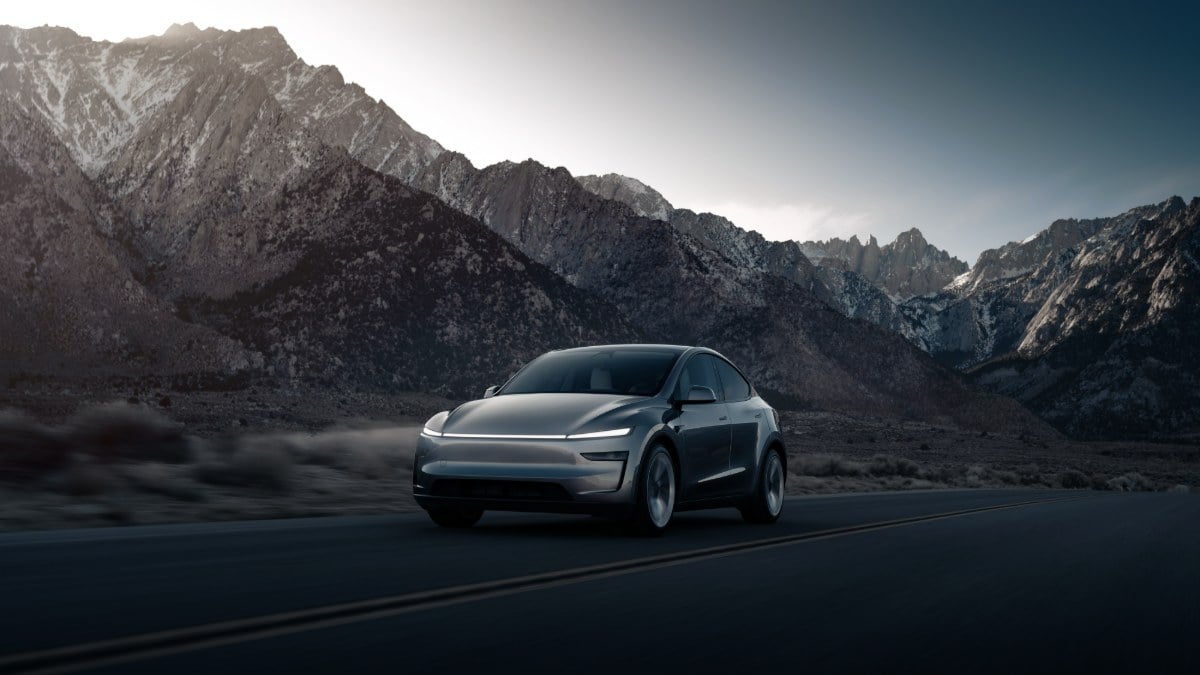
If you use FSD heavily, they write, moving to Rivian will feel like a step backward for now. Rivian is working on more advanced driver assistance, but Tesla has years of experience and data behind its system, and it shows. Then comes the counterweight. Rivian, in this owner’s view, delivers a more comfortable and adjustable suspension, a cabin and exterior that feel more refined than a Model Y, and a driving experience that is more satisfying in the traditional sense. The complaint is not about motors or batteries. It is about software glitches and small bugs on the Rivian side, which stand out when you are used to Tesla’s snappy, well-sorted interface. The ideal, SDNewcomer1234 says in so many words, would be Rivian hardware powered by Tesla software.
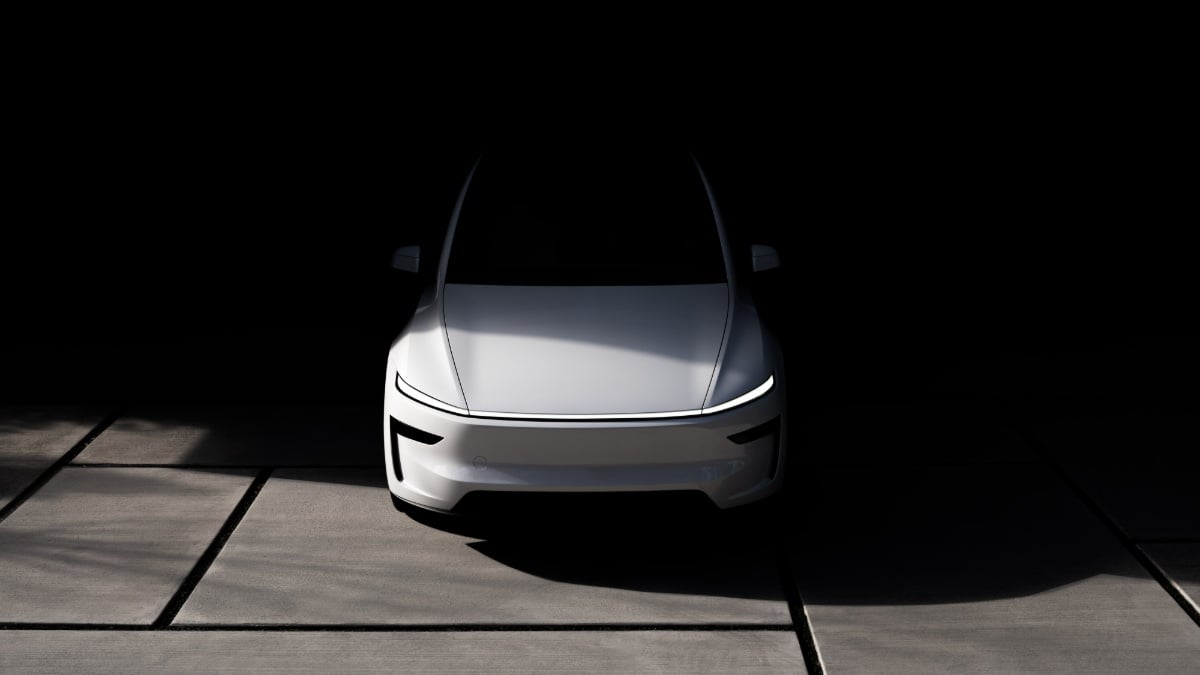
Another commenter, rman18, is a walking example of the same dilemma. They still own a Model Y and already hold an early reservation for the smaller Rivian R2. Yet what keeps them nervous is not charging or acceleration, it is software polish. Tesla’s cabin may be simple, but the code that runs it is almost invisible in daily use, and that is worth a lot to someone who values predictability. On the other side of the spectrum, everforthright36 reports having gone from a Model Y to a Rivian and simply preferring the Rivian as a total package. Autonomy fans should aim for Rivian’s newer generation hardware, they say, but accept that the company still has ground to cover before it reaches FSD parity. Between those two comments, you can see the scale tipping back and forth. Software stability on one side, ride quality and perceived quality on the other, and an owner who thinks deeply about the bot, standing in the middle with a notepad.
Only a handful of people have the unique vantage point of living with both a Tesla and a Rivian in the same driveway, and one of them, johnj2803, weighs in. He comes from a Lexus NX background and is blunt about where that leaves his expectations. In his view, neither the Model Y nor the Rivian R1S is built with the bank-vault solidity of a Lexus, and anyone who is slapping themselves for leaving that world will not suddenly be soothed by switching badges. Yet he also notes that his R1S, with the Max battery pack, goes farther on a full charge than his long-range Model Y and requires fewer stops between South Florida and Tennessee, especially now that both can use Superchargers. Space and comfort, particularly in the second and third row, favor the Rivian. For a family of four hosting visitors, the extra row is not a gimmick. It is the difference between taking one car and paying fewer parking fees or juggling two vehicles on every outing.
Then there is the long technical meditation from aliendepict, who treats the R1S like a piece of equipment as much as a family hauler. He places the interior roughly in BMW 4 Series territory, with a rugged, modern twist rather than the layered luxury of a Mercedes or Lexus. The R1S is larger than a Model Y, and its back seat is more usable for adults, at least on shorter trips. The chassis is a story of design intent. This is an abody-on-frame truck with serious off-road credentials, including a Rubicon Trail crossing on its resume, yet on pavement, its air suspension still manages to feel more supple and composed than the Model Y in his experience. The cost is that it will never quite mimic the isolated glide of a unibody luxury crossover, but within the worldtrucksruck,s it sits near the top. He is frank about the audio too, rating Rivian’s system behind Tesla’s and below the premier offerings from BMW, Land Rover, or Mercedes, while still serviceable in the way many mainstream branded systems are. For someone coming out of an ES350 Ultra Luxury, that is an important detail, not a footnote.
Put together, the thread reads like the owner’s manual Tesla never wrote and the shopping guide Rivian never printed. It confirms what any methodical EV owner already suspects. Tesla still holds a real edge in software integration and advanced driver assistance. Rivian counters with a more luxurious ride, richer materials, more usable space, and serious off-road capability. Neither company matches Lexus for old-school craftsmanship, at least in these anecdotes, and each has its own rough edges. What tips the scales for this particular Model Y owner is not a spec sheet at all, but the growing discomfort of carrying someone else’s reputation on the front of his car and absorbing the occasional honk or middle finger from people reacting to a name he did not design.
The choice he faces is not Tesla versus Rivian in a fan war. It is continuity versus change in the life of a very deliberate driver. On one side is a car he knows well, backed by an unrivaled fast charging network and software that behaves exactly as he expects. On the other side is a truck that promises a calmer ride, more space, and an image that feels less like a lightning rod. A mind as analytical as his will not flip a coin. He will weigh miles, comfort, software, brand perception, and the quiet satisfaction that comes from driving something that reflects his own values instead of someone else’s public persona. Somewhere out on an interstate between Georgia and Texas, with a battery half full and the cruise set, the answer will arrive not as a flash of emotion, but as a simple conclusion. It is time to stay or time to switch. The car, as always, will faithfully execute whichever decision he makes.
Image Sources: Tesla Media Center
Noah Washington is an automotive journalist based in Atlanta, Georgia. He enjoys covering the latest news in the automotive industry and conducting reviews on the latest cars. He has been in the automotive industry since 15 years old and has been featured in prominent automotive news sites. You can reach him on X and LinkedIn for tips and to follow his automotive coverage.
Set Torque News as Preferred Source on Google
Follow us today...