
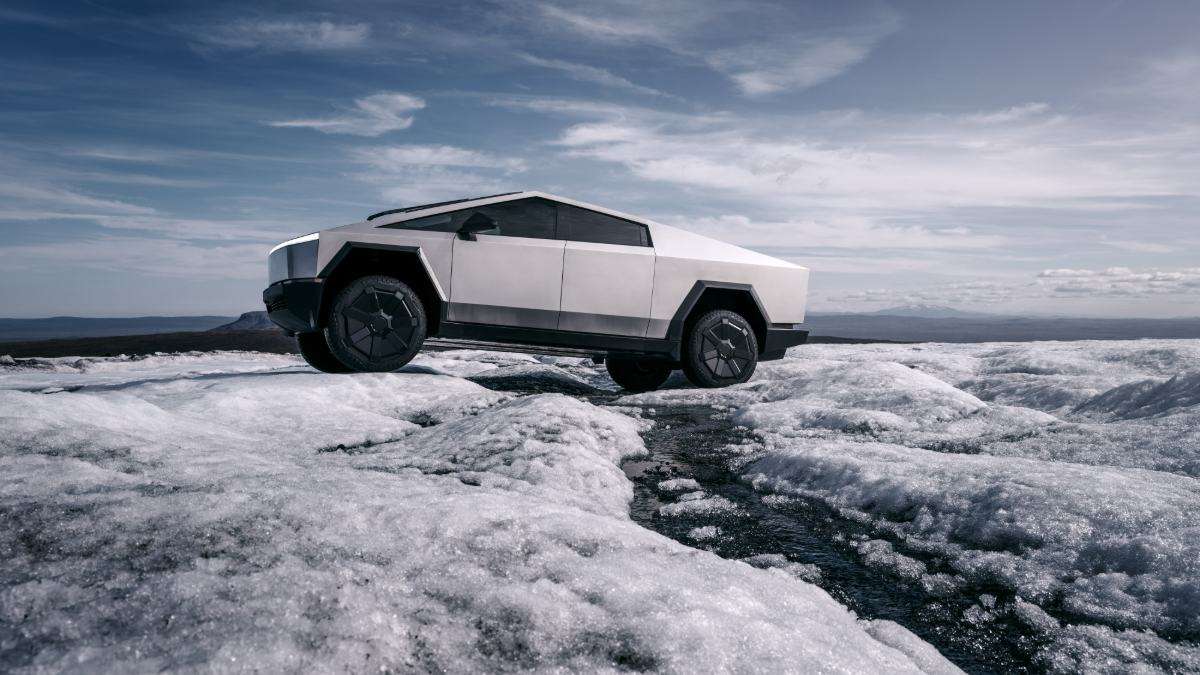

There is a long tradition in the car world of early adopters serving as unpaid test pilots, and few modern vehicles illustrate that reality more clearly than the Tesla Cybertruck. With its stainless steel bodywork, radical proportions, and software-defined personality, the Cybertruck occupies a gray area between finished production truck and continuously evolving prototype. Owners generally understand this going in. Buying one is not merely a purchase of transportation but an agreement to live at the frontier, where astonishing capability and occasional digital confusion coexist under the same sharply creased hood.
That reality came into focus for owner Mark Livings, who described his experience in a Facebook post after just 424 miles of ownership:
"I've had 424 miles on my 2026 and ran into a major glitch. I could not put it in drive or reverse after pressing the brake. I tried to reboot the truck twice, but it didn't work. Got in and out of the truck as recommended, but that didn't work. The screen started to flash red. Got alerts: High voltage system error detected, and Cabin climate control system requires service. I scheduled service and can get in today ( this never happens ). Thoughts ?”
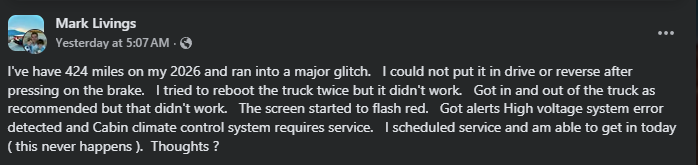
It is a straightforward account, notable less for drama than for how calmly it presents a complete loss of drivability in a brand-new truck.
That tone is revealing. Livings was not venting or issuing ultimatums. He was asking the community for insight. The responses read like a collection of field reports from others who have been there before. One Model S owner called the issue extremely rare and expressed confidence in Tesla's service. Another suggested roadside assistance through the Tesla app, noting the practical difficulty of delivering a vehicle that refuses to move. A fellow Cybertruck owner described an eerily similar failure that resolved itself after the truck sat overnight, and later after simply being left alone for half an hour. This is not blind loyalty so much as collective problem-solving.
The episode underscores how different the Cybertruck is from the historical idea of a pickup. Trucks have traditionally been defined by mechanical honesty and brute durability. If something went wrong, it was usually visible, audible, or at least smelled faintly of gasoline. The Cybertruck, by contrast, behaves more like a rolling computer system with suspension travel. When it functions properly, it delivers performance and capability that border on surreal. When it does not, the remedy can involve reboots, system resets, or simply waiting for the software to sort itself out.
Against its peers, this philosophical split becomes clearer. Electric rivals like the Ford F-150 Lightning and Rivian R1T also rely heavily on software, but they present themselves in a more familiar truck framework. Their interfaces and behaviors tend to ease traditional truck owners into electrification. The Cybertruck makes no such effort. Its steer-by-wire system, centralized controls, and aggressive over-the-air update strategy mean that a software fault can immobilize the vehicle in ways that feel alien to longtime pickup drivers. Tesla’s approach is not necessarily worse, but it is more exposed.
What stands out is that owners still express affection for the vehicle despite these moments. Livings ended his post not with regret, but with curiosity. Other owners offered reassurance rather than warnings. Some shared practical rituals, such as letting the truck sit untouched to allow systems to reset, advice that now sits alongside checking tire pressure or restarting an infotainment screen as part of modern ownership. For many, these inconveniences are balanced by the truck’s performance, utility, and unmistakable presence.
This sense that the Cybertruck is still maturing is consistent with Tesla’s broader development philosophy. The company favors rapid iteration over traditional model-year finality, allowing vehicles to evolve long after delivery. That can mean meaningful improvements over time, but it also means early owners encounter issues that would have been resolved before launch in a more conventional program. High-voltage warnings and cascading system alerts sound alarming, yet owner reports suggest they are often transient rather than catastrophic.
In exchange for living with occasional rough edges, owners gain access to a truck that redefines performance and design within its class. Mark Livings’ experience is a reminder that progress rarely arrives perfectly polished. It arrives early, powerful, and sometimes flashing red, asking its drivers to decide whether they want certainty or the future parked in their driveway today.
Image Sources: Tesla Media Center
Noah Washington is an automotive journalist based in Atlanta, Georgia. He enjoys covering the latest news in the automotive industry and conducting reviews on the latest cars. He has been in the automotive industry since 15 years old and has been featured in prominent automotive news sites. You can reach him on X and LinkedIn for tips and to follow his automotive coverage.
Set Torque News as Preferred Source on Google
Follow us today...




Comments
Yup, nearly all CT owners…
Permalink
Yup, nearly all CT owners experience these catastrophic failures. Just learn to embrace them, that's all. And keep an extra ICE car around for these incidents.