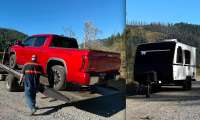

Long-distance electric towing looks far less theoretical after a Rivian R1S pulled a 19-foot inTech Sol Horizon across Washington and returned nearly identical efficiency in both directions.
The tow-specific logs cover 828.1 miles at about 1.2 mi/kWh, enough to show that the combination completed real work rather than a short demonstration. They still cannot establish whether the loaded rig stayed within its tongue-weight, payload, axle, and hitch limits.

The trip began with a blunt Reddit post: “So am I going to die?” The top reply was, “Some day.” Reddit handled the philosophy. The later trip logs handled the engineering.
In a follow-up post, WSUPolar said the broader trip covered 1,300 miles, about 800 of them towing, over Highway 2 and Interstate 90. He reported 1.36 mi/kWh across the full trip and said the roof box was added as an efficiency test ahead of a longer summer journey.
The two towing logs show:
- Seattle to Post Falls: 404.9 miles, 340.0 kWh used, five charging sessions, 361.5 kWh added, an estimated $57.87 in charging, and 8 hours 38 minutes of driving.
- Post Falls to Seattle: 423.2 miles, 366.8 kWh used, eight charging sessions, 364.7 kWh added, an estimated $96.53 in charging, and 10 hours 22 minutes of driving.
- Combined: 828.1 miles, 706.8 kWh used, 726.2 kWh added across 13 charging sessions, and $154.40 in estimated charging cost. Dividing the driving totals produces 1.17 mi/kWh, which rounds to 1.2.
Each summary says one session with invalid data was listed but excluded from the totals. That makes these owner logs useful and unusually specific, while keeping them a step below a charger-by-charger audit.
The Towing Number Is 1.2 mi/kWh, Not the 1.36 Full-Trip Average
The 1.36 mi/kWh figure includes roughly 500 miles without the trailer, so it should not be presented as the R1S’s towing efficiency. The tow-specific summaries are the cleaner baseline, and they put the rig near 1.2 mi/kWh across both directions.
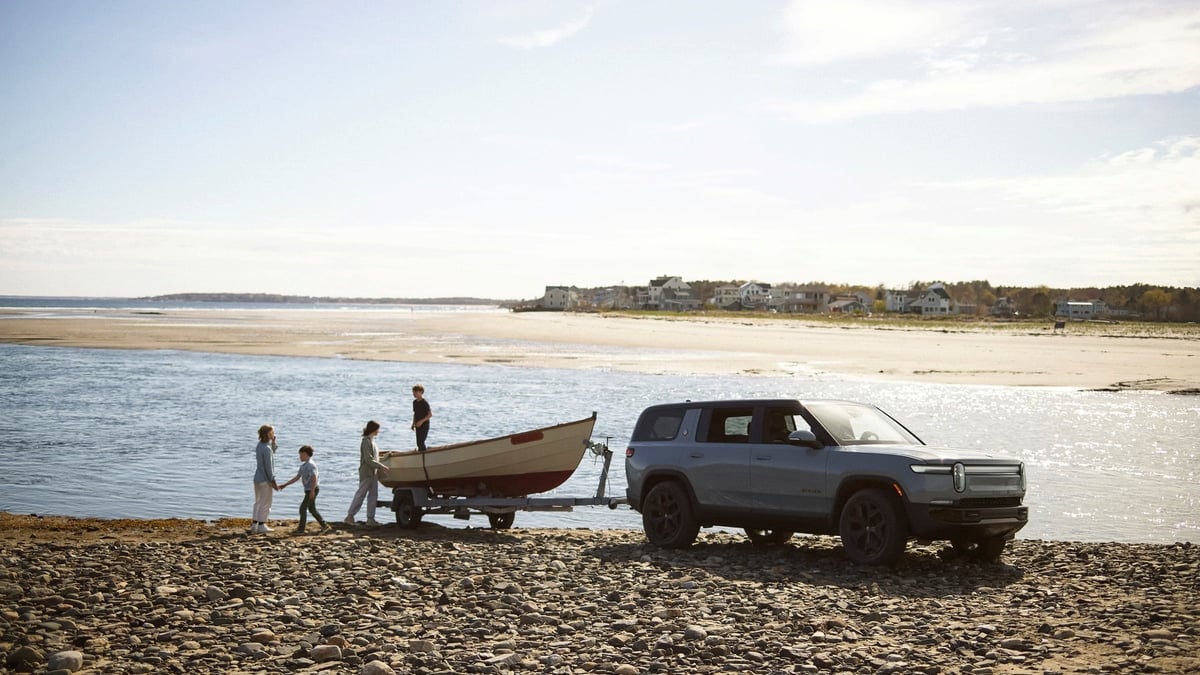
At 1.2 mi/kWh, every 100 towing miles requires about 83 kWh. A 120-mile towing leg represents roughly 100 kWh of driving energy at that efficiency. Route planning still needs a reserve, and harsher conditions or parked loads can raise the total requirement. The owner did not identify the R1S battery configuration, so an exact towing-range claim would be guesswork. The energy-per-leg math remains useful for any pack.
The roof-box experiment is also unresolved. The post gives no roof-box-off run under matching speed, weather, traffic, and trailer load, so the box’s individual penalty cannot be separated from the rest of the trip.
The charging-duration bars need similar restraint. The two summaries show 11 hours 25 minutes and 13 hours 18 minutes in a charging state, but the timelines also include long Gear Guard and idle periods and span extended stops. Adding those bars and calling the result 24 hours 43 minutes of roadside waiting would misrepresent the screenshots. These are trip summaries, not a stopwatch of fast-charging delay.
The Published Tow Rating Looks Comfortable Until Tongue Weight Enters
Current inTech specifications list the Sol Horizon at 19 feet long, approximately 3,500 to 3,900 pounds dry, about 550 pounds of tongue weight, and 4,800 pounds GVWR. The trailer also carries up to 45 gallons of fresh water. A full fresh tank alone can add roughly 375 pounds before propane, batteries, food, clothing, tools, and camping gear enter the calculation. Model-year equipment and the tank’s location can change how those pounds affect the hitch.
Rivian publishes a 5,000-pound towing limit for the R1S with a standard hitch and 7,700 pounds with a weight-distributing hitch. On gross trailer rating alone, a 4,800-pound Sol Horizon can fit under either figure. Under the standard-hitch rating, however, the published gap is only 200 pounds. That number is not a spare payload allowance. The actual trailer weight, hitch hardware, tongue weight, R1S door-jamb payload figure, passengers, cargo, axle loads, and tire ratings all still have to comply.
Rivian also says trailer load transfers to the vehicle and recommends tongue weight near 10 percent of the loaded trailer weight. That is why one commenter’s concern deserved more attention than the death jokes. A fellow Sol owner said the trailer’s front design and single axle make it heavy at the hitch, then warned that rear-mounted gear could put WSUPolar close to the relevant limit. WSUPolar replied, “I have had some concerns about this.”
A photograph cannot resolve that concern. A scale session can. The useful measurements are loaded trailer weight, measured tongue weight, front and rear R1S axle weights with the trailer attached, the vehicle’s payload sticker, and confirmation of the hitch and weight-distribution setup. Without those numbers, the responsible verdict is bound: the model specifications appear compatible, while the exact loaded combination remains unverified.
The Trip Still Makes a Strong Case for the R1S as a Tow Vehicle
The loading caveat should not bury the achievement. The R1S moved a full-height travel trailer for more than 800 recorded towing miles across Washington and returned a repeatable efficiency result in both directions. The owner described the trip as phenomenal, and the logs show a rig that completed the work rather than a one-leg demonstration staged near a charger.
Torque News has seen the same broad efficiency neighborhood in other Rivian towing reports. One R1S owner with another 19-foot inTech Sol Horizon averaged about 1.0 mi/kWh on a 1,200-mile delivery trip. A first-generation R1T towing a 19-foot Airstream returned 1.3 mi/kWh over roughly 1,000 miles. Another R1S pulling a larger Passport trailer through triple-digit desert heat logged 1.09 mi/kWh. Those are not direct comparisons because trailer shape, speed, weight, wind, temperature, elevation, and tire setup move the result dramatically. Together, they show why owner logs are more useful when the exact setup travels with the efficiency number.
WSUPolar’s 1.2 mi/kWh result tells prospective EV towers something practical. A Rivian can make this kind of cross-state camping trip, but the route should be planned around roughly 80 to 85 kWh per 100 towing miles under similar efficiency. Charger access, pull-through geometry, overnight charging, and reserve strategy will shape the experience as much as motor torque.
Will he die? Reddit already supplied the inevitable answer. The towing verdict is less theatrical. The published gross ratings give the setup a credible starting point. A scale ticket, tongue-weight measurement, and payload check would turn it into a complete safety case.
Rivian and other EV owners can make future towing reports far more valuable by sharing loaded trailer weight, tongue weight, vehicle payload sticker, hitch type, cruising speed, temperature and wind, start and end state of charge, charging energy and cost, and whether any stop required unhitching.
About The Author
Noah Washington is an automotive journalist based in Atlanta, Georgia, covering sports cars, luxury vehicles, and performance culture. His reporting focuses on explaining the engineering, design philosophy, and real-world ownership experience behind modern vehicles.
Noah has been immersed in the automotive world since his early teens, attending industry events and following the enthusiast communities that shape how cars are built and driven today. His work blends industry insight with enthusiastic storytelling, helping readers understand not just what a car is, but why it matters.
Noah is also a member of the Southeast Automotive Media Association (SAMA), a professional organization for automotive journalists and industry media in the Southeast.
His coverage regularly explores sports cars, luxury vehicles, and performance-driven segments of the automotive industry, including the evolving culture surrounding Formula Drift and enthusiast builds.
Read more of Noah's work on his author profile page.
You can also follow Noah here:
Set Torque News as Preferred Source on Google
Follow us today...