

Buying an EV to save money isn’t always as straightforward as it seems, kind of like choosing a Ferrari SUV to carry lumber for your next home renovation project. Sure, it looks sleek, feels futuristic, and might even make the neighbors wonder where your income comes from.
But it’s a calculated game of kilowatt-hour economics, tire pressure, grid rates, and meteorology. One wrong move, a high electricity rate, a poor charging setup, or a New England cold snap, and your promised savings evaporate faster than any gas tank.
Which is an issue one Facebook user found out the hard way. He took his frustrations to a Tesla Model Y owners group:
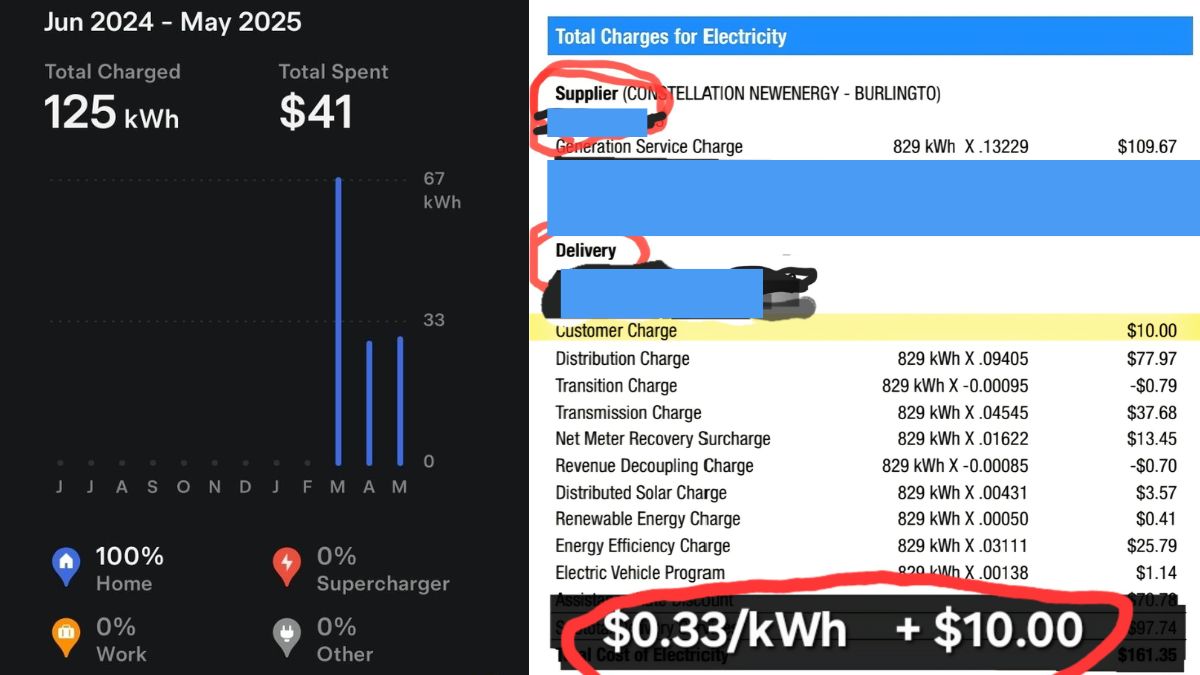
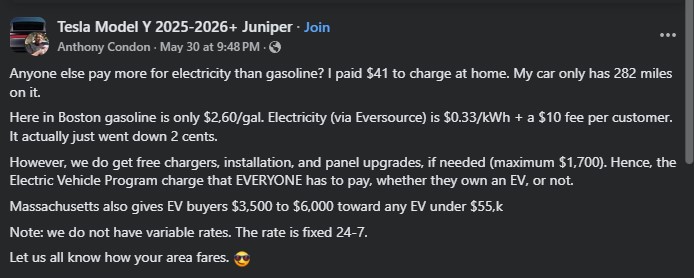
“Anyone else pay more for electricity than gasoline? I paid $41 to charge at home. My car only has 282 miles on it.
Here in Boston, gasoline is only $2,60/gal. Electricity (via Eversource) is $0.33/kWh + a $10 fee per customer.
It actually just went down 2 cents.
However, we do get free chargers, installation, and panel upgrades, if needed (maximum $1,700). Hence, the Electric Vehicle Program charge that EVERYONE has to pay, whether they own an EV or not.
Massachusetts also gives EV buyers $3,500 to $6,000 toward any EV under $55,k
Note: We do not have variable rates. The rate is fixed 24/7.
Let us all know how your area fares. ”
That’s the EV cost paradox in action. The idea is that driving an electric car should save you money. But in Boston, it costs $41 to drive 282 miles, that’s about 33 cents a mile.
It’s not a deal-breaker, just a reminder that real-world costs can vary depending on where and how you charge.
You could run a Toyota Corolla, getting 35 mpg at $2.60 a gallon, for $0.074 per mile. That’s less than a third the cost per mile, and it doesn’t require you to worry about grid load balancing, off-peak hours, or whether your garage has the thermal insulation of a space shuttle.
Boston EV Charging Costs: Electricity Rates, Monthly Bills & Savings Programs
- As of June 2025, Boston residents pay an average of 28.27 cents per kilowatt-hour (kWh) for electricity, which is significantly higher than the national average of 16.15 cents per kWh. This results in an average monthly electric bill of approximately $154.01 for Boston households.
- Charging an EV at home in Boston can be cost-effective. For instance, if your electricity rate is around 14 cents per kWh, and your Level 2 charger dispenses electricity at a rate of 6 to 8 kWh, you can expect to pay about $1.00 per hour of charging. This translates to approximately $65 per month, depending on your driving habits and electricity rates.
- Public charging rates in Massachusetts vary. The city of Boston's municipal ChargePoint stations charge $0.25 per kWh, offering a more affordable option for EV owners. However, the average cost at public charging stations across the state is about $0.52 per kWh, making it one of the more expensive states for public EV charging.
- Programs like National Grid's Off-Peak Charging Program provide financial incentives for EV owners to charge their vehicles during off-peak hours. Participants can earn $0.05 per kWh for charging between 9:00 p.m. and 1:00 p.m. from June to September, and $0.03 per kWh during the same hours from October to May. These rebates are applied as credits on the following month's electric bill.
In Boston, the numbers tell a more complex story, not because anything went wrong, but because incentives and utility rates sometimes overlap in ways that blur the financial picture.
It's a reminder that even well-executed transitions come with a learning curve.
But not all EV owners are suffering.
“I’m in PA and my electricity is $.18 a kWh. Gas in our area is $3.22, so we’ve got some pretty significant savings.”
Commented another user.
“I guess in Boston, you’re driving an EV to feel good, not save money. Sorry.”
Electricity costs vary so wildly across the country that the EV savings story is no longer national, it’s local, even block-by-block. In parts of Pennsylvania or Texas, your EV can pay for itself in a matter of years. In Massachusetts?
You’re basically subsidizing the grid while driving around with a clean conscience.
Even more surreal: our Boston-based driver isn’t new to the game.
Advertising
“Traded my 2024 in for a 2025, with only 1,700 miles. Now I’m trading in my 2025 with under 300 miles on it for a 2026,”
He knows what he’s getting into.
He just doesn’t care. He loves the experience, the tech, and never having to sniff around a gas pump like a lost dog. This isn’t someone trying to win the frugal commuter Olympics. This is a man who finds joy in the routine of silent, high-tech mobility, even if the dollars make less sense than a Cybertruck on a racetrack.
California EV Charging Rates & Gasoline Comparison: Off-Peak Savings Explained
California owners chimed in with their own version of grid roulette.
“I pay $0.22 per kWh from 9 pm to 4 pm the following day, and peak of $0.65 per kWh during a 4 pm to 9 pm window,” said one.
“Gas averages $5+ here, so it’s still cheaper to go electric.”
So now, EV ownership has become a part-time job, amateur energy arbitrage during off-peak hours, studying power utility graphs, etc. Miss the charging window and your savings go up in the same smoke EVs are supposed to prevent.
2025 Tesla Model Y Juniper Specs: Range, Performance, Dimensions & Pricing
- The Model Y offers varying ranges and acceleration times across its trims. The Long Range AWD variant provides an EPA-estimated range of up to 320 miles and accelerates from 0 to 60 mph in approximately 4.6 seconds. The Performance model boasts a quicker 0-60 mph time of 3.5 seconds and a top speed of 155 mph.
- All trims come equipped with a 75 kWh battery pack. The Long Range AWD model delivers around 384 horsepower and 375 lb-ft of torque, while the Performance variant increases output to approximately 456 horsepower and 497 lb-ft of torque.
- The Model Y measures 187 inches in length, 75.6 inches in width, and 64 inches in height, with a wheelbase of 113.8 inches. It offers a maximum cargo capacity of 76.2 cubic feet when the rear seats are folded down.
- The starting MSRP for the 2025 Model Y is approximately $42,990 for the base Rear-Wheel Drive model. The Long Range AWD starts around $47,990, and the Performance trim is priced at about $52,490.
And then there’s the weather. Cold climates are kryptonite to EV efficiency. In a Boston winter, an EV’s range can drop 30% just keeping the battery and cabin warm.
That means more frequent charges, even higher costs, and more time tethered to the wall instead of, you know, driving. It’s not just a matter of owning an EV, it’s managing it like a delicate science project. Keep tire pressures optimal. Precondition your battery. Pray the grid stays stable during a blizzard.
Yet for all this complexity, the core truth endures: people aren’t just buying EVs to save money. They’re buying freedom from gas stations, a smoother ride, and yes, a ticket to the future, even if it’s a bit overpriced.
What’s the highest rate you’ve paid to charge your EV? Let us know in the comments below.
Image Sources: Tesla Newsroom
Noah Washington is an automotive journalist based in Atlanta, Georgia. He enjoys covering the latest news in the automotive industry and conducting reviews on the latest cars. He has been in the automotive industry since 15 years old and has been featured in prominent automotive news sites. You can reach him on X and LinkedIn for tips and to follow his automotive coverage.
Set Torque News as Preferred Source on Google
Follow us today...





Comments
The journalist is arithmetic…
Permalink
The journalist is arithmetic challenged.
$41 is 4100 pennies
4100/280 = ~ 14¢ a mile
It is 33¢ a kWh, but a mile and a kWh are not the same unit. Just saying
Show me a Corolla that gets 35 mpg in urban Boston during the day, and I'll show you a liar.
I could be a little exasperated by this writer, who after so many years of EVs on the roads *could* have caught a little clue, but then I consider that between ingesting Lead and CO poisoning he may just be impaired.
I pay about $0.12/kWh for…
Permalink
I pay about $0.12/kWh for Off-Peak rate 12 midnight to 8am. It varies on the time of the year somewhat.
At peak rates it could be over $0.65/kWh. So I never charge at these very expensive rates.
So it comes out to be about $10 for 300 miles range with mellow driving. With aggressive driving drops to 250 miles range or lower. With very careful driving gentle driving can get over 350 miles range on a level road. Going up will shrink your range!
They fail to mention the…
Permalink
They fail to mention the fact that he is only choosing to drive that amount of milage instead of maximizing the $41 a month flat rate charging fee you pay for at home charging, he could drive unlimited milage monthly for the $41 in an EV which you could not do in an ICEV.
PG&E’s special EV rate…
Permalink
PG and E’s special EV rate plan in Northern California costs 73 cents per kWh peak, 48 cents shoulder and 37 cents overnight. A 75 kWh model Y battery would cost between $31 and $61 to fully charge assuming a 90% charging efficiency and cost between 11 and 22 cents a mile to operate. Even at $5 a gallon a 2025 Honda Accord only costs 10 cents a mile to operate. I’ve tried explaining this math to people but they still don’t believe me when I say a Tesla is more expensive to operate than a gasoline powered car here in Northern California.
Your math is still bad too…
Permalink
In reply to PG&E’s special EV rate… by Christopher (not verified)
Your math is still bad too. I have a Model Y with 35,000 miles and all I have done is rotate the tires.
PG and E’s special EV rate…
Permalink
PG and E’s special EV rate plan in Northern California costs 73 cents per kWh peak, 48 cents shoulder and 37 cents overnight. A 75 kWh model Y battery would cost between $31 and $61 to fully charge assuming a 90% charging efficiency and cost between 11 and 22 cents a mile to operate. Even at $5 a gallon a 2025 Honda Accord only costs 10 cents a mile to operate. I’ve tried explaining this math to people but they still don’t believe me when I say a Tesla is more expensive to operate than a gasoline powered car here in Northern California.
This article is a complete…
Permalink
This article is a complete joke. One off edge case built on fabricated BS. On average you will spend 1/3 to 1/5th the cost per mile charging an EV vs buying gas for an ICE vehicle. I know because I’ve got actual data from the nearly 5 years that I’ve owned my Model Y. And because I have only a fraction of the moving parts in my EV vs that Toyota you mention, I have had ZERO maintenance costs after 5 years and 128,000 miles. How much have you spent on that Toyota Corolla on oil changes, brakes, transmission, and everything else?
From an economic perspective, driving an EV is a no brainer. The actual numbers(vs the fake news numbers in this article) don’t lie,
You are using a ton of other…
Permalink
You are using a ton of other services on your car if the efficiency is that low. Probably running sentry and other such things.
While driving, the y gets around 3-4 miles per kwh, so the power use here would have given 400-500 miles of actual driving.
That said, 33 cent electricity and $2.60 cent gas is still going to be hard to save on as that's very expensive electricity and very cheap gas.
Over in NY, I pay 7 cents for electricity at night and $3.50+ for gas, so it's a very different story.
I live in Texas. Electricity…
Permalink
I live in Texas. Electricity is 15c/KWH. Free at nights. I've never paid for electricity. I drive a simple Chevy bolt. I charge with the slow charger. So long as my daily out is lower than the in....no worries. I love range anxiety because it's like a challenge to overcome. I already plan all my trips before owning an EV. The range problem gave me a fun challenge to tackle.
My home electricity maxes…
Permalink
My home electricity maxes out at .12/kw. That would be $15 for 125 kilowatts of charging. 125 kilowatts gives my car like 560 miles in warmer months, and around 400 in colder months. My work chargers are free, so that's $0 for 125 kilowatts when I'm working and the chargers are available for use.
Unfortunately, the article's…
Permalink
I think the article's headline is VERY misleading. Let's look at some realistic numbers. If indeed a Corolla gets 35 mpg, with gas cost of $3.00/gal (the lowest cost for a gallon of regular in Boston in early June 2025) the cost per mile is $0.086. If a Model Y gets 4 miles per kWh and one kWh costs $0.35 (inclusive of the $10.00 customer charge), his cost per mile is $0.088. So, for 282 miles, his Corolla would cost $24.17 cents (Not $15) and the Model Y would cost $24.68 (Not $41).
Click Bait...Musk Hate....!…
Permalink
Click Bait...Musk Hate....! No way is an EV more expensive than gas. I own 2 EVs!
Madison WI for my gas…
Permalink
Madison WI for my gas vehicle @2.79 a gallon would cost me 39.33, So I would rather have a EV if I could afford one.
put solar on your house and…
Permalink
put solar on your house and drive for free. the solar pays for itself over time, and generates the electricity to charge the car. i know it works because i've done it.
This is a VERY location…
Permalink
This is a VERY location specific article.
Really, how much it costs to charge an ev as relates to gas is location specific. Also, it depend on if one is using home charging or a super charger.
Where i live it costs about. 01c/mile to charge my car at home. So, that 281 miles = $2.81. there is absolutely no way has could possibly compare.
If I charge at a super charger the peak cost would be about $0.36/mile. At night it is $0.21/mile. Still a better rate than gas.
Looks like avg. gas prices…
Permalink
Looks like avg. gas prices in Boston, MA are $3.00/gal now, as of June 10th, 2025; as I write this comment. So I guess prices have gone up 40 cents in the last week, since this article was written… lol
Google “current gas price in Boston MA” and you will see Boston gas is between $3.00 - $3.65/per gallon, depending on gas station and type of gas you buy, as of June 10, 2025.
About electricity prices in Boston, MA; the numbers referenced in the article, starting with Juniper owner, are misleading… lol
Just Google “what are electricity rates for Boston, MA in 2025” and you will see these results:
“…In 2025, the average electricity rate in Boston, MA is 28 cents/per kilowatt-hour (kWh). This translates to an average monthly electric bill of $162.43. However, United States Power Outage Map says that rates can vary, with some providers offering rates as low as $14.95 cents/per kWh…”
So these numbers, provided from current, June 10, 2025 Google info, changes the calculus significantly!!
Let’s just go with 16 cents/per kWh, not the lowest available. Sixteen cents per kWh is less than half of what Anthony said he paid for his electricity. Anthony said he paid .33 cents/per kWh)!! Anthony is the guy who posted about his Tesla Juniper & charging costs).
So I am guessing that in Boston, MA - the worst case scenario is .33 cents/per kWh!!
Anthony needs to get a new electricity provider asap!! Clearly there are providers who offer as low as .14 cents/per kWh in Boston, MA. 😉
/ron
Ron Mobbs
Houston, TX