
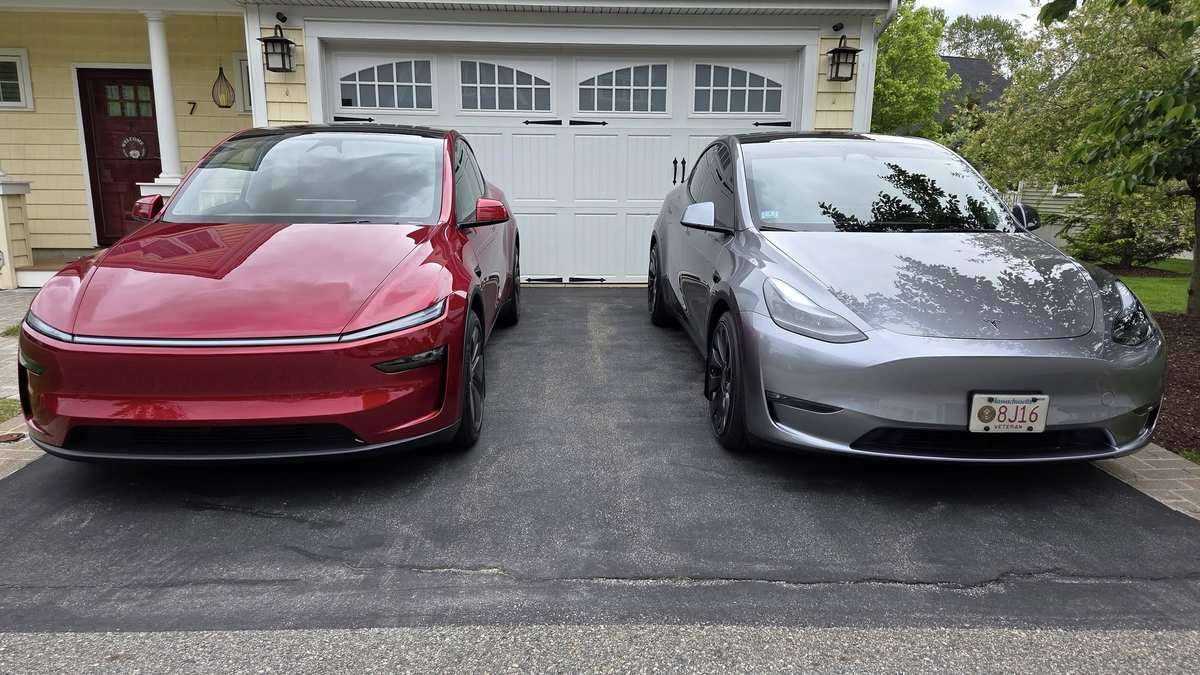

Buying an EV to save money isn’t always as straightforward as it seems, kind of like choosing a Ferrari SUV to carry lumber for your next home renovation project. Sure, it looks sleek, feels futuristic, and might even make the neighbors wonder where your income comes from.
But it’s a calculated game of kilowatt-hour economics, tire pressure, grid rates, and meteorology. One wrong move, a high electricity rate, a poor charging setup, or a New England cold snap, and your promised savings evaporate faster than any gas tank.
Which is an issue one Facebook user found out the hard way. He took his frustrations to a Tesla Model Y owners group:
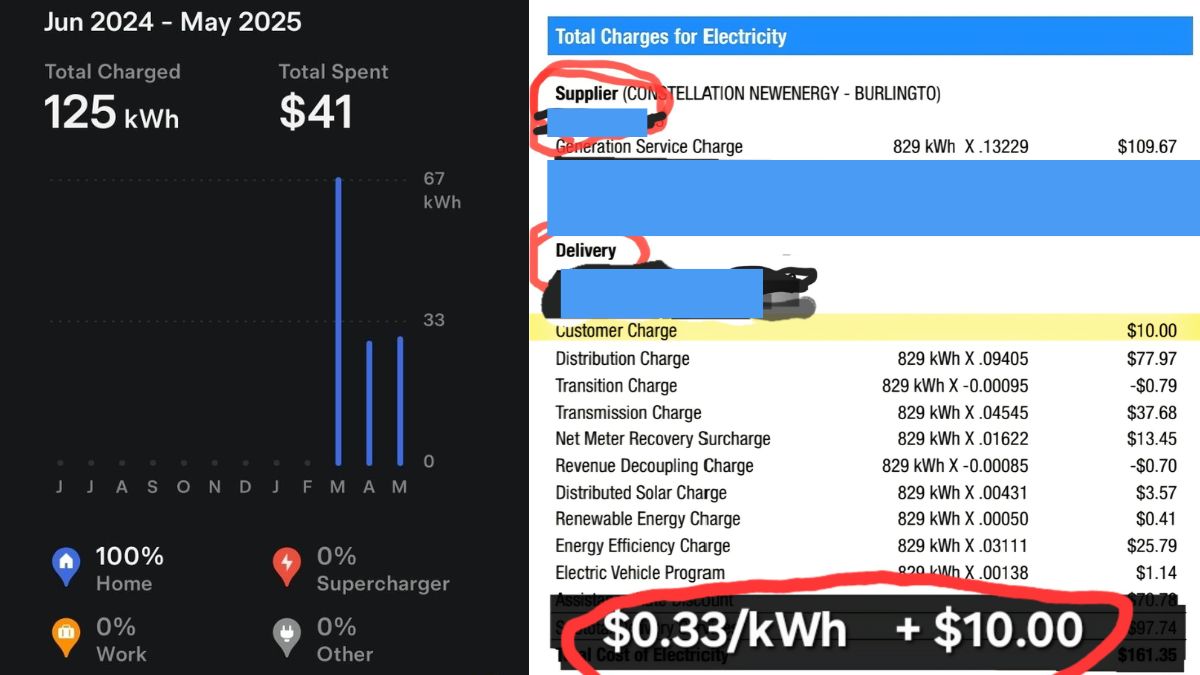
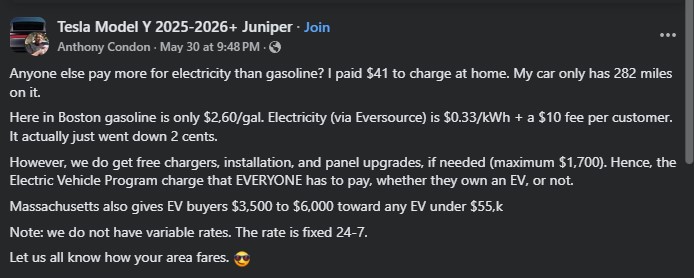
“Anyone else pay more for electricity than gasoline? I paid $41 to charge at home. My car only has 282 miles on it.
Here in Boston, gasoline is only $2,60/gal. Electricity (via Eversource) is $0.33/kWh + a $10 fee per customer.
It actually just went down 2 cents.
However, we do get free chargers, installation, and panel upgrades, if needed (maximum $1,700). Hence, the Electric Vehicle Program charge that EVERYONE has to pay, whether they own an EV or not.
Massachusetts also gives EV buyers $3,500 to $6,000 toward any EV under $55,k
Note: We do not have variable rates. The rate is fixed 24/7.
Let us all know how your area fares. ”
That’s the EV cost paradox in action. The idea is that driving an electric car should save you money. But in Boston, it costs $41 to drive 282 miles, that’s about 33 cents a mile.
It’s not a deal-breaker, just a reminder that real-world costs can vary depending on where and how you charge.
You could run a Toyota Corolla, getting 35 mpg at $2.60 a gallon, for $0.074 per mile. That’s less than a third the cost per mile, and it doesn’t require you to worry about grid load balancing, off-peak hours, or whether your garage has the thermal insulation of a space shuttle.
Boston EV Charging Costs: Electricity Rates, Monthly Bills & Savings Programs
- As of June 2025, Boston residents pay an average of 28.27 cents per kilowatt-hour (kWh) for electricity, which is significantly higher than the national average of 16.15 cents per kWh. This results in an average monthly electric bill of approximately $154.01 for Boston households.
- Charging an EV at home in Boston can be cost-effective. For instance, if your electricity rate is around 14 cents per kWh, and your Level 2 charger dispenses electricity at a rate of 6 to 8 kWh, you can expect to pay about $1.00 per hour of charging. This translates to approximately $65 per month, depending on your driving habits and electricity rates.
- Public charging rates in Massachusetts vary. The city of Boston's municipal ChargePoint stations charge $0.25 per kWh, offering a more affordable option for EV owners. However, the average cost at public charging stations across the state is about $0.52 per kWh, making it one of the more expensive states for public EV charging.
- Programs like National Grid's Off-Peak Charging Program provide financial incentives for EV owners to charge their vehicles during off-peak hours. Participants can earn $0.05 per kWh for charging between 9:00 p.m. and 1:00 p.m. from June to September, and $0.03 per kWh during the same hours from October to May. These rebates are applied as credits on the following month's electric bill.
In Boston, the numbers tell a more complex story, not because anything went wrong, but because incentives and utility rates sometimes overlap in ways that blur the financial picture.
It's a reminder that even well-executed transitions come with a learning curve.
But not all EV owners are suffering.
“I’m in PA and my electricity is $.18 a kWh. Gas in our area is $3.22, so we’ve got some pretty significant savings.”
Commented another user.
“I guess in Boston, you’re driving an EV to feel good, not save money. Sorry.”
Electricity costs vary so wildly across the country that the EV savings story is no longer national, it’s local, even block-by-block. In parts of Pennsylvania or Texas, your EV can pay for itself in a matter of years. In Massachusetts?
You’re basically subsidizing the grid while driving around with a clean conscience.
Even more surreal: our Boston-based driver isn’t new to the game.
Advertising
“Traded my 2024 in for a 2025, with only 1,700 miles. Now I’m trading in my 2025 with under 300 miles on it for a 2026,”
He knows what he’s getting into.
He just doesn’t care. He loves the experience, the tech, and never having to sniff around a gas pump like a lost dog. This isn’t someone trying to win the frugal commuter Olympics. This is a man who finds joy in the routine of silent, high-tech mobility, even if the dollars make less sense than a Cybertruck on a racetrack.
California EV Charging Rates & Gasoline Comparison: Off-Peak Savings Explained
California owners chimed in with their own version of grid roulette.
“I pay $0.22 per kWh from 9 pm to 4 pm the following day, and peak of $0.65 per kWh during a 4 pm to 9 pm window,” said one.
“Gas averages $5+ here, so it’s still cheaper to go electric.”
So now, EV ownership has become a part-time job, amateur energy arbitrage during off-peak hours, studying power utility graphs, etc. Miss the charging window and your savings go up in the same smoke EVs are supposed to prevent.
2025 Tesla Model Y Juniper Specs: Range, Performance, Dimensions & Pricing
- The Model Y offers varying ranges and acceleration times across its trims. The Long Range AWD variant provides an EPA-estimated range of up to 320 miles and accelerates from 0 to 60 mph in approximately 4.6 seconds. The Performance model boasts a quicker 0-60 mph time of 3.5 seconds and a top speed of 155 mph.
- All trims come equipped with a 75 kWh battery pack. The Long Range AWD model delivers around 384 horsepower and 375 lb-ft of torque, while the Performance variant increases output to approximately 456 horsepower and 497 lb-ft of torque.
- The Model Y measures 187 inches in length, 75.6 inches in width, and 64 inches in height, with a wheelbase of 113.8 inches. It offers a maximum cargo capacity of 76.2 cubic feet when the rear seats are folded down.
- The starting MSRP for the 2025 Model Y is approximately $42,990 for the base Rear-Wheel Drive model. The Long Range AWD starts around $47,990, and the Performance trim is priced at about $52,490.
And then there’s the weather. Cold climates are kryptonite to EV efficiency. In a Boston winter, an EV’s range can drop 30% just keeping the battery and cabin warm.
That means more frequent charges, even higher costs, and more time tethered to the wall instead of, you know, driving. It’s not just a matter of owning an EV, it’s managing it like a delicate science project. Keep tire pressures optimal. Precondition your battery. Pray the grid stays stable during a blizzard.
Yet for all this complexity, the core truth endures: people aren’t just buying EVs to save money. They’re buying freedom from gas stations, a smoother ride, and yes, a ticket to the future, even if it’s a bit overpriced.
What’s the highest rate you’ve paid to charge your EV? Let us know in the comments below.
Image Sources: Tesla Newsroom
Noah Washington is an automotive journalist based in Atlanta, Georgia. He enjoys covering the latest news in the automotive industry and conducting reviews on the latest cars. He has been in the automotive industry since 15 years old and has been featured in prominent automotive news sites. You can reach him on X and LinkedIn for tips and to follow his automotive coverage.
Set Torque News as Preferred Source on Google
Follow us today...





Comments
At $.33/kw, that charge…
Permalink
At $.33/kw, that charge should be $25.00....not $41. At $3.13/gallon for Boston gas...$25 gets you 8 gallons. You would need to get 35mpg to match that EV.
$41/282 miles is $0.145/mile…
Permalink
$41/282 miles is $0.145/mile, not $0.33.
It's still much more expensive than in other parts of the country, but the math wasn't mathing.
Just get solar panels and…
Permalink
Just get solar panels and the electricity rate is definitely less than. 33 cents pet kwk
F*ck Boston! I pay $25 per…
Permalink
F*ck Boston! I pay $25 per month to charge my Tesla Model 3 eight hours per day, seven days a week with Tesla Energy.
Haters are gonna hate. You…
Permalink
Haters are gonna hate. You gotta be dumb to charge somewhere for $0.51 /kWh. Hell Teslas superchargers avg $0.30/kWh . Be smart and find you cheaper electricity. I charge at home for $0.09/ kWh and when traveling find most hotel chargers are free. Just have to look hard enough.
F*ck Boston! I pay $25 per…
Permalink
F*ck Boston! I pay $25 per month to charge my Tesla Model 3 eight hours per day, seven days a week with Tesla Energy.
That is very misleading the…
Permalink
That is very misleading the 125kwh is for three months March April and May
Maybe you should retake high…
Permalink
Maybe you should retake high school math. The Facebook user clearly suffers from basic arithmetic problems, and so does the author. Ps - blocking torque fake news from my feed.
The calculation is wrong it…
Permalink
The calculation is wrong it’s not 33 cent per mile. You’re calculating the total cost of charging which includes the energy that is now in the car’s battery that hasn’t been used against the mileage of the car. This car consumes roughly 250 Wh/mi at $0.33 per KWh it’s $0.08 per mile. So very close to a Corolla but this is an SUV not a sedan.
At 2cents kw hour at…
Permalink
At 2cents kw hour at midnight always charge at this time. I pay way less than 15 dollars. My latest power bill for 1600 square foot home 78 dollars. Paying less than a hundred for power is why I have no solar.
Driving around with a clean…
Permalink
Driving around with a clean conscience except for all the harmful micro particles shed by car tires...
Cry me a river.
Permalink
Cry me a river.
None of the math works, and…
Permalink
None of the math works, and the premises are biased (WHY would the EV be assigned 100% of the household fixed charges?). BOGUS. Count on “Torque News” for insidious fossil fuel-supporting propaganda. If there is even rough cost parity, it is due to artificially suppressed cost of gasoline due to government subsidies.
This article is a lie. The…
Permalink
This article is a lie. The EV costs are exaggerated, the gas costs are miscalculated, and the vehicles compared aren't even the same much or anywhere near the same performance category. At least use another SUV.
Additionally, the garage insulation statement is absurd. Insulate from what? Gasoline fires are far more common than battery fires. They also burn incredibly far. Battery fires usually smoke for several minutes before producing a flame. Aresonists use gasoline to start fires, none of them bother using batteries. It would take too long.
Stop lying to people.
I think you meant lumber not…
Permalink
I think you meant lumber not lumbar.
This article is full of…
Permalink
This article is full of errors and poor assumptions to drive a specific narrative. There's no integrity in this reporting which goes to show you the ethics of the author.
Read some of the comments. Cherry picked data and random numbers are used. Just as 1 example, they're using winter efficiency data.
This article is pure fake…
Permalink
This article is pure fake. First, it came from someone unknown. Second, a supercharger would have been cheaper. Third, I have a model Y and charge at home and it never cost that much.
$41 at 33 cents per kWhr…
Permalink
$41 at 33 cents per kWhr would mean the car has a 124kwhr battery....which it doesn't...it is 75 as stated above. Assuming worst case starting to charge at 0% SOC the max cost would be $24.75.
282 miles is the EPA range ... City driving would actually use more than that as Evie's are much more efficient in traffic in City driving. Considering again, worst case scenario of 282 you get 8.7 cents a mile.
Good luck getting over 25mpg…
Permalink
Good luck getting over 25mpg out of a 384 hp 0-60 in 4.6 secs gasoline suv. Second 125kw for 282 miles is misleading. Who puts 282 miles on a vehicle in 2-3 months? Driven fast a X plaid goes 312 miles on that much electricity. $10 fee is not right and should be averaged out. Nice click bait.
My Tesla Model Y Juniper…
Permalink
My Tesla Model Y Juniper Cost Me My Digity, Self-Respect, Wife, Friends, Child, and My Dog, but I’m Happy to Say I Support Dogetard!
Good article. Dashes the…
Permalink
Good article. Dashes the myth proported by EV owners about how much they save on fuel. There can be big savings, but it is dependent on electricity rates, gas prices, weather, and other factors. EVs are cool, although Tesla is probably the best, but I would not buy one now because of Musk. Anyway, I live in MN, a bad climate for an EV. Even if I had a set up for a home charger, I would still pass on an EV. I want the car to serve me, not spend so much effort to efficiently use the car.
Not a single comment about…
Permalink
Not a single comment about how (assuming the car came with a dead battery and all charging was at home) that this shows you were using over 420watts per mile, which is nearly double what it should be. Meaning something draining the battery like phantom drain, sentry mode, lots of time being in the car not moving, manually forcing the HVAC to max heat/fan, etc. it would actually be even worse assuming they gave it to you on even have a charge. 125kwh is about the equivalent of 1.5 full battery charges of nearly 300 miles per battery charge so should have gotten another 150+ miles (again assuming you got the car with a basically dead battery). I would bring it in for service.
At $0.33 per kwh you are at near equivalent of $2.60 per gallon of gas for car that gets 30mi/gal (based on basic math, $.88 vs $.87) though an electric car should still save on maintenance and use less while idle or stopped in traffic.
I would also look into eversources rebates for charging at home or switching to an alternative electric company (allowed when on national grid or eversources). Some offer discounts or rebates for EV charging during certain hours when using a compatible charger that can report usage, while also often charging less for the electricity itself (though still the insanely high delivery fee on MAs electricity). One example is ClearView energy. They rebate charging done between 11pm and 6am.
Tesla Y has a 75 kwh battery…
Permalink
Tesla Y has a 75 kwh battery. 75 * $0.33 = $24.75 with a range of 300 miles. Ignore the $10 being he would still pay that regardless of having an EV or not.
Someone's math is bad.
So the person never said…
Permalink
So the person never said they get 282 miles on a charge, they said their car has 282 miles on it.
It's 6 cents per mile not 30…
Permalink
It's 6 cents per mile not 30 cents. My Model 3 gets 5 miles per KWh and I pay about 30 cents per KWh including the EV off peak discount that National Grid offers. A 30MPG car would pay about 9 cents per mile.
I live in Washington state…
Permalink
I live in Washington state where we pay the 3rd highest gas prices in the US and consequently the lowest electricity prices (my prices is under $0.07 per kilowatt hour through our electricity coop). We have an SUV and payed somewhere between $500 - $800 per month in gas when it was our primary commuting car. I pay roughly $40 per month to charge my tesla at home. I had no clue people in other states paid that much for electricity.
I'll take things that didn't…
Permalink
I'll take things that didn't happen for $500 Alex.
What kind of mileage are you…
Permalink
What kind of mileage are you getting per gallon? At best you got 5 gallons for $15, that means you're getting close to 60 miles per gallon. Your gas cost for 282 miles is closer to the cost of charging the Tesla
In NY they have programs…
Permalink
In NY they have programs with better rates for overnight charging. I’m also using excess solar production, so an EV is a no brainer for me. It’s like I’m driving for free. Downside is, since it’s free I drive a lot more so I’ll probably wear it out sooner.
Sign up for time-of-day…
Permalink
Sign up for time-of-day pricing. We charge between midnight and 8am to get a lower rate from Con Ed. We signed with an electric supplier for 9.9 cents per kilowatt hour.