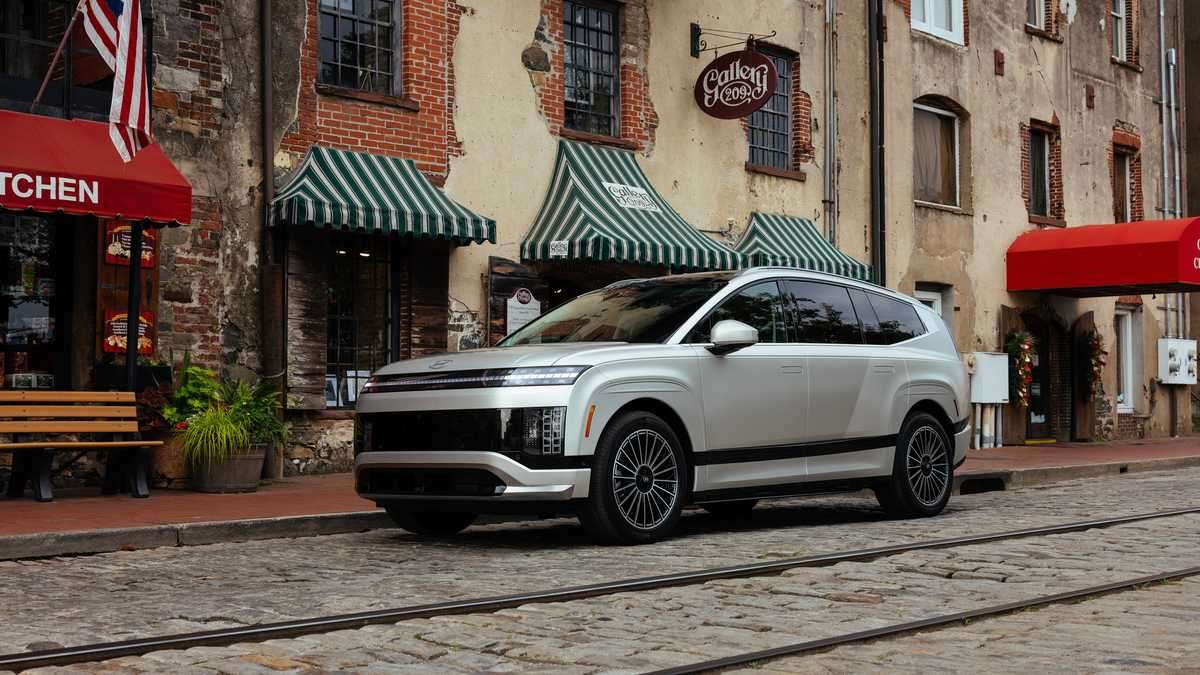

There was a time, not so long ago, when auto shows still had the power to dazzle. Designers threw caution to the wind and built glass-roofed hallucinations with pixelated taillights and wild proportions. Most of these would disappear after a few turns on a motor show carousel, never to return. But Hyundai, bless their courage and stubbornness, broke the cycle. The Ioniq 9 isn’t a watered-down concept. It’s the real thing. A production-spec SUV that looks like a Volvo design study filtered through 8-bit futurism and minted in Seoul.
Don’t take my word for it. Here's what one Redditor wrote after living with the Ioniq 9 Calligraphy:
"Previous experience is a '22 Palisade Calligraphy and the '24 Ioniq 5 Limited AWD (I have the 5 and 9 concurrently). This is a blue exterior with a gray interior.
This is just about everything I wished for in an electric Palisade.
Exterior dimensions are nearly identical, yet it feels like they made an extra foot of space inside out of nowhere.
Very zippy, but taking curves quickly shows its 6000 lbs. Really chunky and expensive tires (285 width). They switched the steering wheel controls! Now it's on the right for volume controls. Less convenient as a lefty.
They did not keep the 5's chunky turn signal stalk and went with something thinner, which I much prefer.
HUD is better. Sharper, and it shows the curve of the road when using cruise control. It also has Android Auto integration and shows the next turn and distance (e.g,. Right Arrow > Main St. 0.6mi)
Native wireless Android Auto is nice, but sometimes I need to charge my phone too, and the wireless charger still gets my phone pretty warm.
The fingerprint reader has worked consistently. Eye tracking with cruise control works well for me, and is an improvement over having to squeeze my steering wheel a lot in both other cars. Besides, if eye tracking complains, I have to squeeze my wheel anyway, so already an improvement.
Digital camera mirror is much lower, at the same height as the backup camera, so you see the grill of the car behind. 5 Limited's placement is at the roof, so I could see everyone do funny stuff when waiting at traffic lights. Mirror and camera quality itself appears identical to the '24 5 Limited, as that was the first year and trim the mirror was available.
There's a lock button now on the tailgate, next to the close tailgate button. Much overdue, as other brands have had that for a while.
My wife and I are bummed at the reduced space under the cargo floor compared to the Palisade. Sure, we have a frunk now, but it's less convenient.
Advertising
NACS is nice. More compact than CCS, and I've already tried a supercharger and a Mercedes NACS charger, and both went very smoothly. Hyundai was also generous to include a level 2 and a level 3 CCS > NACS adapter, so the level 2 sits on my CCS charger at home.
I thought the 9 looked a bit funny, but was overall fine to me upon first reveal. In person, it is so much better. The press photos of the "hearse" look are nonexistent, as it's fatter and shorter than that.
Ride quality and isolation are significantly better than the other two cars, but for different reasons. The ICE engine makes a big difference, as most people know. For the 5, I have replacement Michelin tires, and with the low sidewall, it's a harsh and noisy ride. The 9's Hankook EV tires are really good.
The panoramic roof quality is good. The automatic cover works the same as the 5, but the 9's roof opens, though you have to deal with the black bar in the middle. Small trifle if you just wanted something that opens.
I don't love the 9's handles. I think they're entirely too large and have a little bit of 'give' when using them.
The 9's key fob is an abomination for a nearly $80k car. Looks cheap, feels cheap, clicks cheap. The 5's keyfob is a magnitude better than the 9's.
Aesthetic touches on the 9 are quite beautiful. Interior lighting, handles being lit, and power seat options.
Oh, but the microsuede roof liner is...weird. I've seen many complaints about it because the directional texture is very obvious, and when you look at it, it's very obvious and looks messy. I personally don't care as I don't ever look up there and have no issue, but I understand what they mean.
Tapered side mirror is a thing, but between my camera rearview mirror and blind spot monitor, it doesn't bother me.
The massage seat is...a thing. Better than nothing and likely useful on long drives. Haven't used it at all since testing it one time. I do not experience what the Ioniq Guy did in his first drive video about it being uncomfortable.
The sound system is fine. Much better than the Palisade but worse than the 5, as I think it's tuned much better in a smaller cabin.
Feel free to ask if you have any calligraphy-specific (or not) questions or if you disagree with any of the above."
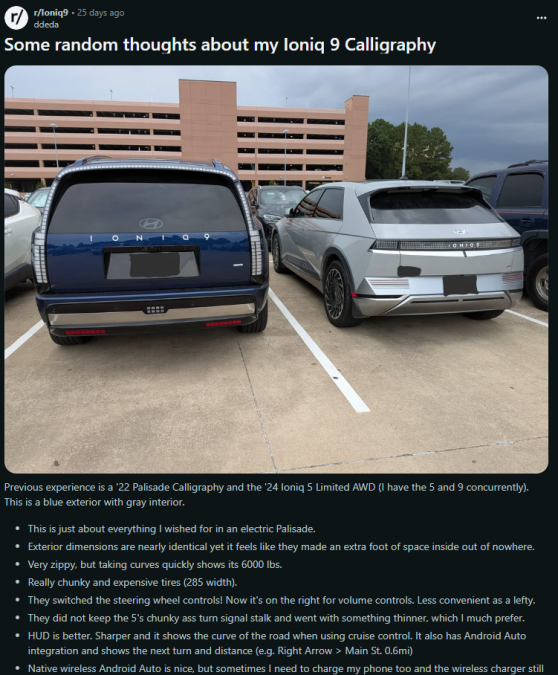
From the driver’s seat, the Ioniq 9 makes a strong first impression: quiet, composed, deliberate. One owner even noted it “feels like a Genesis, not a Kia.” The lane-change logic is snappier than in the Palisade, the cabin is whisper-quiet, and the steering, while not exactly taut, responds more quickly than you'd expect from something weighing in around 6,000 pounds. Those big Hankook EV tires soak up road imperfections, and the long wheelbase settles the ride with luxury-car grace. Just don’t throw it into corners with the enthusiasm of a hot hatch. This is a straight-line cruiser, a grand tourer for the age of digital torque and quiet ambition.
2025 Hyundai Ioniq 9 Price, Specifications, Dimensions
- Launching as a 2026 model, the Hyundai Ioniq 9 starts around US$60,555–60,595 for the base single-motor S trim (including destination), and rises to approximately $78,090 for the 422 hp Performance Calligraphy model
- Built on the E‑GMP platform, it offers RWD, AWD, and AWD Performance options. The dual-motor AWD “Performance” version outputs ~420 hp/516 lb‑ft and rockets 0–60 mph in about 4.9 seconds
- Equipped with a massive 110.3 kWh battery, range estimates include ~335 miles for RWD, ~320 miles for mid-trim, and 311 miles for Performance AWD (EPA-rated)
- With a substantial 123.2‑inch wheelbase, it's spacious and built in both South Korea and the US (Georgia Metaplant), with sales having begun in Korea and the States in early 2025, rolling out as a 2026 model
Visually, it’s striking. The Ioniq 9 plays the design game in its own key, chunky, squared, pixel-lit, unapologetically angular. If the Ioniq 5 was a hatchback in a Tron helmet, the 9 is its grown-up sibling, dressed for a Bauhaus dinner party.
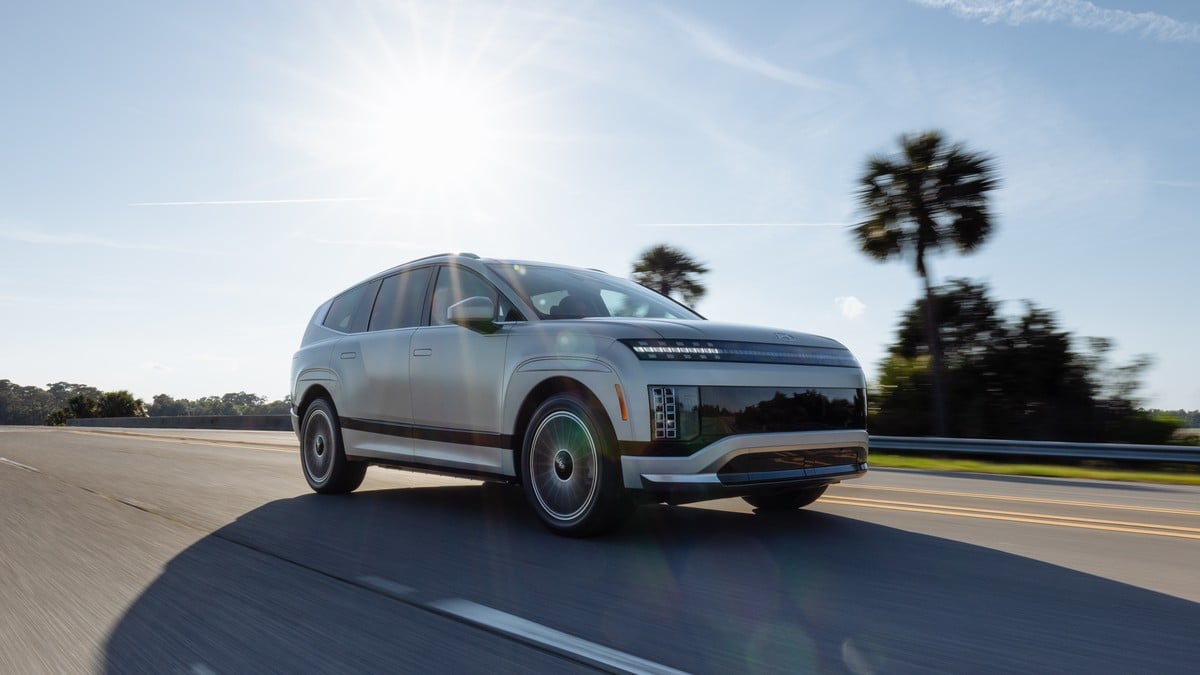
One commenter nailed it: “The press photos of the ‘hearse’ look is nonexistent as it’s fatter and shorter than that.” In person, the 9 doesn’t look like a hearse. It looks like a Volvo concept that survived the pitch meeting. The proportions work, especially in profile, and there’s enough architectural detail in the lighting, body creases, and surfacing to make you forget it’s a people mover first.
Inside, it’s clear Hyundai didn’t just scale up the Ioniq 5; they elevated it. The interior feels both expansive and considered, with floating surfaces, mood lighting, and an impressively responsive HUD that overlays turns, lane info, and Android Auto navigation.
Is The Ioniq 9 A Genesis in Disguise?
The layout is clean, horizontal, and vaguely Scandinavian. Even small touches, like illuminated door handles and customizable ambient lighting, feel thoughtfully executed. But it’s not all praise. That key fob? “An abomination for a nearly $80k car,” said the owner. And they’re not wrong. It’s plasticky and cheap-feeling, more Elantra than executive EV.
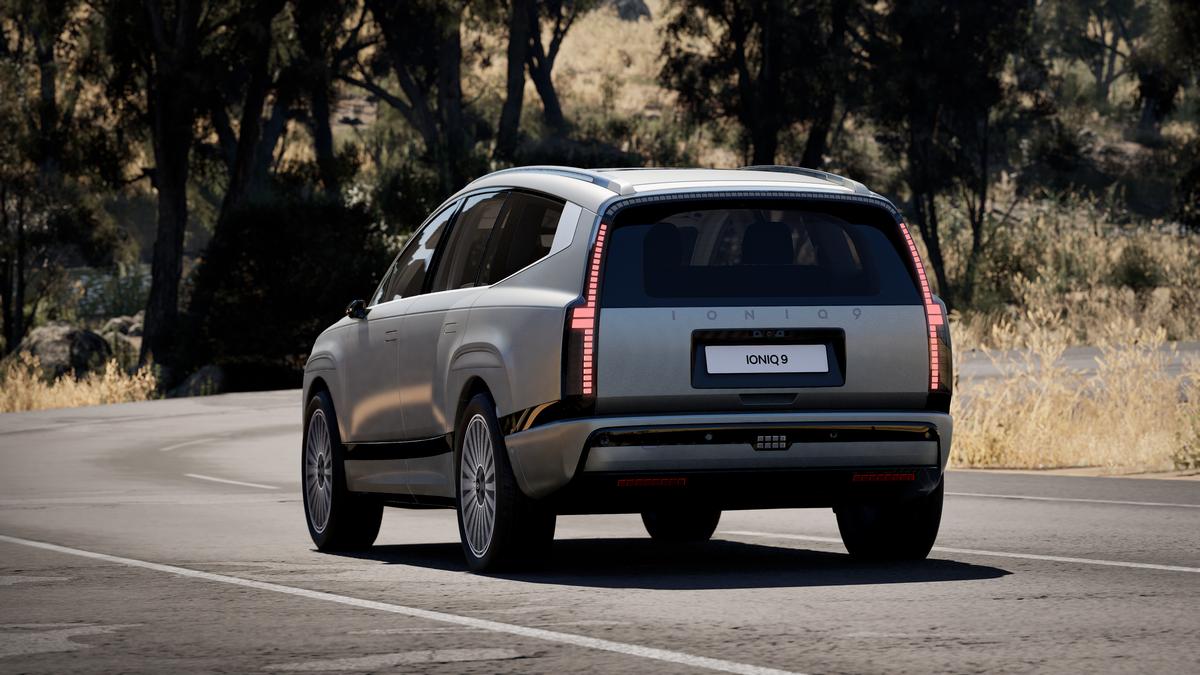
Hyundai’s tech suite is ambitious but grounded. Eye-tracking cruise control reduces the need to grip the wheel, assuming you’re alert and looking forward. The camera mirror system is mounted lower than the Ioniq 5’s, providing a better look at traffic (though not as entertaining as stoplights, one owner noted). The HUD is crisp and genuinely useful, showing road curves and turn prompts, and the native wireless Android Auto is a welcome improvement, even if the charger still warms your phone like a sunlamp. These aren't gimmicks; they're examples of Hyundai iterating fast and listening to users.
2026 Hyundai Ioniq 9 Cargo Space vs 2025 Hyundai Palisade Cargo Space
- The Ioniq 9 offers 21.9 ft³ of cargo room with all seats up, outperforming the Palisade's 18.0 ft³, giving roughly 20% more space for rear storage
- Folding down the 2nd or 3rd row brings similar maximum cargo volumes: the Ioniq 9 hits 86.9 ft³ compared to the Palisade’s 86.4 ft³ behind the 2nd row, and 46.7 ft³ vs 45.8 ft³ behind the 3rd row The Ioniq 9, thanks to its E‑GMP platfor,m provides 163.5 ft³ of passenger volume (7 seats), compared to the Palisade’s 155.3 ft³ (seats 8) **
- Starting at just under $61k, the Ioniq 9 is notably pricier than the gasoline-powered Palisade, which begins around $38,695, a $22K premium, though the EV qualifies for a $7,500 federal tax credit
The Ioniq 9’s one real tradeoff? Cargo space. It’s not that it’s small, it’s that it isn’t as flexible as its little sibling, the Ioniq 5. Several owners commented on the reduced space under the cargo floor, and while there’s a frunk now, it’s not as usable as you’d expect. One called it “less convenient than the Palisade,” and you can see their point. The 9 makes up for this with better packaging in the cabin, more stretch-out room in all three rows, but if your priority is hauling gear over people, the smaller 5 might still be the better choice.
Still, as one Redditor so aptly put it: “This is just about everything I wished for in an electric Palisade.” And that’s the core of it. Hyundai didn’t try to change the world with the Ioniq 9. The fact that it looks like a Volvo concept filtered through an LED sculpture park is just icing. It’s a design-forward, tech-rich, genuinely thoughtful vehicle, one that might not be perfect, but doesn’t need to be. It just needs to work, and look good doing it. And in that respect, the Ioniq 9 delivers.
Image Sources: Hyundai Media Center
Noah Washington is an automotive journalist based in Atlanta, Georgia. He enjoys covering the latest news in the automotive industry and conducting reviews on the latest cars. He has been in the automotive industry since 15 years old and has been featured in prominent automotive news sites. You can reach him on X and LinkedIn for tips and to follow his automotive coverage.
Set Torque News as Preferred Source on Google
Follow us today...