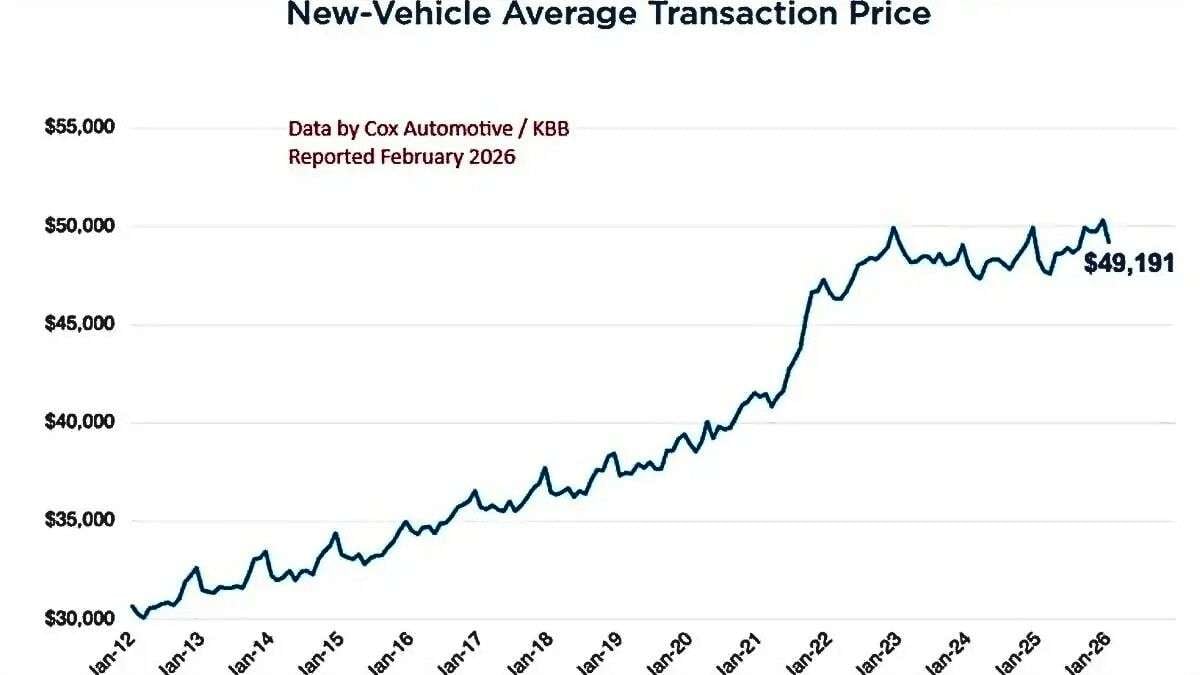

In a recent auto show report by a major media company, the headline was “Car Costs Surge, Leaving Chicago Auto Show Attendees Shocked.” The premise of the story is that the average price of a new car has risen dramatically in recent years. The context is the Chicago auto show that happened this past month. The facts are somewhat different. The average transaction price (ATP) of an automobile in America has not changed in four years. Prices of many affordable types of vehicles have declined year over year. Let’s look at the actual data, as supplied by a respected automotive analyst group, Cox Automotive / KBB. Here are the Cox Automotive average transaction prices for all vehicles recorded in each of the past four Januarys, supplied directly to Torque News for our reporting.
January 2023 $49,388 Revised to $49,143
January 2024 $48,031
January 2025 $48,280
January 2026 $49,191
As you can see, there is no meaningful difference in the average transaction price paid by American consumers for vehicles in January 2023 compared to January 2026. Cox and KBB reported the January 2023 ATP was $49,388. That reported number was the highest January ATP in history. However, Cox later adjusted its ATP after it had published its reporting. Although ATP is a calculation, not a guess, there is an estimation aspect to the number. ATP is not a precise value. Yet, the media seize on any minor uptick to breathlessly report that the world is ending. Then they start assigning blame to an estimated tiny uptick. So-called “Experts” and “Industry Insiders” jump at the chance to offer their pretend “insights” on an imaginary “crisis.”
People in the automotive media know that these ATPs reported by Cox and KBB are estimated numbers and that their accuracy is likely about 1% or 2% either way. So tiny upticks are actually not upticks; they represent a situation in stasis. Not change.
The media plays loose with facts in another way as well. They mix and mingle the words “car” and “vehicle.” It’s called equivocation. The two words are often used interchangeably in discussions about the auto industry, but they have vastly different meanings in the context of vehicle costs. In that context, cars are a type of vehicle, and the more general word vehicle encompasses cars, crossovers, SUVs, vans, and pickup trucks. Trucks are much more expensive than cars. Think we are just parsing words here? Look at the little icon this example of reporting chose to represent all vehicles in its nifty average transaction price graph. Did they choose a hulking and shiny luxury pickup truck? Nope. Their image is of a car that's barely sold in America anymore. A subcompact economy hatchback like the much-loved Honda Fit, which has been off the market for many years. Jump to timestamp 1:50 to see the graph in the video. The implication is that the average price they are showing is for little economy “cars.” The video displays the word “cars” on the screen. But that ATP number is not for small cars. It’s for all vehicles, including huge luxury trucks, and trucks skew the average upward dramatically.
The report also says that car prices “seem to be way up in recent years.” That is a tricky word, “seem.” Perhaps they “seem” that way because most new car buyers only go to the showroom once or twice a decade. “I remember when you could buy a new Camaro for two grand.” Sure, pops, and you could buy a sodapop at the local fountain with a buffalo nickel.
The media report then highlights the difference in ATP from 2016, ten years ago, correctly noting that it has gone up quite a bit over that period. What did they leave out? That the bulk of the upward movement happened during the Biden administration. No mention of that reality. We feel that this is a very vital part of the discussion on vehicle prices. You be the judge if this is paltering on the part of the media group.
Incredibly, the media report flashes the ATPs for 2024 ($49,780) and for 2025 ($48,941) and then downplays the fact that the year-over-year change was that vehicles cost a thousand dollars LESS. According to its very own presented data. If a report’s data show that prices have gone down year over year, how can the headline be that prices are surging?
Near the end of the piece, the reporter interviews an exasperated dad looking at new cars. The dad says that reliability is his first priority. Not price. The newscaster then immediately says, “If price is your first priority…” Ignoring the fact that the actual shopper did not put price at the top of his family’s priority list.
The report’s graph of prices with the little subcompact car icon shows the overall ATP of around $49K. What is the actual ATP of a small, affordable car, let’s say a Corolla, Sentra, or Civic? It’s half that at around $27K - and it declined in 2025 compared to 2024. That’s right, “Car prices went down” would be a factual headline. Did you see that reported on NBC or any other major news outlet? And it’s not just small cars, which are a shrinking part of the automotive market. The largest part of the automotive market is five-passenger compact crossovers like the RAV4 and CR-V. That group’s ATP is $36,417 as of the end of year reporting, and it went DOWN 1% in 2025 compared to 2024. Again, the vehicle that more Americans buy than any other saw a year-over-year decline in consumer costs in the last full year reported.
There is a very interesting news story in the ATP data. It’s that the average transaction price of vehicles has remained unchanged over the past four years. This, despite the federal government having an official policy of about 2% inflation per year. Compounded since 2023, vehicle costs should be up more than ten percent since 2023, but they are not. They are virtually identical. It’s an amazing fact. Worthy of being repeated. More incredibly, affordable small cars and compact crossover vehicles went down year over year from 2024 to 2025. Tell us in the comments below if you feel the message the media is delivering reflects the reality of vehicle costs.
About The Author
John Goreham has been reporting on automotive news for 14 years and serves as the Vice President of the New England Motor Press Association. He is based in Metro Boston.
Publications: John Goreham has published thousands of articles and reviews at American news outlets. In addition to his work at Torque News, John Goreham is a 10-year veteran of Car Talk, where he is a staff writer, vehicle tester and reviewer, and the Car Talk Community Moderator. Prior publications by John include U.S. News and World Report, CarGurus, the Boston Globe, the Providence Journal, iSeeCars, GM-Trucks.com, Chemical Processing Magazine, and Pumps and Systems Magazine.
Education and Training: John Goreham holds a Bachelor of Science in Mechanical Engineering from the University of Massachusetts. His five-year engineering program culminated with an emphasis on electric vehicle design. In addition, John holds an undergraduate certificate in Marketing from Northeastern University. John is an active member of the Society of Automotive Engineers (SAE int). An expert vehicle and tire tester, John is a graduate of three driving schools: The Skip Barber Performance Driving School, the Skip Barber Introduction to Racing School, and the Team O'Neil Rally School's Winter Driving School. John has track-tested hundreds of high-performance vehicles.
Work Experience: Upon graduation, John Goreham worked in the fluid handling industry as an engineer, followed by two decades of work as an engineer and director of sales and marketing in semiconductor manufacturing, biopharma, power generation, and the automotive supply chain. He was a member of management for divisions of Honeywell and Thermo Fisher Scientific.
Social Media Influencer: John Goreham is known for offering unfiltered opinions on automotive topics. You can connect with John on LinkedIn and follow his work on his personal X channel. He is also very active on TikTok, where some of his posts have earned as many as hundreds of thousands of views. John is the founder and administrator of some of Facebook's largest automotive clubs and groups.
Set Torque News as Preferred Source on Google
Follow us today...