

The romantic notion of the open road has always been defined by self-reliance, the ability to push on regardless of the circumstances. In the new electric age, that spirit of independence is being redefined, not by a bigger fuel tank, but by the ability to share energy. John Bouwmeester’s detailed exploration of Vehicle-to-Load (V2L) technology is a masterclass in this new electric altruism, where one electric truck becomes the savior for another, turning a potential roadside emergency into a simple, if slightly complicated, matter of plugging in.
This isn't just about powering a campsite anymore; it’s about creating a mobile energy ecosystem. Bouwmeester's work focuses on the logistics of using the powerful V2L features of trucks like the Chevy Silverado EV, GMC Sierra EV, and Cybertruck to charge any other electric vehicle. It's the ultimate expression of electric utility, turning the truck bed into a high-capacity, rolling power station.
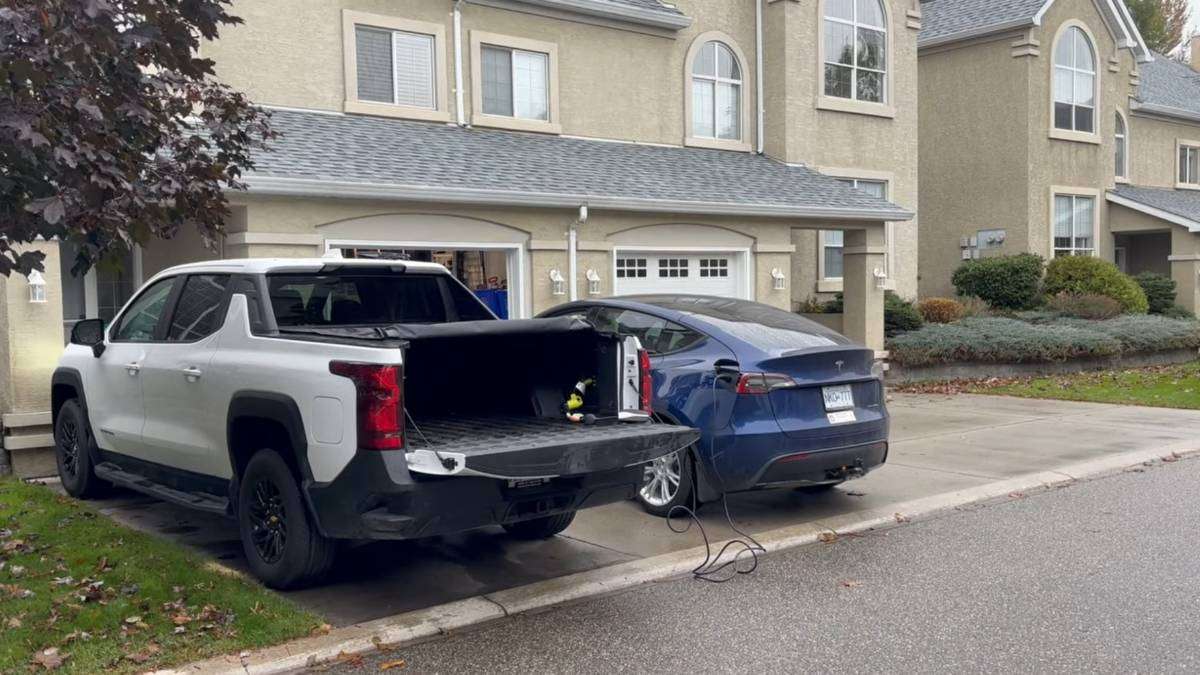
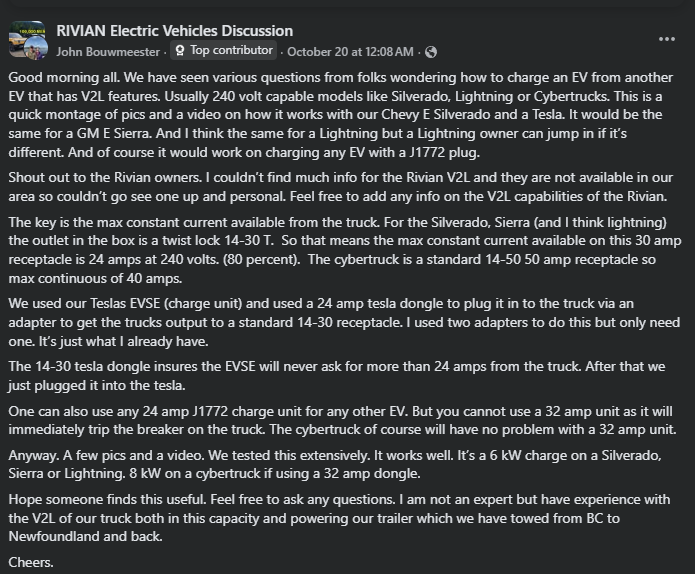
“Good morning all. We have seen various questions from folks wondering how to charge an EV from another EV that has V2L features. Usually 240 volt capable models like Silverado, Lightning or Cybertrucks. This is a quick montage of pics and a video on how it works with our Chevy E Silverado and a Tesla. It would be the same for a GM E Sierra. And I think the same for a Lightning but a Lightning owner can jump in if it’s different. And of course it would work on charging any EV with a J1772 plug.
Shout out to the Rivian owners. I couldn’t find much info for the Rivian V2L and they are not available in our area so couldn’t go see one up and personal. Feel free to add any info on the V2L capabilities of the Rivian.
The key is the max constant current available from the truck. For the Silverado, Sierra (and I think lightning) the outlet in the box is a twist lock 14-30 T. So that means the max constant current available on this 30 amp receptacle is 24 amps at 240 volts. (80 percent). The cybertruck is a standard 14-50 50 amp receptacle so max continuous of 40 amps.
We used our Teslas EVSE (charge unit) and used a 24 amp tesla dongle to plug it in to the truck via an adapter to get the trucks output to a standard 14-30 receptacle. I used two adapters to do this but only need one. It’s just what I already have.
The 14-30 tesla dongle insures the EVSE will never ask for more than 24 amps from the truck. After that we just plugged it into the tesla.
One can also use any 24 amp J1772 charge unit for any other EV. But you cannot use a 32 amp unit as it will immediately trip the breaker on the truck. The cybertruck of course will have no problem with a 32 amp unit.
Anyway. A few pics and a video. We tested this extensively. It works well. It’s a 6 kW charge on a Silverado, Sierra or Lightning. 8 kW on a cybertruck if using a 32 amp dongle.
Advertising
Hope someone finds this useful. Feel free to ask any questions. I am not an expert but have experience with the V2L of our truck both in this capacity and powering our trailer which we have towed from BC to Newfoundland and back.
Cheers.”
Bouwmeester quickly gets down to the technical brass tacks, the kind of detail that separates the dreamers from the doers in the electric world. The key, he notes, is the max constant current available from the truck's outlet. The Silverado, Sierra, and Lightning, with their twist-lock 14-30 T outlet, are limited to a continuous 24 amps at 240 volts. That's a solid 6 kW charge, enough to give a stranded EV a meaningful boost in a reasonable amount of time.
Then there’s the Cybertruck, the electric outlier. The cybertruck is a standard 14-50 50 amp receptacle so max continuous of 40 amps. That's a significant jump, allowing for an 8 kW charge if you have the right equipment. It’s a subtle difference, but in the world of charging, those two kilowatts can feel like the difference between a slow crawl and a brisk walk.
The method itself is a beautiful dance of adapters and dongles, a testament to the ingenuity of the early electric adopter. Bouwmeester details the process of using a dedicated EVSE (charge unit) with a 24-amp dongle to ensure the receiving car never asks for more power than the Silverado can safely deliver. The 14-30 tesla dongle insures the EVSE will never ask for more than 24 amps from the truck. After that we just plugged it into the tesla.
This is the kind of meticulous planning that defines the electric pioneer. It’s not just about having the power; it’s about safely managing the flow, ensuring that neither the donor nor the recipient is overwhelmed. It's a high-tech version of pouring water from one canteen to another, making sure you don't spill a drop.
The Power-Sharing Protocol
- Silverado/Sierra/Lightning: 14-30 T outlet (24A continuous, 6 kW). Cybertruck: 14-50 outlet (40A continuous, 8 kW).
- Use a 24-amp EVSE dongle to prevent the receiving vehicle from tripping the donor truck's breaker.
- Any EV with a J1772 plug can receive the charge, making the V2L truck a true electric Samaritan.
- This feature moves beyond emergency use to become a viable way to power a trailer or charge a second EV at home.
The question of the Rivian R1S and R1T is the elephant in the room, the missing piece of the V2L puzzle. Shout out to the Rivian owners. I couldn’t find much info for the Rivian V2L and they are not available in our area so couldn’t go see one up and personal. Feel free to add any info on the V2L capabilities of the Rivian. It’s a fascinating gap in the knowledge base, a reminder that even in this hyper-connected world, some capabilities remain shrouded in mystery until the community can get its hands on the hardware. Given the off-road focus of the Rivian, one would expect a robust V2L system, and the community is clearly eager to fill in the blanks.
Bouwmeester’s final reflection on his experience, using the V2L to power his trailer on a massive BC to Newfoundland and back journey, is the ultimate validation of this technology. It’s proof that these electric trucks are not just commuter vehicles; they are true utility machines, capable of supporting the most ambitious adventures. This is the new frontier of electric utility, where the vehicle is not just a means of transport but a mobile power grid.
The ability to share power, to turn one vehicle into a charger for another, fundamentally changes the dynamic of electric vehicle ownership. It introduces a layer of mutual reliance and community support that was largely absent in the internal combustion world. It’s a powerful symbol of the electric age: not just independence, but interdependence.
This technological leap is far more significant than a simple horsepower increase. It transforms the electric truck into a true expeditionary vehicle, capable of supporting life and work far from the nearest charging station. This is the kind of innovation that will truly drive adoption, turning skepticism into acceptance. The F-150 Lightning Pro Power Onboard is one of the most talked-about V2L systems, and it's clear why.
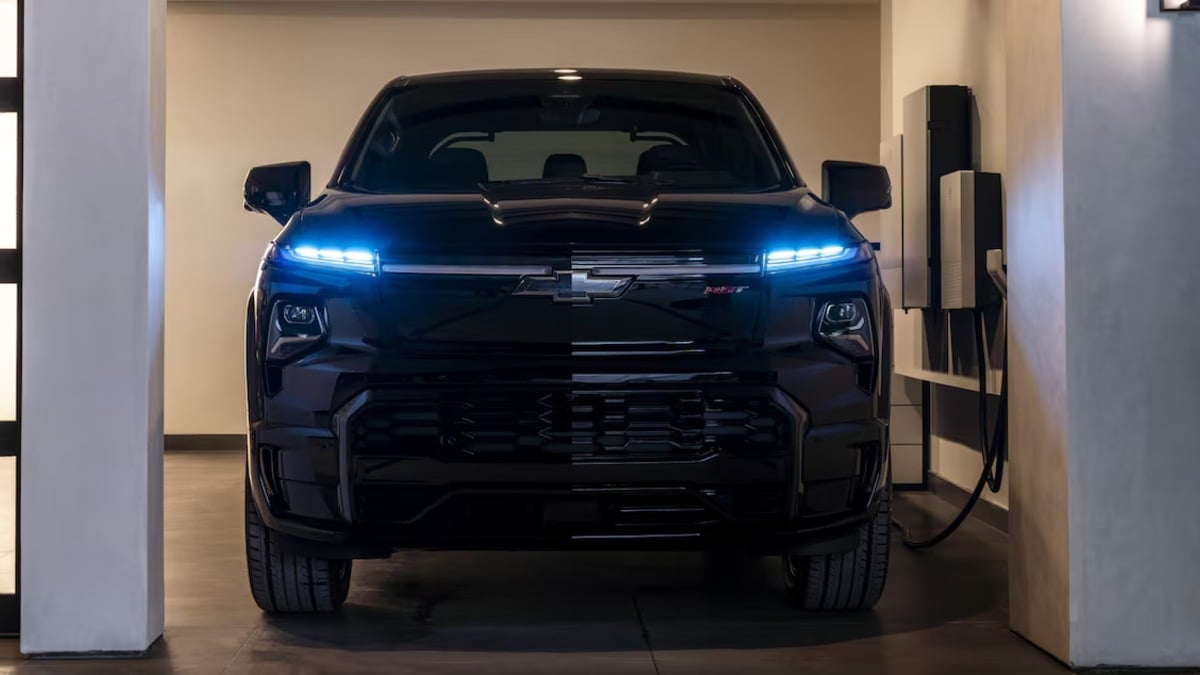
The sheer ingenuity required to navigate the adapter landscape is a testament to the dedication of these early adopters. They are the pioneers, bridging the gap between what the vehicles were designed to do and what the owners need them to do. The Ioniq 5 with 414,000 miles is a testament to the durability of electric vehicles, and the ability to charge them anywhere is a game-changer. The GMC Sierra EV's charging behavior is another example of the complex power management these trucks handle. The Rivian R1T's off-road capability makes its V2L system a critical feature for remote adventures.
The Electric Samaritan is here, and it’s driving a truck.
What are your thoughts on the V2L capabilities of electric trucks, and how do you see this feature changing the future of off-grid power and emergency preparedness? Do you think the Rivian will match the Silverado and Cybertruck in V2L output? Share your adapter hacks and power-sharing stories in the comments below.
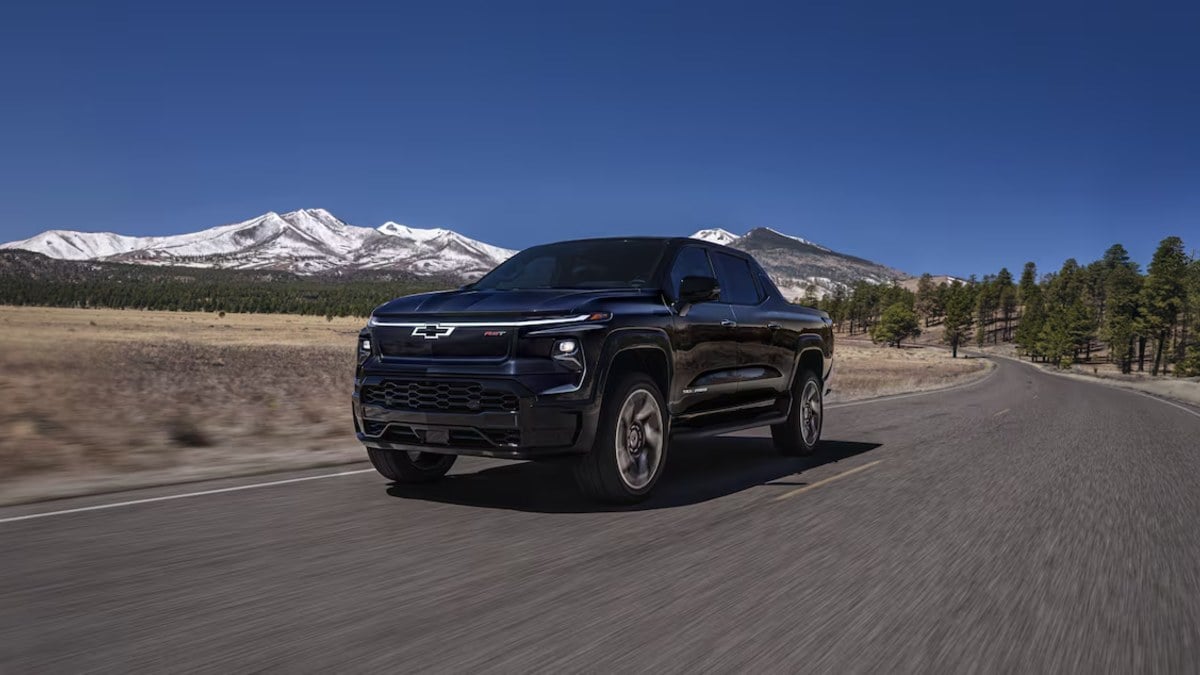
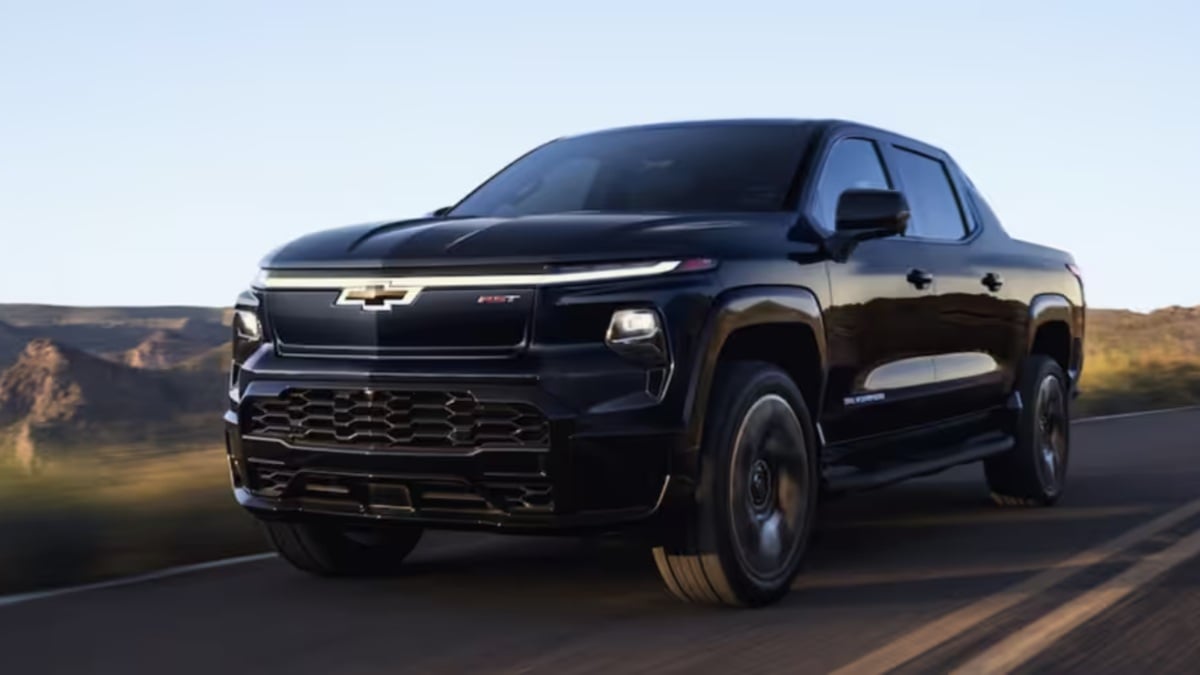
Image Sources: Chevrolet Media Center
Noah Washington is an automotive journalist based in Atlanta, Georgia. He enjoys covering the latest news in the automotive industry and conducting reviews on the latest cars. He has been in the automotive industry since 15 years old and has been featured in prominent automotive news sites. You can reach him on X and LinkedIn for tips and to follow his automotive coverage.
Set Torque News as Preferred Source on Google
Follow us today...







Comments
You couldn't have used an…
Permalink
You couldn't have used an Adapter-L5-30P-Generator-Household-Connector with your 120V EV Portable Charger plugged into that?