
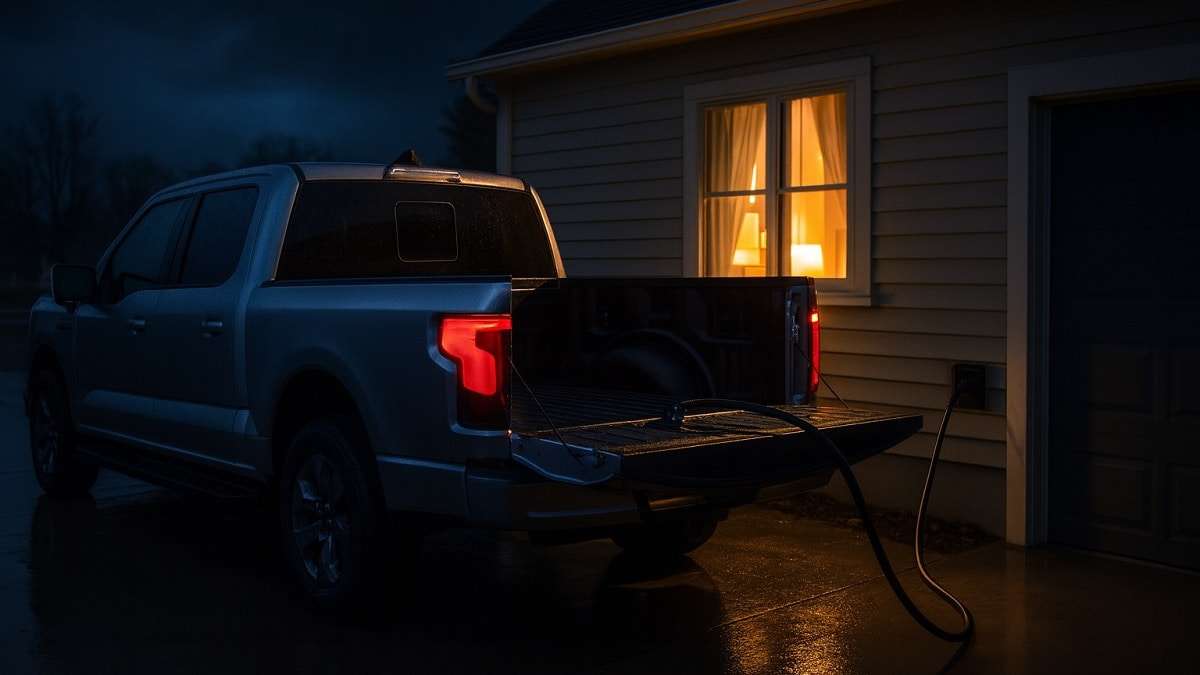

Another exciting advantage of electric vehicles is that we can leverage their huge batteries to power external things like tools or even your home during a power outage. The general term is “vehicle-to-everything” or V2X. V2X increases the utility of EVs by converting them into energy assets. The hardware exists, pilots are running, and utilities are experimenting with programs that reward participation. Durable batteries, owner friendly controls, and fair compensation from utilities will mark the next phase. As these pieces click into place, using your EV to keep the lights in your home on may feel as normal as plugging in to charge.
This has led to a lot of interesting social media buzz about people using their EVs as auxiliary power sources, especially during times of power outages. The following are several interesting discussions on Reddit threads.
“I had a several hour power outage when it was incredibly humid. I plugged my Ford F-150 Lightning right into my generator port and ran my AC, all the lights, refrigerator, etc. off it until the power came back on. I’ve used the same setup during the couple of power outages we had over the winter. It was definitely worth it to me to have the higher lever 9.6kw Pro Power Onboard.”
On another Reddit thread, Lie-Straight described powering his home during Hurricane Beryl:
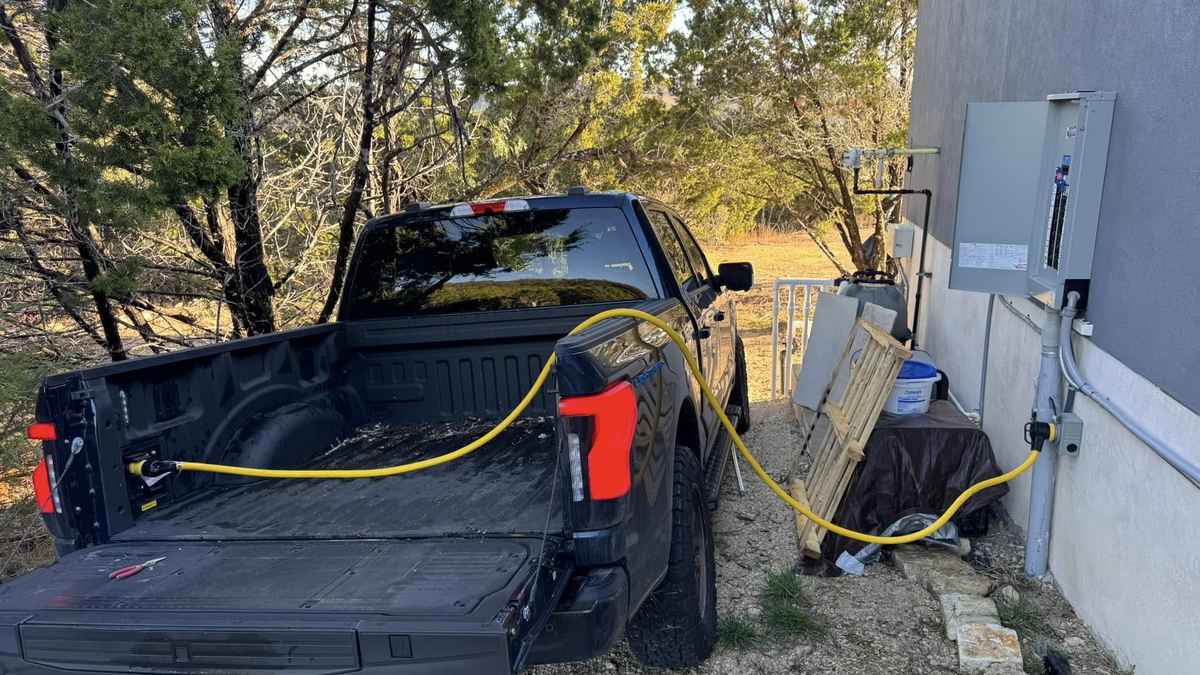
“I have a Hyundia Ioniq5. I recommend you spend about $500 to have an electrician install a 50-amp generator inlet. That way you can use the Vehicle 2 Load (V2L) and have the car battery power critical house circuits (lights, fans, fridge, garage door, modem/Wi-Fi, TV, etc.) during an outage. During Hurricane Beryl, my Ioniq5 powered my house (minus AC) and we had capacity to go a week or more before needing to drive to a charging station.”
In yet another Reddit thread, sdague commented about using Kia EV9’s V2H:
“For an all-electric house, 12 Kw should be fine, especially if you have heat pumps. Our Heat Pump water heater runs on 400W, the Heat Pump dryer can get up to 800W, and our Ground Source Heat pump system for the house is 2200-3000W in heating modes, 1600-2300W in cooling modes.
Induction stove is typically 1600W / burner max (much lower usually), and the electric oven is 1500W or so max. Cooking a four-course meal during a power outage is probably something that you should avoid.
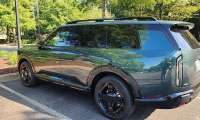
For the Kia EV9 to have Vehicle-to-Home (V2H) functionality, you must purchase a compatible third-party bi-directional charger and installation. Kia has partnered with Wallbox, and their Quasar 2 bi-directional charger is officially supported. When connected via the Wallbox Quasar 2, the Kia EV9 can provide up to 12 kW of power to your home during an outage.”
The Components of V2X
Vehicle to everything turns the EV battery into a portable power plant, capable of running home appliances and even helping a neighbor during an outage. The promise reaches beyond convenience. It hints at a new relationship between cars and the energy grid, where storage on wheels supports resilience, lowers peak strain on the electrical grid, and brings energy where people already live and park.
V2X is manifested in several variations. There is “vehicle-to-load” or V2L. It lets your EV power everyday devices like laptops or power tools. “Vehicle-to-vehicle” or V2V lets one EV charge another EV. “Vehicle to home” or V2H, uses the car as a backup power source for a house. These modes reflect increasing levels of integration, from powering a single device, to helping another car, to keeping an entire home running.
Vehicles on the Market Offer This Today
Ford offers V2H in the F-150 Lightning with Pro Power Onboard, reporting whole-home power for about three days, or essential loads for up to ten days, with an app to reserve driving range for the truck. Ford and the electric utility Pacific Gas and Electric Company in California are testing utility integration, and PG&E announced a similar initiative with GM on the Ultium battery platform. GM offers the Powerbase vehicle-to-load system in its Chevy Silverado EV and GMC Sierra. Hyundai Ioniq 5 and Kia EV6 offer V2L, with the EV6 cited as providing up to about 62 kilowatt hours, enough for a family of four for multiple days, according to the company.
How Ford Offers Vehicle-to-Load
Let’s take a quick dive into how Ford offers V2L. The Ford F-150's Pro Power Onboard is a type of Vehicle-to-Load (V2L) technology, also commonly described as a built-in mobile generator. It is not a vehicle-to-grid (V2G) system, as its primary function is to export power to appliances and tools, not to the electrical grid.
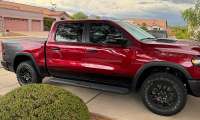
For the Ford F-150 Lightning pickup truck, Pro Power Onboard comes in two power levels, 2.4 kW and 9.6 kW, with the 9.6 kW version typically available on higher-tier trims like the Lariat and Platinum and the 2.4 kW system standard or available on lower trims like the Pro, XLT, and Flash. The F-150 Lightning Pro includes the 2.4kW system with four 120 V outlets, while the XLT has a similar setup but can have the 9.6 kW system optionally. The Flash, Lariat, and Platinum trims are generally equipped with the more powerful 9.6 kW Pro Power Onboard system, offering increased power output and more outlets.
Here's a breakdown by trim level:
Pro: Comes standard with a 2.4 kW Pro Power Onboard system, providing power for tools and devices through four 120-volt outlets in the Mega Power Frunk.
XLT: Builds on the Pro trim's features and may offer the 9.6 kW Pro Power Onboard system as an upgrade, which increases the number of available 120-volt outlets.
Flash: This trim typically includes an extended-range battery and can be equipped with the more powerful 9.6 kW Pro Power Onboard system.
Lariat: Features the high-output 9.6 kW Pro Power Onboard system, providing substantial power for tools and appliances.
Platinum: As the premier trim, the Platinum comes with the powerful 9.6kW Pro Power Onboard system, which is ideal for powering tools and appliances at job sites or during recreational activities.
The Future Vision of V2G
The ultimate goal is for the electrical grid to store energy in EVs during low demand, then buy some back during peaks, with limits set by the owner. Payments and program rules are under development, although the concept could offset part of an EV purchase. Manufacturers and utilities are running pilots, including a German test that connected several electric sedans to the grid. Early programs have focused on fleets of larger vehicles like school busses, expectations arevfor broader personal adoption.
The International Energy Agency (IEA) forecasts a fortyfold increase in lithium-ion demand by 2040 as storage needs expand globally. This rise in demand will move batteries from single purpose roles. Cars that drive in the morning may power homes in the evening, creating distributed storage that scales with EV adoption and neighborhood charging habits.
Please Drop Your Thoughts in the Comments Below
Have you used an EV to power your home during an outage? How did it work out?
How much state of charge would you reserve before powering the house?
Chris Johnston is the author of SAE’s comprehensive book on electric vehicles, "The Arrival of The Electric Car." His coverage on Torque News focuses on electric vehicles. Chris has decades of product management experience in telematics, mobile computing, and wireless communications. Chris has a B.S. in electrical engineering from Purdue University and an MBA. He lives in Seattle. When not working, Chris enjoys restoring classic wooden boats, open water swimming, cycling and flying (as a private pilot). You can connect with Chris on LinkedIn and follow his work on X at ChrisJohnstonEV.
Set Torque News as Preferred Source on Google
Follow us today...



Comments
I'm not sure I would $70 to…
Permalink
I'm not sure I would $70 to 80k, on a EV truck, to run my AC on my house!! Goofy!! 🤪
My F-150 Lightning is my…
Permalink
In reply to I'm not sure I would $70 to… by Steve Petz (not verified)
My F-150 Lightning is my daily driver. During our last outage from a windstorm, it powered our home for about 18 hours. Worth every penny.
Don't forget the hybrids. My…
Permalink
Don't forget the hybrids.
My F-150 Powerboost can run forever turning gas into electricity.
Just fill up cans using our other vehicle if needed. No need to shut the house off to go charge it.
We just put in solar and…
Permalink
We just put in solar and planned to live with it for a year before deciding on whether or not to spring for a battery system. I just read that the new Chevrolet Bolts coming in 2027 will have V2X optional equipment. I love my 2017 Bolt, but this and the faster fast charging finally being offered might pry my old buddy out of my hands!
The Ford Home Integration…
Permalink
The Ford Home Integration System costs about $3,895 for the equipment, not including installation fees. It’s a pretty good deal when you consider that the total cost to install a standby generator ranges from about $8,000 to $16,000.