
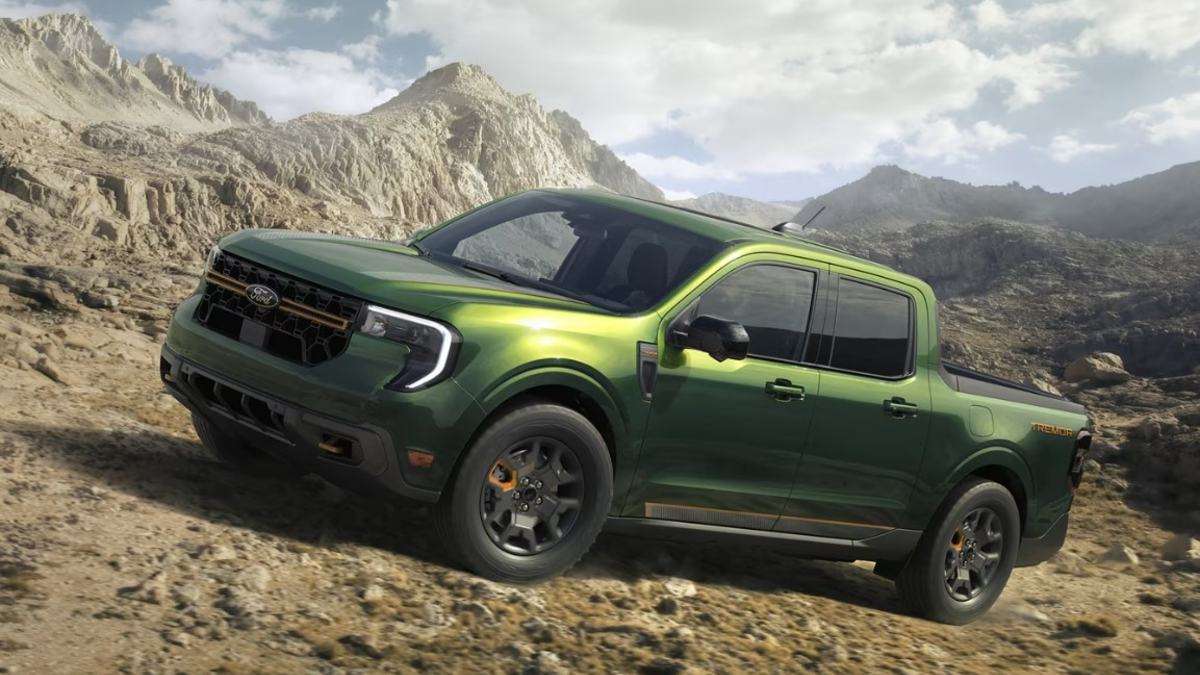

The modern hybrid vehicle represents a complex marriage of internal combustion and electric technologies, creating systems so sophisticated that even experienced mechanics struggle to understand their intricate relationships. Jim Cambron's experience with his 2022 Ford Maverick Hybrid after 122,000 miles and a cross-country journey provides a fascinating case study in how traditional maintenance practices can dramatically impact hybrid system performance in ways that challenge conventional automotive wisdom.
Cambron's detailed account reveals the interconnected nature of hybrid vehicle systems and the surprising effectiveness of old-school maintenance.
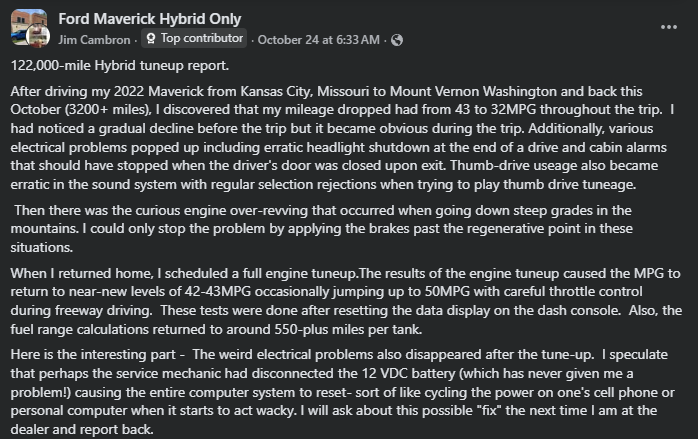
"After driving my 2022 Maverick from Kansas City, Missouri, to Mount Vernon, Washington, and back this October (3,200-plus miles), I discovered that my mileage had dropped from 43 to 32 MPG throughout the trip. I had noticed a gradual decline before the trip, but it became obvious during the trip.
Additionally, various electrical problems popped up, including erratic headlight shutdown at the end of a drive and cabin alarms that should have stopped when the driver's door was closed upon exit. Thumb-drive usage also became erratic in the sound system with regular selection rejections when trying to play thumb drive tuneage.
Then there was the curious engine over-revving that occurred when going down steep grades in the mountains. I could only stop the problem by applying the brakes past the regenerative point in these situations. The results of the engine tuneup caused the MPG to return to near-new levels of 42-43 MPG, occasionally jumping up to 50 MPG with careful throttle control during freeway driving. The weird electrical problems also disappeared after the tune-up."
The transformation Cambron describes challenges the common assumption that hybrid vehicles require specialized maintenance approaches fundamentally different from conventional vehicles. His experience suggests that traditional engine tune-up procedures can have profound effects on hybrid system integration, electrical performance, and overall vehicle behavior in ways that manufacturers may not fully communicate to owners or service technicians.
The fuel economy decline from 43 to 32 MPG represents more than simple engine wear; it indicates a breakdown in the sophisticated coordination between the Maverick's gasoline engine and electric motor systems. This 25% efficiency loss occurred gradually, making it difficult to identify the root cause until the dramatic cross-country journey made the problem undeniable. The restoration to 42-43 MPG levels after the tune-up demonstrates how hybrid systems can mask underlying problems until they reach critical thresholds.

Erratic headlight behavior, malfunctioning door sensors, and audio system glitches might seem unrelated to engine performance, yet their simultaneous resolution following the tune-up suggests deeper system-wide communication issues that traditional diagnostic approaches might miss.
Ford Maverick Hybrid Engineering Innovations:
- The Maverick's 2.5-liter Atkinson cycle engine operates at a higher compression ratio than conventional engines, maximizing thermal efficiency by keeping intake valves open longer during the compression stroke. Cambron's fuel economy restoration to 42-43 MPG after the tune-up demonstrates how precise valve timing and combustion parameters are critical to maintaining this advanced engine's efficiency advantages over traditional powertrains.
- The Maverick Hybrid's electric motor provides instant torque to the rear wheels when traction is needed, eliminating the mechanical complexity of traditional AWD systems. This seamless integration between electric and gasoline power sources requires precise calibration that Cambron's tune-up apparently restored, explaining the dramatic improvement in overall system performance and efficiency.
- The Maverick can capture up to 95% of braking energy through its regenerative system, which explains Cambron's observation about engine over-revving during mountain descents when the battery reached full capacity. The tune-up likely restored proper communication between the engine management system and hybrid controller, allowing more precise coordination of regenerative and friction braking forces.
- Ford's advanced cooling system maintains the Maverick's lithium-ion battery pack within optimal temperature ranges using both air and liquid cooling circuits. Cambron's electrical problems may have stemmed from thermal management issues that the tune-up indirectly addressed by improving overall system efficiency and reducing heat generation throughout the powertrain.
The engine over-revving phenomenon Cambron experienced during mountain descents reveals the complex energy management challenges facing hybrid systems. When the battery reaches full charge capacity, the system must find alternative ways to manage excess energy from regenerative braking and downhill momentum. The over-revving likely represents the engine management system's attempt to consume this excess energy, though Cambron's description suggests the calibration was far from optimal.

Aaron Feyh's explanation that "the battery pack is full and the engine comes on to burn off the extra incoming energy instead of overcharging the high voltage battery pack" provides insight into hybrid energy management strategies, though Cambron's skeptical response highlights the counterintuitive nature of this approach. Ashley Jones' comparison to "Jake brakes in semis" offers another perspective on engine braking strategies, demonstrating how hybrid systems must balance multiple energy management approaches.
The Ford Maverick's innovative hybrid system design represents Ford's attempt to bring hybrid efficiency to the compact truck segment at an affordable price point. Cambron's experience demonstrates both the potential and the complexity of this approach, showing how traditional maintenance practices can have dramatic effects on sophisticated hybrid systems.
Cambron's speculation about the 12-volt battery disconnection during service provides a crucial insight into hybrid vehicle troubleshooting. His comparison to "cycling the power on one's cell phone or personal computer when it starts to act wacky" suggests that hybrid vehicles may benefit from periodic system resets that clear accumulated errors and restore proper communication between multiple control modules.
The interconnected nature of Cambron's problems and their simultaneous resolution points to a fundamental characteristic of modern hybrid vehicles: the extensive integration between traditionally separate automotive systems. Engine performance, electrical accessories, audio systems, and hybrid controls all communicate through shared networks that can propagate problems across seemingly unrelated functions.
Advanced Maverick Hybrid Technology Features:
- The Maverick Hybrid includes advanced driver assistance features that rely on precise sensor calibration and system communication, which may have been affected by the same issues that caused Cambron's electrical problems. The tune-up's restoration of normal electrical function likely improved the reliability of these safety systems, though Cambron doesn't specifically mention driver assistance features in his account.
- The Maverick's rear electric motor can instantly provide up to 100% of available torque to the rear wheels, managed by algorithms that monitor wheel slip, steering input, and throttle position 100 times per second. Cambron's improved fuel economy after the tune-up suggests that this sophisticated traction management system was operating more efficiently following the service work.
- The Maverick offers multiple driving modes that adjust hybrid system behavior, throttle response, and energy management strategies to optimize performance for different conditions. The restoration of proper system communication through the tune-up likely improved the effectiveness of these modes, contributing to Cambron's ability to achieve 50 MPG with careful throttle control.
- The Maverick's hybrid system can seamlessly start and stop the gasoline engine hundreds of times during normal driving, requiring precise coordination between multiple systems to maintain smooth operation. Cambron's electrical problems may have interfered with this coordination, explaining both the fuel economy decline and the dramatic improvement following the tune-up.
The 3,200-mile cross-country journey that revealed Cambron's problems represents the kind of extended, varied driving that can expose hybrid system issues not apparent during typical daily use. The combination of sustained highway speeds, mountain driving, and temperature variations created operating conditions that stressed the Maverick's systems and revealed underlying problems that might have remained hidden during shorter trips.
Mike Jake's comment about completing "over 5,000 miles when done. Zero issues" provides a contrasting perspective on Maverick Hybrid reliability, suggesting that Cambron's experience may not be universal. However, the dramatic improvement following the tune-up indicates that even well-functioning hybrid systems may benefit from periodic comprehensive maintenance that goes beyond manufacturer-recommended service intervals.
The competitive compact truck hybrid market relies heavily on the Maverick's combination of efficiency, capability, and affordability. Cambron's experience demonstrates how proper maintenance can preserve these advantages even at high mileage, making the Maverick a more viable long-term ownership proposition for buyers concerned about hybrid system longevity.
The restoration of 550-plus mile range calculations following the tune-up highlights how hybrid systems depend on accurate fuel consumption data to provide meaningful range estimates. The improvement in these calculations suggests that the tune-up restored proper communication between the engine management system and the vehicle's trip computer, enabling more accurate efficiency monitoring and range prediction.
Cambron's promise to investigate the 12-volt battery disconnection theory with his dealer reflects the kind of proactive ownership approach that hybrid vehicles may require. The complexity of these systems means that owners and service technicians must work together to understand maintenance needs that may differ significantly from conventional vehicle requirements.
The future of hybrid vehicle maintenance may require new approaches that combine traditional mechanical service with sophisticated electronic system management. Cambron's experience suggests that periodic comprehensive maintenance can have benefits that extend far beyond the immediate mechanical improvements typically associated with tune-ups.
The economic implications of Cambron's experience extend beyond the immediate cost of the tune-up to encompass the long-term value proposition of hybrid ownership. The restoration of near-new fuel economy levels at 122,000 miles demonstrates that properly maintained hybrid systems can continue delivering their efficiency advantages well beyond typical warranty periods.
The psychological impact of the transformation Cambron describes cannot be understated. The simultaneous resolution of multiple seemingly unrelated problems likely restored his confidence in the vehicle and validated his decision to invest in hybrid technology. This kind of positive maintenance experience can significantly influence owner satisfaction and brand loyalty.
The evolving automotive service industry landscape must adapt to the unique requirements of hybrid vehicles like the Maverick. Cambron's experience demonstrates how traditional service procedures can have unexpected benefits for complex hybrid systems, suggesting that comprehensive maintenance approaches may be more effective than narrowly focused hybrid-specific service protocols.
The broader implications of Cambron's experience extend to the entire hybrid vehicle ownership community. His detailed documentation provides valuable insight into the long-term maintenance requirements and potential issues facing hybrid owners, particularly those who use their vehicles for extended travel or high-mileage applications.
The restoration of audio system functionality following the engine tune-up illustrates the extensive integration between automotive systems that owners may not fully appreciate. This interconnectedness means that problems in one area can affect seemingly unrelated functions, while comprehensive maintenance can provide benefits that extend throughout the vehicle's electronic architecture.
Cambron's experience serves as a reminder that hybrid vehicles, despite their advanced technology, still benefit from traditional maintenance practices that ensure optimal performance of all system components. The dramatic improvements he documented suggest that hybrid owners should not overlook conventional service procedures in favor of hybrid-specific maintenance protocols.
Have you experienced similar interconnected problems with hybrid vehicle systems that were resolved through comprehensive maintenance? Share your thoughts below.
Image Sources: Ford Media Center
Noah Washington is an automotive journalist based in Atlanta, Georgia. He enjoys covering the latest news in the automotive industry and conducting reviews on the latest cars. He has been in the automotive industry since 15 years old and has been featured in prominent automotive news sites. You can reach him on X and LinkedIn for tips and to follow his automotive coverage.
Set Torque News as Preferred Source on Google
Follow us today...




Comments
A couple of points: 1) the…
Permalink
A couple of points:
1) the service / replacement interval for the Ford 2.5 L hybrid engine iridium spark plugs is typically 100,000 miles, so it would have been interesting to see those pull out of his engine. I suspect the electrodes were severely worn.
2) Was this Maverick connected to home wi-fi and were up-dates enabled? I suspect the dealer likely performed a software update if it was out-of-date which might also have been responsible for the elimination of the problems he was having.
3) The engine software includes learning software to optimize fuel economy. As the spark plugs lost their proper function, the software may have re-calibrated to offset. Disconnecting the battery should reset that software to new and it should re-learn optimal calibration for the drivers specific driving at that point.
4) In an older vehicle, the driver would have likely experienced / heard / felt the miss of a work spark plug but today's engine may have been re-calibrating to offset also reducing fuel economy