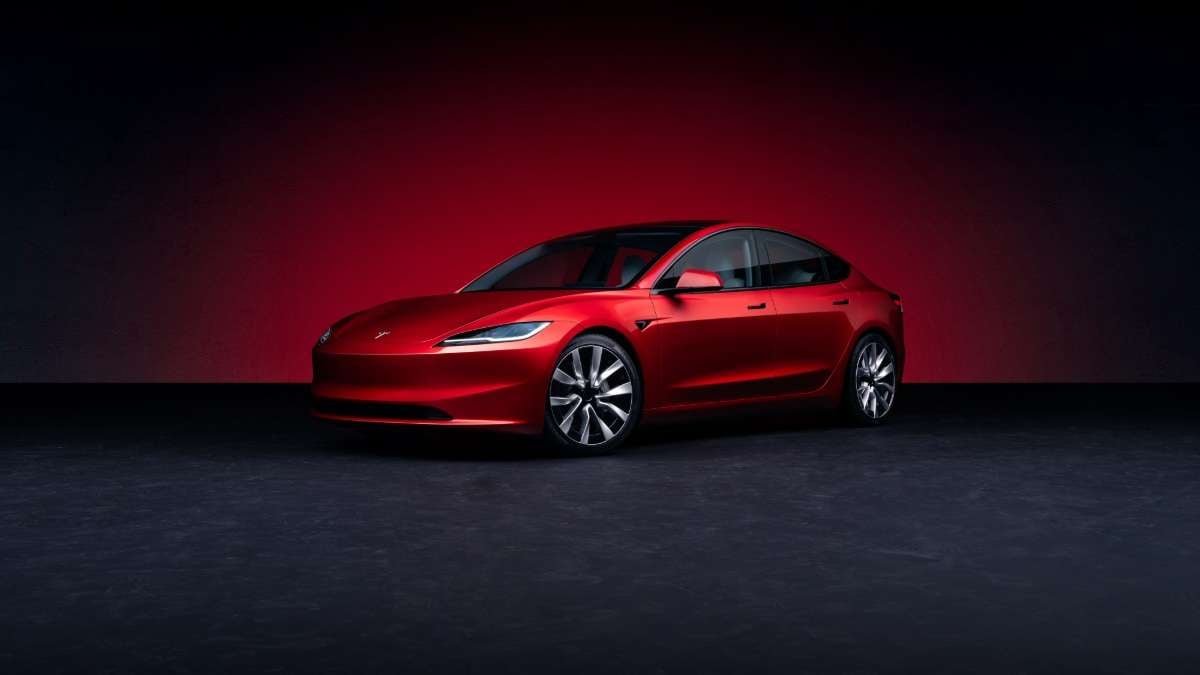

Modern car drama no longer happens only on the highway. Increasingly, it plays out in apps, text threads, and Facebook groups, where owners present their cars like crime scenes and invite the public to judge. That is where a Tesla Model 3 owner near Montréal has brought his case, describing a Smart Summon mishap he pointedly refuses to detail, a routine windshield replacement that allegedly ballooned from roughly two thousand dollars to more than six, and a service dispute that ends with his car, by his account, sitting outside a Quebec service center in falling snow. The technology is futuristic. The argument feels very old-fashioned.
“My Tesla Model 3 cracked its windshield while using Smart Summon. I sent it to Tesla for a simple windshield replacement, quoted at about $2,000, but once it reached the service center, the estimate suddenly jumped to over $6,000. They claimed the roof glass and headliner were also damaged, damage that clearly wasn’t there in my photos before handing it over.
After I challenged it with proof, Tesla denied responsibility, refused a loaner at first, then later changed their stance but still blamed me. Even the service manager admitted my photo showed no roof damage, but still said it “must have happened later.” Now they’ve left my car outside in the snow and closed the service order.
Have a look at the photos, before and after Tesla had the car, and tell me what you think. Does it look like the roof damage happened during the Summon incident or at the service centre?
Detailed version of events in the comments
Since many of you asked me for the details:
Please note: Yes, my insurance covers it, but I was trying to make them accountable
2) They covered my damaged windshield when they refused service and parked my car outside.
Anyways, here is the detailed version:
My Tesla Model 3 ran into something while using "smart" summon and cracked the windshield. Requested service via the Tesla App, which asked for a photo of the damage, and they quoted me $2090 inc. tax for the windshield replacement.
The car was towed to the service centre and was left for repair, which would be done the very next day at 7.15 am, and the car would be ready for pickup soon after midday at 12.30 pm.
Advertising
I got a notification for a new repair quote at around 1 pm for a whopping $6000+. I messaged them asking why the change, which was followed by a call from them explaining that the roof and headliner also needed replacing. They also sent me photos of the damage and said that it would take 3 weeks to repair it because they don't have the roof glass in stock.
When I inspected the photos, it was clear to me that the damage on the roof was not caused by the summon incident. So, I told them exactly that and sent them the pic I had taken to show that the damage was not present.
They kept denying, saying that the pic I took is not clear. I told them to just repair i,t and I'd pay for the windshield, but their mistake should be corrected on their own. I also asked for a loaner, which was refused, for the 3-week delay, since it's the part they damaged that is causing the delay.
So the next day, I ended up calling Tesla Customer Service and escalating. They told me that if the Service Centre and I could not resolve the issue, I should call them back to escalate further. This call forced them to call me to deny everything, but a loan was approved. Also, I was asked by the manager to come by the Service Centre, saying I'd understand that the roof was damaged during the summon event.
I stopped by the Service Centre in the evening with a friend, who is a mechanic. He inspected and assured me that the damage to the roof glass wasn't possible, as was claimed by the Service Centre. We also went through the photos, especially the photo I had taken before giving the car to Tesla, and the manager agreed that he could see that the damage was not present. But then, he claimed that it might have happened after, but definitely not in the Service Centre.
The manager asked me if he could start the repairs, which would be paid for by me. I refused and told him that I would like to contact Tesla Customer Service. To which, his response was "What do the agents in Utah do? The car is here and I am here". I told him that this is what I was told by Tesla Customer Service, and I am going to follow the steps.
That brings us to today. This morning, the manager called me and said that he cannot repair the car because there is too much glass debris, and that he is gonna leave the car in the parking lot (it’s snowing here today). He also gave me an option to tow it to a body shop. I advised him not to do anything right away and that I would contact Tesla Customer Service before making a decision.
Tesla Customer Service took more than an hour to answer my phone, and by then I received a message on the Tesla App, saying that the service is closed, and a message saying the car is parked securely outside in the parking lot.”
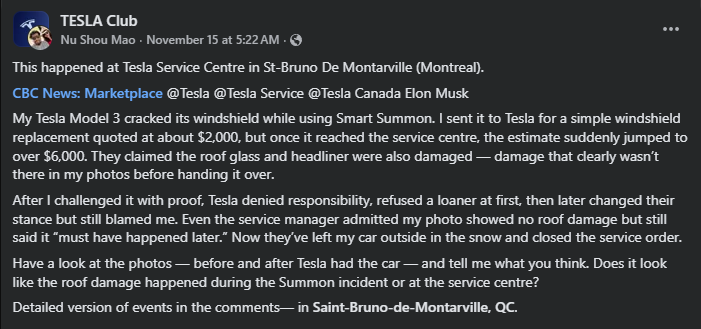
The first odd note in his tale is the incident that starts it all. He says his Model 3 “ran into something” while using Smart Summon, cracked the windshield, and that is that. No curb described, no concrete pillar, no misplaced parking stop. In the comments, other Tesla owners immediately pounce on that blank space. Hung Hua asks how a feature that creeps along at about five miles an hour manages to produce such a dramatic fracture in the glass, and Nate Kennett voices the same doubt. When physics and storytelling do not line up, enthusiasts begin to squint.
Tesla Model 3: Ownership Cost
- Ownership costs for the Model 3 tend to be relatively modest for an EV. The manufacturer estimates annual maintenance at about US $257–$499.
- Real-world out-of-warranty repair and tire costs over 90,000 miles have been reported at around US $5,441, mostly due to repeated tire replacements.
- The brand offers a growing network of service centres and mobile service options, meaning common issues can often be handled without a full shop visit. For example, a user reported a mobile service for battery/charge-port and A/C compressor issues under warranty.
- That said, independent repairers note limited access to repair manuals and longer wait times in some regions for parts and appointments, meaning service centre experience still depends a lot on your local availability.
From there, the chronology is familiar to anyone who has entrusted a car to a service bay. The owner uses the Tesla app, uploads a photo of a damaged windshield, and receives a quote in the neighborhood of $2,090, including tax. The car is towed to the St-Bruno facility with the promise of an early morning appointment and a lunchtime pickup. It is the kind of clean, app-driven transaction the electric age promises: a digital request on one day, a clear car back in the driveway on the next.
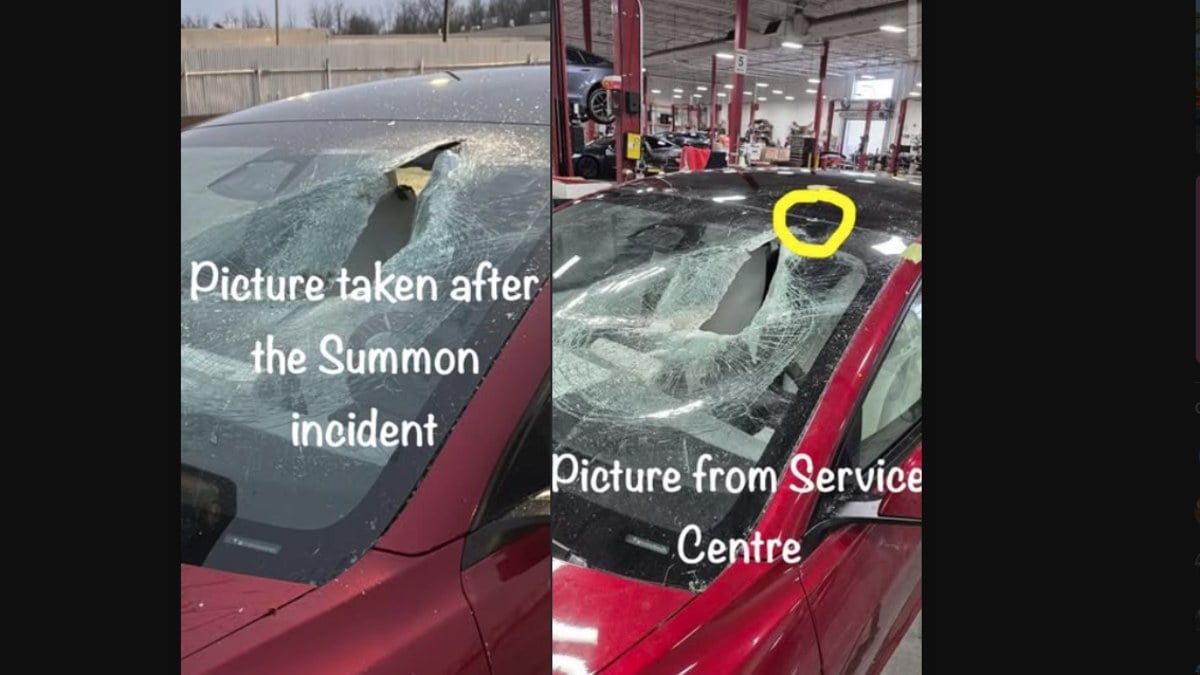
Instead, he says the real story starts around one in the afternoon, with a new estimate on his phone that has tripled. In addition to the cracked windshield, he is told that the panoramic roof glass and the headliner now require replacement, and that parts delays will stretch the job to roughly three weeks. Photos arrive from the service center showing fresh damage on the roof. The owner studies them, compares them to his own pre-tow pictures, and decides the two sets of images do not match. In his view, the roof was fine when the tow truck left his driveway.
What follows is a tug of war over pixels and blame. He sends his before photos to the service team and asks them to cover what he believes is new damage while he pays for the original windshield. According to his post, they counter that his photo is not clear enough and decline a loaner for the extended delay. He escalates to Tesla customer service, at which point a loaner is suddenly approved, but responsibility is still denied. At the manager’s invitation, he arrives at the service center with a friend who is a mechanic. The friend, he says, concludes that the pattern of fractures on the roof glass does not match a slow Smart Summon bump. The manager reportedly concedes that the owner’s earlier photo does not show roof damage, then suggests it “must have happened later,” but insists it did not occur at the facility.
Out in the digital gallery, the comments form a second layer of narrative. Christopher Deak writes that he loves his Model S yet describes years of frustration with service communication and shifting scopes of work. It is one owner’s story, not a verdict on the brand, but it echoes a theme that surfaces often in Tesla circles: stellar daily-drive experience paired with a service system that can feel opaque when something goes wrong. Another commenter, Andre Millard, wonders if the original damage might have worsened in transit, which is a reasonable thought. Glass under stress can propagate cracks with very little provocation, especially on large roof panels.
The turning point in this particular story comes when, according to the owner, the manager calls to say there is too much glass debris to proceed and that the car will be moved outside to the parking lot. The weather, he notes, has turned to snow. He is given the option to tow the car to a body shop. While he waits for another long call with customer service, a notification arrives in his Tesla app saying that the service order is closed and that the car is parked outside. He also mentions that, at one point, Tesla agreed to cover the damaged windshield after refusing further work, which he interprets as a partial acknowledgment of a problem without an admission of fault. Throughout, he stresses that his insurance would cover everything, but that he is chasing accountability instead of a payout.
Strip away the electric drivetrain and the silicon, and what remains is a classically human dispute. On one side, an owner who insists his photos show “damage that wasn’t there” when the car left his custody. On the other hand, a service department that questions the clarity and timing of those same images and attributes the roof damage to an earlier incident. The comment section questions his account of the Smart Summon impact. He questions their account of what happened on the service lot. No independent inspection appears in his post, no third party to referee the argument. All we have are two sets of pictures, a sequence of app messages, and a Model 3 sitting in the snow.
What is certain is that his post has become another data point in an ongoing conversation about service, trust, and the thin layer of confidence that must exist between driver and garage for any of this high-tech mobility to work at all.
Image Sources: Tesla Media Center
Noah Washington is an automotive journalist based in Atlanta, Georgia. He enjoys covering the latest news in the automotive industry and conducting reviews on the latest cars. He has been in the automotive industry since 15 years old and has been featured in prominent automotive news sites. You can reach him on X and LinkedIn for tips and to follow his automotive coverage.
Set Torque News as Preferred Source on Google
Follow us today...