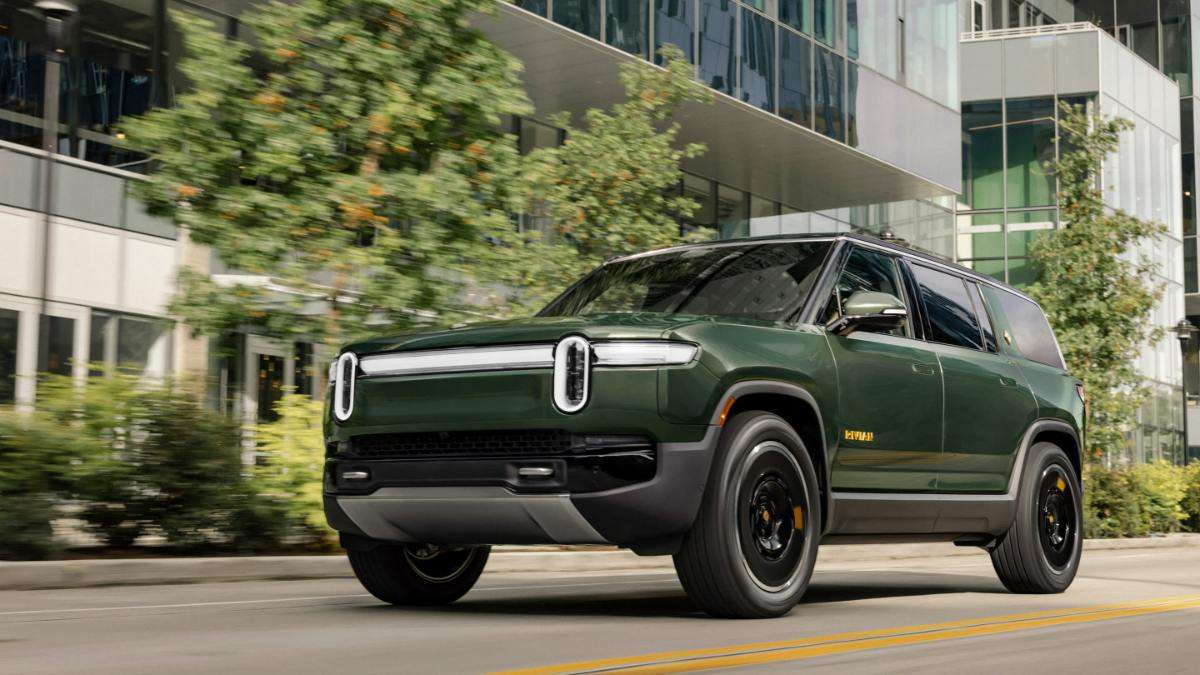

There is a familiar tension in the automotive world whenever a vehicle engineered to do many things collides with an owner who needed it to do one thing exceptionally well. It is not hostility so much as dissonance, the quiet realization that ambition and suitability are not the same concept. The Rivian R1S, a three-row electric SUV designed to blend adventure, technology, and daily usability, has landed squarely in that space. Not because it is fundamentally flawed, but because it asks its owner to meet it halfway.
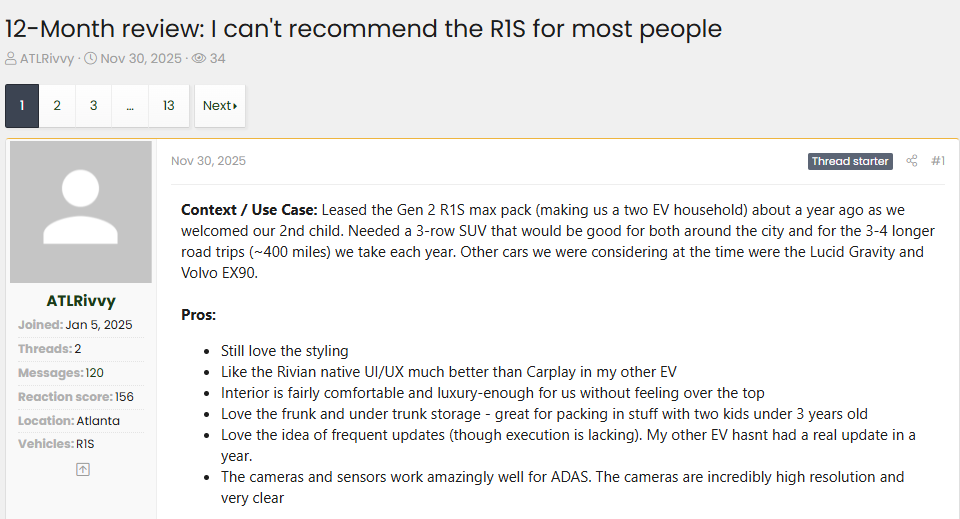
That realization came into focus through a detailed one-year ownership post from an Atlanta-based Rivian forum member known as ATLRivvy. Leasing a Gen 2 R1S Max Pack shortly after welcoming a second child, he needed a vehicle that could handle city duty and several 400-mile road trips each year. The alternatives on his shortlist were the Lucid Gravity and Volvo EX90, both of which lean more heavily toward traditional luxury family transport. His assessment of the Rivian was measured and expansive, praising the styling, storage solutions, user interface, and camera technology, while concluding that the overall execution did not justify the price for his use case.
“Context / Use Case: Leased the Gen 2 R1S max pack (making us a two EV household) about a year ago as we welcomed our 2nd child. Needed a 3-row SUV that would be good for both around the city and for the 3-4 longer road trips (~400 miles) we take each year. Other cars we were considering at the time were the Lucid Gravity and Volvo EX90.
Pros:
Still love the styling
Like the Rivian native UI/UX much better than CarPlay in my other EV
The interior is fairly comfortable and luxurious enough for us without feeling over the top
Love the frunk and under trunk storage - great for packing in stuff with two kids under 3 years old
Love the idea of frequent updates (though execution is lacking). My other EV hasn't had a real update in a year.
The cameras and sensors work amazingly well for ADAS. The cameras are incredibly high resolution and very clear
Cons:
Overall, I just don't think the R1S is a very good car for the price right now
Advertising
Suspension / Ride: Absolutely abysmal - has to be the worst in class. The active suspension does almost nothing to absorb bumps. Lots of bouncing around, and people in the back seat complain about pain from even a moderate bump. This is the thing that pretty much disqualifies this car as one I would recommend to anyone.
A/C: Something I've never experienced before - the A/C system performance is awful. I've never thought about the A/C in any of my other cars. Set a temp, put it on auto, and go. The R1S struggles to keep up to the point of having people sweating in the 2nd and 3rd rows on road trips with 75-degree temps outside.
So. Many. Software Bugs: The "automated" stuff in the car is so unreliable that it might as well be manual.
33% of the time I get in the car, start driving, and then realize all the vents are randomly closed, so I'm getting no a/c.
I still can't figure out how the car decides whether the 2nd row a/c should turn on or not - there are car seats always plugged in, but A/C only starts automatically maybe 50% of the time
25% of the time, the car struggles to "wake" when I walk up to it or use the app, so it's not uncommon to be stuck in the rain for 30 seconds holding a 6-month-old and waiting for the door handles to activate
Every other update, my wife has to remove and reactivate her PAAK (Android phone)
Every once in a while, the car loses the garage button despite havingan accurate GPS position - it works when I manually go to the garage menu, but the garage open/close button doesn't automatically appear
Interior space: The interior feels smaller than the exterior would lead you to believe. Can't have rear-facing car seats in the 2nd and 3rd row and still have a front row passenger. Something I should have tested, so definitely my fault.
3rd row functionality: Baffling decisions on the 3rd row. The slide mechanism to access the third row is terrible - it doesn't move forward enough for easy entry/exit, 2nd row headrests don't auto-drop, and no easy lift mechanism to get 3rd row back up when stored. Baffling oversights at this price range
Self-driving / Autonomy: Despite the RJ hype, Rivian's autonomy isn't very good right now. It's gotten better from when they started (it was unusable), but still lags what other players (not just Tesla) were capable of doing 2 years ago. I prefer my outdated Ford Bluecruise over Rivian by a mile.
Advertising
TL;dr: Love Rivian styling and it's a cool tech toy - but I don't think it's a very good car. Ride quality is completely unacceptable for its price point, the interior isn't very well thought out, and the software is buggy to the point of being unreliable.”
The most serious concern was ride quality. ATLRivvy described the suspension as “absolutely abysmal,” citing excessive bouncing over moderate bumps and rear seat discomfort severe enough to be disqualifying. For a vehicle positioned as premium and family-friendly, that criticism lands with weight. Comfort is not a luxury add-on in a three-row SUV; it is the foundation. When second and third row passengers complain, the promise of versatility begins to unravel.
Rivian R1S: Electric Utility With Everyday Versatility
- The R1S prioritizes versatility by combining a compact electric powertrain with three-row seating, allowing it to function as both a family vehicle and an off-road-capable SUV.
- Its quad-motor or dual-motor setups enable precise torque distribution, which improves stability on loose surfaces and gives the vehicle confident traction in challenging conditions.
- Interior packaging makes efficient use of space, with a flat floor and thoughtful storage solutions that support longer trips and outdoor-focused use.
- Adjustable air suspension allows the R1S to transition smoothly between highway comfort and increased ground clearance when terrain demands it.
Climate control and software reliability compounded the issue. The owner reported an air conditioning system that struggled to maintain comfort even in mild temperatures, along with recurring software bugs that affected vents, phone-based access, and basic wake-up behavior. None of these problems is dramatic in isolation, but together they create friction in daily life, particularly when paired with small children and tight schedules. At this price point, the expectation is that these systems fade into the background rather than demand attention.
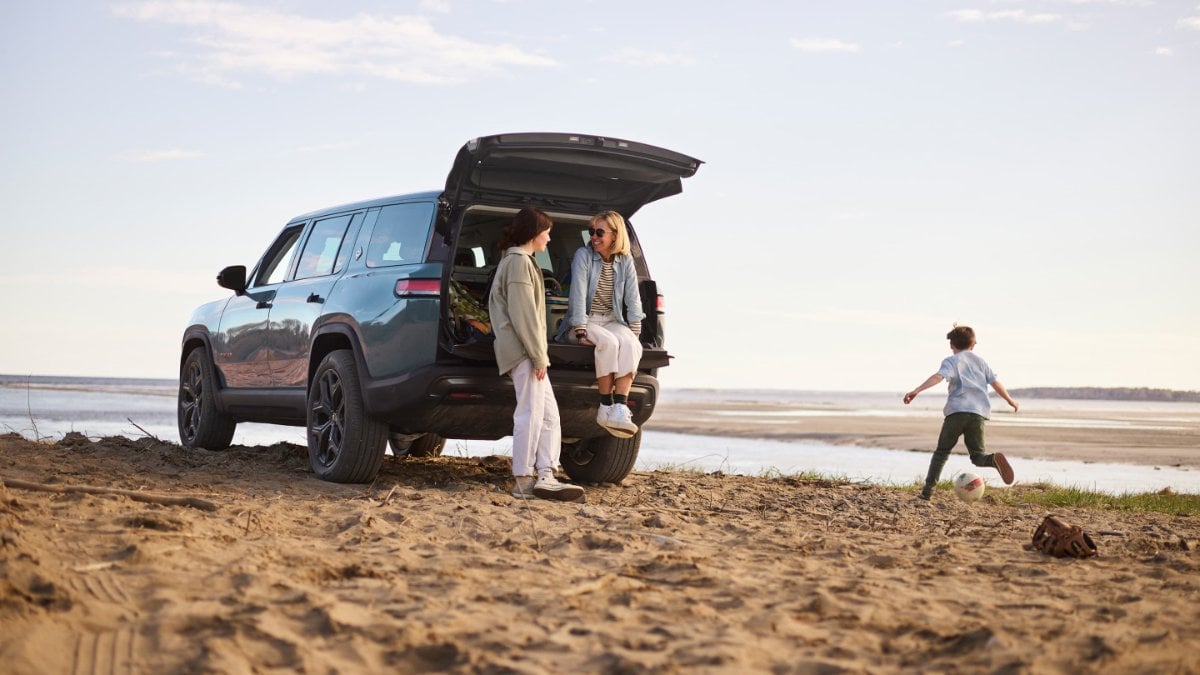
Interior packaging also proved less accommodating than anticipated. Despite the R1S’s imposing exterior dimensions, ATLRivvy found it difficult to fit rear-facing child seats across multiple rows without compromising front passenger space. Access to the third row and its basic functionality felt underdeveloped, a surprising shortcoming for a vehicle marketed on utility. To his credit, the owner acknowledged that some of this should have been caught during testing, an admission that reframes the critique as reflective rather than accusatory.
The forum response offered a useful counterbalance. Other owners, including long-term Rivian drivers, reported dramatically different experiences with ride quality, climate performance, and overall satisfaction. One R1T owner described a suspension that excelled on rough surfaces and an air conditioning system that worked flawlessly from day one. The disagreement was not hostile. It was illustrative. The same platform was delivering very different results depending on expectations, environment, and usage.
There was also a thread of light humor woven through the comments, gentle reminders that modern vehicles sometimes require behavioral adjustments. Suggestions to rely on the key fob instead of proximity unlocking or to precondition the cabin before departure were offered without malice. These responses did not dismiss the original complaints, but they did suggest that some frustrations stemmed from how the vehicle was being asked to operate rather than what it was designed to prioritize.
Taken together, the conversation reveals a larger truth about the R1S. It is not a conventional luxury crossover, nor is it trying to be one. It is a broad capability vehicle, tuned to operate across extremes, and that breadth inevitably brings compromise. For buyers whose daily reality centers on urban driving, school runs, and long highway slogs, something more narrowly focused may deliver greater satisfaction. The Rivian R1S remains an impressive and distinctive machine, but as this owner’s experience shows, even the most ambitious vehicle cannot outrun the importance of fit.
Image Sources: Rivian Media Center
Noah Washington is an automotive journalist based in Atlanta, Georgia. He enjoys covering the latest news in the automotive industry and conducting reviews on the latest cars. He has been in the automotive industry since 15 years old and has been featured in prominent automotive news sites. You can reach him on X and LinkedIn for tips and to follow his automotive coverage.
Set Torque News as Preferred Source on Google
Follow us today...